
Homework Answers
 as
equilibrium shifts reverse direction. So partial pressure of Cl2
increases while CCl4 decreases. So total pressure remains
constant
as
equilibrium shifts reverse direction. So partial pressure of Cl2
increases while CCl4 decreases. So total pressure remains
constant
Add Answer to:
3. The reaction that defines the heat of formation of carbon tetrachloride in the gas phase...
please explain, thanks 1a. The equilibrium for the formation of HOCl in the gas phase from...
 please explain, thanks
1a. The equilibrium for the formation of HOCl in the gas phase from chlorine dioxide (C120) is given below. What are the expected equilibrium pressures if a cylinder has initial pressures as follows: PC120 = PH20 = 0.45 atm; Phoci = 0.65 atm ? (10 points) Cl20 (g) + H2O (g) = 2 HOCl2 (g) Kp=0.085 at 395 °C 1b. Does the total pressure in the cylinder increase, decrease or remain the same as the reactions goes...
please explain, thanks
1a. The equilibrium for the formation of HOCl in the gas phase from chlorine dioxide (C120) is given below. What are the expected equilibrium pressures if a cylinder has initial pressures as follows: PC120 = PH20 = 0.45 atm; Phoci = 0.65 atm ? (10 points) Cl20 (g) + H2O (g) = 2 HOCl2 (g) Kp=0.085 at 395 °C 1b. Does the total pressure in the cylinder increase, decrease or remain the same as the reactions goes...
1a. The equilibrium for the formation of HOCl in the gas phase from chlorine dioxide (C120)...
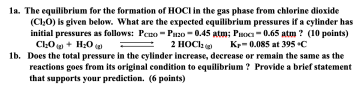 1a. The equilibrium for the formation of HOCl in the gas phase from chlorine dioxide (C120) is given below. What are the expected equilibrium pressures if a cylinder has initial pressures as follows: PC120 = PH20 = 0.45 atm; Phoci = 0.65 atm ? (10 points) Cl20 (g) + H2O (g) = 2 HOCl2 (g) Kp=0.085 at 395 °C 1b. Does the total pressure in the cylinder increase, decrease or remain the same as the reactions goes from its original...
The following reaction has Kc = 0.145 at 298 K in carbon tetrachloride solution: 2BrCl(soln)⇌Br2(soln)+Cl2(soln) If...
The following reaction has Kc = 0.145 at 298 K in carbon tetrachloride solution: 2BrCl(soln)⇌Br2(soln)+Cl2(soln) If the concentrations are [BrCl]=4.8×10⁻²M, [Br2]=3.2×10⁻²M, and [Cl2]=3.2×10⁻²M, Part A Calculate Qc. Express your answer using two significant figures. Qc Q c = nothing Request Answer Part B Determine the direction of reaction to attain equilibrium. The reaction will proceed in the Determine the direction of reaction to attain equilibrium. forward direction. reverse direction. Request Answer Part C Determine the equilibrium concentrations of BrCl. Express...
The initial concentrations or pressures of reactants and products are given for each of the following...
The initial concentrations or pressures of reactants and products are given for each of the following systems. Calculate the reaction quotient and determine the direction in which each system will proceed to reach equilibrium. 2NH3(g)⇌N2(g)+3H2(g)Kc=17; [NH3] = 0.20 M, [N2] = 1.00 M, [H2] = 1.00 M (b) 2NH3(g)⇌N2(g)+3H2(g)KP=6.8×10⁴; NH3 = 3.0 atm, N2 = 2.0 atm, H2 = 1.0 atm (c) 2SO3(g)⇌2SO2(g)+O2(g)Kc=0.230; [SO3] = 0.00 M, [SO2] = 1.00 M, [O2] = 1.00 M (d) 2SO3(g)⇌2SO2(g)+O2(g)KP=16.5; SO3 = 1.00...
1. At equilibrium, the concentrations of reactants and products can be predicted using the equilibrium constant,...
1. At equilibrium, the concentrations of reactants and products can be predicted using the equilibrium constant, Kc, which is a mathematical expression based on the chemical equation. For example, in the reaction aA+bB⇌cC+dD where a, b, c, and d are the stoichiometric coefficients, the equilibrium constant is Kc=[C]c[D]d[A]a[B]b where [A], [B], [C], and [D] are the equilibrium concentrations. If the reaction is not at equilibrium, the quantity can still be calculated, but it is called the reaction quotient, Qc, instead...
MI Review | Constants Periodic Table Part A The equilibrium constant, K, of a reaction at...
 MI Review | Constants Periodic Table Part A The equilibrium constant, K, of a reaction at a particular temperature is determined by the concentrations or pressures of the reactants and products at equilibrium. Phosgene (carbonyl chloride), COCl2, is an extremely toxic gas that is used in manufacturing certain dyes and plastics. Phosgene can be produced by reacting carbon monoxide and chlorine gas at high temperatures: For a gaseous reaction with the general form aA + bB =cC + dD CO(g)...
Q(1) During a chemical reaction, what defines when the concentrations of the reactants and products reach...
 Q(1) During a chemical reaction, what defines when the concentrations of the reactants and products reach a constant level? A) Elementary process B) Rate constant C) Reversible reaction D) Equilibrium E) Rate law Q(2) Which is the correct equilibrium constant expression for the following reaction? FeO(s) + H2(g) - Fe(s) + H2O(g) A) Ke = [H2O] / [H2] B) Ke=[Fe][H2O] / [Fe2O3] [H2] C) Ke=[Fe) (H20] / [Fe2O3] D) Kc = [Hz] / [H2O] E) Ke= [Fe2O3] [H2] / [Fe][H2O]...
Chemie Heterogeneous Reaction Chemical reactions may be envisioned in terms of reactants and products and written...
 Chemie Heterogeneous Reaction Chemical reactions may be envisioned in terms of reactants and products and written in the general form A +bB - C +dD Reactants Products The equilibrium constant may be expressed in the form K - LORD up or K, - P2 where [C] represents the molar concentration of Catequilibrium. For a given reaction, the concentrations at equilibrium would have to be determined experimentally. In application, there are practical cases where some of the reactants and/or products do...
Please answer all six thanks 1) The equilibrium constant for the following reaction is 2.90×10⁻² at...
Please answer all six thanks 1) The equilibrium constant for the following reaction is 2.90×10⁻² at 1.15×10³K. 2SO3(g) ------------------->2SO2(g) + O2(g) If an equilibrium mixture of the three gases in a 17.3 L container at 1.15×10³K contains 0.437 mol of SO3(g) and 0.422 mol of SO2, the equilibrium concentration of O2 is M. 2) A student ran the following reaction in the laboratory at 1100 K: 2SO3(g) -------------------->2SO2(g) + O2(g) When she introduced 7.74×10⁻² moles of SO3(g) into a 1.00 liter...
pkease answer all 1. At 1000 K, the Ky value is 19.9 for the reaction: Fe2O3(s) + 3 CO (8) - 2 Fe (s) + 3 CO2(g). W...
 pkease answer all
1. At 1000 K, the Ky value is 19.9 for the reaction: Fe2O3(s) + 3 CO (8) - 2 Fe (s) + 3 CO2(g). What are the equilibrium pressures of CO and CO2 if 10 grams of iron (III) oxide and a 0.978 atm initial partial pressure of CO are placed in a flask? a. Write the equilibrium expression, Kp, for the balanced chemical reaction: b. Determine the initial concentrations/pressure of each species present: Fe2O3(s) + 3...
pkease answer all
1. At 1000 K, the Ky value is 19.9 for the reaction: Fe2O3(s) + 3 CO (8) - 2 Fe (s) + 3 CO2(g). What are the equilibrium pressures of CO and CO2 if 10 grams of iron (III) oxide and a 0.978 atm initial partial pressure of CO are placed in a flask? a. Write the equilibrium expression, Kp, for the balanced chemical reaction: b. Determine the initial concentrations/pressure of each species present: Fe2O3(s) + 3...
 please explain, thanks
1a. The equilibrium for the formation of HOCl in the gas phase from chlorine dioxide (C120) is given below. What are the expected equilibrium pressures if a cylinder has initial pressures as follows: PC120 = PH20 = 0.45 atm; Phoci = 0.65 atm ? (10 points) Cl20 (g) + H2O (g) = 2 HOCl2 (g) Kp=0.085 at 395 °C 1b. Does the total pressure in the cylinder increase, decrease or remain the same as the reactions goes...
please explain, thanks
1a. The equilibrium for the formation of HOCl in the gas phase from chlorine dioxide (C120) is given below. What are the expected equilibrium pressures if a cylinder has initial pressures as follows: PC120 = PH20 = 0.45 atm; Phoci = 0.65 atm ? (10 points) Cl20 (g) + H2O (g) = 2 HOCl2 (g) Kp=0.085 at 395 °C 1b. Does the total pressure in the cylinder increase, decrease or remain the same as the reactions goes...
 1a. The equilibrium for the formation of HOCl in the gas phase from chlorine dioxide (C120) is given below. What are the expected equilibrium pressures if a cylinder has initial pressures as follows: PC120 = PH20 = 0.45 atm; Phoci = 0.65 atm ? (10 points) Cl20 (g) + H2O (g) = 2 HOCl2 (g) Kp=0.085 at 395 °C 1b. Does the total pressure in the cylinder increase, decrease or remain the same as the reactions goes from its original...
 MI Review | Constants Periodic Table Part A The equilibrium constant, K, of a reaction at a particular temperature is determined by the concentrations or pressures of the reactants and products at equilibrium. Phosgene (carbonyl chloride), COCl2, is an extremely toxic gas that is used in manufacturing certain dyes and plastics. Phosgene can be produced by reacting carbon monoxide and chlorine gas at high temperatures: For a gaseous reaction with the general form aA + bB =cC + dD CO(g)...
 Q(1) During a chemical reaction, what defines when the concentrations of the reactants and products reach a constant level? A) Elementary process B) Rate constant C) Reversible reaction D) Equilibrium E) Rate law Q(2) Which is the correct equilibrium constant expression for the following reaction? FeO(s) + H2(g) - Fe(s) + H2O(g) A) Ke = [H2O] / [H2] B) Ke=[Fe][H2O] / [Fe2O3] [H2] C) Ke=[Fe) (H20] / [Fe2O3] D) Kc = [Hz] / [H2O] E) Ke= [Fe2O3] [H2] / [Fe][H2O]...
 Chemie Heterogeneous Reaction Chemical reactions may be envisioned in terms of reactants and products and written in the general form A +bB - C +dD Reactants Products The equilibrium constant may be expressed in the form K - LORD up or K, - P2 where [C] represents the molar concentration of Catequilibrium. For a given reaction, the concentrations at equilibrium would have to be determined experimentally. In application, there are practical cases where some of the reactants and/or products do...
 pkease answer all
1. At 1000 K, the Ky value is 19.9 for the reaction: Fe2O3(s) + 3 CO (8) - 2 Fe (s) + 3 CO2(g). What are the equilibrium pressures of CO and CO2 if 10 grams of iron (III) oxide and a 0.978 atm initial partial pressure of CO are placed in a flask? a. Write the equilibrium expression, Kp, for the balanced chemical reaction: b. Determine the initial concentrations/pressure of each species present: Fe2O3(s) + 3...
pkease answer all
1. At 1000 K, the Ky value is 19.9 for the reaction: Fe2O3(s) + 3 CO (8) - 2 Fe (s) + 3 CO2(g). What are the equilibrium pressures of CO and CO2 if 10 grams of iron (III) oxide and a 0.978 atm initial partial pressure of CO are placed in a flask? a. Write the equilibrium expression, Kp, for the balanced chemical reaction: b. Determine the initial concentrations/pressure of each species present: Fe2O3(s) + 3...
Most questions answered within 3 hours.
-
Where is the error in this code sequence?
String s1 = "Hello";
String s2 = "ello";...
asked 11 months ago -
Financial data for Joel de Paris, Inc., for last year
follow:
Joel de Paris, Inc.
Balance...
asked 11 months ago -
Consider this reaction:
Al2(SO4)3 (aq)+ BaCl3
(aq) Al2Cl6 (aq)- +
3BaSO4(s) . What is the...
asked 11 months ago -
Suppose that Savneet is considering increasing her
recent random sample from 20 car rentals to 40...
asked 11 months ago -
Trucks arrive at an unloading terminal at an average rate of 120
per hour.
Trucks arrive...
asked 11 months ago -
Why are methanol and ethanol completely soluble in water while
octanol is not very little soluble....
asked 11 months ago -
A facilities manager at a university reads in a research report
that the mean amount of...
asked 11 months ago -
When the CuSO4 is rehydrated by adding water to the anhydrous
compound, is this an endothermic...
asked 11 months ago -
A ray of sunlight is passing from diamond into crown glass; the
angle of incidence is...
asked 11 months ago -
A block of mass 0.249 kg is placed on top of a light, vertical
spring of...
asked 11 months ago -
how do the kidneys compensate in the presences of acidosis
a) trigger hyperventilate
b) reserve acid...
asked 11 months ago -
Question 501 pts
The rental rate of capital to the firm increases. Which of the
following...
asked 11 months ago