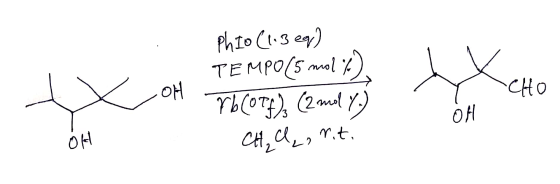
what is the major organic product of each of the following reactions?
![(k) LOH Phlo (1.3 eq) TEMPO (5 mol %) Yb(OTf)3 (2 mol %) CH2Cl2, r.t. [Synlett 2006, 2055] OH](http://img.homeworklib.com/questions/9affff20-d830-11eb-b15c-e7a4db903e86.png?x-oss-process=image/resize,w_560)
Homework Answers
In this reaction, the hydroxy group which is attached to less substituted carbon atom will be oxidized to an aldehyde. Here one of the OH group is attached to a carbon at the terminal and the other is attached to a carbon which is a secondary carbon. Hence the OH at the terminal gets oxidised to aldehyde. The reaction is shown below.
Add Answer to:
what is the major organic product of each of the following
reactions?
(k) LOH Phlo (1.3...
Need some help understanding these Fill in the major organic product or products for the following...
 Need some help understanding these
Fill in the major organic product or products for the following reactions. Make sure to indicate stereochemistry where appropriate. H2SO H20 HBr Br2 CH2Cl2 OH OH OH 1) O3 2) DMS
Fill in the major organic product or products for the following reactions. Make sure to indicate stereochemistry where appropriate. H2SO H20 HBr Br2 CH2Cl2 OH OH OH 1) O3 2) DMS
Need some help understanding these
Fill in the major organic product or products for the following reactions. Make sure to indicate stereochemistry where appropriate. H2SO H20 HBr Br2 CH2Cl2 OH OH OH 1) O3 2) DMS
Fill in the major organic product or products for the following reactions. Make sure to indicate stereochemistry where appropriate. H2SO H20 HBr Br2 CH2Cl2 OH OH OH 1) O3 2) DMS
Give the major organic product for each of the following reactions. a) b) Bry AICl, d)...
 Give the major organic product for each of the following reactions.
a) b) Bry AICl, d) [1] HNO, 2] H,SO4 [3] Zn (Hg), HC CHO HNO H,SO4 H2N OHO 1 eq
Give the major organic product for each of the following reactions.
a) b) Bry AICl, d) [1] HNO, 2] H,SO4 [3] Zn (Hg), HC CHO HNO H,SO4 H2N OHO 1 eq
Give the organic products of each of the following reactions and indicate the major product where...
 Give the organic products of each of the following reactions and
indicate the major product where appropriate.
Give the organic products of each of the following reactions and indicate tne major product where appropriate. Write your answers on these sheets. NO2 Ö T ise Hotels omosha BF3/HF C(CH3)3 + (CH3)2C=CH2 - 1) AICI: 2) HCl(aq), Zn(Hg) ON + OH- 1) NaHCO3 2) H30+
Give the organic products of each of the following reactions and
indicate the major product where appropriate.
Give the organic products of each of the following reactions and indicate tne major product where appropriate. Write your answers on these sheets. NO2 Ö T ise Hotels omosha BF3/HF C(CH3)3 + (CH3)2C=CH2 - 1) AICI: 2) HCl(aq), Zn(Hg) ON + OH- 1) NaHCO3 2) H30+
3. What are the major organic product obtained from the following reactions? (2 points each) H2SO4...
 3. What are the major organic product obtained from the following reactions? (2 points each) H2SO4 o ОН OH ОН OH 4. Please provide a complete mechanism for the following transformation (4 points). I gry not NaOH FO
Draw the structure of the major organic product/s for each of the following reactions. Indicate the...
 Draw the structure of the major organic product/s for each of
the following reactions. Indicate the stereochemistry for each
reaction, when appropriate. If multiple functional groups in the
molecule react under the conditions, you may assume that enough
reagents (excess) are added to react with all the possible
functional groups. If enantiomers are generated, you may draw one
and indicate “+enantiomer”.
LOH 1.Na º 2.CH31 3.CO, HCI, AICIZ/ Cuci
Draw the structure of the major organic product/s for each of
the following reactions. Indicate the stereochemistry for each
reaction, when appropriate. If multiple functional groups in the
molecule react under the conditions, you may assume that enough
reagents (excess) are added to react with all the possible
functional groups. If enantiomers are generated, you may draw one
and indicate “+enantiomer”.
LOH 1.Na º 2.CH31 3.CO, HCI, AICIZ/ Cuci
3. Give the major organic product(s) for each of the following reactions or sequences of reactions....
 3. Give the major organic product(s) for each of the following reactions or sequences of reactions. Show all relevant stereochemistry. KMnO4 1. NaCN andere 2. H20, heat 1. LiAIH THE (c) Cou 2. H20 1. Mg, ether (d) -CHLB 2. CO2 3.H30 le) OH ether
Predict the major organic product for the following organic reactions. Show intermediates when required. If the...
 Predict the major organic product for the following organic
reactions. Show intermediates when required. If the product is
given then provide the appropriate reagents above the arrow in the
reaction.
Me 1. LDA, -78°C 2. TMSCI I. LDA, -78°C 1. Eto, R.T. 2. Mel Provide repent to make the Stork Enamine Me 1) CHI 2) H,O, HO (Hydrolysis) |C,HO Provide reagents
Predict the major organic product for the following organic
reactions. Show intermediates when required. If the product is
given then provide the appropriate reagents above the arrow in the
reaction.
Me 1. LDA, -78°C 2. TMSCI I. LDA, -78°C 1. Eto, R.T. 2. Mel Provide repent to make the Stork Enamine Me 1) CHI 2) H,O, HO (Hydrolysis) |C,HO Provide reagents
4. Draw the major organic product and any by-products for each of the following reactions. Reactions...
 4. Draw the major organic product and any by-products for each of the following reactions. Reactions should be balanced. (12) ΝΗ, .YY."- b. OH d. HD-
draw the structure for the major organic product of each of the following reactions. HOTH PHNHNH,...
 draw the structure for the major organic product of each of the following reactions. HOTH PHNHNH, 16. CHO HOH (3 equiv.) H-OH HO+H CHOH
Draw the major expected organic product(s) for each of the following reactions. Be sure to indicate...
 Draw the major expected organic product(s) for each of the
following reactions. Be sure to indicate stereochemistry when
needed.
OH 1) TsCl, pyr 2) NaBr Br HS Give neutral product. بیاہ 1) SOCl2, pyridine 2) NaSH OH Br DBU d 1) PBr 3 2) KOt-Bu OH
Draw the major expected organic product(s) for each of the
following reactions. Be sure to indicate stereochemistry when
needed.
OH 1) TsCl, pyr 2) NaBr Br HS Give neutral product. بیاہ 1) SOCl2, pyridine 2) NaSH OH Br DBU d 1) PBr 3 2) KOt-Bu OH
 Need some help understanding these
Fill in the major organic product or products for the following reactions. Make sure to indicate stereochemistry where appropriate. H2SO H20 HBr Br2 CH2Cl2 OH OH OH 1) O3 2) DMS
Fill in the major organic product or products for the following reactions. Make sure to indicate stereochemistry where appropriate. H2SO H20 HBr Br2 CH2Cl2 OH OH OH 1) O3 2) DMS
Need some help understanding these
Fill in the major organic product or products for the following reactions. Make sure to indicate stereochemistry where appropriate. H2SO H20 HBr Br2 CH2Cl2 OH OH OH 1) O3 2) DMS
Fill in the major organic product or products for the following reactions. Make sure to indicate stereochemistry where appropriate. H2SO H20 HBr Br2 CH2Cl2 OH OH OH 1) O3 2) DMS
 Give the major organic product for each of the following reactions.
a) b) Bry AICl, d) [1] HNO, 2] H,SO4 [3] Zn (Hg), HC CHO HNO H,SO4 H2N OHO 1 eq
Give the major organic product for each of the following reactions.
a) b) Bry AICl, d) [1] HNO, 2] H,SO4 [3] Zn (Hg), HC CHO HNO H,SO4 H2N OHO 1 eq
 Give the organic products of each of the following reactions and
indicate the major product where appropriate.
Give the organic products of each of the following reactions and indicate tne major product where appropriate. Write your answers on these sheets. NO2 Ö T ise Hotels omosha BF3/HF C(CH3)3 + (CH3)2C=CH2 - 1) AICI: 2) HCl(aq), Zn(Hg) ON + OH- 1) NaHCO3 2) H30+
Give the organic products of each of the following reactions and
indicate the major product where appropriate.
Give the organic products of each of the following reactions and indicate tne major product where appropriate. Write your answers on these sheets. NO2 Ö T ise Hotels omosha BF3/HF C(CH3)3 + (CH3)2C=CH2 - 1) AICI: 2) HCl(aq), Zn(Hg) ON + OH- 1) NaHCO3 2) H30+
 3. What are the major organic product obtained from the following reactions? (2 points each) H2SO4 o ОН OH ОН OH 4. Please provide a complete mechanism for the following transformation (4 points). I gry not NaOH FO
 Draw the structure of the major organic product/s for each of
the following reactions. Indicate the stereochemistry for each
reaction, when appropriate. If multiple functional groups in the
molecule react under the conditions, you may assume that enough
reagents (excess) are added to react with all the possible
functional groups. If enantiomers are generated, you may draw one
and indicate “+enantiomer”.
LOH 1.Na º 2.CH31 3.CO, HCI, AICIZ/ Cuci
Draw the structure of the major organic product/s for each of
the following reactions. Indicate the stereochemistry for each
reaction, when appropriate. If multiple functional groups in the
molecule react under the conditions, you may assume that enough
reagents (excess) are added to react with all the possible
functional groups. If enantiomers are generated, you may draw one
and indicate “+enantiomer”.
LOH 1.Na º 2.CH31 3.CO, HCI, AICIZ/ Cuci
 3. Give the major organic product(s) for each of the following reactions or sequences of reactions. Show all relevant stereochemistry. KMnO4 1. NaCN andere 2. H20, heat 1. LiAIH THE (c) Cou 2. H20 1. Mg, ether (d) -CHLB 2. CO2 3.H30 le) OH ether
 Predict the major organic product for the following organic
reactions. Show intermediates when required. If the product is
given then provide the appropriate reagents above the arrow in the
reaction.
Me 1. LDA, -78°C 2. TMSCI I. LDA, -78°C 1. Eto, R.T. 2. Mel Provide repent to make the Stork Enamine Me 1) CHI 2) H,O, HO (Hydrolysis) |C,HO Provide reagents
Predict the major organic product for the following organic
reactions. Show intermediates when required. If the product is
given then provide the appropriate reagents above the arrow in the
reaction.
Me 1. LDA, -78°C 2. TMSCI I. LDA, -78°C 1. Eto, R.T. 2. Mel Provide repent to make the Stork Enamine Me 1) CHI 2) H,O, HO (Hydrolysis) |C,HO Provide reagents
 4. Draw the major organic product and any by-products for each of the following reactions. Reactions should be balanced. (12) ΝΗ, .YY."- b. OH d. HD-
 draw the structure for the major organic product of each of the following reactions. HOTH PHNHNH, 16. CHO HOH (3 equiv.) H-OH HO+H CHOH
 Draw the major expected organic product(s) for each of the
following reactions. Be sure to indicate stereochemistry when
needed.
OH 1) TsCl, pyr 2) NaBr Br HS Give neutral product. بیاہ 1) SOCl2, pyridine 2) NaSH OH Br DBU d 1) PBr 3 2) KOt-Bu OH
Draw the major expected organic product(s) for each of the
following reactions. Be sure to indicate stereochemistry when
needed.
OH 1) TsCl, pyr 2) NaBr Br HS Give neutral product. بیاہ 1) SOCl2, pyridine 2) NaSH OH Br DBU d 1) PBr 3 2) KOt-Bu OH
Most questions answered within 3 hours.
-
Where is the error in this code sequence?
String s1 = "Hello";
String s2 = "ello";...
asked 11 months ago -
Financial data for Joel de Paris, Inc., for last year
follow:
Joel de Paris, Inc.
Balance...
asked 11 months ago -
Consider this reaction:
Al2(SO4)3 (aq)+ BaCl3
(aq) Al2Cl6 (aq)- +
3BaSO4(s) . What is the...
asked 11 months ago -
Suppose that Savneet is considering increasing her
recent random sample from 20 car rentals to 40...
asked 11 months ago -
Trucks arrive at an unloading terminal at an average rate of 120
per hour.
Trucks arrive...
asked 11 months ago -
Why are methanol and ethanol completely soluble in water while
octanol is not very little soluble....
asked 11 months ago -
A facilities manager at a university reads in a research report
that the mean amount of...
asked 11 months ago -
When the CuSO4 is rehydrated by adding water to the anhydrous
compound, is this an endothermic...
asked 11 months ago -
A ray of sunlight is passing from diamond into crown glass; the
angle of incidence is...
asked 11 months ago -
A block of mass 0.249 kg is placed on top of a light, vertical
spring of...
asked 11 months ago -
how do the kidneys compensate in the presences of acidosis
a) trigger hyperventilate
b) reserve acid...
asked 11 months ago -
Question 501 pts
The rental rate of capital to the firm increases. Which of the
following...
asked 11 months ago