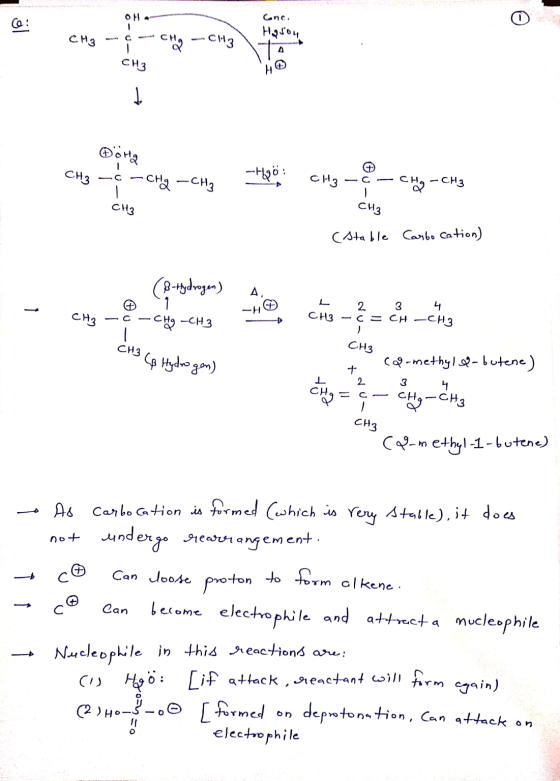
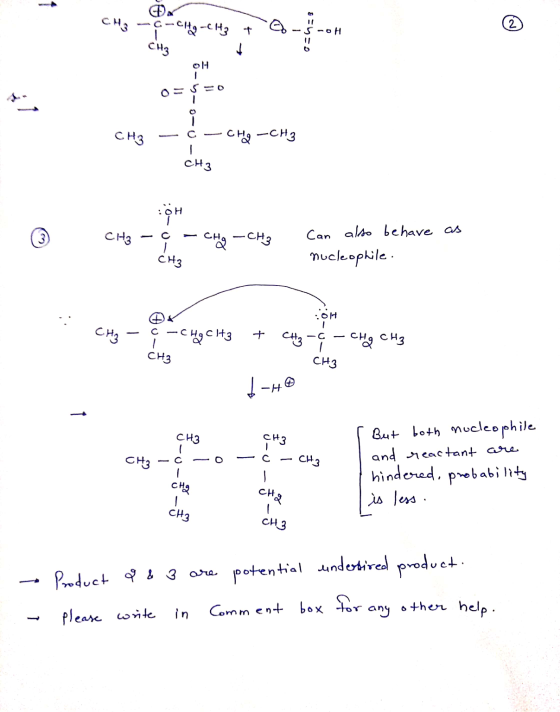
I just need the potential side reaction that will occur. The reaction creating the products (2-methyl-1-butene and 2-methyl-2-butene) is between 2-methyl-2-butanol and sulfuric acid. I already have the arrow pushing mechanism I just do not know what the potential, undesired side product is. Please show the mechanism.

Homework Answers
Add Answer to:
I just need the potential side reaction that will occur. The
reaction creating the products (2-methyl-1-butene...
Draw the reaction mechanism for: a. 2-methyl-2-butanol to 2-methyl-1-butene and 2-methyl-2-butene b. 2-butanol to 1-butene and...
Draw the reaction mechanism for: a. 2-methyl-2-butanol to 2-methyl-1-butene and 2-methyl-2-butene b. 2-butanol to 1-butene and cis-2-butene and trans-2-butene H2SO4 is the catalyst for both
CH3 CH3 CH3CH2C=CH2 + CH2OH 12304, CH3CH,Ć-OCHz CH3 Treating 2-methyl-1-butene with methanol in the presence of...
 CH3 CH3 CH3CH2C=CH2 + CH2OH 12304, CH3CH,Ć-OCHz CH3 Treating 2-methyl-1-butene with methanol in the presence of sulfuric acid gives 2-methoxy-2-methylbutane. Draw curved arrows to show the movement of electrons in this step of the reaction mechanism. Arrow-pushing Instructions no XT CH3. HO CH₂ H-ö-CH3
1. Preparation of 2-chloro-2-methylbutane from 2-methyl-2-butanol involves Sw1 reaction mechanism. What does Sw1 mean? (1 pts)...
 1. Preparation of 2-chloro-2-methylbutane from 2-methyl-2-butanol involves Sw1 reaction mechanism. What does Sw1 mean? (1 pts) 2. This reaction prefers to undergo via Sw1 mechanism over Sw2. Why? (3 pts) 3. Write the structure of carbocation and nucleophile involved in this reaction. (2 pts) 4. Substrate alcohol (2-methyl-2-butanol) consists a poor leaving group (OH group). How do you covert this poor leaving group into good leaving group? (2 pts) 5. Which will be the bottom layer between aqueous and organic...
What is the reaction mechanism of 2-Methyl-2-Butanol in H2SO4+Heat. I know the 2 products are 2-methyl-1-butene...
 What is the reaction mechanism of 2-Methyl-2-Butanol in
H2SO4+Heat. I know the 2 products are 2-methyl-1-butene and
2-methyl-2-butene which product is the major product when its an
acid-catalyzed dehydration reaction that was driven to completion
by distillation? Also on my gas chromatography graph trace which
product is which? Is the bigger peak my major product? I know I am
looking at the peaks at 1.509 and 1.612. Thank you.
: 10/24/2019 11:13:31 AM Injection Date Sample Name Acq. Operator Acq....
What is the reaction mechanism of 2-Methyl-2-Butanol in
H2SO4+Heat. I know the 2 products are 2-methyl-1-butene and
2-methyl-2-butene which product is the major product when its an
acid-catalyzed dehydration reaction that was driven to completion
by distillation? Also on my gas chromatography graph trace which
product is which? Is the bigger peak my major product? I know I am
looking at the peaks at 1.509 and 1.612. Thank you.
: 10/24/2019 11:13:31 AM Injection Date Sample Name Acq. Operator Acq....
Treating 2-methyl-1-butene with methanol in the presence of sulfuric acid gives 2-methoxy-2-methylbutane
 Treating 2-methyl-1-butene with methanol in the presence of sulfuric acid gives 2-methoxy-2-methylbutane. Draw curved arrows to show the movement of electrons in this step of the reaction mechanism.
Draw the detailed SN1 mechanism for the reaction between 2-methyl-2-butanol and HCl to produce 2-chloro-2-methylbutane. 1....
 Draw the detailed SN1 mechanism for the reaction between
2-methyl-2-butanol and HCl to produce
2-chloro-2-methylbutane.
1. Draw the detailed Sn1 mechanism for the reaction between 2-methyl-2-butanol and HCl to produce 2-chloro-2-methylbutane. (3 pts)
Draw the detailed SN1 mechanism for the reaction between
2-methyl-2-butanol and HCl to produce
2-chloro-2-methylbutane.
1. Draw the detailed Sn1 mechanism for the reaction between 2-methyl-2-butanol and HCl to produce 2-chloro-2-methylbutane. (3 pts)
I need help on all of these! Please help with d-h, if possible! d. The reaction...
 I need help on all of these! Please help with d-h, if
possible!
d. The reaction of (2R)-butanol with NaBr and sulfuric acid in acetone proceeds with inversion of configuration. e. The addition reaction of HBr to 1-butene in the presence of peroxides produces the anti- Markovnikov product. (Might not be a review question, might make an appearance in early 3060.) The reaction of 2-methyl-2-butanol with HCl produces as a major product an alkyl halide. An ether and an alkene...
I need help on all of these! Please help with d-h, if
possible!
d. The reaction of (2R)-butanol with NaBr and sulfuric acid in acetone proceeds with inversion of configuration. e. The addition reaction of HBr to 1-butene in the presence of peroxides produces the anti- Markovnikov product. (Might not be a review question, might make an appearance in early 3060.) The reaction of 2-methyl-2-butanol with HCl produces as a major product an alkyl halide. An ether and an alkene...
Provide a mechanism for the entire reaction of 1,4-dimethoxybenzene + 3-methyl-2-butanol + Sulfuric Acid --> 1,4-dimethoxy-2,5-di-tert-pentylbenzene.
Provide a mechanism for the entire reaction of 1,4-dimethoxybenzene + 3-methyl-2-butanol + Sulfuric Acid --> 1,4-dimethoxy-2,5-di-tert-pentylbenzene.
write the structure of the major organic product formed in the reaction of 2-methyl-2-butene (a) hydrogen...
write the structure of the major organic product formed in the reaction of 2-methyl-2-butene (a) hydrogen chloride (b) dilute sulfuric acid (c) diborane in diglyme, followed by basic hydrogen peroxide (d) bromine in carbon tetrachloride (e) bromine in water (f) peroxyacetic acid (g) ozone (h) product of (g) treated with zinc and water (i) product of part (g) treated with dimethyl sulfide (CH3)2S
1) Give the product for the reaction of 1-butene with methanol in the presence of acid....
 1)
Give the product for the reaction of 1-butene with methanol in
the presence of acid. The mechanism is the same as the mechanism
for the addition of water to alkenes.
2-ethoxybutane
1-butanol
2-methoxybutane
1-ethoxybutane
1-methoxybutane
2)
3)
Identify the best nucleophile in an SN2 reaction.
tert-butoxide ion
tert-pentoxide ion
isopropoxide ion
ethoxide ion
4)
Identify the alkyl halide that reacts the fastest in an
SN1 reaction.
2-bromopropane
2-chloropropane
2-iodopropane
2-fluoropropane
What is the major product of the following reaction?...
1)
Give the product for the reaction of 1-butene with methanol in
the presence of acid. The mechanism is the same as the mechanism
for the addition of water to alkenes.
2-ethoxybutane
1-butanol
2-methoxybutane
1-ethoxybutane
1-methoxybutane
2)
3)
Identify the best nucleophile in an SN2 reaction.
tert-butoxide ion
tert-pentoxide ion
isopropoxide ion
ethoxide ion
4)
Identify the alkyl halide that reacts the fastest in an
SN1 reaction.
2-bromopropane
2-chloropropane
2-iodopropane
2-fluoropropane
What is the major product of the following reaction?...
 CH3 CH3 CH3CH2C=CH2 + CH2OH 12304, CH3CH,Ć-OCHz CH3 Treating 2-methyl-1-butene with methanol in the presence of sulfuric acid gives 2-methoxy-2-methylbutane. Draw curved arrows to show the movement of electrons in this step of the reaction mechanism. Arrow-pushing Instructions no XT CH3. HO CH₂ H-ö-CH3
 1. Preparation of 2-chloro-2-methylbutane from 2-methyl-2-butanol involves Sw1 reaction mechanism. What does Sw1 mean? (1 pts) 2. This reaction prefers to undergo via Sw1 mechanism over Sw2. Why? (3 pts) 3. Write the structure of carbocation and nucleophile involved in this reaction. (2 pts) 4. Substrate alcohol (2-methyl-2-butanol) consists a poor leaving group (OH group). How do you covert this poor leaving group into good leaving group? (2 pts) 5. Which will be the bottom layer between aqueous and organic...
 What is the reaction mechanism of 2-Methyl-2-Butanol in
H2SO4+Heat. I know the 2 products are 2-methyl-1-butene and
2-methyl-2-butene which product is the major product when its an
acid-catalyzed dehydration reaction that was driven to completion
by distillation? Also on my gas chromatography graph trace which
product is which? Is the bigger peak my major product? I know I am
looking at the peaks at 1.509 and 1.612. Thank you.
: 10/24/2019 11:13:31 AM Injection Date Sample Name Acq. Operator Acq....
What is the reaction mechanism of 2-Methyl-2-Butanol in
H2SO4+Heat. I know the 2 products are 2-methyl-1-butene and
2-methyl-2-butene which product is the major product when its an
acid-catalyzed dehydration reaction that was driven to completion
by distillation? Also on my gas chromatography graph trace which
product is which? Is the bigger peak my major product? I know I am
looking at the peaks at 1.509 and 1.612. Thank you.
: 10/24/2019 11:13:31 AM Injection Date Sample Name Acq. Operator Acq....
 Treating 2-methyl-1-butene with methanol in the presence of sulfuric acid gives 2-methoxy-2-methylbutane. Draw curved arrows to show the movement of electrons in this step of the reaction mechanism.
 Draw the detailed SN1 mechanism for the reaction between
2-methyl-2-butanol and HCl to produce
2-chloro-2-methylbutane.
1. Draw the detailed Sn1 mechanism for the reaction between 2-methyl-2-butanol and HCl to produce 2-chloro-2-methylbutane. (3 pts)
Draw the detailed SN1 mechanism for the reaction between
2-methyl-2-butanol and HCl to produce
2-chloro-2-methylbutane.
1. Draw the detailed Sn1 mechanism for the reaction between 2-methyl-2-butanol and HCl to produce 2-chloro-2-methylbutane. (3 pts)
 I need help on all of these! Please help with d-h, if
possible!
d. The reaction of (2R)-butanol with NaBr and sulfuric acid in acetone proceeds with inversion of configuration. e. The addition reaction of HBr to 1-butene in the presence of peroxides produces the anti- Markovnikov product. (Might not be a review question, might make an appearance in early 3060.) The reaction of 2-methyl-2-butanol with HCl produces as a major product an alkyl halide. An ether and an alkene...
I need help on all of these! Please help with d-h, if
possible!
d. The reaction of (2R)-butanol with NaBr and sulfuric acid in acetone proceeds with inversion of configuration. e. The addition reaction of HBr to 1-butene in the presence of peroxides produces the anti- Markovnikov product. (Might not be a review question, might make an appearance in early 3060.) The reaction of 2-methyl-2-butanol with HCl produces as a major product an alkyl halide. An ether and an alkene...
 1)
Give the product for the reaction of 1-butene with methanol in
the presence of acid. The mechanism is the same as the mechanism
for the addition of water to alkenes.
2-ethoxybutane
1-butanol
2-methoxybutane
1-ethoxybutane
1-methoxybutane
2)
3)
Identify the best nucleophile in an SN2 reaction.
tert-butoxide ion
tert-pentoxide ion
isopropoxide ion
ethoxide ion
4)
Identify the alkyl halide that reacts the fastest in an
SN1 reaction.
2-bromopropane
2-chloropropane
2-iodopropane
2-fluoropropane
What is the major product of the following reaction?...
1)
Give the product for the reaction of 1-butene with methanol in
the presence of acid. The mechanism is the same as the mechanism
for the addition of water to alkenes.
2-ethoxybutane
1-butanol
2-methoxybutane
1-ethoxybutane
1-methoxybutane
2)
3)
Identify the best nucleophile in an SN2 reaction.
tert-butoxide ion
tert-pentoxide ion
isopropoxide ion
ethoxide ion
4)
Identify the alkyl halide that reacts the fastest in an
SN1 reaction.
2-bromopropane
2-chloropropane
2-iodopropane
2-fluoropropane
What is the major product of the following reaction?...
Most questions answered within 3 hours.
-
Where is the error in this code sequence?
String s1 = "Hello";
String s2 = "ello";...
asked 10 months ago -
Financial data for Joel de Paris, Inc., for last year
follow:
Joel de Paris, Inc.
Balance...
asked 10 months ago -
Consider this reaction:
Al2(SO4)3 (aq)+ BaCl3
(aq) Al2Cl6 (aq)- +
3BaSO4(s) . What is the...
asked 10 months ago -
Suppose that Savneet is considering increasing her
recent random sample from 20 car rentals to 40...
asked 10 months ago -
Trucks arrive at an unloading terminal at an average rate of 120
per hour.
Trucks arrive...
asked 10 months ago -
Why are methanol and ethanol completely soluble in water while
octanol is not very little soluble....
asked 10 months ago -
A facilities manager at a university reads in a research report
that the mean amount of...
asked 10 months ago -
When the CuSO4 is rehydrated by adding water to the anhydrous
compound, is this an endothermic...
asked 10 months ago -
A ray of sunlight is passing from diamond into crown glass; the
angle of incidence is...
asked 10 months ago -
A block of mass 0.249 kg is placed on top of a light, vertical
spring of...
asked 10 months ago -
how do the kidneys compensate in the presences of acidosis
a) trigger hyperventilate
b) reserve acid...
asked 10 months ago -
Question 501 pts
The rental rate of capital to the firm increases. Which of the
following...
asked 10 months ago