A car traveling at 39 m/s runs out of gas while traveling up a 9.0o slope....
Homework Answers
The concept required to solve the problem is Kinematics equation.
Initially, draw the free body diagram and show the components of force due to gravity along
Horizontal and vertical axis. Find the acceleration, substitute the values in the equation  and find the distance travelled.
The deceleration a of the body travelling up an incline at angle  with horizontal is given as follows:

Here, g is the acceleration due to gravity.
Let the velocity of the body changes from u to v after travelling a distance S by the body. The distance travelled by the body is given by following expression:
Use the expression for deceleration, the distance travelled can be given as follows:

The following figure shows the free body diagram of the car.
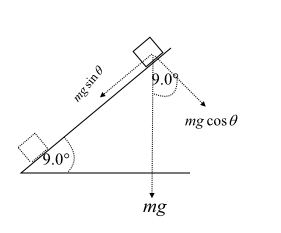
Here, mg is the force due to gravity,  is the angle of inclination,
  is the force component along vertical axis and
  is the force component along horizontal axis.
The expression for calculating the acceleration is given as follows:

Here, F is the component of the weight acting down the incline and m is the mass of the body.
The equation of the motion is given as follows:

Re-arrange the above equation for S.

Substitute  for a in equation .
Substitute  for v,
  for u ,
  for g and
  for in the equation .

The distance travelled by the object before starting to roll down is  .
.
Add Answer to:
A car traveling at 39 m/s runs out of gas while traveling up a 9.0o slope....
A car traveling at 36 m/s runs out of gas while traveling up a 7.0° slope.
 A car traveling at 36 m/s runs out of gas while traveling up a 7.0° slope.Part A How far will it coast before starting to roll back down? Express your answer in meters.
A 1500 kg car traveling at 19 m/s suddenly runs out of gas while approaching the...
 A 1500 kg car traveling at 19 m/s suddenly runs out of gas while
approaching the valley shown in the figure(Figure 1). The alert
driver immediately puts the car in neutral so that it will roll.
What will be the car’s speed as it coasts into the gas station on
the other side of the valley? Express your answer to two
significant figures and include the appropriate units.
Gas station 15 m 10 m
A 1500 kg car traveling at 19 m/s suddenly runs out of gas while
approaching the valley shown in the figure(Figure 1). The alert
driver immediately puts the car in neutral so that it will roll.
What will be the car’s speed as it coasts into the gas station on
the other side of the valley? Express your answer to two
significant figures and include the appropriate units.
Gas station 15 m 10 m
Problem 4 A 1500 kg car traveling at 5 m/s suddenly runs out of gas while...
 Problem 4 A 1500 kg car traveling at 5 m/s suddenly runs out of gas while approaching the valley shown in the figure below. The alert driver immediately puts the car in neutral so that it will roll. Gas station a) Calculate the speed of the car at the bottom of the valley. b) Calculate the maximum height that the car will achieve on the right side. Will it make it to the gas station? c) Calculate the minimum initial...
2. A 1500 kg car is traveling at 25 m/s up a 12° incline when it...
 2. A 1500 kg car is traveling at 25 m/s up a 12° incline when it runs out of gas. The values of Hand uk between the tires of the car and the road are 0.02 and 0.3 respectively. a. Draw clearly the free-body diagram and the motion diagram of the car from the moment it runs out of gas to the moment it comes to a stop. The x-axis should be up the incline. b. Calculate the net force...
1. A 1200kg car traveling at 11.0 m/s runs into a 920kg car traveling in the...
1. A 1200kg car traveling at 11.0 m/s runs into a 920kg car traveling in the same direction at 5.00 m/s. After the collision the 1200kg car has slowed to 8.00 m/s. a) what is the final velocity of the 920kg car? 2. A bullet mass of m=0.0010kg embeds itself in a wooden block with mass M=0.999kg, which then compresses a spring (k=230 N/m) by a distance x=0.050m before coming to rest. The coefficient of kinetic friction between the block...
A 2000 kg car is traveling at 45 m/s. A force of 4000 N is applied...
A 2000 kg car is traveling at 45 m/s. A force of 4000 N is applied to the breaks of the car as it slows down to 15 m/s. How far does the car travel as it slows down? please show all math steps and how you set up the equations. Thanks!
Please show work 3. A car traveling at a constant 39 m/s (-87 mph) passes a...
 Please show work
3. A car traveling at a constant 39 m/s (-87 mph) passes a police car that is initially traveling at 25 m/s (55 mph). At the instant of the pass, the police car accelerates at a constant rate of 3.3 m/s in pursuit. We wish to find how much time elapses before the officer catches the car. (a) Identify the initial states when the car passes the police. (b) Define the final state or conditions which enable...
Please show work
3. A car traveling at a constant 39 m/s (-87 mph) passes a police car that is initially traveling at 25 m/s (55 mph). At the instant of the pass, the police car accelerates at a constant rate of 3.3 m/s in pursuit. We wish to find how much time elapses before the officer catches the car. (a) Identify the initial states when the car passes the police. (b) Define the final state or conditions which enable...
7-The 2000 kg car is moving at 10 m/s and has just run out of gas....
7-The 2000 kg car is moving at 10 m/s and has just run out of gas. The driver quickly shifts into neutral and hopes that he or she can roll to the gas station which is just over the next hill. Assuming negligible friction, under what condition will he make it? Back up your answer with a calculation and a brief explanation.
A 1,832-kg car is moving up a road with a slope (grade) of 23% while slowing...
A 1,832-kg car is moving up a road with a slope (grade) of 23% while slowing down at a rate of 1.7 m/s^2. What is the direction and magnitude of the frictional force? (define positive in the forward direction, i.e., up the slope)?
A car (m = 2000 kg) is traveling down a 15 degree incline at 65 m/s....
 A car (m = 2000 kg) is traveling down a 15 degree incline at 65 m/s. The driver slams on the breaks causing the wheels to lock. Omega_x = 0.3. How far S will the tires skid on the road? If the driver can skid only 10 m before hitting another vehicle, how fast will the driver hit the other vehicle?
 A car traveling at 36 m/s runs out of gas while traveling up a 7.0° slope.Part A How far will it coast before starting to roll back down? Express your answer in meters.
 A 1500 kg car traveling at 19 m/s suddenly runs out of gas while
approaching the valley shown in the figure(Figure 1). The alert
driver immediately puts the car in neutral so that it will roll.
What will be the car’s speed as it coasts into the gas station on
the other side of the valley? Express your answer to two
significant figures and include the appropriate units.
Gas station 15 m 10 m
A 1500 kg car traveling at 19 m/s suddenly runs out of gas while
approaching the valley shown in the figure(Figure 1). The alert
driver immediately puts the car in neutral so that it will roll.
What will be the car’s speed as it coasts into the gas station on
the other side of the valley? Express your answer to two
significant figures and include the appropriate units.
Gas station 15 m 10 m
 Problem 4 A 1500 kg car traveling at 5 m/s suddenly runs out of gas while approaching the valley shown in the figure below. The alert driver immediately puts the car in neutral so that it will roll. Gas station a) Calculate the speed of the car at the bottom of the valley. b) Calculate the maximum height that the car will achieve on the right side. Will it make it to the gas station? c) Calculate the minimum initial...
 2. A 1500 kg car is traveling at 25 m/s up a 12° incline when it runs out of gas. The values of Hand uk between the tires of the car and the road are 0.02 and 0.3 respectively. a. Draw clearly the free-body diagram and the motion diagram of the car from the moment it runs out of gas to the moment it comes to a stop. The x-axis should be up the incline. b. Calculate the net force...
 Please show work
3. A car traveling at a constant 39 m/s (-87 mph) passes a police car that is initially traveling at 25 m/s (55 mph). At the instant of the pass, the police car accelerates at a constant rate of 3.3 m/s in pursuit. We wish to find how much time elapses before the officer catches the car. (a) Identify the initial states when the car passes the police. (b) Define the final state or conditions which enable...
Please show work
3. A car traveling at a constant 39 m/s (-87 mph) passes a police car that is initially traveling at 25 m/s (55 mph). At the instant of the pass, the police car accelerates at a constant rate of 3.3 m/s in pursuit. We wish to find how much time elapses before the officer catches the car. (a) Identify the initial states when the car passes the police. (b) Define the final state or conditions which enable...
 A car (m = 2000 kg) is traveling down a 15 degree incline at 65 m/s. The driver slams on the breaks causing the wheels to lock. Omega_x = 0.3. How far S will the tires skid on the road? If the driver can skid only 10 m before hitting another vehicle, how fast will the driver hit the other vehicle?
Most questions answered within 3 hours.
-
Where is the error in this code sequence?
String s1 = "Hello";
String s2 = "ello";...
asked 11 months ago -
Financial data for Joel de Paris, Inc., for last year
follow:
Joel de Paris, Inc.
Balance...
asked 11 months ago -
Consider this reaction:
Al2(SO4)3 (aq)+ BaCl3
(aq) Al2Cl6 (aq)- +
3BaSO4(s) . What is the...
asked 11 months ago -
Suppose that Savneet is considering increasing her
recent random sample from 20 car rentals to 40...
asked 11 months ago -
Trucks arrive at an unloading terminal at an average rate of 120
per hour.
Trucks arrive...
asked 11 months ago -
Why are methanol and ethanol completely soluble in water while
octanol is not very little soluble....
asked 11 months ago -
A facilities manager at a university reads in a research report
that the mean amount of...
asked 11 months ago -
When the CuSO4 is rehydrated by adding water to the anhydrous
compound, is this an endothermic...
asked 11 months ago -
A ray of sunlight is passing from diamond into crown glass; the
angle of incidence is...
asked 11 months ago -
A block of mass 0.249 kg is placed on top of a light, vertical
spring of...
asked 11 months ago -
how do the kidneys compensate in the presences of acidosis
a) trigger hyperventilate
b) reserve acid...
asked 11 months ago -
Question 501 pts
The rental rate of capital to the firm increases. Which of the
following...
asked 11 months ago