
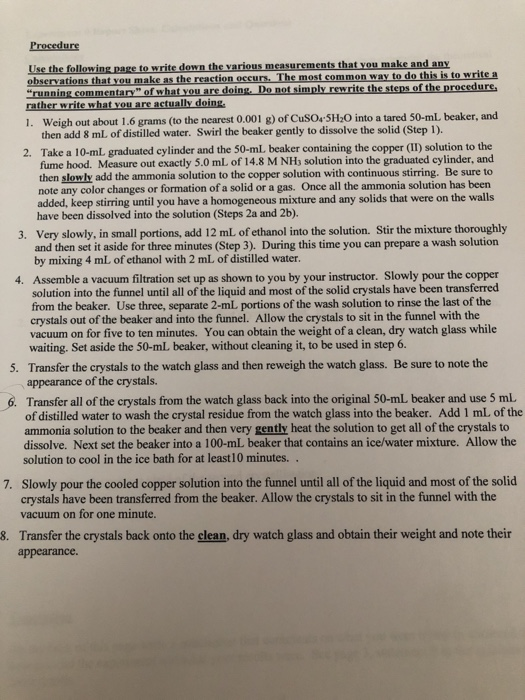
 i need help answering the questions plz and thanks!
Homework Answers
![Readian involed in your synthesis CuSO45H₂O + 4NH3 - [Cu(NH₃)4] SO4 H2O 249.689 Imol 17.03 g/mol .437-95 g/mol molwt. - 1169](http://img.homeworklib.com/questions/472397a0-d8fd-11eb-b7ef-7fa94a0a65bd.png?x-oss-process=image/resize,w_560)
Add Answer to:
i need help answering the questions plz and thanks!
Experiment 9 Report Sheet: Calculations and Questions...
i need to calculate the theortetical yield by finding the limiting reactant of the experiment by...
 i need to calculate the theortetical yield by finding the
limiting reactant of the experiment by converting reactants to
product, then calculate the percent yield using the limiting
reactant
-in my experiment the amout of crystals i obtained was 1.232 g
(watch glass + filter paper = 31.228 g and watch glass, filter
paper, + crystals = 32.460 g)
REACTION SCHEME H сно, ОН- ОСH, CH panisaldehyde acetophenone Molar Mass: 120.15g/mol Molar Mass: 136.15g/mol Molar Mass: 239.30g/mol Density: 1.119g/mL Density:...
i need to calculate the theortetical yield by finding the
limiting reactant of the experiment by converting reactants to
product, then calculate the percent yield using the limiting
reactant
-in my experiment the amout of crystals i obtained was 1.232 g
(watch glass + filter paper = 31.228 g and watch glass, filter
paper, + crystals = 32.460 g)
REACTION SCHEME H сно, ОН- ОСH, CH panisaldehyde acetophenone Molar Mass: 120.15g/mol Molar Mass: 136.15g/mol Molar Mass: 239.30g/mol Density: 1.119g/mL Density:...
Please help! (These are the instructions I had) 1) Preparation of K2[Cu(C2O4)2] 2H2O CuSO4•5H2O + 2K2C2O4•H2O...
Please help! (These are the instructions I had) 1) Preparation of K2[Cu(C2O4)2] 2H2O CuSO4•5H2O + 2K2C2O4•H2O → K2[Cu(C2O4)2]•2H2O + K2SO4 + 5H2O Heat a solution of 2.5g of potassium oxalate monohydrate in 12.5mL of water contained in a 50mL beaker (approx. 90°C). Heat 1.55g of copper sulfate pentahydrate in 3mL of water to about 90°C and add it rapidly, with vigorous stirring to the hot potassium oxalate solution. Set on the bench and allow to cool to room temperature then...
SYNTHESIS OF trans-p-ANISALACETOPHENONE Prepare a table of all chemicals used in the procedure with their purpose...
 SYNTHESIS OF trans-p-ANISALACETOPHENONE
Prepare a table of all chemicals used in the procedure with
their purpose
Melting point of trans-p-anisalacetophenone (with source) and
Molar mass of trans-p-anisalacetophenone (with source) (i cant find
these two things anywhere)
Procedure: 1. Carefully measure 1.0 mL each of p-anisaldehyde and acetophenone and place them in a screw-cap testtube. 2. To this add 3.0 mL of 95% ethanol. Shake the test tube gently to achieve a homogenous mixture. 3. Add 6-7 drops of 40% sodium...
SYNTHESIS OF trans-p-ANISALACETOPHENONE
Prepare a table of all chemicals used in the procedure with
their purpose
Melting point of trans-p-anisalacetophenone (with source) and
Molar mass of trans-p-anisalacetophenone (with source) (i cant find
these two things anywhere)
Procedure: 1. Carefully measure 1.0 mL each of p-anisaldehyde and acetophenone and place them in a screw-cap testtube. 2. To this add 3.0 mL of 95% ethanol. Shake the test tube gently to achieve a homogenous mixture. 3. Add 6-7 drops of 40% sodium...
The first picture is used for question #2, and question #3 can be normally answered. I...
 The first picture is used for question #2, and question #3 can
be normally answered. I believe the answer to question 3 is ->
0.07144M. However I would like someone to check it. I am not sure
about 2.
BE SURE THAT YOU RECORD ALL OF YOUR DATA AND LABEL PROPERLY FOR PARTI OF THIS LABORATORY EXPERIMENT. YOU WILL NEED TO ACCESS THIS INFORMATION IN THREE WEEKS. Part I Synthesis of the Complex Salt containing Copper Procedure 16.004 1. In...
The first picture is used for question #2, and question #3 can
be normally answered. I believe the answer to question 3 is ->
0.07144M. However I would like someone to check it. I am not sure
about 2.
BE SURE THAT YOU RECORD ALL OF YOUR DATA AND LABEL PROPERLY FOR PARTI OF THIS LABORATORY EXPERIMENT. YOU WILL NEED TO ACCESS THIS INFORMATION IN THREE WEEKS. Part I Synthesis of the Complex Salt containing Copper Procedure 16.004 1. In...
Heat lamp or drying oven Hydrated copper chloride Distilled water Aluminum wire 30-ml beaker Glass rod...
 Heat lamp or drying oven Hydrated copper chloride Distilled water Aluminum wire 30-ml beaker Glass rod Watch glass Buchner fiannel Hot plate Ethanol Füter paper CAUTION: Wear all safety equipment, follow all normal safety procedures and experiment as directed by your instructor follow instructions. Dispose of all liquid AND solid waste products from the 1. Weigh a clean, dry 30-mL beaker and record its mass to 3 decimal places. When-it-is-time,heat the beaker 2. Add approximately 1.00 gram of the hydrated...
we have 1.5 g final product for following experiment. how can I draw acid- base curve...
we have 1.5 g final product for following experiment. how can I draw acid- base curve for following experiment? Experimental procedure Weigh approximately 2.5 gof benzoic acid contaminated withtable salt (NaCl) as precisely as possible (record the exact quantity). Transfer the solid to a 100 mL separatory funnel and add 30 mL of ethyl acetate. In a 50 mL beaker, add 20 mL of water and 1.0 mL of 3 M hydrochloric acid. Transferthe mixtureto the separatory funnel. The solid...
1.) What side reactions occur during the following steps. 2.) How can the IR spectrum be...
 1.)
What side reactions occur during the following steps.
2.) How can the IR spectrum be used to show that there is not
starting material left and the products are ketones?
3.) Describe the major differences and similarities between
the IR spectra of benzoin and benzil. Compare your IR spectrum with
those of benzoin and benzil.
Copper-Catalyzed Oxidation of Benzoin 1. Add a stir bar and 1.5 mL of glacial acetic acid, 0.250 g of NH4NO3 and 0.500 g of...
1.)
What side reactions occur during the following steps.
2.) How can the IR spectrum be used to show that there is not
starting material left and the products are ketones?
3.) Describe the major differences and similarities between
the IR spectra of benzoin and benzil. Compare your IR spectrum with
those of benzoin and benzil.
Copper-Catalyzed Oxidation of Benzoin 1. Add a stir bar and 1.5 mL of glacial acetic acid, 0.250 g of NH4NO3 and 0.500 g of...
Write out your separation scheme for this experiment. 1. Heat 75 mL of water to 90...
Write out your separation scheme for this experiment. 1. Heat 75 mL of water to 90 °C in a 250-mL beaker. 2. While the water is being heated, place 250 mg of salicylic acid, 1 drop of 85% phosphoric acid and 0.5 mL of acetic anhydride in a test tube. Add a boiling chip to the mixture and gently shake it in order to mix the reactants. 3. Heat the tube in the beaker of water at 85 - 90...
THE EMPIRICAL FORMULA OF SELECTED HYDRATES experiment PROCEDURE THIS EXPERIMENT SHOULD BE DONE IN PAIRS. 1....
THE EMPIRICAL FORMULA OF SELECTED HYDRATES experiment PROCEDURE THIS EXPERIMENT SHOULD BE DONE IN PAIRS. 1. Available to you should be: a Büchner funnel, a rubber funnel adapter, side-arm filter flask, thick-walled rubber tubing, plastic forceps and a plastic spatula. 2. Before you turn the hotplate on, wipe the hotplate down with a damp paper towel. During this experiment you will be placing filter paper containing products directly onto the surface of the hotplate. As such, you will want to...
3. Crystallization begins with a process called nucleation, where particles of the substance dissolved in solution...
 3. Crystallization begins with a process called nucleation, where particles of the substance dissolved in solution begin to aggregate. Crystals then begin to form on these aggregates. Based on this, explain why Steps 3 and 4 in Part III may induce crystallization. Part II: Observations Upuy Describe qualitative changes to solution - Solution went from bright yellow, orange to a mare dacu Orange /ced - hydrogen peroxide is originally clear but tuck's oldcu in the solution. The addition of hydrogen...
 i need to calculate the theortetical yield by finding the
limiting reactant of the experiment by converting reactants to
product, then calculate the percent yield using the limiting
reactant
-in my experiment the amout of crystals i obtained was 1.232 g
(watch glass + filter paper = 31.228 g and watch glass, filter
paper, + crystals = 32.460 g)
REACTION SCHEME H сно, ОН- ОСH, CH panisaldehyde acetophenone Molar Mass: 120.15g/mol Molar Mass: 136.15g/mol Molar Mass: 239.30g/mol Density: 1.119g/mL Density:...
i need to calculate the theortetical yield by finding the
limiting reactant of the experiment by converting reactants to
product, then calculate the percent yield using the limiting
reactant
-in my experiment the amout of crystals i obtained was 1.232 g
(watch glass + filter paper = 31.228 g and watch glass, filter
paper, + crystals = 32.460 g)
REACTION SCHEME H сно, ОН- ОСH, CH panisaldehyde acetophenone Molar Mass: 120.15g/mol Molar Mass: 136.15g/mol Molar Mass: 239.30g/mol Density: 1.119g/mL Density:...
 SYNTHESIS OF trans-p-ANISALACETOPHENONE
Prepare a table of all chemicals used in the procedure with
their purpose
Melting point of trans-p-anisalacetophenone (with source) and
Molar mass of trans-p-anisalacetophenone (with source) (i cant find
these two things anywhere)
Procedure: 1. Carefully measure 1.0 mL each of p-anisaldehyde and acetophenone and place them in a screw-cap testtube. 2. To this add 3.0 mL of 95% ethanol. Shake the test tube gently to achieve a homogenous mixture. 3. Add 6-7 drops of 40% sodium...
SYNTHESIS OF trans-p-ANISALACETOPHENONE
Prepare a table of all chemicals used in the procedure with
their purpose
Melting point of trans-p-anisalacetophenone (with source) and
Molar mass of trans-p-anisalacetophenone (with source) (i cant find
these two things anywhere)
Procedure: 1. Carefully measure 1.0 mL each of p-anisaldehyde and acetophenone and place them in a screw-cap testtube. 2. To this add 3.0 mL of 95% ethanol. Shake the test tube gently to achieve a homogenous mixture. 3. Add 6-7 drops of 40% sodium...
 The first picture is used for question #2, and question #3 can
be normally answered. I believe the answer to question 3 is ->
0.07144M. However I would like someone to check it. I am not sure
about 2.
BE SURE THAT YOU RECORD ALL OF YOUR DATA AND LABEL PROPERLY FOR PARTI OF THIS LABORATORY EXPERIMENT. YOU WILL NEED TO ACCESS THIS INFORMATION IN THREE WEEKS. Part I Synthesis of the Complex Salt containing Copper Procedure 16.004 1. In...
The first picture is used for question #2, and question #3 can
be normally answered. I believe the answer to question 3 is ->
0.07144M. However I would like someone to check it. I am not sure
about 2.
BE SURE THAT YOU RECORD ALL OF YOUR DATA AND LABEL PROPERLY FOR PARTI OF THIS LABORATORY EXPERIMENT. YOU WILL NEED TO ACCESS THIS INFORMATION IN THREE WEEKS. Part I Synthesis of the Complex Salt containing Copper Procedure 16.004 1. In...
 Heat lamp or drying oven Hydrated copper chloride Distilled water Aluminum wire 30-ml beaker Glass rod Watch glass Buchner fiannel Hot plate Ethanol Füter paper CAUTION: Wear all safety equipment, follow all normal safety procedures and experiment as directed by your instructor follow instructions. Dispose of all liquid AND solid waste products from the 1. Weigh a clean, dry 30-mL beaker and record its mass to 3 decimal places. When-it-is-time,heat the beaker 2. Add approximately 1.00 gram of the hydrated...
 1.)
What side reactions occur during the following steps.
2.) How can the IR spectrum be used to show that there is not
starting material left and the products are ketones?
3.) Describe the major differences and similarities between
the IR spectra of benzoin and benzil. Compare your IR spectrum with
those of benzoin and benzil.
Copper-Catalyzed Oxidation of Benzoin 1. Add a stir bar and 1.5 mL of glacial acetic acid, 0.250 g of NH4NO3 and 0.500 g of...
1.)
What side reactions occur during the following steps.
2.) How can the IR spectrum be used to show that there is not
starting material left and the products are ketones?
3.) Describe the major differences and similarities between
the IR spectra of benzoin and benzil. Compare your IR spectrum with
those of benzoin and benzil.
Copper-Catalyzed Oxidation of Benzoin 1. Add a stir bar and 1.5 mL of glacial acetic acid, 0.250 g of NH4NO3 and 0.500 g of...
 3. Crystallization begins with a process called nucleation, where particles of the substance dissolved in solution begin to aggregate. Crystals then begin to form on these aggregates. Based on this, explain why Steps 3 and 4 in Part III may induce crystallization. Part II: Observations Upuy Describe qualitative changes to solution - Solution went from bright yellow, orange to a mare dacu Orange /ced - hydrogen peroxide is originally clear but tuck's oldcu in the solution. The addition of hydrogen...
Most questions answered within 3 hours.
-
Where is the error in this code sequence?
String s1 = "Hello";
String s2 = "ello";...
asked 11 months ago -
Financial data for Joel de Paris, Inc., for last year
follow:
Joel de Paris, Inc.
Balance...
asked 11 months ago -
Consider this reaction:
Al2(SO4)3 (aq)+ BaCl3
(aq) Al2Cl6 (aq)- +
3BaSO4(s) . What is the...
asked 11 months ago -
Suppose that Savneet is considering increasing her
recent random sample from 20 car rentals to 40...
asked 11 months ago -
Trucks arrive at an unloading terminal at an average rate of 120
per hour.
Trucks arrive...
asked 11 months ago -
Why are methanol and ethanol completely soluble in water while
octanol is not very little soluble....
asked 11 months ago -
A facilities manager at a university reads in a research report
that the mean amount of...
asked 11 months ago -
When the CuSO4 is rehydrated by adding water to the anhydrous
compound, is this an endothermic...
asked 11 months ago -
A ray of sunlight is passing from diamond into crown glass; the
angle of incidence is...
asked 11 months ago -
A block of mass 0.249 kg is placed on top of a light, vertical
spring of...
asked 11 months ago -
how do the kidneys compensate in the presences of acidosis
a) trigger hyperventilate
b) reserve acid...
asked 11 months ago -
Question 501 pts
The rental rate of capital to the firm increases. Which of the
following...
asked 11 months ago