
Homework Answers
Add Answer to:
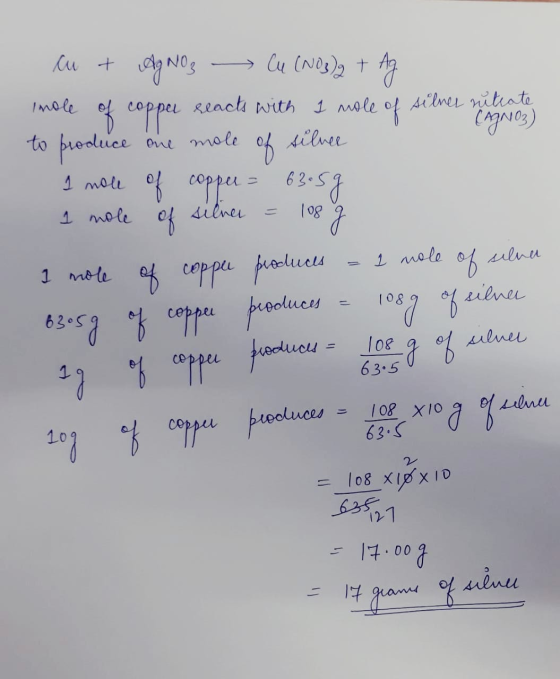
How many grams of silver are produced by reacting completely with 10.0g of copper? Cu +...
Question 20 (1 point) Solid silver can be produced by reacting silver (1) nitrate with copper...
 Question 20 (1 point) Solid silver can be produced by reacting silver (1) nitrate with copper according to the reaction below. How how many moles of silver can be produced if 17.882 g of Cu was placed in silver (1) nitrate solution (Assume the AgNO3 is in excess) Cu(s) + 2 AgNO3(aq) + Cu(NO3)2(aq) + 2 Ag(s) Your Answer: Answer units Question 21 (1 point) . . . . n l .ncc. that
Question 19 (1 point) Solid silver can be produced by reacting silver (1) nitrate with copper...
 Question 19 (1 point) Solid silver can be produced by reacting silver (1) nitrate with copper according to the reaction below. What is the percent yield of a reaction if 9.752 g of Cu was placed in silver (1) nitrate solution and produced 11.500 g of silver (Assume the AgNO3 is in excess)? Cu(s) + 2 AgNO3(aq) Cu(NO3)2(aq) + 2 Ag(s) Your Answer: Answer units Question 20 (1 point) How many moles of chloride ions are present in a 300.0...
When 25.0 g of silver nitrate, AgNO3, is reacted with 5.00 g Cu, how many grams...
When 25.0 g of silver nitrate, AgNO3, is reacted with 5.00 g Cu, how many grams of Ag can you theoretically produce? Cu(s) + 2 AgNO3(aq) → Cu(NO3)2(aq) + 2 Ag(s) Question 6 options: 32.9 g Ag 15.9 g Ag 17.0 g Ag 5.00 g Ag
Question 10 Consider the balanced equation representing the reaction of solid copper and aqueous silver nitrate:...
 Question 10 Consider the balanced equation representing the reaction of solid copper and aqueous silver nitrate: Cu (s) + 2 AgNO3 → 2 Ag (s) + Cu(NO3)2 What mass of solid copper is required to completely react with 16.6 mL of 0.67 M silver nitrate? Calculate the mass in grams, and report your answer to 2 significant figures.
How many grams of silver bromide, AgBr, are produced if 15.0 mL of 0.350 M CaBr2(aq)...
How many grams of silver bromide, AgBr, are produced if 15.0 mL of 0.350 M CaBr2(aq) completely react given the reaction: 2 AgNO3(aq) + CaBr2(aq) → Ca(NO3)2(aq) + 2 AgBr(s)
Consider a reaction of copper reacting with silver ions in aqueous CuSO4 and AgNO3 solutions Cu(s)...
Consider a reaction of copper reacting with silver ions in aqueous CuSO4 and AgNO3 solutions Cu(s) + 2 Ag+(aq) -> Cu2+(aq) + 2Ag(s) a) Indicate which substance loses electrons and which substance gains electrons. b) When a substance is oxidized it loses electrons. Write the oxidation half-reaction. c) When a substance is reduced it gains electrons. Write the reduction half-reaction. d) Add the oxidation and reduction half-reactions to give the overall reaction of copper reacting with silver ions. In order...
Through the magic of electrochemistry, metallic copper can be used to recover solid silver metal from...
Through the magic of electrochemistry, metallic copper can be used to recover solid silver metal from a solution of silver nitrate (AgNO3) according to the following reaction: Cu(s) + AgNO3(aq) → Cu(NO3)2(aq) + Ag(s) What mass of silver metal will be produced if 0.900 g of copper metal is reacted with silver nitrate (AgNO3)? (HINT: You must first balance the chemical equation.)
molecular equation for the reaction of magnesium metal with aqueous silver nitrate > magnesium + silver...
 molecular equation for the reaction of magnesium metal with aqueous
silver nitrate
> magnesium + silver nitrate Mg(s) + 2AgNO, (aq) → Mg(NO3)2(aq) + 2Ag(s) copper(11) nitrate silver Cu(NO3)2(aq) Ag(s) silver nitrate AgNO,(aq) Write the molecular equation for the reaction of magnesium metal with aqueous silver nitrate. Include physical states. molecular equation: ABUS Write the net ionic equation for the reaction of magnesium metal with aqueous silver nitrate. Include physical states. net ionic equation:
molecular equation for the reaction of magnesium metal with aqueous
silver nitrate
> magnesium + silver nitrate Mg(s) + 2AgNO, (aq) → Mg(NO3)2(aq) + 2Ag(s) copper(11) nitrate silver Cu(NO3)2(aq) Ag(s) silver nitrate AgNO,(aq) Write the molecular equation for the reaction of magnesium metal with aqueous silver nitrate. Include physical states. molecular equation: ABUS Write the net ionic equation for the reaction of magnesium metal with aqueous silver nitrate. Include physical states. net ionic equation:
In the reaction between AgNO3 and Cu, Ag and Cu(NO3)2 is produced. We determined that the...
In the reaction between AgNO3 and Cu, Ag and Cu(NO3)2 is produced. We determined that the experimental molar ratio of Ag to Cu is 2 to 1. How would this ratio change (decrease, increase, stay the same) if a) the silver crystals produced were not washed clean before being dried and weighted? b) some of the AgNO3 crystals remained in the original vial while transferring them to the test tube c) Some of the silver crystals were lost when silver...
For the reaction CaI2+2AgNO3⟶2AgI+Ca(NO3)2CaI2+2AgNO3⟶2AgI+Ca(NO3)2 how many grams of silver nitrate, AgNO3, are needed to react completely...
For the reaction CaI2+2AgNO3⟶2AgI+Ca(NO3)2CaI2+2AgNO3⟶2AgI+Ca(NO3)2 how many grams of silver nitrate, AgNO3, are needed to react completely with 88.388.3 g of calcium iodide, CaI2?
 Question 20 (1 point) Solid silver can be produced by reacting silver (1) nitrate with copper according to the reaction below. How how many moles of silver can be produced if 17.882 g of Cu was placed in silver (1) nitrate solution (Assume the AgNO3 is in excess) Cu(s) + 2 AgNO3(aq) + Cu(NO3)2(aq) + 2 Ag(s) Your Answer: Answer units Question 21 (1 point) . . . . n l .ncc. that
 Question 19 (1 point) Solid silver can be produced by reacting silver (1) nitrate with copper according to the reaction below. What is the percent yield of a reaction if 9.752 g of Cu was placed in silver (1) nitrate solution and produced 11.500 g of silver (Assume the AgNO3 is in excess)? Cu(s) + 2 AgNO3(aq) Cu(NO3)2(aq) + 2 Ag(s) Your Answer: Answer units Question 20 (1 point) How many moles of chloride ions are present in a 300.0...
 Question 10 Consider the balanced equation representing the reaction of solid copper and aqueous silver nitrate: Cu (s) + 2 AgNO3 → 2 Ag (s) + Cu(NO3)2 What mass of solid copper is required to completely react with 16.6 mL of 0.67 M silver nitrate? Calculate the mass in grams, and report your answer to 2 significant figures.
 molecular equation for the reaction of magnesium metal with aqueous
silver nitrate
> magnesium + silver nitrate Mg(s) + 2AgNO, (aq) → Mg(NO3)2(aq) + 2Ag(s) copper(11) nitrate silver Cu(NO3)2(aq) Ag(s) silver nitrate AgNO,(aq) Write the molecular equation for the reaction of magnesium metal with aqueous silver nitrate. Include physical states. molecular equation: ABUS Write the net ionic equation for the reaction of magnesium metal with aqueous silver nitrate. Include physical states. net ionic equation:
molecular equation for the reaction of magnesium metal with aqueous
silver nitrate
> magnesium + silver nitrate Mg(s) + 2AgNO, (aq) → Mg(NO3)2(aq) + 2Ag(s) copper(11) nitrate silver Cu(NO3)2(aq) Ag(s) silver nitrate AgNO,(aq) Write the molecular equation for the reaction of magnesium metal with aqueous silver nitrate. Include physical states. molecular equation: ABUS Write the net ionic equation for the reaction of magnesium metal with aqueous silver nitrate. Include physical states. net ionic equation:
Most questions answered within 3 hours.
-
Where is the error in this code sequence?
String s1 = "Hello";
String s2 = "ello";...
asked 11 months ago -
Financial data for Joel de Paris, Inc., for last year
follow:
Joel de Paris, Inc.
Balance...
asked 11 months ago -
Consider this reaction:
Al2(SO4)3 (aq)+ BaCl3
(aq) Al2Cl6 (aq)- +
3BaSO4(s) . What is the...
asked 11 months ago -
Suppose that Savneet is considering increasing her
recent random sample from 20 car rentals to 40...
asked 11 months ago -
Trucks arrive at an unloading terminal at an average rate of 120
per hour.
Trucks arrive...
asked 11 months ago -
Why are methanol and ethanol completely soluble in water while
octanol is not very little soluble....
asked 11 months ago -
A facilities manager at a university reads in a research report
that the mean amount of...
asked 11 months ago -
When the CuSO4 is rehydrated by adding water to the anhydrous
compound, is this an endothermic...
asked 11 months ago -
A ray of sunlight is passing from diamond into crown glass; the
angle of incidence is...
asked 11 months ago -
A block of mass 0.249 kg is placed on top of a light, vertical
spring of...
asked 11 months ago -
how do the kidneys compensate in the presences of acidosis
a) trigger hyperventilate
b) reserve acid...
asked 11 months ago -
Question 501 pts
The rental rate of capital to the firm increases. Which of the
following...
asked 11 months ago