
Homework Answers
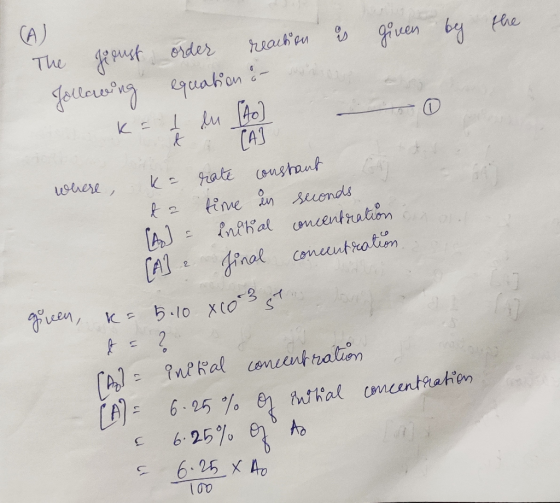

 the solution is provided..hope
it is helpful...please rate if this helps..thank you.
the solution is provided..hope
it is helpful...please rate if this helps..thank you.
Add Answer to:
A certain first-order reaction ( A products) has a rate constant of 5.10x10⁻³⁵-1 at 45 °C....
For a first-order reaction, the half-life is constant. It depends only on the rate constant k...
For a first-order reaction, the half-life is constant. It depends only on the rate constant k and not on the reactant concentration. It is expressed as t 1/2 = 0.693 k For a second-order reaction, the half-life depends on the rate constant and the concentration of the reactant and so is expressed as t 1/2 = 1 k[A ] 0 Part A A certain first-order reaction ( A→products ) has a rate constant of 9.90×10⁻³ s −1 at 45 ∘...
For a first-order reaction, the half-life is constant. It depends only on the rate constant k...
 For a first-order reaction, the half-life is constant. It depends only on the rate constant k and not on the reactant concentration. It is expressed as 0.693 - 1/2K For a second-order reaction, the half-life depends on the rate constant and the concentration of the reactant and so is expressed as 1/2 k(Alo Part A A certain first-order reaction (A>products) has a rate constant of 9.60x10 s-1 at45 C. How many minutes does it take for the concentration of the...
Review Constants Periodic Table Part A A certain first-order reaction ( A products) has a rate constant of 4.50x10-...
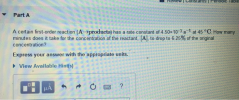 Review Constants Periodic Table Part A A certain first-order reaction ( A products) has a rate constant of 4.50x10⁻³ s at 45 °C. How many minutes does it take for the concentration of the reactant, [A], to drop to 6.25% of the original concentration? Express your answer with the appropriate units. View Available Hint(s) " HÅR O a ?
+ Half-life for First and Second Order Reactions 11 of 11 The half-life of a reaction,...
 + Half-life for First and Second Order Reactions 11 of 11 The half-life of a reaction, t1/2, is the time it takes for the reactant concentration A to decrease by half. For example, after one half-Me the concentration falls from the initial concentration (Alo to A\o/2, after a second half-life to Alo/4 after a third half-life to A./8, and so on. on Review Constants Periodic Table 11/25 For a second-order reaction, the half-life depends on the rate constant and the...
The half-life of a reaction, t1/2, is the time it takes for the reactant concentration [A]...
 The half-life of a reaction,
t1/2, is the time it takes for the reactant concentration [A] to
decrease by half. For example, after one half-life the
concentration falls from the initial concentration [A]0 to [A]0/2,
after a second half-life to [A]0/4, after a third half-life to
[A]0/8, and so on. on. For a first-order reaction, the half-life is
constant. It depends only on the rate constant k and not on the
reactant concentration. It is expressed as t1/2=0.693k For a...
The half-life of a reaction,
t1/2, is the time it takes for the reactant concentration [A] to
decrease by half. For example, after one half-life the
concentration falls from the initial concentration [A]0 to [A]0/2,
after a second half-life to [A]0/4, after a third half-life to
[A]0/8, and so on. on. For a first-order reaction, the half-life is
constant. It depends only on the rate constant k and not on the
reactant concentration. It is expressed as t1/2=0.693k For a...
Part A. A certain first-order reaction (A→products) has a rate constant of 3.90×10⁻³ s−1 at 45...
Part A. A certain first-order reaction (A→products) has a rate constant of 3.90×10⁻³ s−1 at 45 ∘C. How many minutes does it take for the concentration of the reactant, [A], to drop to 6.25% of the original concentration? Part B. A certain second-order reaction (B→products) has a rate constant of 1.90×10⁻³ M−1⋅s−1 at 27 ∘C and an initial half-life of 298 s . What is the concentration of the reactant B after one half-life?
Part A: A certain first-order reaction (A→products) has a rate constant of 6.30×10⁻³ s−1 at 45...
Part A: A certain first-order reaction (A→products) has a rate constant of 6.30×10⁻³ s−1 at 45 ∘C. How many minutes does it take for the concentration of the reactant, [A], to drop to 6.25% of the original concentration? Part B: A certain second-order reaction (B→products) has a rate constant of 1.30×10⁻³ M−1⋅s−1 at 27 ∘C and an initial half-life of 264 s . What is the concentration of the reactant B after one half-life?
For a first-order reaction, the half-life is constant. It depends only on the rate constant k...
For a first-order reaction, the half-life is constant. It depends only on the rate constant k and not on the reactant concentration. It is expressed as t1/2=0.693kt1/2=0.693k For a second-order reaction, the half-life depends on the rate constant and the concentration of the reactant and so is expressed as t1/2=1k[A]0 Part A. A certain first-order reaction (A→products) has a rate constant of 3.00×10⁻³ s−1 at 45 ∘C∘C. How many minutes does it take for the concentration of the reactant, [A],...
Review | Constants | Periodic Tab Part B A certain second-order reaction (B products) has a rate constant of 2.00x...
 Review | Constants | Periodic Tab Part B A certain second-order reaction (B products) has a rate constant of 2.00x 10⁻³ M1.s 1 at 27 °C and an initial half-life of 226 s. What is the concentration of the reactant B after one half-life? S Express your answer with the appropriate units. View Available Hint(s) HA ?
A certain first-order reaction (A→products) has a rate constant of 1.00×10⁻² s-1 at 45 ∘C. How...
A certain first-order reaction (A→products) has a rate constant of 1.00×10⁻² s-1 at 45 ∘C. How many minutes does it take for the concentration of the reactant, [A], to drop to 6.25%% of the original concentration? Express your answer with the appropriate units.
 For a first-order reaction, the half-life is constant. It depends only on the rate constant k and not on the reactant concentration. It is expressed as 0.693 - 1/2K For a second-order reaction, the half-life depends on the rate constant and the concentration of the reactant and so is expressed as 1/2 k(Alo Part A A certain first-order reaction (A>products) has a rate constant of 9.60x10 s-1 at45 C. How many minutes does it take for the concentration of the...
 Review Constants Periodic Table Part A A certain first-order reaction ( A products) has a rate constant of 4.50x10⁻³ s at 45 °C. How many minutes does it take for the concentration of the reactant, [A], to drop to 6.25% of the original concentration? Express your answer with the appropriate units. View Available Hint(s) " HÅR O a ?
 + Half-life for First and Second Order Reactions 11 of 11 The half-life of a reaction, t1/2, is the time it takes for the reactant concentration A to decrease by half. For example, after one half-Me the concentration falls from the initial concentration (Alo to A\o/2, after a second half-life to Alo/4 after a third half-life to A./8, and so on. on Review Constants Periodic Table 11/25 For a second-order reaction, the half-life depends on the rate constant and the...
 The half-life of a reaction,
t1/2, is the time it takes for the reactant concentration [A] to
decrease by half. For example, after one half-life the
concentration falls from the initial concentration [A]0 to [A]0/2,
after a second half-life to [A]0/4, after a third half-life to
[A]0/8, and so on. on. For a first-order reaction, the half-life is
constant. It depends only on the rate constant k and not on the
reactant concentration. It is expressed as t1/2=0.693k For a...
The half-life of a reaction,
t1/2, is the time it takes for the reactant concentration [A] to
decrease by half. For example, after one half-life the
concentration falls from the initial concentration [A]0 to [A]0/2,
after a second half-life to [A]0/4, after a third half-life to
[A]0/8, and so on. on. For a first-order reaction, the half-life is
constant. It depends only on the rate constant k and not on the
reactant concentration. It is expressed as t1/2=0.693k For a...
 Review | Constants | Periodic Tab Part B A certain second-order reaction (B products) has a rate constant of 2.00x 10⁻³ M1.s 1 at 27 °C and an initial half-life of 226 s. What is the concentration of the reactant B after one half-life? S Express your answer with the appropriate units. View Available Hint(s) HA ?
Most questions answered within 3 hours.
-
Where is the error in this code sequence?
String s1 = "Hello";
String s2 = "ello";...
asked 10 months ago -
Financial data for Joel de Paris, Inc., for last year
follow:
Joel de Paris, Inc.
Balance...
asked 10 months ago -
Consider this reaction:
Al2(SO4)3 (aq)+ BaCl3
(aq) Al2Cl6 (aq)- +
3BaSO4(s) . What is the...
asked 10 months ago -
Suppose that Savneet is considering increasing her
recent random sample from 20 car rentals to 40...
asked 10 months ago -
Trucks arrive at an unloading terminal at an average rate of 120
per hour.
Trucks arrive...
asked 10 months ago -
Why are methanol and ethanol completely soluble in water while
octanol is not very little soluble....
asked 10 months ago -
A facilities manager at a university reads in a research report
that the mean amount of...
asked 10 months ago -
When the CuSO4 is rehydrated by adding water to the anhydrous
compound, is this an endothermic...
asked 10 months ago -
A ray of sunlight is passing from diamond into crown glass; the
angle of incidence is...
asked 10 months ago -
A block of mass 0.249 kg is placed on top of a light, vertical
spring of...
asked 10 months ago -
how do the kidneys compensate in the presences of acidosis
a) trigger hyperventilate
b) reserve acid...
asked 10 months ago -
Question 501 pts
The rental rate of capital to the firm increases. Which of the
following...
asked 10 months ago