
Homework Answers
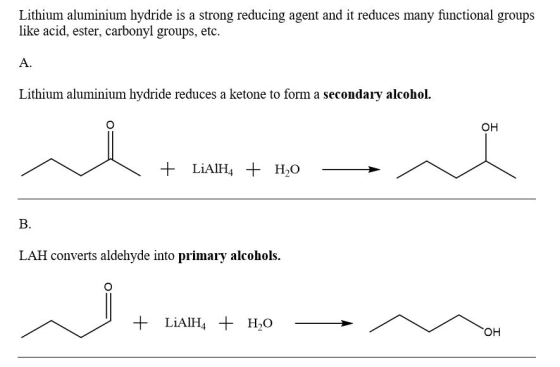
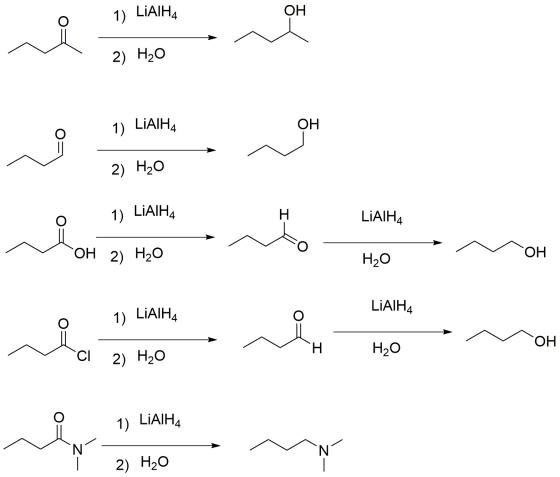
A) will be reduced to secondary alcohol (2-propanol)
B) will be reduced to 1-butanol.
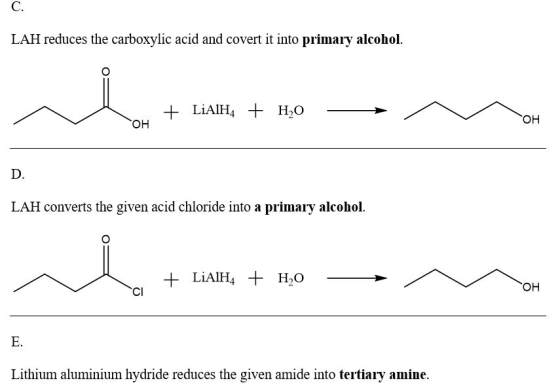
C) will be reduced to 1-butanol as excess of LiAlH4 and H2O is used, First acid will be reduced to aldehyde and then aldehyde will be reduced to alcohol.
D) will be reduced to 1-butanol as excess of LiAlH4 and H2O is used. Eirst acid chloride will be reduced to aldehyde, then aldehyde will be reduced to alcohol.
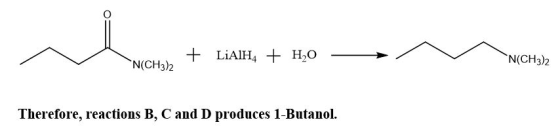
E) will be reduced to amine.
Add Answer to:
Which of the following reactions with produce 1-butanol as one of the products? (Assume excess lithium...
Which one of the following series of reactions does not produce a primary amine? O 1)...
 Which one of the following series of reactions does not produce a primary amine? O 1) LiAlH4 (excess) 1) Fe, HCI, H2O 1) LiAIH4 (excess) A) PhCN B) PhNO2 C) PhNHCCH? 2) H20 2) NaOH, H2O 2) H20 O H2, Raney-Ni NaOH, H20, heat D) PhCHENH E) PENHÖCH Which of the following amines cannot be made by reduction of a nitrile? PhCH2NH2 EtNH2 (CH3)2CHCH2NH2 Me3CCH2NH2 A B C D Ph2CHNH2 E
6. Which one of the following series of reactions does not produce a primary amine? 1)...
 6. Which one of the following series of reactions does not produce a primary amine? 1) LIAIH, (excess) 1) Fe, HCI, H2O A) PHCN B) PhNO2 c) PhNHCCHE 2) H20 2) NaOH, HAO 1) LIAIH4 (excess) 2) H20 H, Raney-Ni NaOH, H2O, heat D) PhCHENH E) PHNHCCH,
Which one of the following series of reactions does not produce a primary amine? Which one...
 Which one of the following series of reactions does not produce
a primary amine?
Which one of the following series of reactions does not produce a primary amine? O 1) LiAIH4 (excess) 1) Fe, HCl, H20 NaOH, H2O, heat A) PhCN B) PHNO2 C) PhNHCCH 2) H20 2) NaOH, H2O H2, Raney-Ni O E) PUNHCCH3 1) LIAIH4 (excess) D) PhCH=NH 2) H20 Which of the following amines cannot be made by reduction of a nitrile? Ph2CHNH2 EtNH2 (CH3)2CHCH2NH2 Me3CCH2NH2 A...
Which one of the following series of reactions does not produce
a primary amine?
Which one of the following series of reactions does not produce a primary amine? O 1) LiAIH4 (excess) 1) Fe, HCl, H20 NaOH, H2O, heat A) PhCN B) PHNO2 C) PhNHCCH 2) H20 2) NaOH, H2O H2, Raney-Ni O E) PUNHCCH3 1) LIAIH4 (excess) D) PhCH=NH 2) H20 Which of the following amines cannot be made by reduction of a nitrile? Ph2CHNH2 EtNH2 (CH3)2CHCH2NH2 Me3CCH2NH2 A...
6. Which one of the following series of reactions does not produce a primary amine? 1)...
 6. Which one of the following series of reactions does not produce a primary amine? 1) LIAIH4 (excess) 1) Fe, HCI, H20 1) LiAIH4 (excess) A) PhCN B) PhNO2 C) PhNHCCHg 2) H20 2) NaOH, H2O 2) H20 H2, Raney-Ni NaOH, H2O, heat D) PhCHENH E) PHNHCCH o 7. Which of the following amines cannot be made by reduction of a nitrile? PhCH2NH2 ENH2 (CH3)2CHCH2NH2 Me3CCH2NH2 А B D PhCHNH, E
2. Predict the product of reaction of this acid (from chrysanthemums) with lithium aluminum hydride. 1....
 2. Predict the product of reaction of this acid (from chrysanthemums) with lithium aluminum hydride. 1. LiAlH4, ether 2. H2O OH 3. Both of the molecules shown below are found in multiple plants. Propose reaction conditions at the arrow to accomplish the following synthesis in a good yield. tubro - OH
can someone please help me with this page??? thanks in advance!! 4. Predict the products for...
 can someone please help me with this page??? thanks in
advance!!
4. Predict the products for the following reaction sequences. Он sOc/2 1. LIAIH 2. Hо (CH3)2NH (a) pyridine CH3Br base (-HBr) CH3CH2Br base (-HBr) (b) NH2 Br NaN3 (a) LIAIH (c) (b) Н-О MCРВА NaN3 (a) LIAIH4 (d) oH(a) NH2 NaBH3CN (e) H2SO4 5. Predict the major product for the following reactions. 1. excess CH3 NH2 (a) 2. Ag O, H2O heat 1. excess CH (b) 2. Ag20, H2O...
can someone please help me with this page??? thanks in
advance!!
4. Predict the products for the following reaction sequences. Он sOc/2 1. LIAIH 2. Hо (CH3)2NH (a) pyridine CH3Br base (-HBr) CH3CH2Br base (-HBr) (b) NH2 Br NaN3 (a) LIAIH (c) (b) Н-О MCРВА NaN3 (a) LIAIH4 (d) oH(a) NH2 NaBH3CN (e) H2SO4 5. Predict the major product for the following reactions. 1. excess CH3 NH2 (a) 2. Ag O, H2O heat 1. excess CH (b) 2. Ag20, H2O...
1. Provide the Major Product from the following reactions CrO3, H2S04 Acetone HBr Me OH OH...
 1. Provide the Major Product from the following reactions CrO3, H2S04 Acetone HBr Me OH OH Tsci, Pyr, NaH он Br 2. Provide Reagents for each Letter in the REDOX Ladder See list of Reagents OH on Back OH PCC DIBAL-H (Diisobutylaluminum Hydride) DMSO, COCh then Et:N Swern Oxidation NaBH4 Sodium Borohydride) H2SO4, CrO Jones Oxidation LiAIH4 Lithium Aluminum Hydride KMnO4 NaOCI HNO3 NaOCI/TEMPC DMP (Dess-Martin Periodinane) H2CrO4 A. B. C. D. E. F.
4. Synthesis Reactions. Draw the feature product of the following reactions. (8 x 3 pts) 1....
 4. Synthesis Reactions. Draw the feature product of the following reactions. (8 x 3 pts) 1. Mg Ph Br 2. CO2 3. H+ 1. NaOH, ANH, 1. NaOH, CANADA ? 2. Lialla NH2 2. LiAIH4 CH3CH2NH2, NaBH3CN, H+ c. PhD Br (excess) CNH LB (excess) NaOH H+ YO- OH . H' CH3 1. NaOH, H2O NH - 2. H+ 1. NaOH, H2O 2. SOCI . N(CH3)2 HO فه H2NCH3 OCH3
Chapter 24- Catalytic Carbon-Carbon Bond Formation 35. What is the major organic product of the following sequence of reactions? H2 (3 atm) 1. LiAIH Pt 2 H30 CN NH2 NH2 CH2CN a. b. 2 C. 36. What is t...
 Chapter 24- Catalytic Carbon-Carbon Bond Formation 35. What is the major organic product of the following sequence of reactions? H2 (3 atm) 1. LiAIH Pt 2 H30 CN NH2 NH2 CH2CN a. b. 2 C. 36. What is the major organic product of the following sequence of reactions? LiAIH4 1 2 eq. NaH A 2. H3o 2. 2 eq. Mel OCH3 OCH3 OCH3 OCH3 2 OCH3 OCH3 OCH3 OCH3 Chapter 24-Catalytic Carbon-Carbon Bond Formation 37. What is the major organic...
What is the major product in the following series of reactions? 1) 03 then DMS 2)...
 What is the major product in the following series of reactions? 1) 03 then DMS 2) LiAlH4 (excess) then H20 3) NaH (1 equiv.) 4) TsCI (1 equiv.) 5) NaOH (dilute) Products OTS a) b) HO OTS OH OH C) d) e) 0.
 Which one of the following series of reactions does not produce a primary amine? O 1) LiAlH4 (excess) 1) Fe, HCI, H2O 1) LiAIH4 (excess) A) PhCN B) PhNO2 C) PhNHCCH? 2) H20 2) NaOH, H2O 2) H20 O H2, Raney-Ni NaOH, H20, heat D) PhCHENH E) PENHÖCH Which of the following amines cannot be made by reduction of a nitrile? PhCH2NH2 EtNH2 (CH3)2CHCH2NH2 Me3CCH2NH2 A B C D Ph2CHNH2 E
 6. Which one of the following series of reactions does not produce a primary amine? 1) LIAIH, (excess) 1) Fe, HCI, H2O A) PHCN B) PhNO2 c) PhNHCCHE 2) H20 2) NaOH, HAO 1) LIAIH4 (excess) 2) H20 H, Raney-Ni NaOH, H2O, heat D) PhCHENH E) PHNHCCH,
 Which one of the following series of reactions does not produce
a primary amine?
Which one of the following series of reactions does not produce a primary amine? O 1) LiAIH4 (excess) 1) Fe, HCl, H20 NaOH, H2O, heat A) PhCN B) PHNO2 C) PhNHCCH 2) H20 2) NaOH, H2O H2, Raney-Ni O E) PUNHCCH3 1) LIAIH4 (excess) D) PhCH=NH 2) H20 Which of the following amines cannot be made by reduction of a nitrile? Ph2CHNH2 EtNH2 (CH3)2CHCH2NH2 Me3CCH2NH2 A...
Which one of the following series of reactions does not produce
a primary amine?
Which one of the following series of reactions does not produce a primary amine? O 1) LiAIH4 (excess) 1) Fe, HCl, H20 NaOH, H2O, heat A) PhCN B) PHNO2 C) PhNHCCH 2) H20 2) NaOH, H2O H2, Raney-Ni O E) PUNHCCH3 1) LIAIH4 (excess) D) PhCH=NH 2) H20 Which of the following amines cannot be made by reduction of a nitrile? Ph2CHNH2 EtNH2 (CH3)2CHCH2NH2 Me3CCH2NH2 A...
 6. Which one of the following series of reactions does not produce a primary amine? 1) LIAIH4 (excess) 1) Fe, HCI, H20 1) LiAIH4 (excess) A) PhCN B) PhNO2 C) PhNHCCHg 2) H20 2) NaOH, H2O 2) H20 H2, Raney-Ni NaOH, H2O, heat D) PhCHENH E) PHNHCCH o 7. Which of the following amines cannot be made by reduction of a nitrile? PhCH2NH2 ENH2 (CH3)2CHCH2NH2 Me3CCH2NH2 А B D PhCHNH, E
 2. Predict the product of reaction of this acid (from chrysanthemums) with lithium aluminum hydride. 1. LiAlH4, ether 2. H2O OH 3. Both of the molecules shown below are found in multiple plants. Propose reaction conditions at the arrow to accomplish the following synthesis in a good yield. tubro - OH
 can someone please help me with this page??? thanks in
advance!!
4. Predict the products for the following reaction sequences. Он sOc/2 1. LIAIH 2. Hо (CH3)2NH (a) pyridine CH3Br base (-HBr) CH3CH2Br base (-HBr) (b) NH2 Br NaN3 (a) LIAIH (c) (b) Н-О MCРВА NaN3 (a) LIAIH4 (d) oH(a) NH2 NaBH3CN (e) H2SO4 5. Predict the major product for the following reactions. 1. excess CH3 NH2 (a) 2. Ag O, H2O heat 1. excess CH (b) 2. Ag20, H2O...
can someone please help me with this page??? thanks in
advance!!
4. Predict the products for the following reaction sequences. Он sOc/2 1. LIAIH 2. Hо (CH3)2NH (a) pyridine CH3Br base (-HBr) CH3CH2Br base (-HBr) (b) NH2 Br NaN3 (a) LIAIH (c) (b) Н-О MCРВА NaN3 (a) LIAIH4 (d) oH(a) NH2 NaBH3CN (e) H2SO4 5. Predict the major product for the following reactions. 1. excess CH3 NH2 (a) 2. Ag O, H2O heat 1. excess CH (b) 2. Ag20, H2O...
 1. Provide the Major Product from the following reactions CrO3, H2S04 Acetone HBr Me OH OH Tsci, Pyr, NaH он Br 2. Provide Reagents for each Letter in the REDOX Ladder See list of Reagents OH on Back OH PCC DIBAL-H (Diisobutylaluminum Hydride) DMSO, COCh then Et:N Swern Oxidation NaBH4 Sodium Borohydride) H2SO4, CrO Jones Oxidation LiAIH4 Lithium Aluminum Hydride KMnO4 NaOCI HNO3 NaOCI/TEMPC DMP (Dess-Martin Periodinane) H2CrO4 A. B. C. D. E. F.
 4. Synthesis Reactions. Draw the feature product of the following reactions. (8 x 3 pts) 1. Mg Ph Br 2. CO2 3. H+ 1. NaOH, ANH, 1. NaOH, CANADA ? 2. Lialla NH2 2. LiAIH4 CH3CH2NH2, NaBH3CN, H+ c. PhD Br (excess) CNH LB (excess) NaOH H+ YO- OH . H' CH3 1. NaOH, H2O NH - 2. H+ 1. NaOH, H2O 2. SOCI . N(CH3)2 HO فه H2NCH3 OCH3
 Chapter 24- Catalytic Carbon-Carbon Bond Formation 35. What is the major organic product of the following sequence of reactions? H2 (3 atm) 1. LiAIH Pt 2 H30 CN NH2 NH2 CH2CN a. b. 2 C. 36. What is the major organic product of the following sequence of reactions? LiAIH4 1 2 eq. NaH A 2. H3o 2. 2 eq. Mel OCH3 OCH3 OCH3 OCH3 2 OCH3 OCH3 OCH3 OCH3 Chapter 24-Catalytic Carbon-Carbon Bond Formation 37. What is the major organic...
 What is the major product in the following series of reactions? 1) 03 then DMS 2) LiAlH4 (excess) then H20 3) NaH (1 equiv.) 4) TsCI (1 equiv.) 5) NaOH (dilute) Products OTS a) b) HO OTS OH OH C) d) e) 0.
Most questions answered within 3 hours.
-
Where is the error in this code sequence?
String s1 = "Hello";
String s2 = "ello";...
asked 11 months ago -
Financial data for Joel de Paris, Inc., for last year
follow:
Joel de Paris, Inc.
Balance...
asked 11 months ago -
Consider this reaction:
Al2(SO4)3 (aq)+ BaCl3
(aq) Al2Cl6 (aq)- +
3BaSO4(s) . What is the...
asked 11 months ago -
Suppose that Savneet is considering increasing her
recent random sample from 20 car rentals to 40...
asked 11 months ago -
Trucks arrive at an unloading terminal at an average rate of 120
per hour.
Trucks arrive...
asked 11 months ago -
Why are methanol and ethanol completely soluble in water while
octanol is not very little soluble....
asked 11 months ago -
A facilities manager at a university reads in a research report
that the mean amount of...
asked 11 months ago -
When the CuSO4 is rehydrated by adding water to the anhydrous
compound, is this an endothermic...
asked 11 months ago -
A ray of sunlight is passing from diamond into crown glass; the
angle of incidence is...
asked 11 months ago -
A block of mass 0.249 kg is placed on top of a light, vertical
spring of...
asked 11 months ago -
how do the kidneys compensate in the presences of acidosis
a) trigger hyperventilate
b) reserve acid...
asked 11 months ago -
Question 501 pts
The rental rate of capital to the firm increases. Which of the
following...
asked 11 months ago