
Homework Answers
Add Answer to:
Thanks
1. Two separate reactions are conducted as outlined below. Reaction 1: 4 drops of 2-bromobutane...
2. Three separate reactions are conducted as outlined below. Reaction 1: 4 drops of 1-chlorobutane in...
 2. Three separate reactions are conducted as outlined below. Reaction 1: 4 drops of 1-chlorobutane in 2 mL of 1% AgNO, in ethanol. Reaction 2: 4 drops of 2-chlorobutane in 2 mL of 1% AgNO, in ethanol. Reaction 3:4 drops of t-butyl chloride in 2 mL of 1% AgNO, in ethanol. a. List the expected rate of each of the reactions. List the slowest reaction first and fastest reaction last. b. Explain your reasoning based on substrate structure, the nature...
Two separate reactions are conducted as outlined below. Reaction 1: 4 drops of benzyl chloride in...
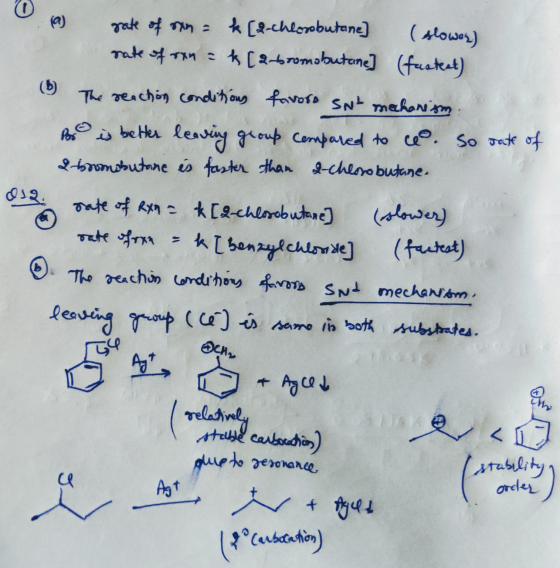
Two separate reactions are conducted as outlined below. Reaction 1: 4 drops of benzyl chloride in 2 mL of 1% AgNO3 in ethanol. Reaction 2: 4 drops of 2-chlorobutane in 2 mL of 1% AgNO3 in ethanol. List the expected rate of each of the reactions. List the slowest reaction first and fastest reaction last. Explain your reasoning based on substrate structure, the nature of the leaving group (if applicable), and whether the conditions favor SN1 or SN2 mechanisms. (NOTE:...
please help with #5 (sn2) and #6 (sn1) 52 Reaction Rates 1. Pace drops of the...
 please help with #5 (sn2) and #6 (sn1)
52 Reaction Rates 1. Pace drops of the compounds in the 9.1 in separate labeled test tubes Table 9.11 FE for Relative Reaction Rates is Sy Reactions Halide Halide S hare -Chord CECH.CH.CH.CH 1-Broomoburane Нr CHCHCHCH typ=77-78°C b.100-101 C oboti CH CH CH.CH 2-Chloro-2-methylbute CH C CH CH, tip-85.86 C 2-r by CI-CH:CHCH, 1-Chloro2- methylpropane Lp68-69°C 2-Bromo-2-methylbutane pr1073H CHỤC CHÍCH, CH CICH.C-CH, H-Chloro-2.2- dimethylpropane -84-85' Browobenzene bp-156 Benzyl Bromide bo198199 2. Recording...
please help with #5 (sn2) and #6 (sn1)
52 Reaction Rates 1. Pace drops of the compounds in the 9.1 in separate labeled test tubes Table 9.11 FE for Relative Reaction Rates is Sy Reactions Halide Halide S hare -Chord CECH.CH.CH.CH 1-Broomoburane Нr CHCHCHCH typ=77-78°C b.100-101 C oboti CH CH CH.CH 2-Chloro-2-methylbute CH C CH CH, tip-85.86 C 2-r by CI-CH:CHCH, 1-Chloro2- methylpropane Lp68-69°C 2-Bromo-2-methylbutane pr1073H CHỤC CHÍCH, CH CICH.C-CH, H-Chloro-2.2- dimethylpropane -84-85' Browobenzene bp-156 Benzyl Bromide bo198199 2. Recording...
1. Write the overall balanced reaction equation for the following reactions: 1-bromobutane + CH3CH,OH + AgNO3...
 1. Write the overall balanced reaction equation for the following reactions: 1-bromobutane + CH3CH,OH + AgNO3 2-bromobutane + CH,CH,OH + AgNO3 2-bromo2-methylpropane + CH CH OH + AgNO3 — 2. For the solvolysis reaction of 2-bromo-2-methylpropane with ethanol in presence of silver nitrate: a. Write the balanced equation for the reaction b. Identify the substrate, nucleophile, leaving group and the solvent c. What is the role of silver nitrate d. Write the mechanism of the reaction(with arrows showing the movement...
Draw the strcture of all substrates you will be using in this reaction and classify them...
 Draw the strcture of all substrates you will be using in this
reaction and classify them as( primary, Secondary, and tertiary)
aryl bezylic or some combination of these (such as primary
bezylic). Identify the nucleophile, substrate, and leaving group in
general equations for reactions 1 and 2
ORRAS sminilah you dimensions (R) or (S), and show their stereochemistry clearly. If your instructor reguests, obtain another set of atoms and connectors and use it to prepare isomers as well. R eal...
Draw the strcture of all substrates you will be using in this
reaction and classify them as( primary, Secondary, and tertiary)
aryl bezylic or some combination of these (such as primary
bezylic). Identify the nucleophile, substrate, and leaving group in
general equations for reactions 1 and 2
ORRAS sminilah you dimensions (R) or (S), and show their stereochemistry clearly. If your instructor reguests, obtain another set of atoms and connectors and use it to prepare isomers as well. R eal...
Write detailed, reaction mechanism of guaifensin synthesis. Must include arrows, electron flow and lone pairs. 100...
 Write detailed, reaction mechanism of guaifensin synthesis. Must
include arrows, electron flow and lone pairs.
100 Pre-lab preparation BREE In your lab notebook, prepare the following (see lab notebook guide for details): Jl. Write all procedures required for this experiment. Prepare it so that it can be used as a sole source of your experimental procedures 2. In your notebook, draw structures of both enantiomers of 3-chloro-1.2-propanediol 3. In few sentences summarize main factors that have influence on Sw2 type...
Write detailed, reaction mechanism of guaifensin synthesis. Must
include arrows, electron flow and lone pairs.
100 Pre-lab preparation BREE In your lab notebook, prepare the following (see lab notebook guide for details): Jl. Write all procedures required for this experiment. Prepare it so that it can be used as a sole source of your experimental procedures 2. In your notebook, draw structures of both enantiomers of 3-chloro-1.2-propanediol 3. In few sentences summarize main factors that have influence on Sw2 type...
I need help with 1-4 please Question 1: Find a table that compares the relative reaction...
 I need help with 1-4 please
Question 1: Find a table that compares the relative reaction rates (Su2) for alkyi fluorides, chlorides, bromides and iodides (Section 9.2 in the textbook). Which halide is the best leaving group? How much faster is it than the slowest halide leaving group? Question 2: The nature of the solvent plays a big role in determining the type of substitution or elimination mechanism that takes place (SH1, SN2, E1 or E2). Draw structures for 2...
I need help with 1-4 please
Question 1: Find a table that compares the relative reaction rates (Su2) for alkyi fluorides, chlorides, bromides and iodides (Section 9.2 in the textbook). Which halide is the best leaving group? How much faster is it than the slowest halide leaving group? Question 2: The nature of the solvent plays a big role in determining the type of substitution or elimination mechanism that takes place (SH1, SN2, E1 or E2). Draw structures for 2...
1. In both the sodium iodide test and the silver nitrate test, why does 2-bromobutane react faster...
 1. In both the sodium iodide
test and the silver nitrate test, why does 2-bromobutane react
faster than 2-chlorobutane?
Bromine is a better leaving group since it is a weaker base than
chlorine is.
2. a. Why does benzyl chloride react under both
SN1 and SN2 conditions?
Benzyl
chloride is a primary alkyl halide, hence reactive under SN2
conditions.
The
primary carbocation formed due to the departure of Cl- is
stabilized by the pi electrons in the benzene ring.
b. Why is...
1. In both the sodium iodide
test and the silver nitrate test, why does 2-bromobutane react
faster than 2-chlorobutane?
Bromine is a better leaving group since it is a weaker base than
chlorine is.
2. a. Why does benzyl chloride react under both
SN1 and SN2 conditions?
Benzyl
chloride is a primary alkyl halide, hence reactive under SN2
conditions.
The
primary carbocation formed due to the departure of Cl- is
stabilized by the pi electrons in the benzene ring.
b. Why is...
answer all 1. In each of the following, indicate which S2 reaction will occur faster. Explain...
 answer all
1. In each of the following, indicate which S2 reaction will occur faster. Explain your reasoning. a. 1-bromo-2,2-dimethylpropane or 1-bromo-3-methylbutane with Nal in DMSO. b. 1-iodopentane with NaN, in ethanol or NaSCH, in ethanol, c. Reaction of isobutyl iodide with NaBr in acetone or in ethanol. 2. In each of the following, indicate which S, 1 reaction will occur faster. Explain your reasoning. a. Reaction of I-chloro-1-methylcyclohexane or 1-chloro-2-methylcyclohexane in aqueous ethanol. b. Reaction of 2-chloropentane or 3-bromohexane...
answer all
1. In each of the following, indicate which S2 reaction will occur faster. Explain your reasoning. a. 1-bromo-2,2-dimethylpropane or 1-bromo-3-methylbutane with Nal in DMSO. b. 1-iodopentane with NaN, in ethanol or NaSCH, in ethanol, c. Reaction of isobutyl iodide with NaBr in acetone or in ethanol. 2. In each of the following, indicate which S, 1 reaction will occur faster. Explain your reasoning. a. Reaction of I-chloro-1-methylcyclohexane or 1-chloro-2-methylcyclohexane in aqueous ethanol. b. Reaction of 2-chloropentane or 3-bromohexane...
sn1: write the reactions for each of the secondary, tertiary, and aryl substrates Chemicals and Solvents,...
 sn1: write the reactions for each of the secondary, tertiary, and
aryl substrates
Chemicals and Solvents, Chemical Abstract Service (CAS): (1) 1-chlorobutane, (109-69-3] (2) 1-bromobutane, (109-65-9) (3) 2-chlorobutane, (78-86-4) (4) 2-bromobutane, (78-76-2] (5) 2-chloro-2-methylpropane, (507-20-0) (6) bromobenzene, (108-86-1) (7) 2-bromo-2-methylpropane, (507-19-7) (8) ethanol, [64-17-5) 2. Sn1 Reaction. For the Sn1 reaction, the nucleophile is ethanol, introduced into the solution as the solvent in a silver nitrate-ethanol solution. If the reaction occurs, silver chloride or silver bromide will form a precipitate...
sn1: write the reactions for each of the secondary, tertiary, and
aryl substrates
Chemicals and Solvents, Chemical Abstract Service (CAS): (1) 1-chlorobutane, (109-69-3] (2) 1-bromobutane, (109-65-9) (3) 2-chlorobutane, (78-86-4) (4) 2-bromobutane, (78-76-2] (5) 2-chloro-2-methylpropane, (507-20-0) (6) bromobenzene, (108-86-1) (7) 2-bromo-2-methylpropane, (507-19-7) (8) ethanol, [64-17-5) 2. Sn1 Reaction. For the Sn1 reaction, the nucleophile is ethanol, introduced into the solution as the solvent in a silver nitrate-ethanol solution. If the reaction occurs, silver chloride or silver bromide will form a precipitate...
 2. Three separate reactions are conducted as outlined below. Reaction 1: 4 drops of 1-chlorobutane in 2 mL of 1% AgNO, in ethanol. Reaction 2: 4 drops of 2-chlorobutane in 2 mL of 1% AgNO, in ethanol. Reaction 3:4 drops of t-butyl chloride in 2 mL of 1% AgNO, in ethanol. a. List the expected rate of each of the reactions. List the slowest reaction first and fastest reaction last. b. Explain your reasoning based on substrate structure, the nature...
 please help with #5 (sn2) and #6 (sn1)
52 Reaction Rates 1. Pace drops of the compounds in the 9.1 in separate labeled test tubes Table 9.11 FE for Relative Reaction Rates is Sy Reactions Halide Halide S hare -Chord CECH.CH.CH.CH 1-Broomoburane Нr CHCHCHCH typ=77-78°C b.100-101 C oboti CH CH CH.CH 2-Chloro-2-methylbute CH C CH CH, tip-85.86 C 2-r by CI-CH:CHCH, 1-Chloro2- methylpropane Lp68-69°C 2-Bromo-2-methylbutane pr1073H CHỤC CHÍCH, CH CICH.C-CH, H-Chloro-2.2- dimethylpropane -84-85' Browobenzene bp-156 Benzyl Bromide bo198199 2. Recording...
please help with #5 (sn2) and #6 (sn1)
52 Reaction Rates 1. Pace drops of the compounds in the 9.1 in separate labeled test tubes Table 9.11 FE for Relative Reaction Rates is Sy Reactions Halide Halide S hare -Chord CECH.CH.CH.CH 1-Broomoburane Нr CHCHCHCH typ=77-78°C b.100-101 C oboti CH CH CH.CH 2-Chloro-2-methylbute CH C CH CH, tip-85.86 C 2-r by CI-CH:CHCH, 1-Chloro2- methylpropane Lp68-69°C 2-Bromo-2-methylbutane pr1073H CHỤC CHÍCH, CH CICH.C-CH, H-Chloro-2.2- dimethylpropane -84-85' Browobenzene bp-156 Benzyl Bromide bo198199 2. Recording...
 1. Write the overall balanced reaction equation for the following reactions: 1-bromobutane + CH3CH,OH + AgNO3 2-bromobutane + CH,CH,OH + AgNO3 2-bromo2-methylpropane + CH CH OH + AgNO3 — 2. For the solvolysis reaction of 2-bromo-2-methylpropane with ethanol in presence of silver nitrate: a. Write the balanced equation for the reaction b. Identify the substrate, nucleophile, leaving group and the solvent c. What is the role of silver nitrate d. Write the mechanism of the reaction(with arrows showing the movement...
 Draw the strcture of all substrates you will be using in this
reaction and classify them as( primary, Secondary, and tertiary)
aryl bezylic or some combination of these (such as primary
bezylic). Identify the nucleophile, substrate, and leaving group in
general equations for reactions 1 and 2
ORRAS sminilah you dimensions (R) or (S), and show their stereochemistry clearly. If your instructor reguests, obtain another set of atoms and connectors and use it to prepare isomers as well. R eal...
Draw the strcture of all substrates you will be using in this
reaction and classify them as( primary, Secondary, and tertiary)
aryl bezylic or some combination of these (such as primary
bezylic). Identify the nucleophile, substrate, and leaving group in
general equations for reactions 1 and 2
ORRAS sminilah you dimensions (R) or (S), and show their stereochemistry clearly. If your instructor reguests, obtain another set of atoms and connectors and use it to prepare isomers as well. R eal...
 Write detailed, reaction mechanism of guaifensin synthesis. Must
include arrows, electron flow and lone pairs.
100 Pre-lab preparation BREE In your lab notebook, prepare the following (see lab notebook guide for details): Jl. Write all procedures required for this experiment. Prepare it so that it can be used as a sole source of your experimental procedures 2. In your notebook, draw structures of both enantiomers of 3-chloro-1.2-propanediol 3. In few sentences summarize main factors that have influence on Sw2 type...
Write detailed, reaction mechanism of guaifensin synthesis. Must
include arrows, electron flow and lone pairs.
100 Pre-lab preparation BREE In your lab notebook, prepare the following (see lab notebook guide for details): Jl. Write all procedures required for this experiment. Prepare it so that it can be used as a sole source of your experimental procedures 2. In your notebook, draw structures of both enantiomers of 3-chloro-1.2-propanediol 3. In few sentences summarize main factors that have influence on Sw2 type...
 I need help with 1-4 please
Question 1: Find a table that compares the relative reaction rates (Su2) for alkyi fluorides, chlorides, bromides and iodides (Section 9.2 in the textbook). Which halide is the best leaving group? How much faster is it than the slowest halide leaving group? Question 2: The nature of the solvent plays a big role in determining the type of substitution or elimination mechanism that takes place (SH1, SN2, E1 or E2). Draw structures for 2...
I need help with 1-4 please
Question 1: Find a table that compares the relative reaction rates (Su2) for alkyi fluorides, chlorides, bromides and iodides (Section 9.2 in the textbook). Which halide is the best leaving group? How much faster is it than the slowest halide leaving group? Question 2: The nature of the solvent plays a big role in determining the type of substitution or elimination mechanism that takes place (SH1, SN2, E1 or E2). Draw structures for 2...
 1. In both the sodium iodide
test and the silver nitrate test, why does 2-bromobutane react
faster than 2-chlorobutane?
Bromine is a better leaving group since it is a weaker base than
chlorine is.
2. a. Why does benzyl chloride react under both
SN1 and SN2 conditions?
Benzyl
chloride is a primary alkyl halide, hence reactive under SN2
conditions.
The
primary carbocation formed due to the departure of Cl- is
stabilized by the pi electrons in the benzene ring.
b. Why is...
1. In both the sodium iodide
test and the silver nitrate test, why does 2-bromobutane react
faster than 2-chlorobutane?
Bromine is a better leaving group since it is a weaker base than
chlorine is.
2. a. Why does benzyl chloride react under both
SN1 and SN2 conditions?
Benzyl
chloride is a primary alkyl halide, hence reactive under SN2
conditions.
The
primary carbocation formed due to the departure of Cl- is
stabilized by the pi electrons in the benzene ring.
b. Why is...
 answer all
1. In each of the following, indicate which S2 reaction will occur faster. Explain your reasoning. a. 1-bromo-2,2-dimethylpropane or 1-bromo-3-methylbutane with Nal in DMSO. b. 1-iodopentane with NaN, in ethanol or NaSCH, in ethanol, c. Reaction of isobutyl iodide with NaBr in acetone or in ethanol. 2. In each of the following, indicate which S, 1 reaction will occur faster. Explain your reasoning. a. Reaction of I-chloro-1-methylcyclohexane or 1-chloro-2-methylcyclohexane in aqueous ethanol. b. Reaction of 2-chloropentane or 3-bromohexane...
answer all
1. In each of the following, indicate which S2 reaction will occur faster. Explain your reasoning. a. 1-bromo-2,2-dimethylpropane or 1-bromo-3-methylbutane with Nal in DMSO. b. 1-iodopentane with NaN, in ethanol or NaSCH, in ethanol, c. Reaction of isobutyl iodide with NaBr in acetone or in ethanol. 2. In each of the following, indicate which S, 1 reaction will occur faster. Explain your reasoning. a. Reaction of I-chloro-1-methylcyclohexane or 1-chloro-2-methylcyclohexane in aqueous ethanol. b. Reaction of 2-chloropentane or 3-bromohexane...
 sn1: write the reactions for each of the secondary, tertiary, and
aryl substrates
Chemicals and Solvents, Chemical Abstract Service (CAS): (1) 1-chlorobutane, (109-69-3] (2) 1-bromobutane, (109-65-9) (3) 2-chlorobutane, (78-86-4) (4) 2-bromobutane, (78-76-2] (5) 2-chloro-2-methylpropane, (507-20-0) (6) bromobenzene, (108-86-1) (7) 2-bromo-2-methylpropane, (507-19-7) (8) ethanol, [64-17-5) 2. Sn1 Reaction. For the Sn1 reaction, the nucleophile is ethanol, introduced into the solution as the solvent in a silver nitrate-ethanol solution. If the reaction occurs, silver chloride or silver bromide will form a precipitate...
sn1: write the reactions for each of the secondary, tertiary, and
aryl substrates
Chemicals and Solvents, Chemical Abstract Service (CAS): (1) 1-chlorobutane, (109-69-3] (2) 1-bromobutane, (109-65-9) (3) 2-chlorobutane, (78-86-4) (4) 2-bromobutane, (78-76-2] (5) 2-chloro-2-methylpropane, (507-20-0) (6) bromobenzene, (108-86-1) (7) 2-bromo-2-methylpropane, (507-19-7) (8) ethanol, [64-17-5) 2. Sn1 Reaction. For the Sn1 reaction, the nucleophile is ethanol, introduced into the solution as the solvent in a silver nitrate-ethanol solution. If the reaction occurs, silver chloride or silver bromide will form a precipitate...
Most questions answered within 3 hours.
-
Where is the error in this code sequence?
String s1 = "Hello";
String s2 = "ello";...
asked 10 months ago -
Financial data for Joel de Paris, Inc., for last year
follow:
Joel de Paris, Inc.
Balance...
asked 10 months ago -
Consider this reaction:
Al2(SO4)3 (aq)+ BaCl3
(aq) Al2Cl6 (aq)- +
3BaSO4(s) . What is the...
asked 10 months ago -
Suppose that Savneet is considering increasing her
recent random sample from 20 car rentals to 40...
asked 10 months ago -
Trucks arrive at an unloading terminal at an average rate of 120
per hour.
Trucks arrive...
asked 10 months ago -
Why are methanol and ethanol completely soluble in water while
octanol is not very little soluble....
asked 10 months ago -
A facilities manager at a university reads in a research report
that the mean amount of...
asked 10 months ago -
When the CuSO4 is rehydrated by adding water to the anhydrous
compound, is this an endothermic...
asked 10 months ago -
A ray of sunlight is passing from diamond into crown glass; the
angle of incidence is...
asked 10 months ago -
A block of mass 0.249 kg is placed on top of a light, vertical
spring of...
asked 10 months ago -
how do the kidneys compensate in the presences of acidosis
a) trigger hyperventilate
b) reserve acid...
asked 10 months ago -
Question 501 pts
The rental rate of capital to the firm increases. Which of the
following...
asked 10 months ago