My lab partner and I are both getting different answers for this questions. Can someone please...
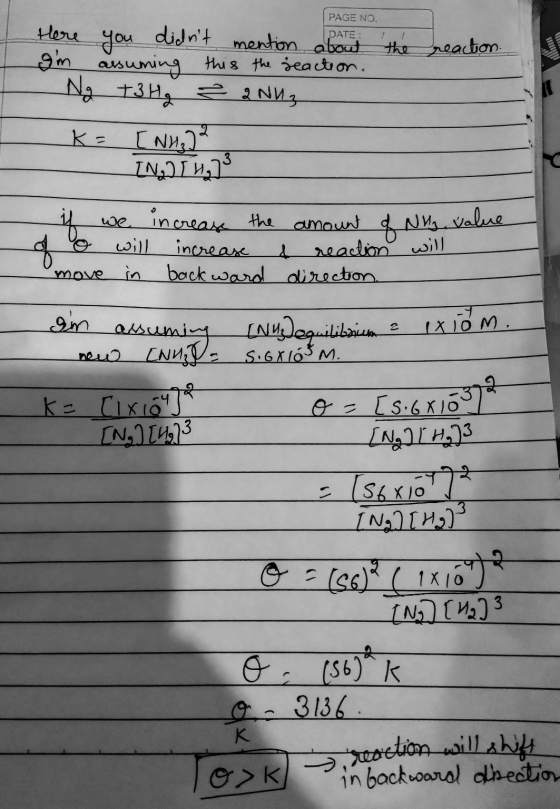
My lab partner and I are both getting different answers for this questions. Can someone please help? If the concentration of the product NH3 was increased from 1.0 x 10⁻⁴ M to 5.6 x 10⁻³ M, calculate the reaction quotient (Q) and determine which way the chemical system would shift by comparing the value of Q to K.
Homework Answers
Add Answer to:
My lab partner and I are both getting different answers for this
questions. Can someone please...
Can someone please show me the steps and how to do this problem? Consider the chemical...
Can someone please show me the steps and how to do this problem? Consider the chemical reaction: N2 + 3H2 yields 2NH3. If the concentration of the reactant H2 was increased from 1.0 x 10⁻² M to 2.5 x 10⁻¹ M, calculate the reaction quotient (Q) and determine which way the chemical system would shift by comparing the value of Q to K.
The equilibrium constant () of the reaction below is K-6.0 x 10 with initial concentrations as...
 The equilibrium constant () of the reaction below is K-6.0 x 10 with initial concentrations as follows: [H2] = 1.0 x 10² M. [Na] - 4.0 M, and (NH) - 1.0 x 10* M. N (8) + 3H,() 2NH3(e) 3. Consider the chemical reaction: N2 + 3H2 yields 2NH3. If the concentration of the reactant Hy was increased from 1.0 x 10⁻²M to 2.5 x 10-M, calculate the reaction quotient (C) and determine which way the chemical system would shift...
I feel like my answers are wrong, so can someone answer these questions? Thank you! 1....
 I feel like my answers are wrong, so can
someone answer these questions? Thank you!
1. Consider the following reaction by which hydrochloric acid is used to neutralize 20 ml of 0.1 M NaOH. a. In the titration process: NaOH should be in the and it is called HCI should be in the and it is called ______ is neutralized by ____ henolphtalein will be added to the analyte to turn the __ _________ into ____at the endpoint. b. Write...
I feel like my answers are wrong, so can
someone answer these questions? Thank you!
1. Consider the following reaction by which hydrochloric acid is used to neutralize 20 ml of 0.1 M NaOH. a. In the titration process: NaOH should be in the and it is called HCI should be in the and it is called ______ is neutralized by ____ henolphtalein will be added to the analyte to turn the __ _________ into ____at the endpoint. b. Write...
i need help with this lab please. can i get someone to answer the entire thing....
 i need help with this lab please. can i get someone to answer
the entire thing. thank you
Instructor Equilibria of Coordination Compounds OBSERVATIONS AND DATA 1. The formation of complex ions with ammonia The net ionic equation for the reaction of excess Cuso, with NH, is 24 Cu2+ + 4NH3 [cu (NH3)4] The predicted effect on the reaction above of adding excess NH, (based on Le Châtelier's principle) is The reaction will shift to the night and product formation...
i need help with this lab please. can i get someone to answer
the entire thing. thank you
Instructor Equilibria of Coordination Compounds OBSERVATIONS AND DATA 1. The formation of complex ions with ammonia The net ionic equation for the reaction of excess Cuso, with NH, is 24 Cu2+ + 4NH3 [cu (NH3)4] The predicted effect on the reaction above of adding excess NH, (based on Le Châtelier's principle) is The reaction will shift to the night and product formation...
Please make sure these both are correct I keep getting different answers, make sure it is...
 Please make sure these both are correct I
keep getting different answers, make sure it is not wrong the
answer you give. THANKS
Reaction 1 below occurs very slowly, while reaction 2 below occurs much more rapidly: 1. O2(g) → 20 (9) 2. Ar(g) + O2(g) → Ar(g) + 2O(g) Q9.1 2 Points a. Ar(g) can be viewd as a catalyst in reaction 2, as it accelerates the reaction, but is neither created nor destroyed by the reaction. Which of...
Please make sure these both are correct I
keep getting different answers, make sure it is not wrong the
answer you give. THANKS
Reaction 1 below occurs very slowly, while reaction 2 below occurs much more rapidly: 1. O2(g) → 20 (9) 2. Ar(g) + O2(g) → Ar(g) + 2O(g) Q9.1 2 Points a. Ar(g) can be viewd as a catalyst in reaction 2, as it accelerates the reaction, but is neither created nor destroyed by the reaction. Which of...
The general form of a chemical reaction is aA + bB = cC +dD Where A...
The general form of a chemical reaction is aA + bB = cC +dD Where A and B are reactants in the forward direction and C and D are products in the forward direction. The lower case letters are the stoichiometric coefficients for the balanced equation. The general form of the equilibrium constant equation is then: Keq = [C]c[D]d/[A]a[B]b Part I: Q vs. K Q: reaction quotient can be calculated for a reaction at any concentration values of reactants and...
= 1-Lab from Chapter 15 Eq and Le Chat - Word Search Design Layout References Mailings...
 = 1-Lab from Chapter 15 Eq and Le Chat - Word Search Design Layout References Mailings Review View Help Add i nk Ink to Ink to Drawing Ink Pen Editor Shape Math C anvas Replay Convert Replay Open the Le Chatlier's Principle Activity found in your textbook, Interactive General Chemistry. (Section 15.6, Figure 15.9), run the simulation and complete the following questions. Pens insert 1. Start with the default settings where K - 1.00. a. Write the expression based on...
CHEM LAB hello can someone help me come up with a procedure for this lab it...
 CHEM LAB
hello can someone help me come up with a procedure for this
lab
it is an standarization of acid and base solution
• Each student will receive approximately 100 mL of an unknown HCl. The approximate concentration of HCl will be 0.1 M or 1.0 M. There will be a common container with NaOH. The approximate concentration of NaOH will be 0.1 M or 1.0 M. You will be given the approximate concentrations of NaOH and HCl on...
CHEM LAB
hello can someone help me come up with a procedure for this
lab
it is an standarization of acid and base solution
• Each student will receive approximately 100 mL of an unknown HCl. The approximate concentration of HCl will be 0.1 M or 1.0 M. There will be a common container with NaOH. The approximate concentration of NaOH will be 0.1 M or 1.0 M. You will be given the approximate concentrations of NaOH and HCl on...
can someone assist with this problem? a classmate and i reviewed our answers and we got...
 can someone assist with this problem? a classmate and i
reviewed our answers and we got different answers.
6. Arsenic Acid (H3AsO4) has the ability to act as a triprotic acid. Calculate the equilionidan concentration of all possible species in a 0.483M arsenic acid solution. The Kal = 6.0 x 10⁻³, K2=1.0 x 10⁻⁷, and K3 = 3.2 x 10⁻¹² 1.) H ₃ As Oy caq? - H + H₂ AsOy i 0.483 x2x 102 = 6.04 10 3 0.483...
can someone assist with this problem? a classmate and i
reviewed our answers and we got different answers.
6. Arsenic Acid (H3AsO4) has the ability to act as a triprotic acid. Calculate the equilionidan concentration of all possible species in a 0.483M arsenic acid solution. The Kal = 6.0 x 10⁻³, K2=1.0 x 10⁻⁷, and K3 = 3.2 x 10⁻¹² 1.) H ₃ As Oy caq? - H + H₂ AsOy i 0.483 x2x 102 = 6.04 10 3 0.483...
Hello as a replacement to actual labs for my orgo 2 lab with coronavirus, I have...
 Hello as a replacement to actual labs for my orgo 2
lab with coronavirus, I have been given worksheets of experiments
and expected to figure it out with no sort of instruction. gotta
love online orgo labs which i am not adjusting well to.
can someone be kind enough to please go question by
question and explain each one to me in detail so I can actually
understand what is going on. my professor hasn't even talked about
this in...
Hello as a replacement to actual labs for my orgo 2
lab with coronavirus, I have been given worksheets of experiments
and expected to figure it out with no sort of instruction. gotta
love online orgo labs which i am not adjusting well to.
can someone be kind enough to please go question by
question and explain each one to me in detail so I can actually
understand what is going on. my professor hasn't even talked about
this in...
 The equilibrium constant () of the reaction below is K-6.0 x 10 with initial concentrations as follows: [H2] = 1.0 x 10² M. [Na] - 4.0 M, and (NH) - 1.0 x 10* M. N (8) + 3H,() 2NH3(e) 3. Consider the chemical reaction: N2 + 3H2 yields 2NH3. If the concentration of the reactant Hy was increased from 1.0 x 10⁻²M to 2.5 x 10-M, calculate the reaction quotient (C) and determine which way the chemical system would shift...
 I feel like my answers are wrong, so can
someone answer these questions? Thank you!
1. Consider the following reaction by which hydrochloric acid is used to neutralize 20 ml of 0.1 M NaOH. a. In the titration process: NaOH should be in the and it is called HCI should be in the and it is called ______ is neutralized by ____ henolphtalein will be added to the analyte to turn the __ _________ into ____at the endpoint. b. Write...
I feel like my answers are wrong, so can
someone answer these questions? Thank you!
1. Consider the following reaction by which hydrochloric acid is used to neutralize 20 ml of 0.1 M NaOH. a. In the titration process: NaOH should be in the and it is called HCI should be in the and it is called ______ is neutralized by ____ henolphtalein will be added to the analyte to turn the __ _________ into ____at the endpoint. b. Write...
 i need help with this lab please. can i get someone to answer
the entire thing. thank you
Instructor Equilibria of Coordination Compounds OBSERVATIONS AND DATA 1. The formation of complex ions with ammonia The net ionic equation for the reaction of excess Cuso, with NH, is 24 Cu2+ + 4NH3 [cu (NH3)4] The predicted effect on the reaction above of adding excess NH, (based on Le Châtelier's principle) is The reaction will shift to the night and product formation...
i need help with this lab please. can i get someone to answer
the entire thing. thank you
Instructor Equilibria of Coordination Compounds OBSERVATIONS AND DATA 1. The formation of complex ions with ammonia The net ionic equation for the reaction of excess Cuso, with NH, is 24 Cu2+ + 4NH3 [cu (NH3)4] The predicted effect on the reaction above of adding excess NH, (based on Le Châtelier's principle) is The reaction will shift to the night and product formation...
 Please make sure these both are correct I
keep getting different answers, make sure it is not wrong the
answer you give. THANKS
Reaction 1 below occurs very slowly, while reaction 2 below occurs much more rapidly: 1. O2(g) → 20 (9) 2. Ar(g) + O2(g) → Ar(g) + 2O(g) Q9.1 2 Points a. Ar(g) can be viewd as a catalyst in reaction 2, as it accelerates the reaction, but is neither created nor destroyed by the reaction. Which of...
Please make sure these both are correct I
keep getting different answers, make sure it is not wrong the
answer you give. THANKS
Reaction 1 below occurs very slowly, while reaction 2 below occurs much more rapidly: 1. O2(g) → 20 (9) 2. Ar(g) + O2(g) → Ar(g) + 2O(g) Q9.1 2 Points a. Ar(g) can be viewd as a catalyst in reaction 2, as it accelerates the reaction, but is neither created nor destroyed by the reaction. Which of...
 = 1-Lab from Chapter 15 Eq and Le Chat - Word Search Design Layout References Mailings Review View Help Add i nk Ink to Ink to Drawing Ink Pen Editor Shape Math C anvas Replay Convert Replay Open the Le Chatlier's Principle Activity found in your textbook, Interactive General Chemistry. (Section 15.6, Figure 15.9), run the simulation and complete the following questions. Pens insert 1. Start with the default settings where K - 1.00. a. Write the expression based on...
 CHEM LAB
hello can someone help me come up with a procedure for this
lab
it is an standarization of acid and base solution
• Each student will receive approximately 100 mL of an unknown HCl. The approximate concentration of HCl will be 0.1 M or 1.0 M. There will be a common container with NaOH. The approximate concentration of NaOH will be 0.1 M or 1.0 M. You will be given the approximate concentrations of NaOH and HCl on...
CHEM LAB
hello can someone help me come up with a procedure for this
lab
it is an standarization of acid and base solution
• Each student will receive approximately 100 mL of an unknown HCl. The approximate concentration of HCl will be 0.1 M or 1.0 M. There will be a common container with NaOH. The approximate concentration of NaOH will be 0.1 M or 1.0 M. You will be given the approximate concentrations of NaOH and HCl on...
 can someone assist with this problem? a classmate and i
reviewed our answers and we got different answers.
6. Arsenic Acid (H3AsO4) has the ability to act as a triprotic acid. Calculate the equilionidan concentration of all possible species in a 0.483M arsenic acid solution. The Kal = 6.0 x 10⁻³, K2=1.0 x 10⁻⁷, and K3 = 3.2 x 10⁻¹² 1.) H ₃ As Oy caq? - H + H₂ AsOy i 0.483 x2x 102 = 6.04 10 3 0.483...
can someone assist with this problem? a classmate and i
reviewed our answers and we got different answers.
6. Arsenic Acid (H3AsO4) has the ability to act as a triprotic acid. Calculate the equilionidan concentration of all possible species in a 0.483M arsenic acid solution. The Kal = 6.0 x 10⁻³, K2=1.0 x 10⁻⁷, and K3 = 3.2 x 10⁻¹² 1.) H ₃ As Oy caq? - H + H₂ AsOy i 0.483 x2x 102 = 6.04 10 3 0.483...
 Hello as a replacement to actual labs for my orgo 2
lab with coronavirus, I have been given worksheets of experiments
and expected to figure it out with no sort of instruction. gotta
love online orgo labs which i am not adjusting well to.
can someone be kind enough to please go question by
question and explain each one to me in detail so I can actually
understand what is going on. my professor hasn't even talked about
this in...
Hello as a replacement to actual labs for my orgo 2
lab with coronavirus, I have been given worksheets of experiments
and expected to figure it out with no sort of instruction. gotta
love online orgo labs which i am not adjusting well to.
can someone be kind enough to please go question by
question and explain each one to me in detail so I can actually
understand what is going on. my professor hasn't even talked about
this in...
Most questions answered within 3 hours.
-
Where is the error in this code sequence?
String s1 = "Hello";
String s2 = "ello";...
asked 10 months ago -
Financial data for Joel de Paris, Inc., for last year
follow:
Joel de Paris, Inc.
Balance...
asked 10 months ago -
Consider this reaction:
Al2(SO4)3 (aq)+ BaCl3
(aq) Al2Cl6 (aq)- +
3BaSO4(s) . What is the...
asked 10 months ago -
Suppose that Savneet is considering increasing her
recent random sample from 20 car rentals to 40...
asked 10 months ago -
Trucks arrive at an unloading terminal at an average rate of 120
per hour.
Trucks arrive...
asked 10 months ago -
Why are methanol and ethanol completely soluble in water while
octanol is not very little soluble....
asked 10 months ago -
A facilities manager at a university reads in a research report
that the mean amount of...
asked 10 months ago -
When the CuSO4 is rehydrated by adding water to the anhydrous
compound, is this an endothermic...
asked 10 months ago -
A ray of sunlight is passing from diamond into crown glass; the
angle of incidence is...
asked 10 months ago -
A block of mass 0.249 kg is placed on top of a light, vertical
spring of...
asked 10 months ago -
how do the kidneys compensate in the presences of acidosis
a) trigger hyperventilate
b) reserve acid...
asked 10 months ago -
Question 501 pts
The rental rate of capital to the firm increases. Which of the
following...
asked 10 months ago