
Homework Answers
Add Answer to:
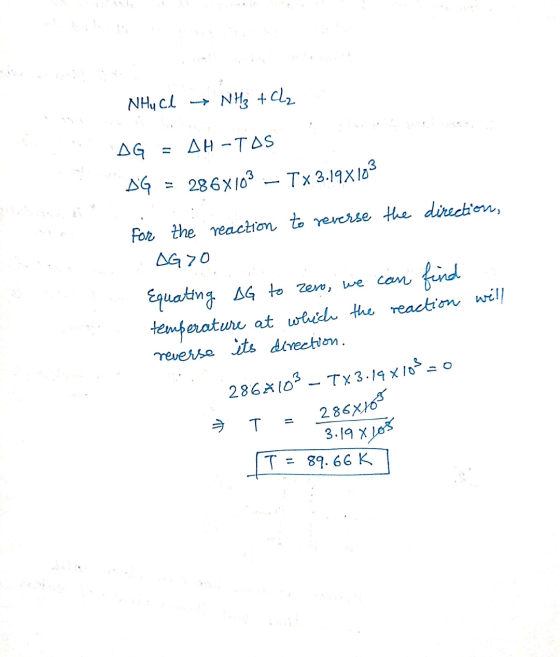
3) At what temperature will the following reaction reverse direction? NH,Cl - NHÀ + Cl, (AH...
7 Consider the following reaction at 298 K: NH3(g) +HCI(g)NH4CI(s) Using the thermochemical data at 298 K given below (a) Determine the AH for the reaction. (2 marks) (b) Determine the AG for the...
 7 Consider the following reaction at 298 K: NH3(g) +HCI(g)NH4CI(s) Using the thermochemical data at 298 K given below (a) Determine the AH for the reaction. (2 marks) (b) Determine the AG for the reaction and comment on its value. (3 marks) (c) Determine the maximum work done available in the reaction. (3 marks) An equilibrium mixture, consisting of 0.5 atm of NHy(), 0.5 atm of HCKg) and excessive of NH Cl(s), is enclosed in a container at 298 K...
Consider the following system at equilibrium where A1°-268 kJ, and Ke-5.10x10⁻⁶, at 548 K. NH4CI(s)NH(g+HCI(g) When...
 Consider the following system at equilibrium where A1°-268 kJ, and Ke-5.10x10⁻⁶, at 548 K. NH4CI(s)NH(g+HCI(g) When some moles of NH4CI(s) are removed from the equilibrium system at constant temperature: The value of Kc The value of Qc Kc The reaction must Orun in the forward direction to restablish equilibrium. Orun in the reverse direction to restablish equilibrium. ○remain the same. It is already at equilibrium. The concentration of NH will
dal values if needed for this question Consider the following system at equilibrium where AH* =...
 dal values if needed for this question Consider the following system at equilibrium where AH* = 92.7 kJ, and K = 1.80*10*, at 298 K, NH,HS() NH3(e) + H2S(g) When some moles of NH HS(s) are added to the equilibrium system at constant temperature: The value of Kc The value of QC The reaction must run in the forward direction to restablish equilitlum. run in the reverse direction to restablish equilibrium. remain the same. It is already at equilibrium. The...
Consider the following system at equilibrium where AH° = -198 kJ, and K. = 34.5, at...
 Consider the following system at equilibrium where AH° = -198 kJ, and K. = 34.5, at 1.15*10' K. 2802(g) + O2(g) 2803(g) If the VOLUME of the equilibrium system is suddenly decreased at constant temperature: The value of K A. increases. B. decreases. C. remains the same. The value of Qc A. is greater than K. B. is equal to K C. is less than K The reaction must: A. run in the forward direction to reestablish equilibrium. B. run...
10. At what temperature (or a range of T) will a reaction be spontaneous if AH"...
 10. At what temperature (or a range of T) will a reaction be spontaneous if AH" =-12.7 kJ an and A,S = +135 J/K?
5. Above what temperature does the following reaction become nonspontaneous AS = -153.2 J/K Given: AH...
 5. Above what temperature does the following reaction become nonspontaneous AS = -153.2 J/K Given: AH = -1036 k); 2 H2(g) + 3 O2(g) → 2 502(g) + 2 H20(g) AG - AH' - TAS 46 = -1036000 -(T)(-153.2) = 0 6. What is the minimum temperature required for the spontaneous conversion of Cla(I) to CCL() Given: AH"vap) is 57.3 kJ/mol and ASva) is 164 J/(mol)? AG AH - TAS = 298 K 06 = 57300 - (298)(164) 46°= 8428...
For the reaction CO(g) + H2O(1)—*CO2(g) + H2(g) AH° = 2.8 kJ and AS° = 76.8...
 For the reaction CO(g) + H2O(1)—*CO2(g) + H2(g) AH° = 2.8 kJ and AS° = 76.8 J/K The standard free energy change for the reaction of 2.33 moles of CO(g) at 288 K, 1 atm would be kJ. This reaction is (reactant, product) favored under standard conditions at 288 K. Assume that AH° and ASº are independent of temperature. Submit Answer Retry Entire Group 9 more group attempts remaining For the reaction 2 NO(g) + O2(g) → 2 NO2(g) AG°...
For a particular reaction, AH = 27.58 kJ and AS = 284.6J/K. Calculate AG for this...
 For a particular reaction, AH = 27.58 kJ and AS = 284.6J/K. Calculate AG for this reaction at 298 K. AG = What can be said about the spontaneity of the reaction at 298 K? The system is spontaneous as written The system is at equilibrium. The system is spontaneous in the reverse direction.
At what temperature will a reaction be spontaneous? AH = +22.2 kJ/mol and AS = +81.1...
 At what temperature will a reaction be spontaneous? AH = +22.2 kJ/mol and AS = +81.1 J/K-mol and assume both do not vary with temperature. at T > 298 K at all temperatures at T < 298 K at T < 274 K at T> 274 K
12. (5 pt) Consider the reaction: PCI PCL + Cl AH = -15.0 kJ and the...
 12. (5 pt) Consider the reaction: PCI PCL + Cl AH = -15.0 kJ and the energy of activation of the reaction is 25.0 kJ. Determine the frequency factor for the reaction PCI + Cl2 ---- PCls, with a rate constant of 1.080 L.mol's at 27 °C. 13. (5 pts) Consider the reaction in equilibrium: 3 A (g) + 3 B () --- 6 C(s) + 3 D (8) K = 2.40 at 27 °C. Determine K for the equilibrium...
 7 Consider the following reaction at 298 K: NH3(g) +HCI(g)NH4CI(s) Using the thermochemical data at 298 K given below (a) Determine the AH for the reaction. (2 marks) (b) Determine the AG for the reaction and comment on its value. (3 marks) (c) Determine the maximum work done available in the reaction. (3 marks) An equilibrium mixture, consisting of 0.5 atm of NHy(), 0.5 atm of HCKg) and excessive of NH Cl(s), is enclosed in a container at 298 K...
 Consider the following system at equilibrium where A1°-268 kJ, and Ke-5.10x10⁻⁶, at 548 K. NH4CI(s)NH(g+HCI(g) When some moles of NH4CI(s) are removed from the equilibrium system at constant temperature: The value of Kc The value of Qc Kc The reaction must Orun in the forward direction to restablish equilibrium. Orun in the reverse direction to restablish equilibrium. ○remain the same. It is already at equilibrium. The concentration of NH will
 dal values if needed for this question Consider the following system at equilibrium where AH* = 92.7 kJ, and K = 1.80*10*, at 298 K, NH,HS() NH3(e) + H2S(g) When some moles of NH HS(s) are added to the equilibrium system at constant temperature: The value of Kc The value of QC The reaction must run in the forward direction to restablish equilitlum. run in the reverse direction to restablish equilibrium. remain the same. It is already at equilibrium. The...
 Consider the following system at equilibrium where AH° = -198 kJ, and K. = 34.5, at 1.15*10' K. 2802(g) + O2(g) 2803(g) If the VOLUME of the equilibrium system is suddenly decreased at constant temperature: The value of K A. increases. B. decreases. C. remains the same. The value of Qc A. is greater than K. B. is equal to K C. is less than K The reaction must: A. run in the forward direction to reestablish equilibrium. B. run...
 10. At what temperature (or a range of T) will a reaction be spontaneous if AH" =-12.7 kJ an and A,S = +135 J/K?
 5. Above what temperature does the following reaction become nonspontaneous AS = -153.2 J/K Given: AH = -1036 k); 2 H2(g) + 3 O2(g) → 2 502(g) + 2 H20(g) AG - AH' - TAS 46 = -1036000 -(T)(-153.2) = 0 6. What is the minimum temperature required for the spontaneous conversion of Cla(I) to CCL() Given: AH"vap) is 57.3 kJ/mol and ASva) is 164 J/(mol)? AG AH - TAS = 298 K 06 = 57300 - (298)(164) 46°= 8428...
 For the reaction CO(g) + H2O(1)—*CO2(g) + H2(g) AH° = 2.8 kJ and AS° = 76.8 J/K The standard free energy change for the reaction of 2.33 moles of CO(g) at 288 K, 1 atm would be kJ. This reaction is (reactant, product) favored under standard conditions at 288 K. Assume that AH° and ASº are independent of temperature. Submit Answer Retry Entire Group 9 more group attempts remaining For the reaction 2 NO(g) + O2(g) → 2 NO2(g) AG°...
 For a particular reaction, AH = 27.58 kJ and AS = 284.6J/K. Calculate AG for this reaction at 298 K. AG = What can be said about the spontaneity of the reaction at 298 K? The system is spontaneous as written The system is at equilibrium. The system is spontaneous in the reverse direction.
 At what temperature will a reaction be spontaneous? AH = +22.2 kJ/mol and AS = +81.1 J/K-mol and assume both do not vary with temperature. at T > 298 K at all temperatures at T < 298 K at T < 274 K at T> 274 K
 12. (5 pt) Consider the reaction: PCI PCL + Cl AH = -15.0 kJ and the energy of activation of the reaction is 25.0 kJ. Determine the frequency factor for the reaction PCI + Cl2 ---- PCls, with a rate constant of 1.080 L.mol's at 27 °C. 13. (5 pts) Consider the reaction in equilibrium: 3 A (g) + 3 B () --- 6 C(s) + 3 D (8) K = 2.40 at 27 °C. Determine K for the equilibrium...
Most questions answered within 3 hours.
-
Where is the error in this code sequence?
String s1 = "Hello";
String s2 = "ello";...
asked 10 months ago -
Financial data for Joel de Paris, Inc., for last year
follow:
Joel de Paris, Inc.
Balance...
asked 10 months ago -
Consider this reaction:
Al2(SO4)3 (aq)+ BaCl3
(aq) Al2Cl6 (aq)- +
3BaSO4(s) . What is the...
asked 10 months ago -
Suppose that Savneet is considering increasing her
recent random sample from 20 car rentals to 40...
asked 10 months ago -
Trucks arrive at an unloading terminal at an average rate of 120
per hour.
Trucks arrive...
asked 10 months ago -
Why are methanol and ethanol completely soluble in water while
octanol is not very little soluble....
asked 10 months ago -
A facilities manager at a university reads in a research report
that the mean amount of...
asked 10 months ago -
When the CuSO4 is rehydrated by adding water to the anhydrous
compound, is this an endothermic...
asked 10 months ago -
A ray of sunlight is passing from diamond into crown glass; the
angle of incidence is...
asked 10 months ago -
A block of mass 0.249 kg is placed on top of a light, vertical
spring of...
asked 10 months ago -
how do the kidneys compensate in the presences of acidosis
a) trigger hyperventilate
b) reserve acid...
asked 10 months ago -
Question 501 pts
The rental rate of capital to the firm increases. Which of the
following...
asked 10 months ago