
Homework Answers

Add Answer to:
12. (5 pt) Consider the reaction: PCI PCL + Cl AH = -15.0 kJ and the...
2. (5 points) The vapor of PCl, decomposes as PC,->PCI, +Cl. The density of a partially...
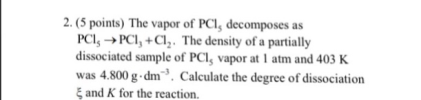 2. (5 points) The vapor of PCl, decomposes as PC,->PCI, +Cl. The density of a partially dissociated sample of PCls vapor at 1 atm and 403 K was 4.800 g.dm. Calculate the degree of dissociation , and K for the reaction.
Consider the reaction. PCl5(g)↽−−⇀PCl3(g)+Cl2(g)?c=0.0420 PCl 5 ( g ) ↽ − − ⇀ PCl 3 (...
Consider the reaction. PCl5(g)↽−−⇀PCl3(g)+Cl2(g)?c=0.0420 PCl 5 ( g ) ↽ − − ⇀ PCl 3 ( g ) + Cl 2 ( g ) K c = 0.0420 The concentrations of the products at equilibrium are [PCl3]=0.270 M [ PCl 3 ] = 0.270 M and [Cl2]=0.180 M [ Cl 2 ] = 0.180 M . What is the concentration of the reactant, PCl5 PCl 5 , at equilibrium? [PCl5]= [ PCl 5 ] =
GENERAL CHEMISTRY GROUP STUDY SB The first 3 problems are to be submitted today. #1.(30pts, 15...
 GENERAL CHEMISTRY GROUP STUDY SB The first 3 problems are to be submitted today. #1.(30pts, 15 pts each) (c) Consider a 135 meter high waterfall. If the decrease in potential energy of the water (i.e., mgh) is totally converted into heat, calculate the temperature difference between the top and bottom of the waterfall. Data: m-mass, g- acceleration due to gravity 9.81 m/s. The specific heat of water- 4.184 J/(g "C). (d) If a system absorbs 30.0 J of heat from...
Use the energy diagrams of the two reactions to answer the questions. Reaction A Reaction B...
 Use the energy diagrams of the two reactions to answer the questions. Reaction A Reaction B Energy HHHH! (kJ/mol Energy 100 (kJ/mol) 50 Reaction progress Reaction progress What is the change in energy for reaction A? What is the change in energy for reaction B? AEX = kJ/mol AE/x = kJ/mol What is the activation energy for reaction A? What is the activation energy for reaction B? E = kJ/mol E.= kJ/mol Question 2 of 20 > For the reaction...
Consider the following reaction: CH3OH(9) CO(9)+2H (9) AH = +90.7kJ AH = 130 kJ Previous Answers...
 Consider the following reaction: CH3OH(9) CO(9)+2H (9) AH = +90.7kJ AH = 130 kJ Previous Answers Correct Part For a given sample of CH,OH the enthalpy change on reaction is 185 kJ How many grams of hydrogen gas are produced? I AED ROO? Submit Previous Answers Request Answer X Incorrect; Try Again; 5 attempts remaining Part D What is the value of AH for the reverse of the previous reaction? AED ROO? AH. Submit Previous Answers Request Answer X Incorrect;...
Using provided data, determine AG* (in kJ) for the following reaction. 2036) ++3026) AH,(kJ/mol) S /mol)...
 Using provided data, determine AG* (in kJ) for the following reaction. 2036) ++3026) AH,(kJ/mol) S /mol) Ozle) 205.0 Ole) 143 238.82 Question 11 2 pts Use the provided information to determine the equilibrium constant at 298 K for the reaction given 2NO26) N204(8) 4 AH® (kJ/mol) 5° (J/molk) NO2(g) 33.2 239.9 N2048) 9.16 304.3 Equilibrium Constant - (Select) x 10 (Select)
Practice Questions Exam 2 Fall 2019 9. The reaction profile represents the following chemical equation: AB-CD...
 Practice Questions Exam 2 Fall 2019 9. The reaction profile represents the following chemical equation: AB-CD Calculate the activation energy (Ea) and AH of the reaction at 200 K Page 2 of 5 14. Consider the following reaction at 1700*C. 2CH ) CH.(g) + 3H2(g) Initially, the reaction mixture contains only [CH] -0.320 M. At equilibrium, the mixture contains [C,H,1 -0.070 M. What is the equilibrium constant for this reaction at 1700 °C? 1200 kJ 500 kJ 200 kJ Ea...
5. (20 pts) Consider the following reaction OF2(g) + H2O(g) ---> 2 HF(g) + O2(g) AH.(kJ/mole)=-318 kJ/mole (a) U...
 5. (20 pts) Consider the following reaction OF2(g) + H2O(g) ---> 2 HF(g) + O2(g) AH.(kJ/mole)=-318 kJ/mole (a) Using this information along with data in the appendix of your textbook, calculate AH (OF,(g)) in kJ/mole at 25°C. (b) If 15.0 g of OF2(g) and 10.0 g of H2Og) react, how much heat, expressed in kJ is released? Hint: First calculate the limiting reagent.
we - Google Given the following data, determine the rate law for the following reaction 2A+B+2C...
 we - Google Given the following data, determine the rate law for the following reaction 2A+B+2C - products Experiment 2 [A] 0.273 0.819 0.273 0.273 [B] [C] Rate (M/s) 0.763 0.400 3.0 0.763 0.400 9.0 1.526 0.400 12.0 0.763 0.800 4 6.0 Rate = k[A][B][C] Rate = k[A][B][C] Rate = K[A] [B]*C]2 Rate = K[A]2[B] [CH Rate = k[A] [B][C] Question 16 5 pts SOCl2 gas dissociates into SO2 and Cly via the following reaction: SOCI2(e) + SO2(g) + Cl2(8)...
5. (20 pts) Consider the following reaction OF2(g) + H2O(g) ---> 2 HF(g) + O2(g) AH.(kJ/mole) -318 kJ/mole (a) U...
 5. (20 pts) Consider the following reaction OF2(g) + H2O(g) ---> 2 HF(g) + O2(g) AH.(kJ/mole) -318 kJ/mole (a) Using this information along with data in the appendix of your textbook, calculate AH;(OF,(8)) in kJ/mole at 25°C. (b) If 15.0 g of OF2(g) and 10.0 g of H2Og) react, how much heat, expressed in kJ is released? Hint: First calculate the limiting reagent. 6.(20 pts) Consider two Styrofoam coffee cups. If cup #1 contains 102.0 mL of water at 81.8°C...
 2. (5 points) The vapor of PCl, decomposes as PC,->PCI, +Cl. The density of a partially dissociated sample of PCls vapor at 1 atm and 403 K was 4.800 g.dm. Calculate the degree of dissociation , and K for the reaction.
 GENERAL CHEMISTRY GROUP STUDY SB The first 3 problems are to be submitted today. #1.(30pts, 15 pts each) (c) Consider a 135 meter high waterfall. If the decrease in potential energy of the water (i.e., mgh) is totally converted into heat, calculate the temperature difference between the top and bottom of the waterfall. Data: m-mass, g- acceleration due to gravity 9.81 m/s. The specific heat of water- 4.184 J/(g "C). (d) If a system absorbs 30.0 J of heat from...
 Use the energy diagrams of the two reactions to answer the questions. Reaction A Reaction B Energy HHHH! (kJ/mol Energy 100 (kJ/mol) 50 Reaction progress Reaction progress What is the change in energy for reaction A? What is the change in energy for reaction B? AEX = kJ/mol AE/x = kJ/mol What is the activation energy for reaction A? What is the activation energy for reaction B? E = kJ/mol E.= kJ/mol Question 2 of 20 > For the reaction...
 Consider the following reaction: CH3OH(9) CO(9)+2H (9) AH = +90.7kJ AH = 130 kJ Previous Answers Correct Part For a given sample of CH,OH the enthalpy change on reaction is 185 kJ How many grams of hydrogen gas are produced? I AED ROO? Submit Previous Answers Request Answer X Incorrect; Try Again; 5 attempts remaining Part D What is the value of AH for the reverse of the previous reaction? AED ROO? AH. Submit Previous Answers Request Answer X Incorrect;...
 Using provided data, determine AG* (in kJ) for the following reaction. 2036) ++3026) AH,(kJ/mol) S /mol) Ozle) 205.0 Ole) 143 238.82 Question 11 2 pts Use the provided information to determine the equilibrium constant at 298 K for the reaction given 2NO26) N204(8) 4 AH® (kJ/mol) 5° (J/molk) NO2(g) 33.2 239.9 N2048) 9.16 304.3 Equilibrium Constant - (Select) x 10 (Select)
 Practice Questions Exam 2 Fall 2019 9. The reaction profile represents the following chemical equation: AB-CD Calculate the activation energy (Ea) and AH of the reaction at 200 K Page 2 of 5 14. Consider the following reaction at 1700*C. 2CH ) CH.(g) + 3H2(g) Initially, the reaction mixture contains only [CH] -0.320 M. At equilibrium, the mixture contains [C,H,1 -0.070 M. What is the equilibrium constant for this reaction at 1700 °C? 1200 kJ 500 kJ 200 kJ Ea...
 5. (20 pts) Consider the following reaction OF2(g) + H2O(g) ---> 2 HF(g) + O2(g) AH.(kJ/mole)=-318 kJ/mole (a) Using this information along with data in the appendix of your textbook, calculate AH (OF,(g)) in kJ/mole at 25°C. (b) If 15.0 g of OF2(g) and 10.0 g of H2Og) react, how much heat, expressed in kJ is released? Hint: First calculate the limiting reagent.
 we - Google Given the following data, determine the rate law for the following reaction 2A+B+2C - products Experiment 2 [A] 0.273 0.819 0.273 0.273 [B] [C] Rate (M/s) 0.763 0.400 3.0 0.763 0.400 9.0 1.526 0.400 12.0 0.763 0.800 4 6.0 Rate = k[A][B][C] Rate = k[A][B][C] Rate = K[A] [B]*C]2 Rate = K[A]2[B] [CH Rate = k[A] [B][C] Question 16 5 pts SOCl2 gas dissociates into SO2 and Cly via the following reaction: SOCI2(e) + SO2(g) + Cl2(8)...
 5. (20 pts) Consider the following reaction OF2(g) + H2O(g) ---> 2 HF(g) + O2(g) AH.(kJ/mole) -318 kJ/mole (a) Using this information along with data in the appendix of your textbook, calculate AH;(OF,(8)) in kJ/mole at 25°C. (b) If 15.0 g of OF2(g) and 10.0 g of H2Og) react, how much heat, expressed in kJ is released? Hint: First calculate the limiting reagent. 6.(20 pts) Consider two Styrofoam coffee cups. If cup #1 contains 102.0 mL of water at 81.8°C...
Most questions answered within 3 hours.
-
Where is the error in this code sequence?
String s1 = "Hello";
String s2 = "ello";...
asked 11 months ago -
Financial data for Joel de Paris, Inc., for last year
follow:
Joel de Paris, Inc.
Balance...
asked 11 months ago -
Consider this reaction:
Al2(SO4)3 (aq)+ BaCl3
(aq) Al2Cl6 (aq)- +
3BaSO4(s) . What is the...
asked 11 months ago -
Suppose that Savneet is considering increasing her
recent random sample from 20 car rentals to 40...
asked 11 months ago -
Trucks arrive at an unloading terminal at an average rate of 120
per hour.
Trucks arrive...
asked 11 months ago -
Why are methanol and ethanol completely soluble in water while
octanol is not very little soluble....
asked 11 months ago -
A facilities manager at a university reads in a research report
that the mean amount of...
asked 11 months ago -
When the CuSO4 is rehydrated by adding water to the anhydrous
compound, is this an endothermic...
asked 11 months ago -
A ray of sunlight is passing from diamond into crown glass; the
angle of incidence is...
asked 11 months ago -
A block of mass 0.249 kg is placed on top of a light, vertical
spring of...
asked 11 months ago -
how do the kidneys compensate in the presences of acidosis
a) trigger hyperventilate
b) reserve acid...
asked 11 months ago -
Question 501 pts
The rental rate of capital to the firm increases. Which of the
following...
asked 11 months ago