Homework Answers
Add Answer to:
please help in all sections asap!!
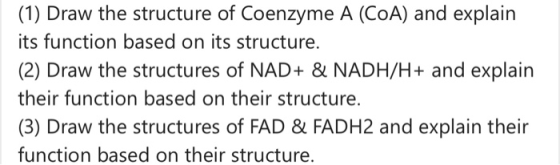
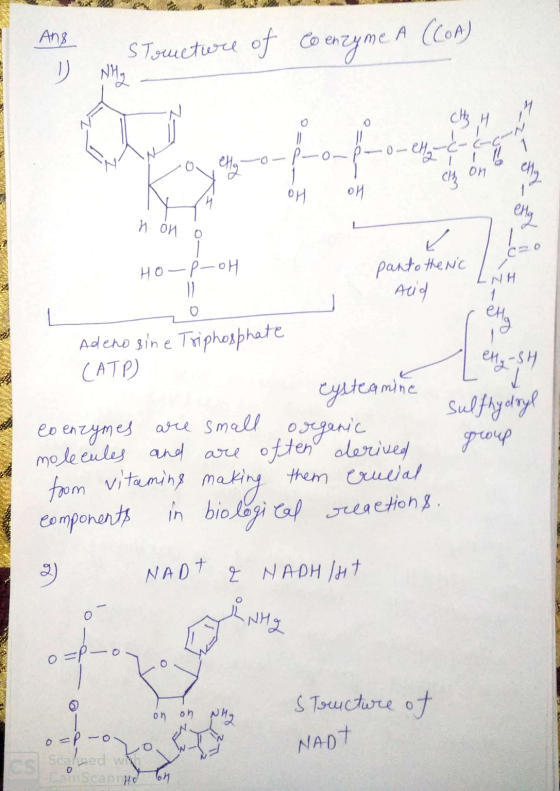
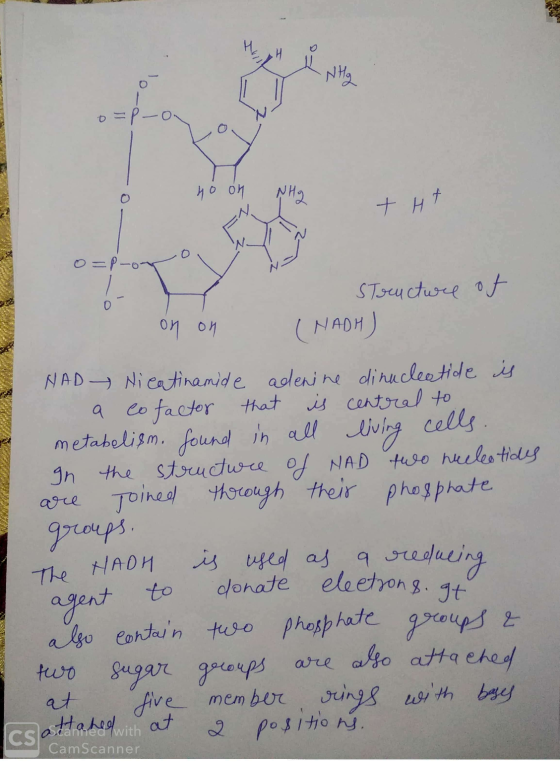
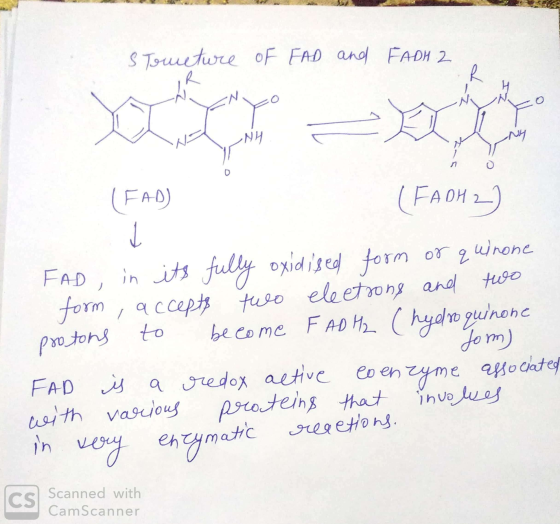
(1) Draw the structure of Coenzyme A (COA) and explain...
Answer all biochemistry questions asap 6. Deficiency of glucose 6-phosphate dehydrogenase (G6PD) is the most common...
 Answer all biochemistry questions asap
6. Deficiency of glucose 6-phosphate dehydrogenase (G6PD) is the most common human enzyme deficiency. a. How would the amount of NADPH in a person with a G6PD deficiency compare with a "normal" person? b. How would the amount of oxidized glutathione (GSSG) in a person with a G6PD deficiency compare with a "normal" person? c. How would the RBCs of a person with a G6PD deficiency be able to handle oxidative stress compared to a...
Answer all biochemistry questions asap
6. Deficiency of glucose 6-phosphate dehydrogenase (G6PD) is the most common human enzyme deficiency. a. How would the amount of NADPH in a person with a G6PD deficiency compare with a "normal" person? b. How would the amount of oxidized glutathione (GSSG) in a person with a G6PD deficiency compare with a "normal" person? c. How would the RBCs of a person with a G6PD deficiency be able to handle oxidative stress compared to a...
Please answer ASAP!! will rate! thank you Part A Write the chemical equation for the reduction...
 Please answer ASAP!! will rate! thank
you
Part A Write the chemical equation for the reduction of acetaldehyde to ethanol. Complete the reaction by dragging the appropriate labels to their respective targets. Note: not all labels will be used. Reset Help OH CH;-(-OH CO2 + NADH NAD NADH + H Hz-CH2-C- CH3-C-H HS - COA + NAD+ CH3-C-C-H (coenzyme) (coenzyme)
Please answer ASAP!! will rate! thank
you
Part A Write the chemical equation for the reduction of acetaldehyde to ethanol. Complete the reaction by dragging the appropriate labels to their respective targets. Note: not all labels will be used. Reset Help OH CH;-(-OH CO2 + NADH NAD NADH + H Hz-CH2-C- CH3-C-H HS - COA + NAD+ CH3-C-C-H (coenzyme) (coenzyme)
Coenzyme Homework Due: 11:15 AM/Monday (11/08/2019) NAME All descriptions/narratives must be typed (Times Roman/12 point font)...
 Coenzyme Homework Due: 11:15 AM/Monday (11/08/2019) NAME All descriptions/narratives must be typed (Times Roman/12 point font) and all figures must be drawn by hand. Provide detailed descriptions (name, structure, function) for the following. (1) ATP, ADP, AMP, PPI, Pi (2) NAD/NADH, H (3) FAD/FADH2 (4) Provide detailed explanations (figures, narratives) why ATP hydrolysis is so exergonic.
please help in all sections asap! Chapter 16 & 17: Carbohydrate Energetics (1) Consider glycolysis, the...
 please help in all sections asap!
Chapter 16 & 17: Carbohydrate Energetics (1) Consider glycolysis, the connecting step and the TCA cycle, and write out in detail (names/structures) the steps where ATP is consumed (used as a reactant/substrate/co- substrate). (2) Consider glycolysis, the connecting step and the TCA cycle, and write out in detail (names/structures) the steps where ATP is produced (made as a product/co-product). (3) Consider glycolysis, the connecting step and the TCA cycle, and write out in detail...
please help in all sections asap!
Chapter 16 & 17: Carbohydrate Energetics (1) Consider glycolysis, the connecting step and the TCA cycle, and write out in detail (names/structures) the steps where ATP is consumed (used as a reactant/substrate/co- substrate). (2) Consider glycolysis, the connecting step and the TCA cycle, and write out in detail (names/structures) the steps where ATP is produced (made as a product/co-product). (3) Consider glycolysis, the connecting step and the TCA cycle, and write out in detail...
Please answer all. Draw the structures of the following coenzyme molecules: 1. COA-SH/Acetyl-S-COA 2. NADTINADH +...
 Please answer all.
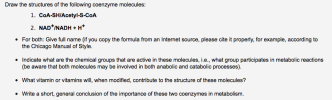
Draw the structures of the following coenzyme molecules: 1. COA-SH/Acetyl-S-COA 2. NADTINADH + H+ • For both: Give full name (if you copy the formula from an Internet source, please cite it properly, for example, according to the Chicago Manual of Style. • Indicate what are the chemical groups that are active in these molecules, i.e., what group participates in metabolic reactions (be aware that both molecules may be involved in both anabolic and catabolic processes). •...
Please answer all.
Draw the structures of the following coenzyme molecules: 1. COA-SH/Acetyl-S-COA 2. NADTINADH + H+ • For both: Give full name (if you copy the formula from an Internet source, please cite it properly, for example, according to the Chicago Manual of Style. • Indicate what are the chemical groups that are active in these molecules, i.e., what group participates in metabolic reactions (be aware that both molecules may be involved in both anabolic and catabolic processes). •...
This is for biochem. Please answer and explain why? As a representation of the respiratory chain, what is wrong with this picture? There are 4 deliberate errors. Select all that apply NADHFAD ног Coa...
 This is for biochem. Please answer and explain why?
As a representation of the respiratory chain, what is wrong with this picture? There are 4 deliberate errors. Select all that apply NADHFAD ног Coa 1. NADH is oxidized by FMN, not FAD. 2. NADH is oxidized by CoQ, not FAD. 3. Reduced flavin (FADH2 or FMNH2) is oxidized by CoQ, not CoQH2. 4. O2 is reduced to H2O, not H202 5. Cyt c, accepts e-from cyt a-a3, and is then...
This is for biochem. Please answer and explain why?
As a representation of the respiratory chain, what is wrong with this picture? There are 4 deliberate errors. Select all that apply NADHFAD ног Coa 1. NADH is oxidized by FMN, not FAD. 2. NADH is oxidized by CoQ, not FAD. 3. Reduced flavin (FADH2 or FMNH2) is oxidized by CoQ, not CoQH2. 4. O2 is reduced to H2O, not H202 5. Cyt c, accepts e-from cyt a-a3, and is then...
pLEASE HELP BIOCHEM 2a Predict all of the following that are consequences of withdrawing oxygen given...
pLEASE HELP BIOCHEM 2a Predict all of the following that are consequences of withdrawing oxygen given constant supply of NADH. may have more than one answer a. Pool of coenzyme Q becomes fully reduced. b. recycling of NAD+ continues indefinitely c. rate of NADH oxidation becomes zero owing to a lack of oxidized coenzyme Q(Q) to accept electrons d.pool of cytochrome C becomes fully oxidized (Cyt Cox). 2.b Choose all the following that are characteristic of Complex 3. a. recycles...
Biochem 0. Fad Accepss H Proton H:H Acetyl groups 1. NAD+ accepts ___ H Proton H:H...
Biochem 0. Fad Accepss H Proton H:H Acetyl groups 1. NAD+ accepts ___ H Proton H:H Acetyl groups 2. Coenzyme A accepts Acyl Acetyl Thioesters All of above 3. Which coenzyme upon oxidation reduction makes the most atp? CoA Lipoic Acid FAD NADH
labelNeed help labeling the numbers. doo FAD FADH, HO Ha NAD NADH, H COA COA COA...
 labelNeed help labeling the
numbers.
doo FAD FADH, HO Ha NAD NADH, H COA COA COA COA H3 H 1 2 3 H2 н. 4 18 ΝΗ P-ribose COO COA HN-H COA нс Hac FOA 10 11 +H2O 5 Ç00 CH o COO- HC "OOC ç -OH сн. coo 14 CH2 coo OOC NADH + HS 6 9 NAD 15 HES COO- 17 CEO нсон Çooº H2C P-ribose OOH HO CH C-0 CH CH2 coo coo 8 7 coo COA-S....
labelNeed help labeling the
numbers.
doo FAD FADH, HO Ha NAD NADH, H COA COA COA COA H3 H 1 2 3 H2 н. 4 18 ΝΗ P-ribose COO COA HN-H COA нс Hac FOA 10 11 +H2O 5 Ç00 CH o COO- HC "OOC ç -OH сн. coo 14 CH2 coo OOC NADH + HS 6 9 NAD 15 HES COO- 17 CEO нсон Çooº H2C P-ribose OOH HO CH C-0 CH CH2 coo coo 8 7 coo COA-S....
acetyl-CoA COA The reactions of the citric acid cycle are shown in the image. As labeled...
 acetyl-CoA COA The reactions of the citric acid cycle are shown in the image. As labeled in the diagram, reactions 1, 3, and 4 are regulation points in the citric acid cycle. oxaloacetate citrate synthase citrate NADH +Hi 7 malate dehydrogenase NAD malate aconitase 2 Which molecule inhibits reaction 1? isocitrate 7 fumarase NAD isocitrate dehydrogenase 3 NADH + H+ O citrate O NAD acetyl-CoA + CO2 fumarate C-ketoglutarate FADH succinate O dehydrogenase FAD O-ketoglutarate a dehydrogenase NAD + COA...
 Answer all biochemistry questions asap
6. Deficiency of glucose 6-phosphate dehydrogenase (G6PD) is the most common human enzyme deficiency. a. How would the amount of NADPH in a person with a G6PD deficiency compare with a "normal" person? b. How would the amount of oxidized glutathione (GSSG) in a person with a G6PD deficiency compare with a "normal" person? c. How would the RBCs of a person with a G6PD deficiency be able to handle oxidative stress compared to a...
Answer all biochemistry questions asap
6. Deficiency of glucose 6-phosphate dehydrogenase (G6PD) is the most common human enzyme deficiency. a. How would the amount of NADPH in a person with a G6PD deficiency compare with a "normal" person? b. How would the amount of oxidized glutathione (GSSG) in a person with a G6PD deficiency compare with a "normal" person? c. How would the RBCs of a person with a G6PD deficiency be able to handle oxidative stress compared to a...
 Please answer ASAP!! will rate! thank
you
Part A Write the chemical equation for the reduction of acetaldehyde to ethanol. Complete the reaction by dragging the appropriate labels to their respective targets. Note: not all labels will be used. Reset Help OH CH;-(-OH CO2 + NADH NAD NADH + H Hz-CH2-C- CH3-C-H HS - COA + NAD+ CH3-C-C-H (coenzyme) (coenzyme)
Please answer ASAP!! will rate! thank
you
Part A Write the chemical equation for the reduction of acetaldehyde to ethanol. Complete the reaction by dragging the appropriate labels to their respective targets. Note: not all labels will be used. Reset Help OH CH;-(-OH CO2 + NADH NAD NADH + H Hz-CH2-C- CH3-C-H HS - COA + NAD+ CH3-C-C-H (coenzyme) (coenzyme)
 Coenzyme Homework Due: 11:15 AM/Monday (11/08/2019) NAME All descriptions/narratives must be typed (Times Roman/12 point font) and all figures must be drawn by hand. Provide detailed descriptions (name, structure, function) for the following. (1) ATP, ADP, AMP, PPI, Pi (2) NAD/NADH, H (3) FAD/FADH2 (4) Provide detailed explanations (figures, narratives) why ATP hydrolysis is so exergonic.
 please help in all sections asap!
Chapter 16 & 17: Carbohydrate Energetics (1) Consider glycolysis, the connecting step and the TCA cycle, and write out in detail (names/structures) the steps where ATP is consumed (used as a reactant/substrate/co- substrate). (2) Consider glycolysis, the connecting step and the TCA cycle, and write out in detail (names/structures) the steps where ATP is produced (made as a product/co-product). (3) Consider glycolysis, the connecting step and the TCA cycle, and write out in detail...
please help in all sections asap!
Chapter 16 & 17: Carbohydrate Energetics (1) Consider glycolysis, the connecting step and the TCA cycle, and write out in detail (names/structures) the steps where ATP is consumed (used as a reactant/substrate/co- substrate). (2) Consider glycolysis, the connecting step and the TCA cycle, and write out in detail (names/structures) the steps where ATP is produced (made as a product/co-product). (3) Consider glycolysis, the connecting step and the TCA cycle, and write out in detail...
 Please answer all.
Draw the structures of the following coenzyme molecules: 1. COA-SH/Acetyl-S-COA 2. NADTINADH + H+ • For both: Give full name (if you copy the formula from an Internet source, please cite it properly, for example, according to the Chicago Manual of Style. • Indicate what are the chemical groups that are active in these molecules, i.e., what group participates in metabolic reactions (be aware that both molecules may be involved in both anabolic and catabolic processes). •...
Please answer all.
Draw the structures of the following coenzyme molecules: 1. COA-SH/Acetyl-S-COA 2. NADTINADH + H+ • For both: Give full name (if you copy the formula from an Internet source, please cite it properly, for example, according to the Chicago Manual of Style. • Indicate what are the chemical groups that are active in these molecules, i.e., what group participates in metabolic reactions (be aware that both molecules may be involved in both anabolic and catabolic processes). •...
 This is for biochem. Please answer and explain why?
As a representation of the respiratory chain, what is wrong with this picture? There are 4 deliberate errors. Select all that apply NADHFAD ног Coa 1. NADH is oxidized by FMN, not FAD. 2. NADH is oxidized by CoQ, not FAD. 3. Reduced flavin (FADH2 or FMNH2) is oxidized by CoQ, not CoQH2. 4. O2 is reduced to H2O, not H202 5. Cyt c, accepts e-from cyt a-a3, and is then...
This is for biochem. Please answer and explain why?
As a representation of the respiratory chain, what is wrong with this picture? There are 4 deliberate errors. Select all that apply NADHFAD ног Coa 1. NADH is oxidized by FMN, not FAD. 2. NADH is oxidized by CoQ, not FAD. 3. Reduced flavin (FADH2 or FMNH2) is oxidized by CoQ, not CoQH2. 4. O2 is reduced to H2O, not H202 5. Cyt c, accepts e-from cyt a-a3, and is then...
 labelNeed help labeling the
numbers.
doo FAD FADH, HO Ha NAD NADH, H COA COA COA COA H3 H 1 2 3 H2 н. 4 18 ΝΗ P-ribose COO COA HN-H COA нс Hac FOA 10 11 +H2O 5 Ç00 CH o COO- HC "OOC ç -OH сн. coo 14 CH2 coo OOC NADH + HS 6 9 NAD 15 HES COO- 17 CEO нсон Çooº H2C P-ribose OOH HO CH C-0 CH CH2 coo coo 8 7 coo COA-S....
labelNeed help labeling the
numbers.
doo FAD FADH, HO Ha NAD NADH, H COA COA COA COA H3 H 1 2 3 H2 н. 4 18 ΝΗ P-ribose COO COA HN-H COA нс Hac FOA 10 11 +H2O 5 Ç00 CH o COO- HC "OOC ç -OH сн. coo 14 CH2 coo OOC NADH + HS 6 9 NAD 15 HES COO- 17 CEO нсон Çooº H2C P-ribose OOH HO CH C-0 CH CH2 coo coo 8 7 coo COA-S....
 acetyl-CoA COA The reactions of the citric acid cycle are shown in the image. As labeled in the diagram, reactions 1, 3, and 4 are regulation points in the citric acid cycle. oxaloacetate citrate synthase citrate NADH +Hi 7 malate dehydrogenase NAD malate aconitase 2 Which molecule inhibits reaction 1? isocitrate 7 fumarase NAD isocitrate dehydrogenase 3 NADH + H+ O citrate O NAD acetyl-CoA + CO2 fumarate C-ketoglutarate FADH succinate O dehydrogenase FAD O-ketoglutarate a dehydrogenase NAD + COA...
Most questions answered within 3 hours.
-
Where is the error in this code sequence?
String s1 = "Hello";
String s2 = "ello";...
asked 10 months ago -
Financial data for Joel de Paris, Inc., for last year
follow:
Joel de Paris, Inc.
Balance...
asked 10 months ago -
Consider this reaction:
Al2(SO4)3 (aq)+ BaCl3
(aq) Al2Cl6 (aq)- +
3BaSO4(s) . What is the...
asked 10 months ago -
Suppose that Savneet is considering increasing her
recent random sample from 20 car rentals to 40...
asked 10 months ago -
Trucks arrive at an unloading terminal at an average rate of 120
per hour.
Trucks arrive...
asked 10 months ago -
Why are methanol and ethanol completely soluble in water while
octanol is not very little soluble....
asked 10 months ago -
A facilities manager at a university reads in a research report
that the mean amount of...
asked 10 months ago -
When the CuSO4 is rehydrated by adding water to the anhydrous
compound, is this an endothermic...
asked 10 months ago -
A ray of sunlight is passing from diamond into crown glass; the
angle of incidence is...
asked 10 months ago -
A block of mass 0.249 kg is placed on top of a light, vertical
spring of...
asked 10 months ago -
how do the kidneys compensate in the presences of acidosis
a) trigger hyperventilate
b) reserve acid...
asked 10 months ago -
Question 501 pts
The rental rate of capital to the firm increases. Which of the
following...
asked 10 months ago