This is for biochem. Please answer and explain why?
Homework Answers
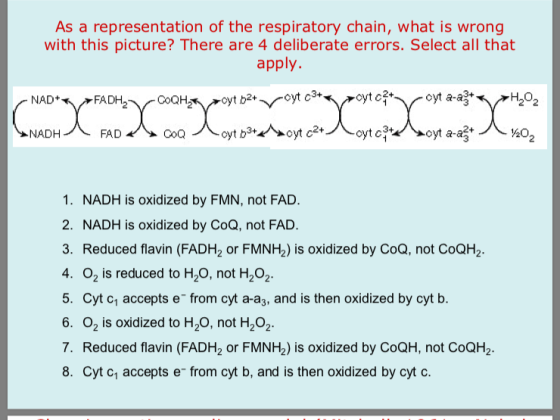
1. NADH is oxidized by FMN, which is a part of Complex I, not FAD.
3. Reduced flavin(FADH2 or FMNH2) is oxidized by CoQ, not CoQH2 because CoQ accepts the electrons from FADH2 and oxidized it to FAD.
8. Cyt C1 accepts an electron from Cyt b and is then oxidized by Cyt C, not from Cyt a-a3.
4. Water is reduced to H2O, not H2O2.
Thank you...:)
Add Answer to:
This is for biochem. Please answer and explain why? As a representation of the respiratory chain, what is wrong with this picture? There are 4 deliberate errors. Select all that apply NADHFAD ног Coa...
3) Below is a representation of a respiratory chain, what is wrong with this picture? (more...
 3) Below is a representation of a respiratory chain, what is wrong with this picture? (more than one mistake is present) See figure on PPT malate NADTO Vytacat FADHz CoQ Hargt bi, cytat3 is a cute FADT K & 60 cyth cytet? cyte cyta-asi cytara H2O2 ²02 oxaloocetate NADH
Please help me figure these out, and if you could explain why you got the answer...
Please help me figure these out, and if you could explain why you got the answer you did that would be great, because I have an exam tomorrow! Thanks in advance. 1. Anaplerotic reactions __________. A. produce oxaloacetate and malate to maintain constant levels of citric acid cycle intermediates B. produce biotin needed by pyruvate carboxylase C. recycle pantothenate used to make CoA D. produce pyruvate and citrate to maintain constant levels of citric acid cycle intermediates E. All of...
Use the chart to answer the questions. Please be correct and careful In one step of...
 Use the chart to answer the questions. Please be correct and
careful
In one step of glycolysis, glyceraldehyde 3-phosphate is oxidized by NAD+ to yield 3-phosphoglycerate and NADH. 2 2 2 Table 10-2 Standard Reduction Potentials for Redox Pairs of Biological Relevance* Redox Pair Number of (oxidized form → reduced form) Electrons E.(V) acetate pyruvate 2 -0.70 succinate → a-ketoglutarate 2 -0.67 acetate acetaldehyde 2 -0.60 3-phosphoglycerate → glyceraldehyde-3-P 2 -0.55 a-ketoglutarate isocitrate -0.38 NAD+ → NADH 2 -0.32 FMN-FMNH2...
Use the chart to answer the questions. Please be correct and
careful
In one step of glycolysis, glyceraldehyde 3-phosphate is oxidized by NAD+ to yield 3-phosphoglycerate and NADH. 2 2 2 Table 10-2 Standard Reduction Potentials for Redox Pairs of Biological Relevance* Redox Pair Number of (oxidized form → reduced form) Electrons E.(V) acetate pyruvate 2 -0.70 succinate → a-ketoglutarate 2 -0.67 acetate acetaldehyde 2 -0.60 3-phosphoglycerate → glyceraldehyde-3-P 2 -0.55 a-ketoglutarate isocitrate -0.38 NAD+ → NADH 2 -0.32 FMN-FMNH2...
 3) Below is a representation of a respiratory chain, what is wrong with this picture? (more than one mistake is present) See figure on PPT malate NADTO Vytacat FADHz CoQ Hargt bi, cytat3 is a cute FADT K & 60 cyth cytet? cyte cyta-asi cytara H2O2 ²02 oxaloocetate NADH
 Use the chart to answer the questions. Please be correct and
careful
In one step of glycolysis, glyceraldehyde 3-phosphate is oxidized by NAD+ to yield 3-phosphoglycerate and NADH. 2 2 2 Table 10-2 Standard Reduction Potentials for Redox Pairs of Biological Relevance* Redox Pair Number of (oxidized form → reduced form) Electrons E.(V) acetate pyruvate 2 -0.70 succinate → a-ketoglutarate 2 -0.67 acetate acetaldehyde 2 -0.60 3-phosphoglycerate → glyceraldehyde-3-P 2 -0.55 a-ketoglutarate isocitrate -0.38 NAD+ → NADH 2 -0.32 FMN-FMNH2...
Use the chart to answer the questions. Please be correct and
careful
In one step of glycolysis, glyceraldehyde 3-phosphate is oxidized by NAD+ to yield 3-phosphoglycerate and NADH. 2 2 2 Table 10-2 Standard Reduction Potentials for Redox Pairs of Biological Relevance* Redox Pair Number of (oxidized form → reduced form) Electrons E.(V) acetate pyruvate 2 -0.70 succinate → a-ketoglutarate 2 -0.67 acetate acetaldehyde 2 -0.60 3-phosphoglycerate → glyceraldehyde-3-P 2 -0.55 a-ketoglutarate isocitrate -0.38 NAD+ → NADH 2 -0.32 FMN-FMNH2...
Most questions answered within 3 hours.
-
Where is the error in this code sequence?
String s1 = "Hello";
String s2 = "ello";...
asked 11 months ago -
Financial data for Joel de Paris, Inc., for last year
follow:
Joel de Paris, Inc.
Balance...
asked 11 months ago -
Consider this reaction:
Al2(SO4)3 (aq)+ BaCl3
(aq) Al2Cl6 (aq)- +
3BaSO4(s) . What is the...
asked 11 months ago -
Suppose that Savneet is considering increasing her
recent random sample from 20 car rentals to 40...
asked 11 months ago -
Trucks arrive at an unloading terminal at an average rate of 120
per hour.
Trucks arrive...
asked 11 months ago -
Why are methanol and ethanol completely soluble in water while
octanol is not very little soluble....
asked 11 months ago -
A facilities manager at a university reads in a research report
that the mean amount of...
asked 11 months ago -
When the CuSO4 is rehydrated by adding water to the anhydrous
compound, is this an endothermic...
asked 11 months ago -
A ray of sunlight is passing from diamond into crown glass; the
angle of incidence is...
asked 11 months ago -
A block of mass 0.249 kg is placed on top of a light, vertical
spring of...
asked 11 months ago -
how do the kidneys compensate in the presences of acidosis
a) trigger hyperventilate
b) reserve acid...
asked 11 months ago -
Question 501 pts
The rental rate of capital to the firm increases. Which of the
following...
asked 11 months ago