which of the following gives no E2 reaction, even with a strong base?

which of the following gives no E2 reaction, even with a strong base?
Homework Answers

Add Answer to:
which of the following gives no E2 reaction, even with
a strong base?
strong nucleophile weak base strong bulky base strong nucleophile strong base Promote SN2/E2 weak nucleophile weak...
 strong nucleophile weak base strong bulky base strong nucleophile strong base Promote SN2/E2 weak nucleophile weak base Promote SN1/E1 Promote SN2 Promote E2 CH Br HS NCT HO CHO CHÚCHO NaNO NaOH NOME Noe HOORS Conjugate acids have pka 16-18 Conjugate acids Recall, you make hydroxide have pka 11 or alkoxide ons from the corresponding alcohol or water and Nat CH,OH (MOH) HO CH,CH,OH (EXOH) | HC-Ć-o to CH tert-BUOK NOCH KOHBU NEOBU The structures above are all ways of...
This structure is a strong base and favors E2. Please explain if it is a strong...
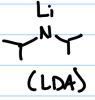 This structure is a strong base and favors E2. Please explain if
it is a strong bulky base or strong small base? Plus what type of
hydrogen is eliminated?
(LDAS - Mg Br
This structure is a strong base and favors E2. Please explain if
it is a strong bulky base or strong small base? Plus what type of
hydrogen is eliminated?
(LDAS - Mg Br
Explain why the neutralization reaction of a strong acid and a weak base gives a weakly...
Explain why the neutralization reaction of a strong acid and a weak base gives a weakly acidic solution.
Write the major organic product formed when it undergoes an E2 reaction with a strong base...
Write the major organic product formed when it undergoes an E2 reaction with a strong base (NaOCH2CH3). Please use the E/Z notation when specifying stereochemistry. Reminder - the double bond takes precedence over alkyl groups when numbering the parent. 4-bromohex-1-ene
4. The reaction between cis-1-bromo-2-methylcyclohexane and ethoxide (a very strong base) results in an E2 reaction...
 4. The reaction between cis-1-bromo-2-methylcyclohexane and ethoxide (a very strong base) results in an E2 reaction. (refer to Mechanism 9.8 in your textbook) a. Show the transition state for this reaction. CHE + CH, CH, CH, OH b. Show the formation of the product(s) from the transition state. c. Use the rule from part 3d, to determine the major and minor alkene products.
The reaction of 2,3-dibromobutane with two equivalents of strong base gives three different products, each of...
 The reaction of 2,3-dibromobutane with two equivalents of strong base gives three different products, each of which contains two new T-bonds. Product A has two sp-hybridized carbons, product B has one sp-hybridized carbon, and product C has none. Draw the structures of products A, B, and C. (0.6 pts)
When determining which mechanism (E1 or E2) occurs, the following process is helpful: 1) Determine the...
 When determining which mechanism (E1 or E2) occurs, the following process is helpful: 1) Determine the substitution (methyl, 1º, 2º, or 3“) of the alkyl halide 2) Determine the strength of the nucleophile Please fill out the following table, indicating the category of reaction (E1 or E2) that will occur in each set of alkyl halides and nucleophiles. If no reaction occurs, write 'NR: Alkyl Halide Strong Base Weak Base Methyl 1° 20 3° For each of the following reactions,...
Consider a reaction with a 3° leaving group and a strong nucleophile/bad base. What reaction pathway...
 Consider a reaction with a 3° leaving group and a strong nucleophile/bad base. What reaction pathway will prevall (SN1, SN2, E1, or E2)? Explain your reasoning.
In the net ionic equation for a reaction between a strong acid and a strong base,...
In the net ionic equation for a reaction between a strong acid and a strong base, which of the following are written on the reactant side?
1. Under second-order conditions (strong base/nucleophile), SN2 and E2 reactions may occur simultaneously and compete with...
 1. Under second-order conditions (strong base/nucleophile),
SN2 and E2 reactions may occur simultaneously and
compete with each other.
Show what products might be expected from the reaction of
2-bromo-3-methylbutane (a moderately hindered 2∘ alkyl halide) with
sodium ethoxide.
2.Under second-order conditions (strong base/nucleophile),
SN2 and E2 reactions may occur simultaneously and
compete with each other.
Show what products might be expected from the reaction of
2-bromo-3-methylbutane (a moderately hindered 2∘ alkyl halide) with
sodium ethoxide
3.. Provide the structure of...
1. Under second-order conditions (strong base/nucleophile),
SN2 and E2 reactions may occur simultaneously and
compete with each other.
Show what products might be expected from the reaction of
2-bromo-3-methylbutane (a moderately hindered 2∘ alkyl halide) with
sodium ethoxide.
2.Under second-order conditions (strong base/nucleophile),
SN2 and E2 reactions may occur simultaneously and
compete with each other.
Show what products might be expected from the reaction of
2-bromo-3-methylbutane (a moderately hindered 2∘ alkyl halide) with
sodium ethoxide
3.. Provide the structure of...
 strong nucleophile weak base strong bulky base strong nucleophile strong base Promote SN2/E2 weak nucleophile weak base Promote SN1/E1 Promote SN2 Promote E2 CH Br HS NCT HO CHO CHÚCHO NaNO NaOH NOME Noe HOORS Conjugate acids have pka 16-18 Conjugate acids Recall, you make hydroxide have pka 11 or alkoxide ons from the corresponding alcohol or water and Nat CH,OH (MOH) HO CH,CH,OH (EXOH) | HC-Ć-o to CH tert-BUOK NOCH KOHBU NEOBU The structures above are all ways of...
 This structure is a strong base and favors E2. Please explain if
it is a strong bulky base or strong small base? Plus what type of
hydrogen is eliminated?
(LDAS - Mg Br
This structure is a strong base and favors E2. Please explain if
it is a strong bulky base or strong small base? Plus what type of
hydrogen is eliminated?
(LDAS - Mg Br
 4. The reaction between cis-1-bromo-2-methylcyclohexane and ethoxide (a very strong base) results in an E2 reaction. (refer to Mechanism 9.8 in your textbook) a. Show the transition state for this reaction. CHE + CH, CH, CH, OH b. Show the formation of the product(s) from the transition state. c. Use the rule from part 3d, to determine the major and minor alkene products.
 The reaction of 2,3-dibromobutane with two equivalents of strong base gives three different products, each of which contains two new T-bonds. Product A has two sp-hybridized carbons, product B has one sp-hybridized carbon, and product C has none. Draw the structures of products A, B, and C. (0.6 pts)
 When determining which mechanism (E1 or E2) occurs, the following process is helpful: 1) Determine the substitution (methyl, 1º, 2º, or 3“) of the alkyl halide 2) Determine the strength of the nucleophile Please fill out the following table, indicating the category of reaction (E1 or E2) that will occur in each set of alkyl halides and nucleophiles. If no reaction occurs, write 'NR: Alkyl Halide Strong Base Weak Base Methyl 1° 20 3° For each of the following reactions,...
 Consider a reaction with a 3° leaving group and a strong nucleophile/bad base. What reaction pathway will prevall (SN1, SN2, E1, or E2)? Explain your reasoning.
 1. Under second-order conditions (strong base/nucleophile),
SN2 and E2 reactions may occur simultaneously and
compete with each other.
Show what products might be expected from the reaction of
2-bromo-3-methylbutane (a moderately hindered 2∘ alkyl halide) with
sodium ethoxide.
2.Under second-order conditions (strong base/nucleophile),
SN2 and E2 reactions may occur simultaneously and
compete with each other.
Show what products might be expected from the reaction of
2-bromo-3-methylbutane (a moderately hindered 2∘ alkyl halide) with
sodium ethoxide
3.. Provide the structure of...
1. Under second-order conditions (strong base/nucleophile),
SN2 and E2 reactions may occur simultaneously and
compete with each other.
Show what products might be expected from the reaction of
2-bromo-3-methylbutane (a moderately hindered 2∘ alkyl halide) with
sodium ethoxide.
2.Under second-order conditions (strong base/nucleophile),
SN2 and E2 reactions may occur simultaneously and
compete with each other.
Show what products might be expected from the reaction of
2-bromo-3-methylbutane (a moderately hindered 2∘ alkyl halide) with
sodium ethoxide
3.. Provide the structure of...
Most questions answered within 3 hours.
-
Where is the error in this code sequence?
String s1 = "Hello";
String s2 = "ello";...
asked 11 months ago -
Financial data for Joel de Paris, Inc., for last year
follow:
Joel de Paris, Inc.
Balance...
asked 11 months ago -
Consider this reaction:
Al2(SO4)3 (aq)+ BaCl3
(aq) Al2Cl6 (aq)- +
3BaSO4(s) . What is the...
asked 11 months ago -
Suppose that Savneet is considering increasing her
recent random sample from 20 car rentals to 40...
asked 11 months ago -
Trucks arrive at an unloading terminal at an average rate of 120
per hour.
Trucks arrive...
asked 11 months ago -
Why are methanol and ethanol completely soluble in water while
octanol is not very little soluble....
asked 11 months ago -
A facilities manager at a university reads in a research report
that the mean amount of...
asked 11 months ago -
When the CuSO4 is rehydrated by adding water to the anhydrous
compound, is this an endothermic...
asked 11 months ago -
A ray of sunlight is passing from diamond into crown glass; the
angle of incidence is...
asked 11 months ago -
A block of mass 0.249 kg is placed on top of a light, vertical
spring of...
asked 11 months ago -
how do the kidneys compensate in the presences of acidosis
a) trigger hyperventilate
b) reserve acid...
asked 11 months ago -
Question 501 pts
The rental rate of capital to the firm increases. Which of the
following...
asked 11 months ago