Identify the incorrect answer below. A. I2 is a molecular solid. B. C10H22 is a molecular...
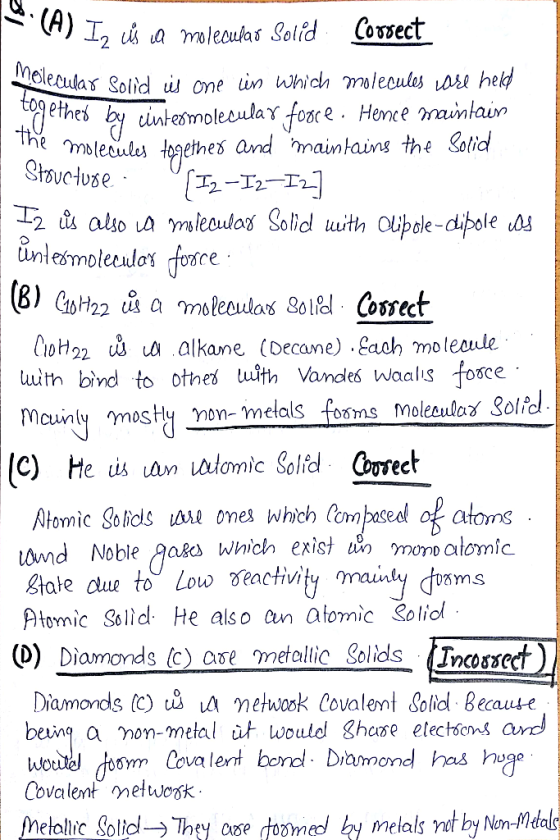
Identify the incorrect answer below.
A. I2 is a molecular solid.
B. C10H22 is a molecular solid.
C. He is an atomic solid.
D. Diamonds (C) are metallic solids.
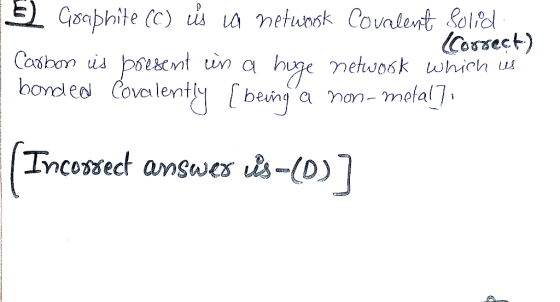
E. Graphite (C) is a network covalent solid.
Homework Answers
Solution.
Add Answer to:
Identify the incorrect answer below.
A. I2 is a molecular solid.
B. C10H22 is a molecular...
Identify the type of crystalline solid (metallic, network covalent, ionic, or molecular) formed by each of...
Identify the type of crystalline solid (metallic, network covalent, ionic, or molecular) formed by each of the following substances: a. Ti b. S8 c. KBr d. SiO2
For combination of the “type of solid” and specific example is incorrect? If you believe that...
For combination of the “type of solid” and specific example is incorrect? If you believe that (a)-(d) are correct, then select (e) as your answer. (a) Ionic / “table salt” (NaCl) (b) Metallic / copper wire (c) Molecular / “dry ice” (CO2) (d) Network covalent / cholesterol (C27H45OH) (e) All of the above combinations are correct
Hi, I need to double check my homework answer, need help with this. My answer is...
Hi, I need to double check my homework answer, need help with this. My answer is in bold: A) Which solids may exist in the solid state at room temperature? Ionic Solids, Molecular Solids, Metallic Solids, or Covalent Network Solids B) Which types of solids conduct electricity as pure solids (not aqueous)? Molecular Solids, Ionic Solids, Metallic Solids, or None of these C) What does the flat part of heating curves indicate? Gaseous states, Liquid states, Solid States, Phase transitions...
Identify the type of solid for argon. metallic atomic solid ionic solid nonbonding atomic solid molecular...
 Identify the type of solid for argon. metallic atomic solid ionic solid nonbonding atomic solid molecular solid networking atomic solid Rhodium has a face-centered cubic s radius?
Q6. HOCH2CH2OH(s) is classified as a/an: A. metallic crystal. B. covalent solid. C. molecular crystal....
 Q6. HOCH2CH2OH(s) is classified as a/an: A. metallic crystal. B. covalent solid. C. molecular crystal. D. amorphous solid. Q7. Magnesium oxide, MgO, melts at 2,800°C and is very hard. The liquid conducts electricity very well. What kind of crystal is this? A. Ionic Crystal B. Covalent Crystal C. Metallic Crystal D. Molecular Crystal Q8. Which one of the following substances will have both dispersion forces and dipole-dipole forces? A. HC B . Br2 D. H2 E. CO2 Q9. W(s) is classified as a/an A. metallic crystal. B. covalent...
A crystalline solid has a high melting point and is known to be held together with...
A crystalline solid has a high melting point and is known to be held together with covalent bonds. This solid is an example of _____. A. A network covalent solid B. An ionic solid C. A metallic solid D. A molecular solid
What type of solid does each of the following form? metallic, network, molecular, or ironic solid?...
What type of solid does each of the following form? metallic, network, molecular, or ironic solid? a) C6H12O6 b) C c) MgCO3 d) Zn e) N2O5 f) O2
1. Based on what you know about the characteristics of solids, classify the following solids as...
 1. Based on what you know about the characteristics of solids, classify the following solids as molecular, network, ionic, or metallic. a. Cu(s) b. H2O(s) c. Quartz (SiO2) d. Graphite (Cis) e. Sugar (C12H22O11)
1. type of solid choices -molecular, atomic, or ionic 2. force holding the solid together choices: dispersion,...
 1. type of solid choices -molecular, atomic,
or ionic
2. force holding the solid together choices: dispersion, dipole,
hydrogen boding, metallic bonding, ionic bonding, or covalent
bonding
3. melting point of solid: 1(highest),2, or. 3(lowest)
completely lost please help
O GASES, LIQUIDS AND SOLIDS Predicting the type of solid formed by a compound Decide what kind of crystalline solid each element or compound in the table forms, and what kind of force holds the solid together. Then, rank the solids in...
1. type of solid choices -molecular, atomic,
or ionic
2. force holding the solid together choices: dispersion, dipole,
hydrogen boding, metallic bonding, ionic bonding, or covalent
bonding
3. melting point of solid: 1(highest),2, or. 3(lowest)
completely lost please help
O GASES, LIQUIDS AND SOLIDS Predicting the type of solid formed by a compound Decide what kind of crystalline solid each element or compound in the table forms, and what kind of force holds the solid together. Then, rank the solids in...
We discussed different types of solid in this lesson. Which type of solid is chromium? A....
 We discussed different types of solid in this lesson. Which type of solid is chromium? A. metallic atomic solid B.covalent atomic solid C. ionic solid D. molecular solid E. nonbonding atomic solid
 Identify the type of solid for argon. metallic atomic solid ionic solid nonbonding atomic solid molecular solid networking atomic solid Rhodium has a face-centered cubic s radius?
 1. Based on what you know about the characteristics of solids, classify the following solids as molecular, network, ionic, or metallic. a. Cu(s) b. H2O(s) c. Quartz (SiO2) d. Graphite (Cis) e. Sugar (C12H22O11)
 1. type of solid choices -molecular, atomic,
or ionic
2. force holding the solid together choices: dispersion, dipole,
hydrogen boding, metallic bonding, ionic bonding, or covalent
bonding
3. melting point of solid: 1(highest),2, or. 3(lowest)
completely lost please help
O GASES, LIQUIDS AND SOLIDS Predicting the type of solid formed by a compound Decide what kind of crystalline solid each element or compound in the table forms, and what kind of force holds the solid together. Then, rank the solids in...
1. type of solid choices -molecular, atomic,
or ionic
2. force holding the solid together choices: dispersion, dipole,
hydrogen boding, metallic bonding, ionic bonding, or covalent
bonding
3. melting point of solid: 1(highest),2, or. 3(lowest)
completely lost please help
O GASES, LIQUIDS AND SOLIDS Predicting the type of solid formed by a compound Decide what kind of crystalline solid each element or compound in the table forms, and what kind of force holds the solid together. Then, rank the solids in...
 We discussed different types of solid in this lesson. Which type of solid is chromium? A. metallic atomic solid B.covalent atomic solid C. ionic solid D. molecular solid E. nonbonding atomic solid
Most questions answered within 3 hours.
-
Where is the error in this code sequence?
String s1 = "Hello";
String s2 = "ello";...
asked 10 months ago -
Financial data for Joel de Paris, Inc., for last year
follow:
Joel de Paris, Inc.
Balance...
asked 10 months ago -
Consider this reaction:
Al2(SO4)3 (aq)+ BaCl3
(aq) Al2Cl6 (aq)- +
3BaSO4(s) . What is the...
asked 10 months ago -
Suppose that Savneet is considering increasing her
recent random sample from 20 car rentals to 40...
asked 10 months ago -
Trucks arrive at an unloading terminal at an average rate of 120
per hour.
Trucks arrive...
asked 10 months ago -
Why are methanol and ethanol completely soluble in water while
octanol is not very little soluble....
asked 10 months ago -
A facilities manager at a university reads in a research report
that the mean amount of...
asked 10 months ago -
When the CuSO4 is rehydrated by adding water to the anhydrous
compound, is this an endothermic...
asked 10 months ago -
A ray of sunlight is passing from diamond into crown glass; the
angle of incidence is...
asked 10 months ago -
A block of mass 0.249 kg is placed on top of a light, vertical
spring of...
asked 10 months ago -
how do the kidneys compensate in the presences of acidosis
a) trigger hyperventilate
b) reserve acid...
asked 10 months ago -
Question 501 pts
The rental rate of capital to the firm increases. Which of the
following...
asked 10 months ago