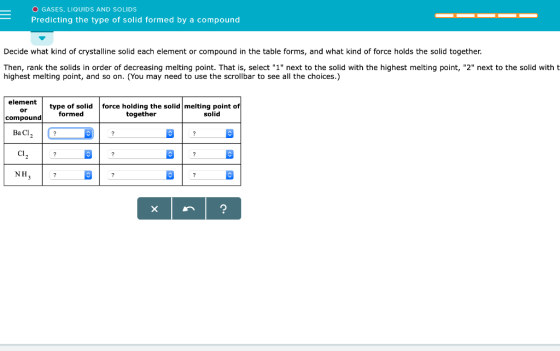
1. type of solid choices -molecular, atomic, or ionic
2. force holding the solid together choices: dispersion, dipole, hydrogen boding, metallic bonding, ionic bonding, or covalent bonding
3. melting point of solid: 1(highest),2, or. 3(lowest)
completely lost please help
Homework Answers
Request Answer!
We need at least 10 more requests to produce the answer.
0 / 10 have requested this problem solution
The more requests, the faster the answer.
Add Answer to:
1. type of solid choices -molecular, atomic,
or ionic
2. force holding the solid together choices: dispersion,...
Decide what kind of crystalline solid each element or compound in the table forms, and what kind of force holds the sol...
 Decide what kind of crystalline solid each element or compound in the table forms, and what kind of force holds the solid together Then, rank the solids in order of decreasing melting point. That is, select "1" next to the solid with the highest melting point, "2" next to the solid with the next highest melting point, and so on. (You may need to use the scrollbar to see all the choices.) element type of solid formed force holding the...
Decide what kind of crystalline solid each element or compound in the table forms, and what kind of force holds the solid together. Then, rank the solids in order of decreasing melting point....
 Decide what kind of crystalline solid each element or compound in the table forms, and what kind of force holds the solid together. Then, rank the solids in order of decreasing melting point. That Is, select "1" next to the solid with the highest melting point, "2" next to the solid w highest melting point, and so on. CYou may need to use the scrollbar to see all the choices.) type of solid force holding the solid melting point o...
Decide what kind of crystalline solid each element or compound in the table forms, and what kind of force holds the sol...
 Decide what kind of crystalline solid each element or compound in the table forms, and what kind of force holds the solid together. Then, rank the solids in order of decreasing melting point. That is, select "1" next to the solid with the highest melting point, "2" next to the solid with the next highest melting point, and so on. (You may need to use the scrollbar to see all the choices.) element or type of solid formed force holding...
Decide what kind of crystalline solid each element or compound in the table forms, and what...
 Decide what kind of crystalline solid each element or compound in the table forms, and what kind of force hoids the solid together. Then, rank the solids in order of decreasing melting point. That is, select "1, next to the solid with the highest melting point -2" next to the solid with the next highest melting point, and so on. (You may need to use the scrollbar to see all the choices.) type of solld force holding the solld melting...
1. For each of the following compounds, list the type of intermolecular forces holding it together...
1. For each of the following compounds, list the type of intermolecular forces holding it together and rank them in order from lowest to highest melting points: acetaldehyde, sodium formate, ethanol and propane 2. If the melting point of an unknown sample is 134oC, what is the best way to determine whether it is Cinnamic Acid (mp 133134oC) or Urea (mp 132135oC)? 3. What is the typical melting point range for a pure solid? 4. List three specific experimental errors...
9. The greatest gas solubility in water is predicted under what conditions? A) high T, high...
 9. The greatest gas solubility in water is predicted under what conditions? A) high T, high partial pressure C) low T, low P 8) high T, low P D) low T, high P Identify the type of interaction between atoms in a nonbonding atomic solid. A) polar bonding B) ionic bonding C) covalent bonding D) hydrogen bonding E) weak dispersion forces 10. 11. Identify the formula for silica. 12. Identify the element with the least band gap A) Lead B)...
Which of the following best describes London dispersion forces. Question 1 options: the intermolecular forces that...
Which of the following best describes London dispersion forces. Question 1 options: the intermolecular forces that exist when ions from an ionic compound are attracted to the dipole of polar molecules in a mixture. involves molecular orientations in which the positive end of one dipole is near the negative end of another forces that exist only between molecules that contain hydrogen atoms bonded to highly electronegative atoms such as O, N, F. Interactions between temporary dipoles cause atoms to be...
Separating a Mixture, Recrystallization, pre-lab assignment could you also explain why you chose that substance for...
 Separating a Mixture, Recrystallization, pre-lab
assignment
could you also explain why you chose that substance for the empty
spaces and question marks
EXPERIMENT 4 Pre-Lab Assignment Separating a Mixture, Recrystalliration Name Date 1. Complete the following flowchart which shows how to separate a mixture of sand, sodium chloride and acetanilide. Notice that after a separation process (a down arrow) the filtered solids are shown on the left and the filtrate (the liquid) is shown on the right. The terminal step...
Separating a Mixture, Recrystallization, pre-lab
assignment
could you also explain why you chose that substance for the empty
spaces and question marks
EXPERIMENT 4 Pre-Lab Assignment Separating a Mixture, Recrystalliration Name Date 1. Complete the following flowchart which shows how to separate a mixture of sand, sodium chloride and acetanilide. Notice that after a separation process (a down arrow) the filtered solids are shown on the left and the filtrate (the liquid) is shown on the right. The terminal step...
e. 18 Test Your Knowledge MULTIPLE CHOICE: Choose the one best answer. 1. Each element has...
 e. 18 Test Your Knowledge MULTIPLE CHOICE: Choose the one best answer. 1. Each element has its own characteristic atom in which a. the atomic mass is constant. b. the atomic number is constant. c. the mass number is constant. d. Two of the above are correct. e. All of the above are correct. 2. Which of the following is not a trace element in the human body? a. iodine b. zinc c. iron d. calcium e. fluorine 3. A...
 Decide what kind of crystalline solid each element or compound in the table forms, and what kind of force holds the solid together Then, rank the solids in order of decreasing melting point. That is, select "1" next to the solid with the highest melting point, "2" next to the solid with the next highest melting point, and so on. (You may need to use the scrollbar to see all the choices.) element type of solid formed force holding the...
 Decide what kind of crystalline solid each element or compound in the table forms, and what kind of force holds the solid together. Then, rank the solids in order of decreasing melting point. That Is, select "1" next to the solid with the highest melting point, "2" next to the solid w highest melting point, and so on. CYou may need to use the scrollbar to see all the choices.) type of solid force holding the solid melting point o...
 Decide what kind of crystalline solid each element or compound in the table forms, and what kind of force holds the solid together. Then, rank the solids in order of decreasing melting point. That is, select "1" next to the solid with the highest melting point, "2" next to the solid with the next highest melting point, and so on. (You may need to use the scrollbar to see all the choices.) element or type of solid formed force holding...
 Decide what kind of crystalline solid each element or compound in the table forms, and what kind of force hoids the solid together. Then, rank the solids in order of decreasing melting point. That is, select "1, next to the solid with the highest melting point -2" next to the solid with the next highest melting point, and so on. (You may need to use the scrollbar to see all the choices.) type of solld force holding the solld melting...
 9. The greatest gas solubility in water is predicted under what conditions? A) high T, high partial pressure C) low T, low P 8) high T, low P D) low T, high P Identify the type of interaction between atoms in a nonbonding atomic solid. A) polar bonding B) ionic bonding C) covalent bonding D) hydrogen bonding E) weak dispersion forces 10. 11. Identify the formula for silica. 12. Identify the element with the least band gap A) Lead B)...
 Separating a Mixture, Recrystallization, pre-lab
assignment
could you also explain why you chose that substance for the empty
spaces and question marks
EXPERIMENT 4 Pre-Lab Assignment Separating a Mixture, Recrystalliration Name Date 1. Complete the following flowchart which shows how to separate a mixture of sand, sodium chloride and acetanilide. Notice that after a separation process (a down arrow) the filtered solids are shown on the left and the filtrate (the liquid) is shown on the right. The terminal step...
Separating a Mixture, Recrystallization, pre-lab
assignment
could you also explain why you chose that substance for the empty
spaces and question marks
EXPERIMENT 4 Pre-Lab Assignment Separating a Mixture, Recrystalliration Name Date 1. Complete the following flowchart which shows how to separate a mixture of sand, sodium chloride and acetanilide. Notice that after a separation process (a down arrow) the filtered solids are shown on the left and the filtrate (the liquid) is shown on the right. The terminal step...
 e. 18 Test Your Knowledge MULTIPLE CHOICE: Choose the one best answer. 1. Each element has its own characteristic atom in which a. the atomic mass is constant. b. the atomic number is constant. c. the mass number is constant. d. Two of the above are correct. e. All of the above are correct. 2. Which of the following is not a trace element in the human body? a. iodine b. zinc c. iron d. calcium e. fluorine 3. A...
Most questions answered within 3 hours.
-
Where is the error in this code sequence?
String s1 = "Hello";
String s2 = "ello";...
asked 10 months ago -
Financial data for Joel de Paris, Inc., for last year
follow:
Joel de Paris, Inc.
Balance...
asked 10 months ago -
Consider this reaction:
Al2(SO4)3 (aq)+ BaCl3
(aq) Al2Cl6 (aq)- +
3BaSO4(s) . What is the...
asked 10 months ago -
Suppose that Savneet is considering increasing her
recent random sample from 20 car rentals to 40...
asked 10 months ago -
Trucks arrive at an unloading terminal at an average rate of 120
per hour.
Trucks arrive...
asked 10 months ago -
Why are methanol and ethanol completely soluble in water while
octanol is not very little soluble....
asked 10 months ago -
A facilities manager at a university reads in a research report
that the mean amount of...
asked 10 months ago -
When the CuSO4 is rehydrated by adding water to the anhydrous
compound, is this an endothermic...
asked 10 months ago -
A ray of sunlight is passing from diamond into crown glass; the
angle of incidence is...
asked 10 months ago -
A block of mass 0.249 kg is placed on top of a light, vertical
spring of...
asked 10 months ago -
how do the kidneys compensate in the presences of acidosis
a) trigger hyperventilate
b) reserve acid...
asked 10 months ago -
Question 501 pts
The rental rate of capital to the firm increases. Which of the
following...
asked 10 months ago