1. For each of the following compounds, list the type of intermolecular forces holding it together...
1. For each of the following compounds, list the type of intermolecular forces holding it together and rank them in order from lowest to highest melting points: acetaldehyde, sodium formate, ethanol and propane
2. If the melting point of an unknown sample is 134oC, what is the best way to determine whether it is Cinnamic Acid (mp 133134oC) or Urea (mp 132135oC)?
3. What is the typical melting point range for a pure solid?
4. List three specific experimental errors that could cause your melting point to be inaccurate.
Homework Answers
Acetaldehyde has dipole - dipole interactions among its molecules
Sodium formate has electrostatic interactions among sodium and formate ions
Ethanol has intermolecular hydrogen bonds among its molecules.
Propane has weak Lodon forces among its molecules.
NOW,
The strength of inter molecular forces is,
Lodon forces < dipole - dipole interactions < hydrogen bond < ionic bond
SO, the the increasing order of melting points is,
Propane < Acetaldehyde < Ethanol < Sodium formate
2.
The melting point of unknown compound is very close to the melting of Cinnamic acid.
Hence the unknown compound is Cinnamic acid.
3.
For pure solid the melting point range should be less than over 2 degree C
4.
Presence of impurity.
Equipment error
Handling error
Add Answer to:
1. For each of the following compounds, list the type of
intermolecular forces holding it together...
List the following five compounds, ethanamide, 1-propanol, methyl formate, acetic acid, and propanenitrile, in order of...
 List the following five compounds, ethanamide, 1-propanol,
methyl formate, acetic acid, and propanenitrile, in order of
decreasing boiling point. Start with the highest boiling
compound.
Rank the following compounds from compound with highest boiling
point to compound with lowest boiling point. To rank items as
equivalent, overlap them.
List the following five compounds, ethanamide, 1-propanol, methyl formate, acetic acid, and propanenitrile, in order of decreasing boiling point. Start with the highest boiling compound Rank the following compounds from compound with...
List the following five compounds, ethanamide, 1-propanol,
methyl formate, acetic acid, and propanenitrile, in order of
decreasing boiling point. Start with the highest boiling
compound.
Rank the following compounds from compound with highest boiling
point to compound with lowest boiling point. To rank items as
equivalent, overlap them.
List the following five compounds, ethanamide, 1-propanol, methyl formate, acetic acid, and propanenitrile, in order of decreasing boiling point. Start with the highest boiling compound Rank the following compounds from compound with...
7. (10 pts) List the intermolecular forces between the compounds in the previous problem and water....
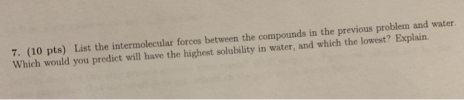 7. (10 pts) List the intermolecular forces between the compounds in the previous problem and water. ict will have the highest solubility in water, and which the lowest? Explain
1. type of solid choices -molecular, atomic, or ionic 2. force holding the solid together choices: dispersion,...
 1. type of solid choices -molecular, atomic,
or ionic
2. force holding the solid together choices: dispersion, dipole,
hydrogen boding, metallic bonding, ionic bonding, or covalent
bonding
3. melting point of solid: 1(highest),2, or. 3(lowest)
completely lost please help
O GASES, LIQUIDS AND SOLIDS Predicting the type of solid formed by a compound Decide what kind of crystalline solid each element or compound in the table forms, and what kind of force holds the solid together. Then, rank the solids in...
1. type of solid choices -molecular, atomic,
or ionic
2. force holding the solid together choices: dispersion, dipole,
hydrogen boding, metallic bonding, ionic bonding, or covalent
bonding
3. melting point of solid: 1(highest),2, or. 3(lowest)
completely lost please help
O GASES, LIQUIDS AND SOLIDS Predicting the type of solid formed by a compound Decide what kind of crystalline solid each element or compound in the table forms, and what kind of force holds the solid together. Then, rank the solids in...
INTERMOLECULAR FORCES INTRODUCTION LEARNING OBJECTIVES To relate the effecet of intermolecular fo...
 INTERMOLECULAR FORCES INTRODUCTION LEARNING OBJECTIVES To relate the effecet of intermolecular forces on relative melting points and vapour pressures of some organic substances THEORY Weak attractive forces that occur between individual molecules in substances are called intermolecular forces. These include London dispersion forces, dipole-dipole forces and hydrogen-bonding forces. Collectively, the three types of intermolecular forces are referred to as Van der Waals forces. These attractive forces are much weaker than the chemical bonds between atoms in a molecule. Note that...
1. What type of intermolecular force is predominant in the following two compounds? H3C -C-CH3 H3C-...
 1. What type of intermolecular force is predominant in the following two compounds? H3C -C-CH3 H3C- CH-CH (3 points) 2. Hydrazine (NH2NH2), hydrogen peroxide (HooH), and water (H20) all have higher boiling points in comparison with other substances of comparable molecular weights. What structural property do these substances have in common, and how might that account for (4 points) their high boiling points? 3. The most significant factor which is responsible for the higher boiling point of ethanol C2H5OH, compared...
What type(s) of intermolecular forces are expected between SO2Cl2 molecules? ball & stick V - labels...
 What type(s) of intermolecular forces are expected between SO2Cl2 molecules? ball & stick V - labels Indicate with a Y (yes) or an N (no) which apply. dipole forces induced dipole forces hydrogen bonding What type(s) of intermolecular forces are expected between PC13 molecules? Choose all that apply dispersion hydrogen bonding dipole-dipole ion-ion What type(s) of intermolecular forces are expected between H20 molecules? ball & stick v + labels Indicate with a Y (yes) or an N (no) which apply....
*Explanations should be brief. Draw a box around each final answer, if applicable.* 1. Consider intermolecular...
 *Explanations should be brief. Draw a box around each final answer, if applicable.* 1. Consider intermolecular forces and kinetic energies with respect to a solid and a liquid. Explain why molecules in a liquid are free to move past each other, while molecules in a solid are held in fixed positions. 2. Use your knowledge of intermolecular forces to provide an explanation for why the boiling point of 2-hexanol is higher than the boiling point of 2,3-dimethyl-2-butanol. Be sure to...
1. Which of the following compounds should be soluble in CC14? a) Naci b ) H20...
 1. Which of the following compounds should be soluble in CC14? a) Naci b ) H20 c) NaOH d) C3H18 e) None of these 2. with increasing CO2 pressure and_ with The solubility of carbon dioxide gas in water increasing temperature. a) increases, increases b) increases, decreases c) decreases, increases d) decreases, decreases e) remains constant, decreases 3. Pressure . Based on the Raoult's Law plot for a mixture of liquids A and B shown on the right, which of...
6. Provide the IUPAC names for the compounds below Name: 7. Draw the following: cis-1-isobutyl-2-propyleyclopentane 8....
 6. Provide the IUPAC names for the compounds below Name: 7. Draw the following: cis-1-isobutyl-2-propyleyclopentane 8. Label the indicated atoms in the structure below as 1º, 2º, 3º, or 4º. PB A A B co 9. Draw Newman projections for the day-diethylane about the C4CS bond, Circle the most stable conforme if you need additional space, please feel free to the backside of this paper 10. Draw the chair conformation and ring-flip for the given compound. Calculate the sterie strain...
 List the following five compounds, ethanamide, 1-propanol,
methyl formate, acetic acid, and propanenitrile, in order of
decreasing boiling point. Start with the highest boiling
compound.
Rank the following compounds from compound with highest boiling
point to compound with lowest boiling point. To rank items as
equivalent, overlap them.
List the following five compounds, ethanamide, 1-propanol, methyl formate, acetic acid, and propanenitrile, in order of decreasing boiling point. Start with the highest boiling compound Rank the following compounds from compound with...
List the following five compounds, ethanamide, 1-propanol,
methyl formate, acetic acid, and propanenitrile, in order of
decreasing boiling point. Start with the highest boiling
compound.
Rank the following compounds from compound with highest boiling
point to compound with lowest boiling point. To rank items as
equivalent, overlap them.
List the following five compounds, ethanamide, 1-propanol, methyl formate, acetic acid, and propanenitrile, in order of decreasing boiling point. Start with the highest boiling compound Rank the following compounds from compound with...
 7. (10 pts) List the intermolecular forces between the compounds in the previous problem and water. ict will have the highest solubility in water, and which the lowest? Explain
 1. type of solid choices -molecular, atomic,
or ionic
2. force holding the solid together choices: dispersion, dipole,
hydrogen boding, metallic bonding, ionic bonding, or covalent
bonding
3. melting point of solid: 1(highest),2, or. 3(lowest)
completely lost please help
O GASES, LIQUIDS AND SOLIDS Predicting the type of solid formed by a compound Decide what kind of crystalline solid each element or compound in the table forms, and what kind of force holds the solid together. Then, rank the solids in...
1. type of solid choices -molecular, atomic,
or ionic
2. force holding the solid together choices: dispersion, dipole,
hydrogen boding, metallic bonding, ionic bonding, or covalent
bonding
3. melting point of solid: 1(highest),2, or. 3(lowest)
completely lost please help
O GASES, LIQUIDS AND SOLIDS Predicting the type of solid formed by a compound Decide what kind of crystalline solid each element or compound in the table forms, and what kind of force holds the solid together. Then, rank the solids in...
 INTERMOLECULAR FORCES INTRODUCTION LEARNING OBJECTIVES To relate the effecet of intermolecular forces on relative melting points and vapour pressures of some organic substances THEORY Weak attractive forces that occur between individual molecules in substances are called intermolecular forces. These include London dispersion forces, dipole-dipole forces and hydrogen-bonding forces. Collectively, the three types of intermolecular forces are referred to as Van der Waals forces. These attractive forces are much weaker than the chemical bonds between atoms in a molecule. Note that...
 1. What type of intermolecular force is predominant in the following two compounds? H3C -C-CH3 H3C- CH-CH (3 points) 2. Hydrazine (NH2NH2), hydrogen peroxide (HooH), and water (H20) all have higher boiling points in comparison with other substances of comparable molecular weights. What structural property do these substances have in common, and how might that account for (4 points) their high boiling points? 3. The most significant factor which is responsible for the higher boiling point of ethanol C2H5OH, compared...
 What type(s) of intermolecular forces are expected between SO2Cl2 molecules? ball & stick V - labels Indicate with a Y (yes) or an N (no) which apply. dipole forces induced dipole forces hydrogen bonding What type(s) of intermolecular forces are expected between PC13 molecules? Choose all that apply dispersion hydrogen bonding dipole-dipole ion-ion What type(s) of intermolecular forces are expected between H20 molecules? ball & stick v + labels Indicate with a Y (yes) or an N (no) which apply....
 *Explanations should be brief. Draw a box around each final answer, if applicable.* 1. Consider intermolecular forces and kinetic energies with respect to a solid and a liquid. Explain why molecules in a liquid are free to move past each other, while molecules in a solid are held in fixed positions. 2. Use your knowledge of intermolecular forces to provide an explanation for why the boiling point of 2-hexanol is higher than the boiling point of 2,3-dimethyl-2-butanol. Be sure to...
 1. Which of the following compounds should be soluble in CC14? a) Naci b ) H20 c) NaOH d) C3H18 e) None of these 2. with increasing CO2 pressure and_ with The solubility of carbon dioxide gas in water increasing temperature. a) increases, increases b) increases, decreases c) decreases, increases d) decreases, decreases e) remains constant, decreases 3. Pressure . Based on the Raoult's Law plot for a mixture of liquids A and B shown on the right, which of...
 6. Provide the IUPAC names for the compounds below Name: 7. Draw the following: cis-1-isobutyl-2-propyleyclopentane 8. Label the indicated atoms in the structure below as 1º, 2º, 3º, or 4º. PB A A B co 9. Draw Newman projections for the day-diethylane about the C4CS bond, Circle the most stable conforme if you need additional space, please feel free to the backside of this paper 10. Draw the chair conformation and ring-flip for the given compound. Calculate the sterie strain...
Most questions answered within 3 hours.
-
Where is the error in this code sequence?
String s1 = "Hello";
String s2 = "ello";...
asked 11 months ago -
Financial data for Joel de Paris, Inc., for last year
follow:
Joel de Paris, Inc.
Balance...
asked 11 months ago -
Consider this reaction:
Al2(SO4)3 (aq)+ BaCl3
(aq) Al2Cl6 (aq)- +
3BaSO4(s) . What is the...
asked 11 months ago -
Suppose that Savneet is considering increasing her
recent random sample from 20 car rentals to 40...
asked 11 months ago -
Trucks arrive at an unloading terminal at an average rate of 120
per hour.
Trucks arrive...
asked 11 months ago -
Why are methanol and ethanol completely soluble in water while
octanol is not very little soluble....
asked 11 months ago -
A facilities manager at a university reads in a research report
that the mean amount of...
asked 11 months ago -
When the CuSO4 is rehydrated by adding water to the anhydrous
compound, is this an endothermic...
asked 11 months ago -
A ray of sunlight is passing from diamond into crown glass; the
angle of incidence is...
asked 11 months ago -
A block of mass 0.249 kg is placed on top of a light, vertical
spring of...
asked 11 months ago -
how do the kidneys compensate in the presences of acidosis
a) trigger hyperventilate
b) reserve acid...
asked 11 months ago -
Question 501 pts
The rental rate of capital to the firm increases. Which of the
following...
asked 11 months ago