
Homework Answers
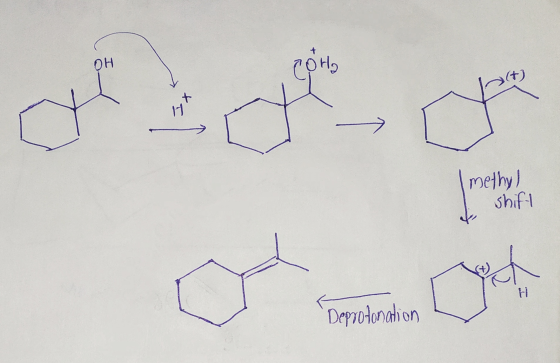
Answer: A. a methyl 1,2-shift
In this reaction, a secondary carbocation is formed after the removal of water. Which under go a methyl shift in order to result a more stable tertiary carbon cation. And then the removal of proton take place to form corresponding alkene. Mechanism of the formation of major product for the following reaction is given below.
Add Answer to:
28. Before the alcohol shown undergoes alkene formation, what will occur prior to proton loss? H.SO...
A. loss of leaving group B. proton transfer C. nucleophilic addition D. methyl shift E. hydride...
 A. loss of leaving group
B. proton transfer
C. nucleophilic addition
D. methyl shift
E. hydride shift
Identify the arrow pushing mechanism shown. The new bond that is formed is shown in red.
A. loss of leaving group
B. proton transfer
C. nucleophilic addition
D. methyl shift
E. hydride shift
Identify the arrow pushing mechanism shown. The new bond that is formed is shown in red.
Identify the arrow pushing mechanism shown. o A loss of a leaving group proton transfer O...
 Identify the arrow pushing mechanism shown. o A loss of a leaving group proton transfer O C nucleophilic addition (also called nucleophilic attack) OD methyl shift O E hydride shift
31. What is the best term to describe the rearrangement that causes the formation of 2-methyl-2-butanol...
 31. What is the best term to describe the rearrangement that causes the formation of 2-methyl-2-butanol from methylbutane? (a) 1,2-hydride shift (b) 1,3-hydride shift (c) 1,2-tectonic shift (d) 1,3-methyl shift 32. What stereochemistry is needed for an E2 reaction? (a) Anti-coplanar arrangement with H and X on adjacent carbons. (b) Syn-coplanar arrangement with H and X in adjacent carbons. (c) Hand X are on the same carbon. (d) H and X are two carbons apart. 33. What conditions are best...
1.1 What is the equation for the rate of formation of tert-butyl alcohol from the reaction...
 1.1 What is the equation for the rate of formation of tert-butyl
alcohol from the reaction of tert-butyl bromide (t-BuBr) with water
by an SN1 mechanism?
A. Rate= k[t-BuBr]
B Rate=k[ t-BuBr][H2O]
C. Rate=k[ H2O]
D. Rate=k[t-BuBr]^2
1.2 What is the equation for the rate of formation of
1-iodobutane from the reaction of 1-chlorobutane (BuCl) with NaI by
an SN2 mechanism?
A. Rate=k[BuCl]
B. Rate=k[BuCl][NaI]
C. Rate=k[NaI]
D. Rate=k[BuCl]^2
1.3 What is the equation for the rate of formation of...
1.1 What is the equation for the rate of formation of tert-butyl
alcohol from the reaction of tert-butyl bromide (t-BuBr) with water
by an SN1 mechanism?
A. Rate= k[t-BuBr]
B Rate=k[ t-BuBr][H2O]
C. Rate=k[ H2O]
D. Rate=k[t-BuBr]^2
1.2 What is the equation for the rate of formation of
1-iodobutane from the reaction of 1-chlorobutane (BuCl) with NaI by
an SN2 mechanism?
A. Rate=k[BuCl]
B. Rate=k[BuCl][NaI]
C. Rate=k[NaI]
D. Rate=k[BuCl]^2
1.3 What is the equation for the rate of formation of...
Chemistry 2401 Experiment 7 Acid Catalyzed Dehydration of 3.3-Dimethyl-2-Butanol with Rearrangement Experiment 7 Pre-lab Assignment Dehydration...
 Chemistry 2401 Experiment 7 Acid Catalyzed Dehydration of 3.3-Dimethyl-2-Butanol with Rearrangement Experiment 7 Pre-lab Assignment Dehydration of 3,3-Dimethyl-2-Butanol 1. Draw the structures of all the expected products from the following reactions: a) 3-methyl-3-pentanol + H = b)2-methylcyclohexanol + H - c) 2-methyl-2-butanol + H - d) 2,2-dimethylcyclohexanol + H = This reaction will give a complex mixture of products, since rearrangements can occur. Show the full mechanism for this reaction and how the possible products can form from the carbocation...
ASU important unanisWL before leaving class d draw the carbocation od the alkene shown below. ebo...
 ASU important unanisWL before leaving class d draw the carbocation od the alkene shown below. ebo BroUDU 52 Additional Questions: 16. a) Use curved arrows to illustrate electron movement, and drawi intermediate first formed from the reaction of HBr and the alke Toro 15 OD 901 915 Molebo Br + HBr om ni + HBO B oobs 3 dezodos los bruogma of babbsalo D o no sol bbs Hmont Hori bib node Vods wens OV no bag o ubora 2010...
Alkene reaction and mechanisms practice exercise 1) O₃ 2) (CH3)2S 25) Treatment of cyclopentene with peroxybenzoic...
 Alkene reaction and mechanisms practice exercise
1) O₃ 2) (CH3)2S 25) Treatment of cyclopentene with peroxybenzoic acid A) results in oxidative cleavage of the ring to produce an acyclic compound B) yields a meso epoxide C) yields an equimolar mixture of enantiomeric epoxides D) gives the same product as treatment of cyclopentene with Os04 E) none of the above 26) Provide a detailed, step-by-step mechanism for the reaction shown below. но Br2 na + HBT Br 27) Provide a detailed,...
Alkene reaction and mechanisms practice exercise
1) O₃ 2) (CH3)2S 25) Treatment of cyclopentene with peroxybenzoic acid A) results in oxidative cleavage of the ring to produce an acyclic compound B) yields a meso epoxide C) yields an equimolar mixture of enantiomeric epoxides D) gives the same product as treatment of cyclopentene with Os04 E) none of the above 26) Provide a detailed, step-by-step mechanism for the reaction shown below. но Br2 na + HBT Br 27) Provide a detailed,...
(C) Protonation of alkene to form a carbocation followed by addition of bromide ion (D) Addition...
 (C) Protonation of alkene to form a carbocation followed by addition of bromide ion (D) Addition of the proton to one face of the alkene with simultaneous delivery of a bromide ion from a different molecule of H-Br. 11. Which compound is the strongest nmucleophile for reaction of methane methanesulfonate (CHOS0.CH) in methanol at room temperature? (You may assume that everything is soluble in methanol) (A) potassium bromide (B) cesium iodide (C) sodiam chloride (D) lithium flaoride 12. Which proton...
Chapter 11: 1. What is a prime rule in naming alkenes? a. Find the longest carbon...
Chapter 11: 1. What is a prime rule in naming alkenes? a. Find the longest carbon chain. b.Find the longest carbon chain containing the alkene. c. Find whether the alkene has a cis- or trans- configuration. d.Find how far the alkene functionality is from either end. 2. What is the IUPAC name of the following alkene? a. cis-5-methyl-2-heptene b. trans-2-ethyl-4-hexene c. trans-5-methyl-2-heptene d. trans-3-methyl-5-heptene 3. What is the hybridization, geometry, and bond angle of the carbon marked by an asterisk?...
What results when a secondary alcohol is oxidized? a. a ketone d. an acid b. an...
 What results when a secondary alcohol is oxidized? a. a ketone d. an acid b. an amine e. no reaction c. an aldehyde Which of the following combinations will react spontaneously? A. 12 + Cu2+ B. Pb2+ + Ag C. Zn2+ + Mg D. Sn2+ + Ni2+ The general formula for a cycloalkane can be represented by which of the following? a. C,H, C. CH b. C.H2n+2 d. C.H21-2 In a certain reaction AH =-136 kJ and E, = 96...
 A. loss of leaving group
B. proton transfer
C. nucleophilic addition
D. methyl shift
E. hydride shift
Identify the arrow pushing mechanism shown. The new bond that is formed is shown in red.
A. loss of leaving group
B. proton transfer
C. nucleophilic addition
D. methyl shift
E. hydride shift
Identify the arrow pushing mechanism shown. The new bond that is formed is shown in red.
 Identify the arrow pushing mechanism shown. o A loss of a leaving group proton transfer O C nucleophilic addition (also called nucleophilic attack) OD methyl shift O E hydride shift
 31. What is the best term to describe the rearrangement that causes the formation of 2-methyl-2-butanol from methylbutane? (a) 1,2-hydride shift (b) 1,3-hydride shift (c) 1,2-tectonic shift (d) 1,3-methyl shift 32. What stereochemistry is needed for an E2 reaction? (a) Anti-coplanar arrangement with H and X on adjacent carbons. (b) Syn-coplanar arrangement with H and X in adjacent carbons. (c) Hand X are on the same carbon. (d) H and X are two carbons apart. 33. What conditions are best...
 1.1 What is the equation for the rate of formation of tert-butyl
alcohol from the reaction of tert-butyl bromide (t-BuBr) with water
by an SN1 mechanism?
A. Rate= k[t-BuBr]
B Rate=k[ t-BuBr][H2O]
C. Rate=k[ H2O]
D. Rate=k[t-BuBr]^2
1.2 What is the equation for the rate of formation of
1-iodobutane from the reaction of 1-chlorobutane (BuCl) with NaI by
an SN2 mechanism?
A. Rate=k[BuCl]
B. Rate=k[BuCl][NaI]
C. Rate=k[NaI]
D. Rate=k[BuCl]^2
1.3 What is the equation for the rate of formation of...
1.1 What is the equation for the rate of formation of tert-butyl
alcohol from the reaction of tert-butyl bromide (t-BuBr) with water
by an SN1 mechanism?
A. Rate= k[t-BuBr]
B Rate=k[ t-BuBr][H2O]
C. Rate=k[ H2O]
D. Rate=k[t-BuBr]^2
1.2 What is the equation for the rate of formation of
1-iodobutane from the reaction of 1-chlorobutane (BuCl) with NaI by
an SN2 mechanism?
A. Rate=k[BuCl]
B. Rate=k[BuCl][NaI]
C. Rate=k[NaI]
D. Rate=k[BuCl]^2
1.3 What is the equation for the rate of formation of...
 Chemistry 2401 Experiment 7 Acid Catalyzed Dehydration of 3.3-Dimethyl-2-Butanol with Rearrangement Experiment 7 Pre-lab Assignment Dehydration of 3,3-Dimethyl-2-Butanol 1. Draw the structures of all the expected products from the following reactions: a) 3-methyl-3-pentanol + H = b)2-methylcyclohexanol + H - c) 2-methyl-2-butanol + H - d) 2,2-dimethylcyclohexanol + H = This reaction will give a complex mixture of products, since rearrangements can occur. Show the full mechanism for this reaction and how the possible products can form from the carbocation...
 ASU important unanisWL before leaving class d draw the carbocation od the alkene shown below. ebo BroUDU 52 Additional Questions: 16. a) Use curved arrows to illustrate electron movement, and drawi intermediate first formed from the reaction of HBr and the alke Toro 15 OD 901 915 Molebo Br + HBr om ni + HBO B oobs 3 dezodos los bruogma of babbsalo D o no sol bbs Hmont Hori bib node Vods wens OV no bag o ubora 2010...
 Alkene reaction and mechanisms practice exercise
1) O₃ 2) (CH3)2S 25) Treatment of cyclopentene with peroxybenzoic acid A) results in oxidative cleavage of the ring to produce an acyclic compound B) yields a meso epoxide C) yields an equimolar mixture of enantiomeric epoxides D) gives the same product as treatment of cyclopentene with Os04 E) none of the above 26) Provide a detailed, step-by-step mechanism for the reaction shown below. но Br2 na + HBT Br 27) Provide a detailed,...
Alkene reaction and mechanisms practice exercise
1) O₃ 2) (CH3)2S 25) Treatment of cyclopentene with peroxybenzoic acid A) results in oxidative cleavage of the ring to produce an acyclic compound B) yields a meso epoxide C) yields an equimolar mixture of enantiomeric epoxides D) gives the same product as treatment of cyclopentene with Os04 E) none of the above 26) Provide a detailed, step-by-step mechanism for the reaction shown below. но Br2 na + HBT Br 27) Provide a detailed,...
 (C) Protonation of alkene to form a carbocation followed by addition of bromide ion (D) Addition of the proton to one face of the alkene with simultaneous delivery of a bromide ion from a different molecule of H-Br. 11. Which compound is the strongest nmucleophile for reaction of methane methanesulfonate (CHOS0.CH) in methanol at room temperature? (You may assume that everything is soluble in methanol) (A) potassium bromide (B) cesium iodide (C) sodiam chloride (D) lithium flaoride 12. Which proton...
 What results when a secondary alcohol is oxidized? a. a ketone d. an acid b. an amine e. no reaction c. an aldehyde Which of the following combinations will react spontaneously? A. 12 + Cu2+ B. Pb2+ + Ag C. Zn2+ + Mg D. Sn2+ + Ni2+ The general formula for a cycloalkane can be represented by which of the following? a. C,H, C. CH b. C.H2n+2 d. C.H21-2 In a certain reaction AH =-136 kJ and E, = 96...
Most questions answered within 3 hours.
-
Where is the error in this code sequence?
String s1 = "Hello";
String s2 = "ello";...
asked 10 months ago -
Financial data for Joel de Paris, Inc., for last year
follow:
Joel de Paris, Inc.
Balance...
asked 10 months ago -
Consider this reaction:
Al2(SO4)3 (aq)+ BaCl3
(aq) Al2Cl6 (aq)- +
3BaSO4(s) . What is the...
asked 10 months ago -
Suppose that Savneet is considering increasing her
recent random sample from 20 car rentals to 40...
asked 10 months ago -
Trucks arrive at an unloading terminal at an average rate of 120
per hour.
Trucks arrive...
asked 10 months ago -
Why are methanol and ethanol completely soluble in water while
octanol is not very little soluble....
asked 10 months ago -
A facilities manager at a university reads in a research report
that the mean amount of...
asked 10 months ago -
When the CuSO4 is rehydrated by adding water to the anhydrous
compound, is this an endothermic...
asked 10 months ago -
A ray of sunlight is passing from diamond into crown glass; the
angle of incidence is...
asked 10 months ago -
A block of mass 0.249 kg is placed on top of a light, vertical
spring of...
asked 10 months ago -
how do the kidneys compensate in the presences of acidosis
a) trigger hyperventilate
b) reserve acid...
asked 10 months ago -
Question 501 pts
The rental rate of capital to the firm increases. Which of the
following...
asked 10 months ago