
Homework Answers
Usually organic compounds are insoluble in water.
Insoluble in water- organic
Ionic bonds are seen in inorganic compounds.
Ionic bonds- inorganic
Inorganic compounds contain metal
Contains metal atoms - inorganic
Organic compounds have covalent bonds formed by sharing of electrons between atoms.
Covalent bond- organic
Organic compounds are flammable
Thus, flammable- organic
Ionic compounds are formed due to electrostatic force of attraction between the ions. Thus, they have high melting point.
High melting point- inorganic.
Add Answer to:
insoluble in water ionic bonds contains metal atoms covalent bonds flammable high melting point organic inorganic
Inorganic Compounds Organic Compounds Property Bonding within molecules mostly Covalent Many are ionic Some covalent Forces...
 Inorganic Compounds Organic Compounds Property Bonding within molecules mostly Covalent Many are ionic Some covalent Forces between molecules Normal physical state Flammability High Not Low Most are Soluable Solubility in water soluble Conductivity Rates of chemical reactions
In water, the melting point is unusually high because of O the heat content of the...
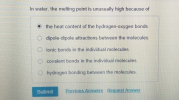 In water, the melting point is unusually high because of O the heat content of the hydrogen-oxygen bonds. O dipole-dipole attractions between the molecules. ionic bonds in the individual molecules. covalent bonds in the individual molecules. O hydrogen bonding between the molecules. Submit Previous Answers Request Answer
Organic compounds are always polar and dissolve in water True False Question 2 1 pts Inorganic...
 Organic compounds are always polar and dissolve in water True False Question 2 1 pts Inorganic salts are usually polar and soluble in water O True False Question 3 1 pts What kind of bonds do we usually find in organic hydrocarbons? non polar covalent bonds polar covalent bonds polar ionic bonds coordinated bonds
Why are most organic compounds nonconducting and insoluble in water? Check all that apply. They don't...
Why are most organic compounds nonconducting and insoluble in water? Check all that apply. They don't conduct electricity because they are covalent, not ionic. Most organic compounds don't dissolve in water because they are polar. Most organic compounds don't dissolve in water because they are nonpolar. They don't conduct electricity because they are ionic, not covalent.
AJ by oxygen Donas Bjoy nyarogen bonas ionic bonds D) by nonpolar covalent bonds Coy E)...
 AJ by oxygen Donas Bjoy nyarogen bonas ionic bonds D) by nonpolar covalent bonds Coy E) by isotopes 29) Which answer below best describes H,0? A) Water molecule bonds are ionic bonds, in which electrons are gained and lost to create the bond. B) Water molecule bonds are oxygen bonds, in which oxygen atoms form bonds together. C) Water molecule bonds are polar covalent bonds, in which unequal sharing of electrons occurs. D) Water molecule bonds are nonpolar covalent bonds,...
Determine if each of the statements is true or false. 1) K2SO4 contains both polar covalent bonds and ionic bonds....
 Determine if each of the statements is true or false. 1) K2SO4 contains both polar covalent bonds and ionic bonds. [ Select ] 2) A covalent bond is formed through the transfer of electrons from one atom to another. True 3) When two atoms form a chemical bond, they lower the potential energy between the bonding atoms or ions. (Select]
A crystalline solid has a high melting point and is known to be held together with...
A crystalline solid has a high melting point and is known to be held together with covalent bonds. This solid is an example of _____. A. A network covalent solid B. An ionic solid C. A metallic solid D. A molecular solid
Classify each substance in the table as either an atomic, metallic, ionic, molecular, or covalent network...
 Classify each substance in the table as either an atomic, metallic, ionic, molecular, or covalent network solid: Electrical Conductivity Solubility in Water insoluble insoluble Substance Melting Point Appearance lustrous, malleable soft, white 1500 °C high X poor - 157.2 ° C 113 °C 800 °C soft, yellow hard, white insoluble soluble Y none only if melted/dissolved Z Z = W = X = Y =
Question 3 1 pts Ionic bonds form due to of electrons between bonded atoms. Covalent bonds...
 Question 3 1 pts Ionic bonds form due to of electrons between bonded atoms. Covalent bonds form due to of electrons between bonded atoms. Question 4 1 pts Polar covalent bonds have a difference in electronegativity between and
Ammonium bicarbonate, NH4HCO3, contains both ionic and covalent bonds. Draw the Lewis structure of this compound....
Ammonium bicarbonate, NH4HCO3, contains both ionic and covalent bonds. Draw the Lewis structure of this compound. Explicitly draw all H atoms. Draw cations and anions in separate sketchers. Do not use the square brackets tool in your answer.
 Inorganic Compounds Organic Compounds Property Bonding within molecules mostly Covalent Many are ionic Some covalent Forces between molecules Normal physical state Flammability High Not Low Most are Soluable Solubility in water soluble Conductivity Rates of chemical reactions
 In water, the melting point is unusually high because of O the heat content of the hydrogen-oxygen bonds. O dipole-dipole attractions between the molecules. ionic bonds in the individual molecules. covalent bonds in the individual molecules. O hydrogen bonding between the molecules. Submit Previous Answers Request Answer
 Organic compounds are always polar and dissolve in water True False Question 2 1 pts Inorganic salts are usually polar and soluble in water O True False Question 3 1 pts What kind of bonds do we usually find in organic hydrocarbons? non polar covalent bonds polar covalent bonds polar ionic bonds coordinated bonds
 AJ by oxygen Donas Bjoy nyarogen bonas ionic bonds D) by nonpolar covalent bonds Coy E) by isotopes 29) Which answer below best describes H,0? A) Water molecule bonds are ionic bonds, in which electrons are gained and lost to create the bond. B) Water molecule bonds are oxygen bonds, in which oxygen atoms form bonds together. C) Water molecule bonds are polar covalent bonds, in which unequal sharing of electrons occurs. D) Water molecule bonds are nonpolar covalent bonds,...
 Determine if each of the statements is true or false. 1) K2SO4 contains both polar covalent bonds and ionic bonds. [ Select ] 2) A covalent bond is formed through the transfer of electrons from one atom to another. True 3) When two atoms form a chemical bond, they lower the potential energy between the bonding atoms or ions. (Select]
 Classify each substance in the table as either an atomic, metallic, ionic, molecular, or covalent network solid: Electrical Conductivity Solubility in Water insoluble insoluble Substance Melting Point Appearance lustrous, malleable soft, white 1500 °C high X poor - 157.2 ° C 113 °C 800 °C soft, yellow hard, white insoluble soluble Y none only if melted/dissolved Z Z = W = X = Y =
 Question 3 1 pts Ionic bonds form due to of electrons between bonded atoms. Covalent bonds form due to of electrons between bonded atoms. Question 4 1 pts Polar covalent bonds have a difference in electronegativity between and
Most questions answered within 3 hours.
-
Where is the error in this code sequence?
String s1 = "Hello";
String s2 = "ello";...
asked 10 months ago -
Financial data for Joel de Paris, Inc., for last year
follow:
Joel de Paris, Inc.
Balance...
asked 10 months ago -
Consider this reaction:
Al2(SO4)3 (aq)+ BaCl3
(aq) Al2Cl6 (aq)- +
3BaSO4(s) . What is the...
asked 10 months ago -
Suppose that Savneet is considering increasing her
recent random sample from 20 car rentals to 40...
asked 10 months ago -
Trucks arrive at an unloading terminal at an average rate of 120
per hour.
Trucks arrive...
asked 10 months ago -
Why are methanol and ethanol completely soluble in water while
octanol is not very little soluble....
asked 10 months ago -
A facilities manager at a university reads in a research report
that the mean amount of...
asked 10 months ago -
When the CuSO4 is rehydrated by adding water to the anhydrous
compound, is this an endothermic...
asked 10 months ago -
A ray of sunlight is passing from diamond into crown glass; the
angle of incidence is...
asked 10 months ago -
A block of mass 0.249 kg is placed on top of a light, vertical
spring of...
asked 10 months ago -
how do the kidneys compensate in the presences of acidosis
a) trigger hyperventilate
b) reserve acid...
asked 10 months ago -
Question 501 pts
The rental rate of capital to the firm increases. Which of the
following...
asked 10 months ago