
Homework Answers
Add Answer to:
2. For each of these spectra, propose a structure that is consistent with the chemical shifts...
For NMR Structure of following compounds: Why splitting is like this?Why chemical shifts are like this?So...
 For NMR Structure of following compounds:
Why splitting is like this?Why chemical shifts are like this?So
i have the answer of this question here.But i need detailed
explanation.
(a) Sketch the 'H NMR spectrum you would expect for the following compounds, showing the splitting patterns, chemical shifts and integration of each signal. Explain in detail. (40P) OH CI CH(CH3)2 4-isopropylphenol H3C OH 3-chloro-2-buten-1-ol 9.06 ОН 6.68 6.68 7.22 27.22 12.87 120 120 10 PPM Two CH3 groups appear as doublet...
For NMR Structure of following compounds:
Why splitting is like this?Why chemical shifts are like this?So
i have the answer of this question here.But i need detailed
explanation.
(a) Sketch the 'H NMR spectrum you would expect for the following compounds, showing the splitting patterns, chemical shifts and integration of each signal. Explain in detail. (40P) OH CI CH(CH3)2 4-isopropylphenol H3C OH 3-chloro-2-buten-1-ol 9.06 ОН 6.68 6.68 7.22 27.22 12.87 120 120 10 PPM Two CH3 groups appear as doublet...
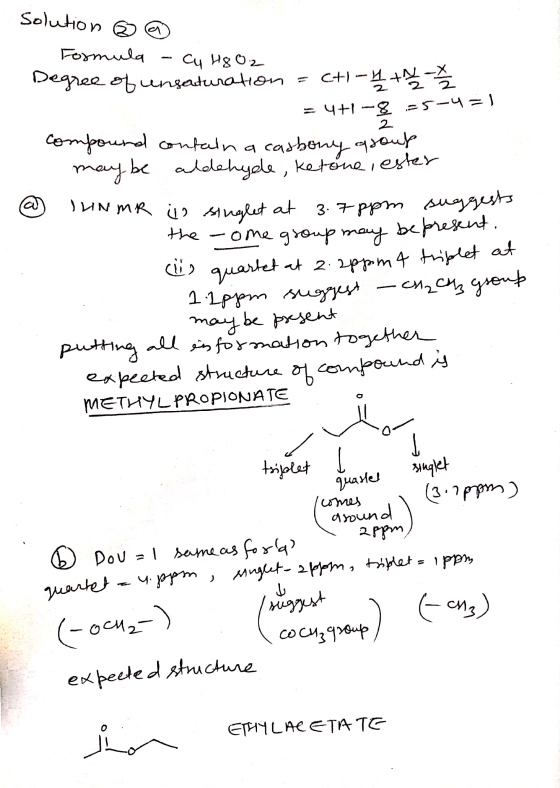
2. The molecular formulas, 'H chemical shifts, splitting patterns, and relative numbers of hydrogen atoms for three...
 2. The molecular formulas, 'H chemical shifts, splitting patterns, and relative numbers of hydrogen atoms for three compounds are provided in a-c. You may find it helpful to sketch these spectra on a sheet of paper. • Deduce one or more structures consistent with each of these sets of data. • Support your answers by indicating next to each set of equivalent H's in your structures o what splitting should be seen, o the relative number of H's they correspond...
Predict 1H NMR and 13C NMR chemical shifts and splitting patterns for 6-chloro-3-methyl-1-heptene. (hint: Draw the...
Predict 1H NMR and 13C NMR chemical shifts and splitting patterns for 6-chloro-3-methyl-1-heptene. (hint: Draw the structure, find distinct group of Hs/Cs and provide approximate chemical shifts with splitting patterns).
Problem 1 Provide a structure of a compound having a molecular formula of CaH1oO2 that is...
 Problem 1 Provide a structure of a compound having a molecular formula of CaH1oO2 that is consistent with the following spectra. SHOW your work and assign all relevant peaks in the IR and 'H NMR spectra. To confirm your choice, predict the splitting patterns for the protons in your proposed structure and estimate and/or calculate their chemical shifts riet tiwld sple baton alt lates 3H 3H 2H 2H a.
1. Sketch the proton NMR spectrum of Et2O showing splitting patterns, chemical shifts and integrals (1H,...
1. Sketch the proton NMR spectrum of Et2O showing splitting patterns, chemical shifts and integrals (1H, 2H, etc). Chemical shifts range from 0 to 12 ppm. _______________________________________________________________ 12 10 8 6 4 2 0 2. Sketch the proton NMR spectrum of (CH3)2C=O showing splitting patterns, chemical shifts and integrals (1H, 2H, etc). Chemical shifts range from 0 to 12 ppm. _______________________________________________________________ 12 10 8 6 4 2 0 3. Sketch the proton NMR spectrum of CH3OH showing splitting patterns, chemical...
1. List and comment on the structural characteristics from each spectrum. (Chemical shifts, splitting patterns, coupling...
 1. List and comment on the
structural characteristics from each spectrum. (Chemical shifts,
splitting patterns, coupling constants, fragmentation patterns,
absorption bands, etc)
2. Determine the compound presented and propose a structure.
el peak for Me m/2 113 with prominent peak atm/268 3 3,5 4 4.5 wavelength (um) 5 5.5 6 When 7 8 8 9 9 10 10 11 11 12 13 14 15 16 4000 3500 3000 2500 2000 1800 1600 wavenumber (cm) 1400 1200 1000 800 600 2013...
1. List and comment on the
structural characteristics from each spectrum. (Chemical shifts,
splitting patterns, coupling constants, fragmentation patterns,
absorption bands, etc)
2. Determine the compound presented and propose a structure.
el peak for Me m/2 113 with prominent peak atm/268 3 3,5 4 4.5 wavelength (um) 5 5.5 6 When 7 8 8 9 9 10 10 11 11 12 13 14 15 16 4000 3500 3000 2500 2000 1800 1600 wavenumber (cm) 1400 1200 1000 800 600 2013...
Propose a structure that is consistent with the spectral data below. (The spectra and data provided...
 Propose a structure that is consistent with the spectral data below. (The spectra and data provided were obtained from a pure organic molecule. For 'H NMR spectra, the integral is given in number of hydrogens (#H) or as a relative ratio.) Mass Spectrum (not shown): [M] = 162 m/z (100%) IR Spectrum (not shown): 3022, 2980, 1685, 1600, 1510 cm (all listed are strong (s) unless otherwise indicated) 'H NMR Spectrum (300 MHz, DMSO, 25 °C) dd (J= 2 Hz)...
2. Predict the # of signals (nonequivalent types of hydrogens, those with different chemical shifts), their...
 2. Predict the # of signals (nonequivalent types of hydrogens, those with different chemical shifts), their approximate chemical shift, and their splitting pattern in the NMR spectrum for each of the following compounds. HHO
Analzye the following spectra, and propose a structure for each. The bottom set of 3 spectra are ...
 Analzye the following spectra, and propose a structure for each.
The bottom set of 3 spectra are DEPT spectra, top: CH only, middle:
CH, CH3 up, CH2 down, bottom: normal BB decoupled spectrum. Explain
your assignments . Analyze means determine integrals, draw
splitting trees, determine carbon type (C, vs CH vs CH2 vs CH3 and
structural environment. Use ChemDraw to check your proposed
structure (include output),
Problem C 7.5 7.0 .5 6.05.55.0 4.5 4.03.5 3.0 2.5 ppm 31 ppm 140...
Analzye the following spectra, and propose a structure for each.
The bottom set of 3 spectra are DEPT spectra, top: CH only, middle:
CH, CH3 up, CH2 down, bottom: normal BB decoupled spectrum. Explain
your assignments . Analyze means determine integrals, draw
splitting trees, determine carbon type (C, vs CH vs CH2 vs CH3 and
structural environment. Use ChemDraw to check your proposed
structure (include output),
Problem C 7.5 7.0 .5 6.05.55.0 4.5 4.03.5 3.0 2.5 ppm 31 ppm 140...
Construct a 13C NMR data table for the structure shown. Identify the chemical shifts, and the...
 Construct a 13C NMR data table for the structure shown. Identify
the chemical shifts, and the type of splitting that you\'d expect
were a \"coupled\" carbon-NMR to be acquired.
Construct a 13C NMR data table for the structure shown. Identify the chemical shifts, and the type of splitting that you'd expect were a "coupled" carbon-NMR to be acquired. CH3)2CHCH, CH = CHCH,OCH3 0-50 50-100 100-160 160-220 singlet doublet triplet quartet Chem. Shift Splitting
Construct a 13C NMR data table for the structure shown. Identify
the chemical shifts, and the type of splitting that you\'d expect
were a \"coupled\" carbon-NMR to be acquired.
Construct a 13C NMR data table for the structure shown. Identify the chemical shifts, and the type of splitting that you'd expect were a "coupled" carbon-NMR to be acquired. CH3)2CHCH, CH = CHCH,OCH3 0-50 50-100 100-160 160-220 singlet doublet triplet quartet Chem. Shift Splitting
 For NMR Structure of following compounds:
Why splitting is like this?Why chemical shifts are like this?So
i have the answer of this question here.But i need detailed
explanation.
(a) Sketch the 'H NMR spectrum you would expect for the following compounds, showing the splitting patterns, chemical shifts and integration of each signal. Explain in detail. (40P) OH CI CH(CH3)2 4-isopropylphenol H3C OH 3-chloro-2-buten-1-ol 9.06 ОН 6.68 6.68 7.22 27.22 12.87 120 120 10 PPM Two CH3 groups appear as doublet...
For NMR Structure of following compounds:
Why splitting is like this?Why chemical shifts are like this?So
i have the answer of this question here.But i need detailed
explanation.
(a) Sketch the 'H NMR spectrum you would expect for the following compounds, showing the splitting patterns, chemical shifts and integration of each signal. Explain in detail. (40P) OH CI CH(CH3)2 4-isopropylphenol H3C OH 3-chloro-2-buten-1-ol 9.06 ОН 6.68 6.68 7.22 27.22 12.87 120 120 10 PPM Two CH3 groups appear as doublet...
 2. The molecular formulas, 'H chemical shifts, splitting patterns, and relative numbers of hydrogen atoms for three compounds are provided in a-c. You may find it helpful to sketch these spectra on a sheet of paper. • Deduce one or more structures consistent with each of these sets of data. • Support your answers by indicating next to each set of equivalent H's in your structures o what splitting should be seen, o the relative number of H's they correspond...
 Problem 1 Provide a structure of a compound having a molecular formula of CaH1oO2 that is consistent with the following spectra. SHOW your work and assign all relevant peaks in the IR and 'H NMR spectra. To confirm your choice, predict the splitting patterns for the protons in your proposed structure and estimate and/or calculate their chemical shifts riet tiwld sple baton alt lates 3H 3H 2H 2H a.
 1. List and comment on the
structural characteristics from each spectrum. (Chemical shifts,
splitting patterns, coupling constants, fragmentation patterns,
absorption bands, etc)
2. Determine the compound presented and propose a structure.
el peak for Me m/2 113 with prominent peak atm/268 3 3,5 4 4.5 wavelength (um) 5 5.5 6 When 7 8 8 9 9 10 10 11 11 12 13 14 15 16 4000 3500 3000 2500 2000 1800 1600 wavenumber (cm) 1400 1200 1000 800 600 2013...
1. List and comment on the
structural characteristics from each spectrum. (Chemical shifts,
splitting patterns, coupling constants, fragmentation patterns,
absorption bands, etc)
2. Determine the compound presented and propose a structure.
el peak for Me m/2 113 with prominent peak atm/268 3 3,5 4 4.5 wavelength (um) 5 5.5 6 When 7 8 8 9 9 10 10 11 11 12 13 14 15 16 4000 3500 3000 2500 2000 1800 1600 wavenumber (cm) 1400 1200 1000 800 600 2013...
 Propose a structure that is consistent with the spectral data below. (The spectra and data provided were obtained from a pure organic molecule. For 'H NMR spectra, the integral is given in number of hydrogens (#H) or as a relative ratio.) Mass Spectrum (not shown): [M] = 162 m/z (100%) IR Spectrum (not shown): 3022, 2980, 1685, 1600, 1510 cm (all listed are strong (s) unless otherwise indicated) 'H NMR Spectrum (300 MHz, DMSO, 25 °C) dd (J= 2 Hz)...
 2. Predict the # of signals (nonequivalent types of hydrogens, those with different chemical shifts), their approximate chemical shift, and their splitting pattern in the NMR spectrum for each of the following compounds. HHO
 Analzye the following spectra, and propose a structure for each.
The bottom set of 3 spectra are DEPT spectra, top: CH only, middle:
CH, CH3 up, CH2 down, bottom: normal BB decoupled spectrum. Explain
your assignments . Analyze means determine integrals, draw
splitting trees, determine carbon type (C, vs CH vs CH2 vs CH3 and
structural environment. Use ChemDraw to check your proposed
structure (include output),
Problem C 7.5 7.0 .5 6.05.55.0 4.5 4.03.5 3.0 2.5 ppm 31 ppm 140...
Analzye the following spectra, and propose a structure for each.
The bottom set of 3 spectra are DEPT spectra, top: CH only, middle:
CH, CH3 up, CH2 down, bottom: normal BB decoupled spectrum. Explain
your assignments . Analyze means determine integrals, draw
splitting trees, determine carbon type (C, vs CH vs CH2 vs CH3 and
structural environment. Use ChemDraw to check your proposed
structure (include output),
Problem C 7.5 7.0 .5 6.05.55.0 4.5 4.03.5 3.0 2.5 ppm 31 ppm 140...
 Construct a 13C NMR data table for the structure shown. Identify
the chemical shifts, and the type of splitting that you\'d expect
were a \"coupled\" carbon-NMR to be acquired.
Construct a 13C NMR data table for the structure shown. Identify the chemical shifts, and the type of splitting that you'd expect were a "coupled" carbon-NMR to be acquired. CH3)2CHCH, CH = CHCH,OCH3 0-50 50-100 100-160 160-220 singlet doublet triplet quartet Chem. Shift Splitting
Construct a 13C NMR data table for the structure shown. Identify
the chemical shifts, and the type of splitting that you\'d expect
were a \"coupled\" carbon-NMR to be acquired.
Construct a 13C NMR data table for the structure shown. Identify the chemical shifts, and the type of splitting that you'd expect were a "coupled" carbon-NMR to be acquired. CH3)2CHCH, CH = CHCH,OCH3 0-50 50-100 100-160 160-220 singlet doublet triplet quartet Chem. Shift Splitting
Most questions answered within 3 hours.
-
Where is the error in this code sequence?
String s1 = "Hello";
String s2 = "ello";...
asked 10 months ago -
Financial data for Joel de Paris, Inc., for last year
follow:
Joel de Paris, Inc.
Balance...
asked 10 months ago -
Consider this reaction:
Al2(SO4)3 (aq)+ BaCl3
(aq) Al2Cl6 (aq)- +
3BaSO4(s) . What is the...
asked 10 months ago -
Suppose that Savneet is considering increasing her
recent random sample from 20 car rentals to 40...
asked 10 months ago -
Trucks arrive at an unloading terminal at an average rate of 120
per hour.
Trucks arrive...
asked 10 months ago -
Why are methanol and ethanol completely soluble in water while
octanol is not very little soluble....
asked 10 months ago -
A facilities manager at a university reads in a research report
that the mean amount of...
asked 10 months ago -
When the CuSO4 is rehydrated by adding water to the anhydrous
compound, is this an endothermic...
asked 10 months ago -
A ray of sunlight is passing from diamond into crown glass; the
angle of incidence is...
asked 10 months ago -
A block of mass 0.249 kg is placed on top of a light, vertical
spring of...
asked 10 months ago -
how do the kidneys compensate in the presences of acidosis
a) trigger hyperventilate
b) reserve acid...
asked 10 months ago -
Question 501 pts
The rental rate of capital to the firm increases. Which of the
following...
asked 10 months ago