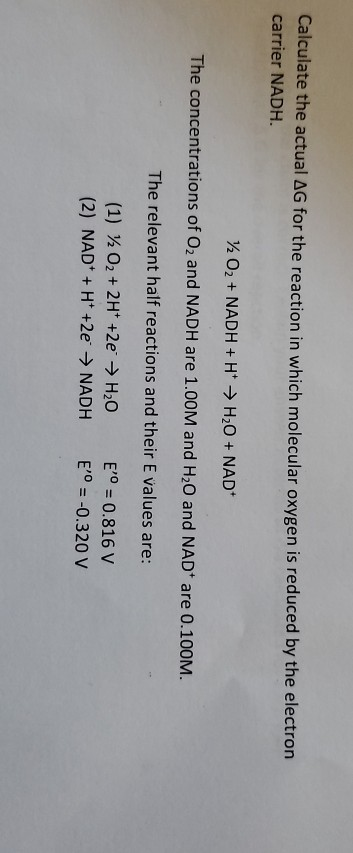
If anyone can provide help that would be great! Thanks!
Homework Answers
![/ O₂ + NADUTH H₂O & NADO E° = 0816-(-0.320) v =+ 1.136 V E=60+ 0.050 log [02] [NADA] s [220] [NADY = 1.136+ 0.059 log (1)12x1](http://img.homeworklib.com/questions/3c234e70-dc5a-11eb-86b8-f1bea7c12686.png?x-oss-process=image/resize,w_560)
Add Answer to:
If anyone can provide help that would be great!
Thanks!
Calculate the actual AG for the...
Question 2a (1 pt): Alcohol dehydrogenase catalyzes the reversible reaction shown. In the space below, write...
 Question 2a (1 pt): Alcohol dehydrogenase catalyzes the reversible reaction shown. In the space below, write the two half-reactions for the redox reaction. Then, determine the cell potential (AE) and standard Gibbs free energy change (AG) for the reaction. (Hint: Use Tables 13.7a/b in "Metabolism Overview") Acetaldehyde + NADH+H→ Ethanol + NAD Question 2b (1 pt): Under physiological conditions, the reaction actually proceeds in the direction that has a positive AG. What would be the minimum value of the reaction...
Consider the degradation of glucose to pyruvate by the glycolytic pathway: glucose+2ADP+2Pi+2NAD+→2pyruvate+2ATP+2H2O+2NADH+2H+ Part A Calculate ΔG...
Consider the degradation of glucose to pyruvate by the glycolytic pathway: glucose+2ADP+2Pi+2NAD+→2pyruvate+2ATP+2H2O+2NADH+2H+ Part A Calculate ΔG for this reaction at pH=7.4 and 37 ∘C when the reactants and products are at the concentrations given below. ATP=4.00mM Pi=5.90mM ADP=220μM glucose=5.10 mM pyruvate=64.0 μM NAD+=350μM NADH=14.5μM CO2=15.0torr half reaction E∘′(V) NAD++H++2e− ⟶ NADH −0.315 2pyruvate+6H++4e− ⟶ glucose −0.590 pyruvate+NADH+2H+ ⟶ ethanol+NAD++CO2 ΔG∘′=−64.4kJ/mol ATP+H2O ⟶ ADP+Pi+H+ ΔG∘′=−32.2kJ/mol
Can anyone help me check mu answer and show the solution? Thanks! If a redox reaction...
 Can anyone help me check mu answer and show the solution?
Thanks!
If a redox reaction occured with the 2 redox couples provided below, which species would be the reducing agent? Ag+ (aq) + e - Ag(s) E° = 0.80 V Co2+ (aq) + 2e - Co(s) = -0.28 V Oa. Co2(aq) Ob. Co(s) Oc. H2O(1) Od. Ag(s) Oe. Ag (aq)
Can anyone help me check mu answer and show the solution?
Thanks!
If a redox reaction occured with the 2 redox couples provided below, which species would be the reducing agent? Ag+ (aq) + e - Ag(s) E° = 0.80 V Co2+ (aq) + 2e - Co(s) = -0.28 V Oa. Co2(aq) Ob. Co(s) Oc. H2O(1) Od. Ag(s) Oe. Ag (aq)
i need help with the "if all protons could be uses for atp production" questions please!!!...
 i need help with the "if all protons could be uses for atp
production" questions please!!!
5. (8 points) Consider the oxidation of a mole of NADH: 202 +2e + 2H+ - HO EⓇ = 0.83 V NAD + 2e + H+ - NADH E = -0.32 V What is the AG for the oxidation of a mole of NADH by oxygen? How many moles of protons are pumped as a result of the oxidation of a mole of NADH?...
i need help with the "if all protons could be uses for atp
production" questions please!!!
5. (8 points) Consider the oxidation of a mole of NADH: 202 +2e + 2H+ - HO EⓇ = 0.83 V NAD + 2e + H+ - NADH E = -0.32 V What is the AG for the oxidation of a mole of NADH by oxygen? How many moles of protons are pumped as a result of the oxidation of a mole of NADH?...
For the reaction: L-Malate + NAD⁺ ← → Oxaloacetate + NADH ΔE' = -0.154 n=2 T=298...
 For the reaction: L-Malate + NAD⁺ ← → Oxaloacetate + NADH
ΔE' = -0.154
n=2
T=298 K
using the equation
ln (Keq) = (nFΔE'৹)/(RT)
Find Keq?
I know this sounds just plug and chug but am confused about the
signs of the numbers when plugged in. Please only answer if you're
of what you're doing!
Standard Reduction Potential of Some Biologically Important Half-Reactions, at pH 7.0 and 25°C (298 K) Half-reaction E' (V) 2H+ + 2e — H, (at standard...
For the reaction: L-Malate + NAD⁺ ← → Oxaloacetate + NADH
ΔE' = -0.154
n=2
T=298 K
using the equation
ln (Keq) = (nFΔE'৹)/(RT)
Find Keq?
I know this sounds just plug and chug but am confused about the
signs of the numbers when plugged in. Please only answer if you're
of what you're doing!
Standard Reduction Potential of Some Biologically Important Half-Reactions, at pH 7.0 and 25°C (298 K) Half-reaction E' (V) 2H+ + 2e — H, (at standard...
16A. Do the same energy calculation for iron oxidation (Fe2+ → Fest) using oxygen as an...
 16A. Do the same energy calculation for iron oxidation (Fe2+ → Fest) using oxygen as an electron acceptor. How many ATP could a cell make from this (1 ATP - 44 kJ/mol)? 16B. Does the redox reaction have a stronger electron donor or acceptor? TABLE 14.1 "Electron Tower" of Standard Reduction Potentials E®(mv) AG® (kJ) Electron donor [CH2O] glucose + H2O 1 Hz +166 +81 +62 1 1 NADH+H HS +27 1 1 +46 1 1 Electron acceptor CO2 +...
help!! (CH3),CBr + 1 → (CH3),CI + Br the following data were collected: [(CH3)3Br] (M) Time...
 help!!
(CH3),CBr + 1 → (CH3),CI + Br the following data were collected: [(CH3)3Br] (M) Time (s) 0.600 0 0.424 10.0 0.300 20.0 0.212 30.0 0.150 40.0 Determine the rate law for this reaction and calculate the rate constant. (20 points) E (V) Thermodynamics: AGº - AH-TAS Nernst Equation: 8 = 8°-(RT/nF)InQ AGⓇ--RTINK At 25°C: 8-6° -0.0591/n)logQ AG RT K-e AG° = -nF8° Units/Constants: Volt: 1 V-1 JC Faraday: 1 F -96,485 C/mole Ea/RT Arrhenius Equation: k = Ae R-8.314...
help!!
(CH3),CBr + 1 → (CH3),CI + Br the following data were collected: [(CH3)3Br] (M) Time (s) 0.600 0 0.424 10.0 0.300 20.0 0.212 30.0 0.150 40.0 Determine the rate law for this reaction and calculate the rate constant. (20 points) E (V) Thermodynamics: AGº - AH-TAS Nernst Equation: 8 = 8°-(RT/nF)InQ AGⓇ--RTINK At 25°C: 8-6° -0.0591/n)logQ AG RT K-e AG° = -nF8° Units/Constants: Volt: 1 V-1 JC Faraday: 1 F -96,485 C/mole Ea/RT Arrhenius Equation: k = Ae R-8.314...
5. How much faster would a reaction be if a catalyst is used that lowers the...
 5. How much faster would a reaction be if a catalyst is used that lowers the activation energy from 20.0 kJ/mol to 10.0 kJ/mol? Do the calculation at two temperatures: first at 25.0°C and then at 0.0°C. (20 points) (V) Helpful Stuff Thermodynamics: AG° = AH-TAS Nernst Equation: 6 = 6 - (RT/nF)InQ AG=RTIK At 25°C: 8 = 6 - (0.0591/n)logQ AGRT Ke=e AGⓇ =-nF8° Units/Constants: Volt: 1 V = 1 J/C Faraday: 1 F = 96,485 C/mole Arrhenius Equation:...
Can anyone help me check mu answer and show the solution? Thanks! Consider the galvanic cell...
 Can anyone help me check mu answer and show the solution?
Thanks!
Consider the galvanic cell shown below (the contents of each half-cell are written beneath each compartment): Pt 1.0 M Br2 1.0 M Cr3+ 1.0 M Br The standard reduction potentials are as follows: Cr3+ (aq) + 3e" - Cr(s) = -0.725 V Br2(aq) + 2e - 2Br (aq) E = + 1.090 V When current is allowed to flow, which species is reduced? Select one: O a. Br...
Can anyone help me check mu answer and show the solution?
Thanks!
Consider the galvanic cell shown below (the contents of each half-cell are written beneath each compartment): Pt 1.0 M Br2 1.0 M Cr3+ 1.0 M Br The standard reduction potentials are as follows: Cr3+ (aq) + 3e" - Cr(s) = -0.725 V Br2(aq) + 2e - 2Br (aq) E = + 1.090 V When current is allowed to flow, which species is reduced? Select one: O a. Br...
2. Using the decay chain for 238U, calculate the amount of time it takes 5.0 kg...
 2. Using the decay chain for 238U, calculate the amount of time it takes 5.0 kg of 238U to decay to 2.5 kg. What mass of 206Pb is produced? (5 points) (V) Helpful Stuff Thermodynamics: AG° = AH-TAS Nernst Equation: 6 = 6 - (RT/nF)InQ AG=RTIK At 25°C: 8 = 6 - (0.0591/n)logQ ΔGIRT Ke=e AGⓇ = -nF8° Units/Constants: Volt: 1 V=1/C Faraday: 1 F -96,485 C/mol e Arrhenius Equation: k = Ae Ea/RT R= 8.314 J/mol K Integrated Rate...
 Question 2a (1 pt): Alcohol dehydrogenase catalyzes the reversible reaction shown. In the space below, write the two half-reactions for the redox reaction. Then, determine the cell potential (AE) and standard Gibbs free energy change (AG) for the reaction. (Hint: Use Tables 13.7a/b in "Metabolism Overview") Acetaldehyde + NADH+H→ Ethanol + NAD Question 2b (1 pt): Under physiological conditions, the reaction actually proceeds in the direction that has a positive AG. What would be the minimum value of the reaction...
 Can anyone help me check mu answer and show the solution?
Thanks!
If a redox reaction occured with the 2 redox couples provided below, which species would be the reducing agent? Ag+ (aq) + e - Ag(s) E° = 0.80 V Co2+ (aq) + 2e - Co(s) = -0.28 V Oa. Co2(aq) Ob. Co(s) Oc. H2O(1) Od. Ag(s) Oe. Ag (aq)
Can anyone help me check mu answer and show the solution?
Thanks!
If a redox reaction occured with the 2 redox couples provided below, which species would be the reducing agent? Ag+ (aq) + e - Ag(s) E° = 0.80 V Co2+ (aq) + 2e - Co(s) = -0.28 V Oa. Co2(aq) Ob. Co(s) Oc. H2O(1) Od. Ag(s) Oe. Ag (aq)
 i need help with the "if all protons could be uses for atp
production" questions please!!!
5. (8 points) Consider the oxidation of a mole of NADH: 202 +2e + 2H+ - HO EⓇ = 0.83 V NAD + 2e + H+ - NADH E = -0.32 V What is the AG for the oxidation of a mole of NADH by oxygen? How many moles of protons are pumped as a result of the oxidation of a mole of NADH?...
i need help with the "if all protons could be uses for atp
production" questions please!!!
5. (8 points) Consider the oxidation of a mole of NADH: 202 +2e + 2H+ - HO EⓇ = 0.83 V NAD + 2e + H+ - NADH E = -0.32 V What is the AG for the oxidation of a mole of NADH by oxygen? How many moles of protons are pumped as a result of the oxidation of a mole of NADH?...
 For the reaction: L-Malate + NAD⁺ ← → Oxaloacetate + NADH
ΔE' = -0.154
n=2
T=298 K
using the equation
ln (Keq) = (nFΔE'৹)/(RT)
Find Keq?
I know this sounds just plug and chug but am confused about the
signs of the numbers when plugged in. Please only answer if you're
of what you're doing!
Standard Reduction Potential of Some Biologically Important Half-Reactions, at pH 7.0 and 25°C (298 K) Half-reaction E' (V) 2H+ + 2e — H, (at standard...
For the reaction: L-Malate + NAD⁺ ← → Oxaloacetate + NADH
ΔE' = -0.154
n=2
T=298 K
using the equation
ln (Keq) = (nFΔE'৹)/(RT)
Find Keq?
I know this sounds just plug and chug but am confused about the
signs of the numbers when plugged in. Please only answer if you're
of what you're doing!
Standard Reduction Potential of Some Biologically Important Half-Reactions, at pH 7.0 and 25°C (298 K) Half-reaction E' (V) 2H+ + 2e — H, (at standard...
 16A. Do the same energy calculation for iron oxidation (Fe2+ → Fest) using oxygen as an electron acceptor. How many ATP could a cell make from this (1 ATP - 44 kJ/mol)? 16B. Does the redox reaction have a stronger electron donor or acceptor? TABLE 14.1 "Electron Tower" of Standard Reduction Potentials E®(mv) AG® (kJ) Electron donor [CH2O] glucose + H2O 1 Hz +166 +81 +62 1 1 NADH+H HS +27 1 1 +46 1 1 Electron acceptor CO2 +...
 help!!
(CH3),CBr + 1 → (CH3),CI + Br the following data were collected: [(CH3)3Br] (M) Time (s) 0.600 0 0.424 10.0 0.300 20.0 0.212 30.0 0.150 40.0 Determine the rate law for this reaction and calculate the rate constant. (20 points) E (V) Thermodynamics: AGº - AH-TAS Nernst Equation: 8 = 8°-(RT/nF)InQ AGⓇ--RTINK At 25°C: 8-6° -0.0591/n)logQ AG RT K-e AG° = -nF8° Units/Constants: Volt: 1 V-1 JC Faraday: 1 F -96,485 C/mole Ea/RT Arrhenius Equation: k = Ae R-8.314...
help!!
(CH3),CBr + 1 → (CH3),CI + Br the following data were collected: [(CH3)3Br] (M) Time (s) 0.600 0 0.424 10.0 0.300 20.0 0.212 30.0 0.150 40.0 Determine the rate law for this reaction and calculate the rate constant. (20 points) E (V) Thermodynamics: AGº - AH-TAS Nernst Equation: 8 = 8°-(RT/nF)InQ AGⓇ--RTINK At 25°C: 8-6° -0.0591/n)logQ AG RT K-e AG° = -nF8° Units/Constants: Volt: 1 V-1 JC Faraday: 1 F -96,485 C/mole Ea/RT Arrhenius Equation: k = Ae R-8.314...
 5. How much faster would a reaction be if a catalyst is used that lowers the activation energy from 20.0 kJ/mol to 10.0 kJ/mol? Do the calculation at two temperatures: first at 25.0°C and then at 0.0°C. (20 points) (V) Helpful Stuff Thermodynamics: AG° = AH-TAS Nernst Equation: 6 = 6 - (RT/nF)InQ AG=RTIK At 25°C: 8 = 6 - (0.0591/n)logQ AGRT Ke=e AGⓇ =-nF8° Units/Constants: Volt: 1 V = 1 J/C Faraday: 1 F = 96,485 C/mole Arrhenius Equation:...
 Can anyone help me check mu answer and show the solution?
Thanks!
Consider the galvanic cell shown below (the contents of each half-cell are written beneath each compartment): Pt 1.0 M Br2 1.0 M Cr3+ 1.0 M Br The standard reduction potentials are as follows: Cr3+ (aq) + 3e" - Cr(s) = -0.725 V Br2(aq) + 2e - 2Br (aq) E = + 1.090 V When current is allowed to flow, which species is reduced? Select one: O a. Br...
Can anyone help me check mu answer and show the solution?
Thanks!
Consider the galvanic cell shown below (the contents of each half-cell are written beneath each compartment): Pt 1.0 M Br2 1.0 M Cr3+ 1.0 M Br The standard reduction potentials are as follows: Cr3+ (aq) + 3e" - Cr(s) = -0.725 V Br2(aq) + 2e - 2Br (aq) E = + 1.090 V When current is allowed to flow, which species is reduced? Select one: O a. Br...
 2. Using the decay chain for 238U, calculate the amount of time it takes 5.0 kg of 238U to decay to 2.5 kg. What mass of 206Pb is produced? (5 points) (V) Helpful Stuff Thermodynamics: AG° = AH-TAS Nernst Equation: 6 = 6 - (RT/nF)InQ AG=RTIK At 25°C: 8 = 6 - (0.0591/n)logQ ΔGIRT Ke=e AGⓇ = -nF8° Units/Constants: Volt: 1 V=1/C Faraday: 1 F -96,485 C/mol e Arrhenius Equation: k = Ae Ea/RT R= 8.314 J/mol K Integrated Rate...
Most questions answered within 3 hours.
-
Where is the error in this code sequence?
String s1 = "Hello";
String s2 = "ello";...
asked 10 months ago -
Financial data for Joel de Paris, Inc., for last year
follow:
Joel de Paris, Inc.
Balance...
asked 10 months ago -
Consider this reaction:
Al2(SO4)3 (aq)+ BaCl3
(aq) Al2Cl6 (aq)- +
3BaSO4(s) . What is the...
asked 10 months ago -
Suppose that Savneet is considering increasing her
recent random sample from 20 car rentals to 40...
asked 10 months ago -
Trucks arrive at an unloading terminal at an average rate of 120
per hour.
Trucks arrive...
asked 10 months ago -
Why are methanol and ethanol completely soluble in water while
octanol is not very little soluble....
asked 10 months ago -
A facilities manager at a university reads in a research report
that the mean amount of...
asked 10 months ago -
When the CuSO4 is rehydrated by adding water to the anhydrous
compound, is this an endothermic...
asked 10 months ago -
A ray of sunlight is passing from diamond into crown glass; the
angle of incidence is...
asked 10 months ago -
A block of mass 0.249 kg is placed on top of a light, vertical
spring of...
asked 10 months ago -
how do the kidneys compensate in the presences of acidosis
a) trigger hyperventilate
b) reserve acid...
asked 10 months ago -
Question 501 pts
The rental rate of capital to the firm increases. Which of the
following...
asked 10 months ago