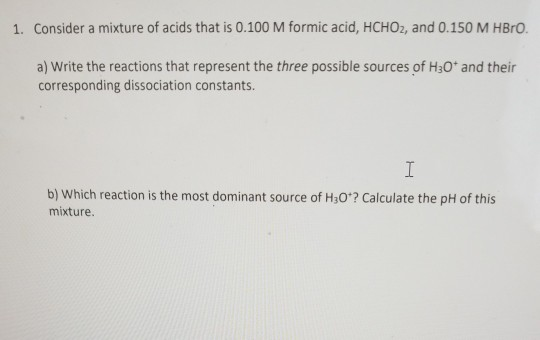
b. Which reaction is the most dominant source of H3O+? Calculate the pH of this mixture.
Homework Answers
Add Answer to:
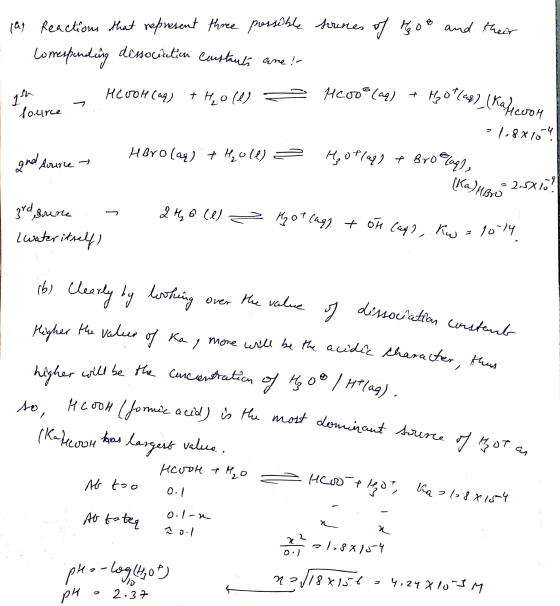
b. Which reaction is the most dominant source of H3O+?
Calculate the pH of this mixture....
2. Calculate the pH of the following solutions: (a) [H3O+] = 1.4 x 10-'M (b) [OH-]...
 2. Calculate the pH of the following solutions: (a) [H3O+] = 1.4 x 10-'M (b) [OH-] = 3.5 x 10⁻²M (c) pOH = 10.5 3. What is the pH of a 0.10 M solution of HCIO4? (A strong acid) 4. Write the dissociation reaction and the corresponding K, expression for the following acids in water. (a) H3PO4 (b) C&H OH 5. Write the reaction and corresponding Ko expression for each of the following bases in water. (a) NH3 (b) PO4...
Finding ph in a mixture of weak acids. Please explain:) Mixture of weak Acids: Find the...
 Finding ph in a mixture of weak acids. Please explain:)
Mixture of weak Acids: Find the pH of a mixture that is 0.150 M HF and 0.100 M HCIO. Ka of HF 3.5 x 10⁻⁴ K, of HCIO 2.9 x 10 Kw of H20 1.0 x 10⁻¹⁴ In a mixture of 2 weak acids in which one is weaker than the other, the H contribution from the ionization of the weaker acid can be ignored in calculating the pH of...
Finding ph in a mixture of weak acids. Please explain:)
Mixture of weak Acids: Find the pH of a mixture that is 0.150 M HF and 0.100 M HCIO. Ka of HF 3.5 x 10⁻⁴ K, of HCIO 2.9 x 10 Kw of H20 1.0 x 10⁻¹⁴ In a mixture of 2 weak acids in which one is weaker than the other, the H contribution from the ionization of the weaker acid can be ignored in calculating the pH of...
Question 47 (1 point) Calculate the pH of a solution that is 0.310 Min sodium formate...
 Question 47 (1 point) Calculate the pH of a solution that is 0.310 Min sodium formate (NaHCO2) and 0.190M in formic acid (HCO2H). The Ką of formic acid is 1.77 x 10⁻⁴. 13.79 3.532 3.958 4.975 10.04 MOCRA Question 42 (1 point) What is the hydronium ion concentration of a 0.100 M hypochlorous acid solution with Ka = 35 x 10-87 The equation for the dissociation of hypochlorous acid is: HOCH(aq) + H2011) =H30*(aq) + OCH@g). O 1.9 x 10⁻⁵...
Worksheet 19 Titration of Polyprotic Acids Name: 1. Calculate the sulfite ion [SO3'] concentration in a...
 Worksheet 19 Titration of Polyprotic Acids Name: 1. Calculate the sulfite ion [SO3'] concentration in a 0.123 M solution of the weak acid, sulfurous acid (H2SO3). The stepwise dissociation constants of carbonic acid are: Ka1 1.41 x 10² Ka2-6.31 x 10⁸ 3. Consider the following dissociation of the triprotic acid, phosphoric acid (HsPOs): Step 1 H3POa + H2O <=> H30+ + H2PO4, Step 2 HP0i + H2O <=> H30+ + HP042- Step 3 HPO42-+ H2O <-> H3O+ + PO43- Kal=7.1...
Calculate (a) the pH and (b) the concentration of acetate ion resulting from the mixture of400...
 Calculate (a) the pH and (b) the concentration of acetate ion resulting from the mixture of400 ml of 0.1 M formic acid and 100 ml 0.1 M sodium acetate. This mixture constitutes a two component buffer. Such buffers are frequently used in the laboratory. More to the point, cell and body fluids contain more than one buffer system.
in some cases, there may be a mixture of two or more acids. When this happens,...
 in some cases, there may be a mixture of two or more acids. When this happens, the stronger acid will dissociate completely, so you should be able to calculate how much H,0 is in solution as a result. Writing out the equation for the dissociation often helps The weak acid will attempt to dissociate and is governed by the equilibrium (K,). You should write out the equation for the weak acid Now-write in the values for the concentrations that you'll...
1. Calculate the concentration of H3O+ for an aqueous solution with a pH of 1.2 A)...
 1. Calculate the concentration of H3O+ for an aqueous solution with a pH of 1.2 A) 6.3 x 10⁻⁷M B ) 1.6 x 10⁸ M. C) 1.0 x 10⁻¹⁴ M. D) 6.20 x 10⁻² M E) 4.0 x 10⁻⁴M 2. Calculate the concentration of OH- for an aqueous solution with a pH of 13.8. A) 0.64 M B) 4.0 x 10⁻⁵M C) 1.5 x 10⁻⁵M D) 1.0 x 10⁻¹⁴ M E) 2.5 x 10⁻¹⁰ M 3. Which of the following...
answer all parts (a and b) please! Hydrogen sulfide (H2S) is a diprotic weak acid which...
 answer all parts (a and b) please!
Hydrogen sulfide (H2S) is a diprotic weak acid which can be used to selectively precipitate metal sulfide compounds from solution. The two deprotonation reactions of hydrogen sulfide are provided below along with their respective acid dissociation constants. H2S(ag) + H2O7) = HS (an) + H30+(aq) Kal = 1.0 * 10-7 HS (aq) + H2O) = 52 (ag) + H30 (29) K22=1 * 10-19 Imagine you have an aqueous solution buffered at pH 3...
answer all parts (a and b) please!
Hydrogen sulfide (H2S) is a diprotic weak acid which can be used to selectively precipitate metal sulfide compounds from solution. The two deprotonation reactions of hydrogen sulfide are provided below along with their respective acid dissociation constants. H2S(ag) + H2O7) = HS (an) + H30+(aq) Kal = 1.0 * 10-7 HS (aq) + H2O) = 52 (ag) + H30 (29) K22=1 * 10-19 Imagine you have an aqueous solution buffered at pH 3...
thanks in advance ☺ (A). For the hypothetical reaction A+B → C the following rate data...
 thanks in advance ☺
(A). For the hypothetical reaction A+B → C the following rate data (with and without catalyst) were obtained: Rate, M/s Rate, M/s (A), M [B, M (uncatalyzed) (catalyzed) 0.100 0.200 3.51 x 10 4 7.14 x 10⁻² 0.100 0.100 1.75 x 10⁴ 7.14 x 10⁻² 0.0500 0.200 1.76 x 10⁴ 3.57 x 10⁻² 0.0500 0.100 8.80 x 10⁻⁵ 3.57 x 10⁻² Based on these data: a. Determine the uncatalyzed and catalyzed rate laws for this reaction,...
thanks in advance ☺
(A). For the hypothetical reaction A+B → C the following rate data (with and without catalyst) were obtained: Rate, M/s Rate, M/s (A), M [B, M (uncatalyzed) (catalyzed) 0.100 0.200 3.51 x 10 4 7.14 x 10⁻² 0.100 0.100 1.75 x 10⁴ 7.14 x 10⁻² 0.0500 0.200 1.76 x 10⁴ 3.57 x 10⁻² 0.0500 0.100 8.80 x 10⁻⁵ 3.57 x 10⁻² Based on these data: a. Determine the uncatalyzed and catalyzed rate laws for this reaction,...
1. Here you have a saturated solution a. Calculate the molar solubility of cadmium (I)hy b....
 1. Here you have a saturated solution a. Calculate the molar solubility of cadmium (I)hy b. (extra credit) What is the pH of this solution? c. What would be the molar solubility of cadmium () () on of cadmium (ID hydroxide, Cd(OH)2 at 25 oC. (1.5 pts) sodiumn byodar solebiliy of yxide when the solution nitily contains 0.010 M of sodium hydroxide (NaOH)? d. um (lI) hydroxideicther the following chemicals can increase or decrease the solubility of cadmium (II) hydroxide....
 2. Calculate the pH of the following solutions: (a) [H3O+] = 1.4 x 10-'M (b) [OH-] = 3.5 x 10⁻²M (c) pOH = 10.5 3. What is the pH of a 0.10 M solution of HCIO4? (A strong acid) 4. Write the dissociation reaction and the corresponding K, expression for the following acids in water. (a) H3PO4 (b) C&H OH 5. Write the reaction and corresponding Ko expression for each of the following bases in water. (a) NH3 (b) PO4...
 Finding ph in a mixture of weak acids. Please explain:)
Mixture of weak Acids: Find the pH of a mixture that is 0.150 M HF and 0.100 M HCIO. Ka of HF 3.5 x 10⁻⁴ K, of HCIO 2.9 x 10 Kw of H20 1.0 x 10⁻¹⁴ In a mixture of 2 weak acids in which one is weaker than the other, the H contribution from the ionization of the weaker acid can be ignored in calculating the pH of...
Finding ph in a mixture of weak acids. Please explain:)
Mixture of weak Acids: Find the pH of a mixture that is 0.150 M HF and 0.100 M HCIO. Ka of HF 3.5 x 10⁻⁴ K, of HCIO 2.9 x 10 Kw of H20 1.0 x 10⁻¹⁴ In a mixture of 2 weak acids in which one is weaker than the other, the H contribution from the ionization of the weaker acid can be ignored in calculating the pH of...
 Question 47 (1 point) Calculate the pH of a solution that is 0.310 Min sodium formate (NaHCO2) and 0.190M in formic acid (HCO2H). The Ką of formic acid is 1.77 x 10⁻⁴. 13.79 3.532 3.958 4.975 10.04 MOCRA Question 42 (1 point) What is the hydronium ion concentration of a 0.100 M hypochlorous acid solution with Ka = 35 x 10-87 The equation for the dissociation of hypochlorous acid is: HOCH(aq) + H2011) =H30*(aq) + OCH@g). O 1.9 x 10⁻⁵...
 Worksheet 19 Titration of Polyprotic Acids Name: 1. Calculate the sulfite ion [SO3'] concentration in a 0.123 M solution of the weak acid, sulfurous acid (H2SO3). The stepwise dissociation constants of carbonic acid are: Ka1 1.41 x 10² Ka2-6.31 x 10⁸ 3. Consider the following dissociation of the triprotic acid, phosphoric acid (HsPOs): Step 1 H3POa + H2O <=> H30+ + H2PO4, Step 2 HP0i + H2O <=> H30+ + HP042- Step 3 HPO42-+ H2O <-> H3O+ + PO43- Kal=7.1...
 Calculate (a) the pH and (b) the concentration of acetate ion resulting from the mixture of400 ml of 0.1 M formic acid and 100 ml 0.1 M sodium acetate. This mixture constitutes a two component buffer. Such buffers are frequently used in the laboratory. More to the point, cell and body fluids contain more than one buffer system.
 in some cases, there may be a mixture of two or more acids. When this happens, the stronger acid will dissociate completely, so you should be able to calculate how much H,0 is in solution as a result. Writing out the equation for the dissociation often helps The weak acid will attempt to dissociate and is governed by the equilibrium (K,). You should write out the equation for the weak acid Now-write in the values for the concentrations that you'll...
 1. Calculate the concentration of H3O+ for an aqueous solution with a pH of 1.2 A) 6.3 x 10⁻⁷M B ) 1.6 x 10⁸ M. C) 1.0 x 10⁻¹⁴ M. D) 6.20 x 10⁻² M E) 4.0 x 10⁻⁴M 2. Calculate the concentration of OH- for an aqueous solution with a pH of 13.8. A) 0.64 M B) 4.0 x 10⁻⁵M C) 1.5 x 10⁻⁵M D) 1.0 x 10⁻¹⁴ M E) 2.5 x 10⁻¹⁰ M 3. Which of the following...
 answer all parts (a and b) please!
Hydrogen sulfide (H2S) is a diprotic weak acid which can be used to selectively precipitate metal sulfide compounds from solution. The two deprotonation reactions of hydrogen sulfide are provided below along with their respective acid dissociation constants. H2S(ag) + H2O7) = HS (an) + H30+(aq) Kal = 1.0 * 10-7 HS (aq) + H2O) = 52 (ag) + H30 (29) K22=1 * 10-19 Imagine you have an aqueous solution buffered at pH 3...
answer all parts (a and b) please!
Hydrogen sulfide (H2S) is a diprotic weak acid which can be used to selectively precipitate metal sulfide compounds from solution. The two deprotonation reactions of hydrogen sulfide are provided below along with their respective acid dissociation constants. H2S(ag) + H2O7) = HS (an) + H30+(aq) Kal = 1.0 * 10-7 HS (aq) + H2O) = 52 (ag) + H30 (29) K22=1 * 10-19 Imagine you have an aqueous solution buffered at pH 3...
 thanks in advance ☺
(A). For the hypothetical reaction A+B → C the following rate data (with and without catalyst) were obtained: Rate, M/s Rate, M/s (A), M [B, M (uncatalyzed) (catalyzed) 0.100 0.200 3.51 x 10 4 7.14 x 10⁻² 0.100 0.100 1.75 x 10⁴ 7.14 x 10⁻² 0.0500 0.200 1.76 x 10⁴ 3.57 x 10⁻² 0.0500 0.100 8.80 x 10⁻⁵ 3.57 x 10⁻² Based on these data: a. Determine the uncatalyzed and catalyzed rate laws for this reaction,...
thanks in advance ☺
(A). For the hypothetical reaction A+B → C the following rate data (with and without catalyst) were obtained: Rate, M/s Rate, M/s (A), M [B, M (uncatalyzed) (catalyzed) 0.100 0.200 3.51 x 10 4 7.14 x 10⁻² 0.100 0.100 1.75 x 10⁴ 7.14 x 10⁻² 0.0500 0.200 1.76 x 10⁴ 3.57 x 10⁻² 0.0500 0.100 8.80 x 10⁻⁵ 3.57 x 10⁻² Based on these data: a. Determine the uncatalyzed and catalyzed rate laws for this reaction,...
 1. Here you have a saturated solution a. Calculate the molar solubility of cadmium (I)hy b. (extra credit) What is the pH of this solution? c. What would be the molar solubility of cadmium () () on of cadmium (ID hydroxide, Cd(OH)2 at 25 oC. (1.5 pts) sodiumn byodar solebiliy of yxide when the solution nitily contains 0.010 M of sodium hydroxide (NaOH)? d. um (lI) hydroxideicther the following chemicals can increase or decrease the solubility of cadmium (II) hydroxide....
Most questions answered within 3 hours.
-
Where is the error in this code sequence?
String s1 = "Hello";
String s2 = "ello";...
asked 10 months ago -
Financial data for Joel de Paris, Inc., for last year
follow:
Joel de Paris, Inc.
Balance...
asked 10 months ago -
Consider this reaction:
Al2(SO4)3 (aq)+ BaCl3
(aq) Al2Cl6 (aq)- +
3BaSO4(s) . What is the...
asked 10 months ago -
Suppose that Savneet is considering increasing her
recent random sample from 20 car rentals to 40...
asked 10 months ago -
Trucks arrive at an unloading terminal at an average rate of 120
per hour.
Trucks arrive...
asked 10 months ago -
Why are methanol and ethanol completely soluble in water while
octanol is not very little soluble....
asked 10 months ago -
A facilities manager at a university reads in a research report
that the mean amount of...
asked 10 months ago -
When the CuSO4 is rehydrated by adding water to the anhydrous
compound, is this an endothermic...
asked 10 months ago -
A ray of sunlight is passing from diamond into crown glass; the
angle of incidence is...
asked 10 months ago -
A block of mass 0.249 kg is placed on top of a light, vertical
spring of...
asked 10 months ago -
how do the kidneys compensate in the presences of acidosis
a) trigger hyperventilate
b) reserve acid...
asked 10 months ago -
Question 501 pts
The rental rate of capital to the firm increases. Which of the
following...
asked 10 months ago