![The reaction A+B +C+D rate = k[A] [B]? has an initial rate of 0.0730 M/s. What will the initial rate be if [A] is halved and](http://img.homeworklib.com/questions/e1d06b40-dd00-11eb-8eeb-7736fa4608f0.png?x-oss-process=image/resize,w_560)
![For the reaction 2 H2O(g) = 2H2(g) + O2(g) the equilibrium concentrations were found to be [H,O] = 0.250 M, [H] = 0.330 M, an](http://img.homeworklib.com/questions/e23653e0-dd00-11eb-a4fb-e36778193b3c.png?x-oss-process=image/resize,w_560)
Homework Answers
![# я, с кLA] Св) Я. , а Я, кLAJLзв) эя, чS хоо13 ( л о. Зг 85 м/х 1. «КСА) Св) . лак Lan) [8)* 2 2) Я сб.15 я, - ə |я, со оЅч1](http://img.homeworklib.com/questions/09519c80-dd01-11eb-8b44-23af5da78a94.png?x-oss-process=image/resize,w_560)
Add Answer to:
answer all
The reaction A+B +C+D rate = k[A] [B]? has an initial rate of 0.0730...
The reaction A+B rightarrow C+D rate=k[A][B]^2 has an initial rate of 0.0300 M/s. What will the...
 The reaction A+B rightarrow C+D rate=k[A][B]^2 has an initial rate of 0.0300 M/s. What will the initial rate be if [A] is halved and [B] is tripled? What will the initial rate be if [A] is tripled and [B] is halved?
For the reaction 2H2O(g)−⇀↽−2H2(g)+O2(g)2H2O(g)↽−−⇀2H2(g)+O2(g) the equilibrium concentrations were found to be [H2O]=0.250 M,[H2O]=0.250 M, [H2]=0.490 M,[H2]=0.490...
For the reaction 2H2O(g)−⇀↽−2H2(g)+O2(g)2H2O(g)↽−−⇀2H2(g)+O2(g) the equilibrium concentrations were found to be [H2O]=0.250 M,[H2O]=0.250 M, [H2]=0.490 M,[H2]=0.490 M, and [O2]=0.750 M.[O2]=0.750 M. What is the equilibrium constant for this reaction?
For the reaction 2H2O(g)−⇀↽−2H2(g)+O2(g) the equilibrium concentrations were found to be [H2O]=0.250 M, [H2]=0.340 M, and...
For the reaction 2H2O(g)−⇀↽−2H2(g)+O2(g) the equilibrium concentrations were found to be [H2O]=0.250 M, [H2]=0.340 M, and [O2]=0.750 M. What is the equilibrium constant for this reaction?
For the reaction 2 H2O(g) + 2 H2(g) + O2(g) the equilibrium concentrations were found to...
 For the reaction 2 H2O(g) + 2 H2(g) + O2(g) the equilibrium concentrations were found to be [H,0) = 0.250 M, [H2) = 0.520 M, and [0,1 = 0.800 M. W equilibrium constant for this reaction? Kon II
The reaction A + B -> C + D has been found to obey the following...
The reaction A + B -> C + D has been found to obey the following rate law: rate=k[A][B]2 and has an initial rate of 0.0130 M/s. What will be the rate of the reaction if [A] is tripled and [B] is halved?
For the reaction 2H,O(g) = 2H,(8) +0,(9) the equilibrium concentrations were found to be [ H0]...
 For the reaction 2H,O(g) = 2H,(8) +0,(9) the equilibrium concentrations were found to be [ H0] -0.250 M, [H,! = 0.510 M, and (0,1 = 0.800 M. What is the equilibrium constant for this reaction? Kog
What will the initial rate be if [A] is tripled and [B] is halved? The reaction...
 What will the initial rate be if [A] is tripled and [B] is
halved?
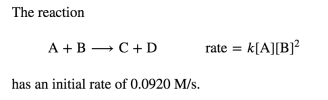
The reaction A + B + C +D rate k[A][B]2 has an initial rate of 0.0920 M/s.
What will the initial rate be if [A] is tripled and [B] is
halved?
The reaction A + B + C +D rate k[A][B]2 has an initial rate of 0.0920 M/s.
Calculate the equilibrium concentrations of H2O, Cl, HCl, and O2 at 298 K if the initial...
 Calculate the equilibrium concentrations of H2O, Cl, HCl, and O2 at 298 K if the initial concentrations are (H2O) = 0.070 M and (Cl2] = 0.120 M. The equilibrium constant Kc for the reaction H2O(g) + Cl2(g) + 2HCl(g) + O2(g) is 8.96 x 10 -9 at 298 K
2.c and 2.d 2. The rate law for the reaction A+B a. Write the rate law...
 2.c
and 2.d
2. The rate law for the reaction A+B a. Write the rate law expression. C + D is first order in [A] and second order in [B]. Rate low- k[A] [B]² b. What is the overall order of reaction? 1 +2= 3 c. How does the rate change if [A] is halved and [B] is tripled?! d. Given the data below, propose initial concentrations for A and B that would enable you to empirically determine the given...
2.c
and 2.d
2. The rate law for the reaction A+B a. Write the rate law expression. C + D is first order in [A] and second order in [B]. Rate low- k[A] [B]² b. What is the overall order of reaction? 1 +2= 3 c. How does the rate change if [A] is halved and [B] is tripled?! d. Given the data below, propose initial concentrations for A and B that would enable you to empirically determine the given...
please solve all. Hydrogen bonds are noncovalent interactions between a hydrogen atom with a partial positive...
 please solve all.
Hydrogen bonds are noncovalent interactions between a hydrogen atom with a partial positive charge, called the hydrogen bond donor, and an atom with a partial negative charge, called the hydrogen bond acceptor. Progesterone is a hormone that contains two ketone groups. The oxygen in the ketone group can function as a hydrogen bond acceptor. н, со CH, Select the amino acids that have side chains that can form a hydrogen bond with progesterone at pH 7. tryptophan...
please solve all.
Hydrogen bonds are noncovalent interactions between a hydrogen atom with a partial positive charge, called the hydrogen bond donor, and an atom with a partial negative charge, called the hydrogen bond acceptor. Progesterone is a hormone that contains two ketone groups. The oxygen in the ketone group can function as a hydrogen bond acceptor. н, со CH, Select the amino acids that have side chains that can form a hydrogen bond with progesterone at pH 7. tryptophan...
 The reaction A+B rightarrow C+D rate=k[A][B]^2 has an initial rate of 0.0300 M/s. What will the initial rate be if [A] is halved and [B] is tripled? What will the initial rate be if [A] is tripled and [B] is halved?
 For the reaction 2 H2O(g) + 2 H2(g) + O2(g) the equilibrium concentrations were found to be [H,0) = 0.250 M, [H2) = 0.520 M, and [0,1 = 0.800 M. W equilibrium constant for this reaction? Kon II
 For the reaction 2H,O(g) = 2H,(8) +0,(9) the equilibrium concentrations were found to be [ H0] -0.250 M, [H,! = 0.510 M, and (0,1 = 0.800 M. What is the equilibrium constant for this reaction? Kog
 What will the initial rate be if [A] is tripled and [B] is
halved?
The reaction A + B + C +D rate k[A][B]2 has an initial rate of 0.0920 M/s.
What will the initial rate be if [A] is tripled and [B] is
halved?
The reaction A + B + C +D rate k[A][B]2 has an initial rate of 0.0920 M/s.
 Calculate the equilibrium concentrations of H2O, Cl, HCl, and O2 at 298 K if the initial concentrations are (H2O) = 0.070 M and (Cl2] = 0.120 M. The equilibrium constant Kc for the reaction H2O(g) + Cl2(g) + 2HCl(g) + O2(g) is 8.96 x 10 -9 at 298 K
 2.c
and 2.d
2. The rate law for the reaction A+B a. Write the rate law expression. C + D is first order in [A] and second order in [B]. Rate low- k[A] [B]² b. What is the overall order of reaction? 1 +2= 3 c. How does the rate change if [A] is halved and [B] is tripled?! d. Given the data below, propose initial concentrations for A and B that would enable you to empirically determine the given...
2.c
and 2.d
2. The rate law for the reaction A+B a. Write the rate law expression. C + D is first order in [A] and second order in [B]. Rate low- k[A] [B]² b. What is the overall order of reaction? 1 +2= 3 c. How does the rate change if [A] is halved and [B] is tripled?! d. Given the data below, propose initial concentrations for A and B that would enable you to empirically determine the given...
 please solve all.
Hydrogen bonds are noncovalent interactions between a hydrogen atom with a partial positive charge, called the hydrogen bond donor, and an atom with a partial negative charge, called the hydrogen bond acceptor. Progesterone is a hormone that contains two ketone groups. The oxygen in the ketone group can function as a hydrogen bond acceptor. н, со CH, Select the amino acids that have side chains that can form a hydrogen bond with progesterone at pH 7. tryptophan...
please solve all.
Hydrogen bonds are noncovalent interactions between a hydrogen atom with a partial positive charge, called the hydrogen bond donor, and an atom with a partial negative charge, called the hydrogen bond acceptor. Progesterone is a hormone that contains two ketone groups. The oxygen in the ketone group can function as a hydrogen bond acceptor. н, со CH, Select the amino acids that have side chains that can form a hydrogen bond with progesterone at pH 7. tryptophan...
Most questions answered within 3 hours.
-
Where is the error in this code sequence?
String s1 = "Hello";
String s2 = "ello";...
asked 10 months ago -
Financial data for Joel de Paris, Inc., for last year
follow:
Joel de Paris, Inc.
Balance...
asked 10 months ago -
Consider this reaction:
Al2(SO4)3 (aq)+ BaCl3
(aq) Al2Cl6 (aq)- +
3BaSO4(s) . What is the...
asked 10 months ago -
Suppose that Savneet is considering increasing her
recent random sample from 20 car rentals to 40...
asked 10 months ago -
Trucks arrive at an unloading terminal at an average rate of 120
per hour.
Trucks arrive...
asked 10 months ago -
Why are methanol and ethanol completely soluble in water while
octanol is not very little soluble....
asked 10 months ago -
A facilities manager at a university reads in a research report
that the mean amount of...
asked 10 months ago -
When the CuSO4 is rehydrated by adding water to the anhydrous
compound, is this an endothermic...
asked 10 months ago -
A ray of sunlight is passing from diamond into crown glass; the
angle of incidence is...
asked 10 months ago -
A block of mass 0.249 kg is placed on top of a light, vertical
spring of...
asked 10 months ago -
how do the kidneys compensate in the presences of acidosis
a) trigger hyperventilate
b) reserve acid...
asked 10 months ago -
Question 501 pts
The rental rate of capital to the firm increases. Which of the
following...
asked 10 months ago