
Homework Answers

Add Answer to:
QUESTIUN 15 5.5 pum Suppose the surface-catalyzed hydrogenation reaction of an unsaturated hydrocarbon has a rate...
QUESTION 11 Suppose the surface-catalyzed hydrogenation reaction of an unsaturated hydrocarbon has a rate constant of...
QUESTION 11 Suppose the surface-catalyzed hydrogenation reaction of an unsaturated hydrocarbon has a rate constant of 0.374 M/min. The reaction is observed to follow zero-order kinetics. If the initial concentration of the hydrocarbon is 2.90 M, what is the half-life of the reaction in seconds? *Please report 3 significant figures. Numbers only, no unit. No scientific notation.
Suppose the surface-catalyzed hydrogenation reaction of an unsaturated hydrocarbon has a rate constant of 0.796 M/min....
Suppose the surface-catalyzed hydrogenation reaction of an unsaturated hydrocarbon has a rate constant of 0.796 M/min. The reaction is observed to follow zero-order kinetics. If the initial concentration of the hydrocarbon is 6.70 M, what is the half-life of the reaction in seconds? *Please report 3 significant figures. Numbers only, no unit. No scientific notation.
QUESTION 17 Suppose the surface-catalyzed hydrogenation reaction of an unsaturated hydrocarbon has a rate constant of...
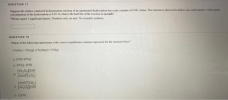 QUESTION 17 Suppose the surface-catalyzed hydrogenation reaction of an unsaturated hydrocarbon has a rate constant of 0681 M min. The reaction is observed to follow zero order kinetics. If the initial concentration of the hydrocarbon is 8.30 M, what is the half-life of the reaction in seconds? "Please report 3 significant figures Numbers only, no unit. No scientific notation QUESTION 18 Which of the following expressions is the correct equilibrium constant expression for the reaction below 3 F60(0) + CO2(g)...
Suppose the surface-catalyzed hydrogenation reaction of an unsaturated hydrocarbon has a rate constant of 0.673 M'min....
 Suppose the surface-catalyzed hydrogenation reaction of an unsaturated hydrocarbon has a rate constant of 0.673 M'min. The reaction is observed to follow zero-order kinetics. If the initial concentration of the hydrocarbon is 5.40 M, what is the half-life of the reaction in seconds? *Please report 3 significant figures. Numbers only, no unit. No scientific notation. QUESTION 14 The rate law of a reaction is ratek[X][Y). The units of the rate constant are L mol-1-1 L2 mol-2-1 mol L-1.1 mol2 L-2-1...
1) 2) Suppose the surface-catalyzed hydrogenation reaction of an unsaturated hydrocarbon has a rate constant of...
 1)
2)
Suppose the surface-catalyzed hydrogenation reaction of an unsaturated hydrocarbon has a rate constant of 0.398 M/min. The reaction is observed to follow zero-order kinetics. If the initial concentration of the hydrocarbon is 6.20 M, what is the half-life of the reaction in seconds? *Please report 3 significant figures. Numbers only, no unit. No scientific notation. The equilibrium constant for the gas phase reaction 2503 (g) = 2502 (g) + O2 (g) is Keq = 2.2 x 10⁻⁹ at...
1)
2)
Suppose the surface-catalyzed hydrogenation reaction of an unsaturated hydrocarbon has a rate constant of 0.398 M/min. The reaction is observed to follow zero-order kinetics. If the initial concentration of the hydrocarbon is 6.20 M, what is the half-life of the reaction in seconds? *Please report 3 significant figures. Numbers only, no unit. No scientific notation. The equilibrium constant for the gas phase reaction 2503 (g) = 2502 (g) + O2 (g) is Keq = 2.2 x 10⁻⁹ at...
Suppose the surface-catalyzed hydrogenation reaction of an unsaturated hydrocarbon has a rate constant of 0.812 M/min....
Suppose the surface-catalyzed hydrogenation reaction of an unsaturated hydrocarbon has a rate constant of 0.812 M/min. The reaction is observed to follow zero-order kinetics. If the initial concentration of the hydrocarbon is 8.10 M, what is the half-life of the reaction in seconds?
1) 2) 3) The decomposition of dinitrogen tetroxide to nitrogen dioxide at 400°C follows first-order kinetics...
 1)
2)
3)
The decomposition of dinitrogen tetroxide to nitrogen dioxide at 400°C follows first-order kinetics with a rate constant of 3.84 X10⁻³-1. Starting with pure N204, how many minutes will it take for 38.0% to decompose? Suppose the surface-catalyzed hydrogenation reaction of an unsaturated hydrocarbon has a rate constant of 0.374 M/min. The reaction is observed to follow zero-order kinetics. If the initial concentration of the hydrocarbon is 2.90 M, what is the half-life of the reaction in seconds?...
1)
2)
3)
The decomposition of dinitrogen tetroxide to nitrogen dioxide at 400°C follows first-order kinetics with a rate constant of 3.84 X10⁻³-1. Starting with pure N204, how many minutes will it take for 38.0% to decompose? Suppose the surface-catalyzed hydrogenation reaction of an unsaturated hydrocarbon has a rate constant of 0.374 M/min. The reaction is observed to follow zero-order kinetics. If the initial concentration of the hydrocarbon is 2.90 M, what is the half-life of the reaction in seconds?...
A second order reaction where the starting reactant concentration is 0.0963 M has a measured rate...
A second order reaction where the starting reactant concentration is 0.0963 M has a measured rate constant of 0.70 M/s at 10 oC. What is the concentration of the reactant after 36.0 seconds? - report your answer in three significant figures - do not write your answer in scientific notation - do not include units
1-The rate constant of a chemical reaction was measured at several temperature values and a plot...
1-The rate constant of a chemical reaction was measured at several temperature values and a plot of ln k (on the y-axis) was plotted against 1/T (on the x-axis, temperature was measured in Kelvin). If the slope of the plot was -9.21 x 10³ K and the y-intercept was 13.0, what is the activation energy (EA) of the reaction in kJ mol-1? 2-In an enzyme-catalyzed reaction, the rate of the reaction depends on which of the following at very low...
QuestiII Il poll ILS) Consider the data below: Time (minutes) Concentration (M) 1 0.05 2 0.042...
 QuestiII Il poll ILS) Consider the data below: Time (minutes) Concentration (M) 1 0.05 2 0.042 3 0.034 4 0.028 5 0.018 Construct a concentration versus time plot with concentration on the y-axis and time on the x-axis. Then, determine the equation of the line that describes the data set. In blank # 1, report the slope of the line. Do not use scientific notation. In blank # 2, report the y-intercept of the line. Do not use scientific notation....
 QUESTION 17 Suppose the surface-catalyzed hydrogenation reaction of an unsaturated hydrocarbon has a rate constant of 0681 M min. The reaction is observed to follow zero order kinetics. If the initial concentration of the hydrocarbon is 8.30 M, what is the half-life of the reaction in seconds? "Please report 3 significant figures Numbers only, no unit. No scientific notation QUESTION 18 Which of the following expressions is the correct equilibrium constant expression for the reaction below 3 F60(0) + CO2(g)...
 Suppose the surface-catalyzed hydrogenation reaction of an unsaturated hydrocarbon has a rate constant of 0.673 M'min. The reaction is observed to follow zero-order kinetics. If the initial concentration of the hydrocarbon is 5.40 M, what is the half-life of the reaction in seconds? *Please report 3 significant figures. Numbers only, no unit. No scientific notation. QUESTION 14 The rate law of a reaction is ratek[X][Y). The units of the rate constant are L mol-1-1 L2 mol-2-1 mol L-1.1 mol2 L-2-1...
 1)
2)
Suppose the surface-catalyzed hydrogenation reaction of an unsaturated hydrocarbon has a rate constant of 0.398 M/min. The reaction is observed to follow zero-order kinetics. If the initial concentration of the hydrocarbon is 6.20 M, what is the half-life of the reaction in seconds? *Please report 3 significant figures. Numbers only, no unit. No scientific notation. The equilibrium constant for the gas phase reaction 2503 (g) = 2502 (g) + O2 (g) is Keq = 2.2 x 10⁻⁹ at...
1)
2)
Suppose the surface-catalyzed hydrogenation reaction of an unsaturated hydrocarbon has a rate constant of 0.398 M/min. The reaction is observed to follow zero-order kinetics. If the initial concentration of the hydrocarbon is 6.20 M, what is the half-life of the reaction in seconds? *Please report 3 significant figures. Numbers only, no unit. No scientific notation. The equilibrium constant for the gas phase reaction 2503 (g) = 2502 (g) + O2 (g) is Keq = 2.2 x 10⁻⁹ at...
 1)
2)
3)
The decomposition of dinitrogen tetroxide to nitrogen dioxide at 400°C follows first-order kinetics with a rate constant of 3.84 X10⁻³-1. Starting with pure N204, how many minutes will it take for 38.0% to decompose? Suppose the surface-catalyzed hydrogenation reaction of an unsaturated hydrocarbon has a rate constant of 0.374 M/min. The reaction is observed to follow zero-order kinetics. If the initial concentration of the hydrocarbon is 2.90 M, what is the half-life of the reaction in seconds?...
1)
2)
3)
The decomposition of dinitrogen tetroxide to nitrogen dioxide at 400°C follows first-order kinetics with a rate constant of 3.84 X10⁻³-1. Starting with pure N204, how many minutes will it take for 38.0% to decompose? Suppose the surface-catalyzed hydrogenation reaction of an unsaturated hydrocarbon has a rate constant of 0.374 M/min. The reaction is observed to follow zero-order kinetics. If the initial concentration of the hydrocarbon is 2.90 M, what is the half-life of the reaction in seconds?...
 QuestiII Il poll ILS) Consider the data below: Time (minutes) Concentration (M) 1 0.05 2 0.042 3 0.034 4 0.028 5 0.018 Construct a concentration versus time plot with concentration on the y-axis and time on the x-axis. Then, determine the equation of the line that describes the data set. In blank # 1, report the slope of the line. Do not use scientific notation. In blank # 2, report the y-intercept of the line. Do not use scientific notation....
Most questions answered within 3 hours.
-
Where is the error in this code sequence?
String s1 = "Hello";
String s2 = "ello";...
asked 10 months ago -
Financial data for Joel de Paris, Inc., for last year
follow:
Joel de Paris, Inc.
Balance...
asked 10 months ago -
Consider this reaction:
Al2(SO4)3 (aq)+ BaCl3
(aq) Al2Cl6 (aq)- +
3BaSO4(s) . What is the...
asked 10 months ago -
Suppose that Savneet is considering increasing her
recent random sample from 20 car rentals to 40...
asked 10 months ago -
Trucks arrive at an unloading terminal at an average rate of 120
per hour.
Trucks arrive...
asked 10 months ago -
Why are methanol and ethanol completely soluble in water while
octanol is not very little soluble....
asked 10 months ago -
A facilities manager at a university reads in a research report
that the mean amount of...
asked 10 months ago -
When the CuSO4 is rehydrated by adding water to the anhydrous
compound, is this an endothermic...
asked 10 months ago -
A ray of sunlight is passing from diamond into crown glass; the
angle of incidence is...
asked 10 months ago -
A block of mass 0.249 kg is placed on top of a light, vertical
spring of...
asked 10 months ago -
how do the kidneys compensate in the presences of acidosis
a) trigger hyperventilate
b) reserve acid...
asked 10 months ago -
Question 501 pts
The rental rate of capital to the firm increases. Which of the
following...
asked 10 months ago