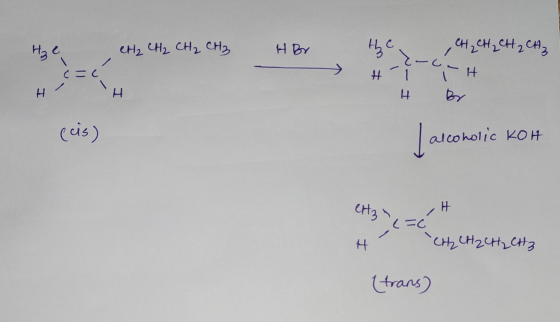
Show how you would accomplish the following transformation: cis-2-heptene to trans-2-heptene
Show how you would accomplish the following transformation:
cis-2-heptene to trans-2-heptene
Homework Answers
Add Answer to:
Show how you would accomplish the following transformation:
cis-2-heptene to trans-2-heptene
Show the mechanisms and reaction energy diagrams for the transformation with potassium tert-butoxide leading to trans-2-heptene....
Show the mechanisms and reaction energy diagrams for the transformation with potassium tert-butoxide leading to trans-2-heptene. Please include a drawing of the anti-periplanar transition state. Would the transition state energy for the reaction leading to cis-2-heptene be higher or lower? Please explain your hypothesis. Would the product ratio (trans-2-heptene / 2-cis-2-heptene change if you run our experiment at room temperature instead of reflux temperature? Please explain your hypothesis.
Which of the following alkenes can exist as cis-trans isomers? 3-Methyl-2-hexene 1-Heptene 2-Methyl-2-hexeue 2-Heptene 3-Heptene
 Which of the following alkenes can exist as cis-trans isomers? 3-Methyl-2-hexene 1-Heptene 2-Methyl-2-hexeue 2-Heptene 3-Heptene
U. Cis-nept-2-ene+CH212, Zn(Cu) 19. (10 points)Show how you would accomplish each of the following synthetic conversions....
 U. Cis-nept-2-ene+CH212, Zn(Cu) 19. (10 points)Show how you would accomplish each of the following synthetic conversions. a. trans - but - 2 - ene + tra - 1,2-dimethylcyclopropane cyclopentene - cyclohexanol
Problem #2 Show how you would accomplish the following transformation. You may use any reagent necessary....
 Problem #2 Show how you would accomplish the following transformation. You may use any reagent necessary. Oh oh
Show how you would accomplish the following conversions a) trans-hex-3-ene to meso-hexane-3-4-diol. Please explain when to...
 Show how you would accomplish the following conversions a)
trans-hex-3-ene to meso-hexane-3-4-diol. Please explain when to
rotate. Thank you !
Show how you would accomplish the following conversions. trans-hex-3-ene to meso-hexane-3,4-diol . ~ CH,C01H HO Chocolate HO rotate CH,CO,H HO HO HO OH Submit Request Answer Part D trans-hex-3-ene to (0,2)-hexane-3,4-diol ~ Ho t do anemie van OSO. rotate racemic (d.1) HO Но он ~ rotate CH CO, HO CHCOM enten met racemic (d.1) HOOH CHICOH HO racemic (d.1) Но...
Show how you would accomplish the following conversions a)
trans-hex-3-ene to meso-hexane-3-4-diol. Please explain when to
rotate. Thank you !
Show how you would accomplish the following conversions. trans-hex-3-ene to meso-hexane-3,4-diol . ~ CH,C01H HO Chocolate HO rotate CH,CO,H HO HO HO OH Submit Request Answer Part D trans-hex-3-ene to (0,2)-hexane-3,4-diol ~ Ho t do anemie van OSO. rotate racemic (d.1) HO Но он ~ rotate CH CO, HO CHCOM enten met racemic (d.1) HOOH CHICOH HO racemic (d.1) Но...
#1 & #2 1. Identify the reagents that you would use to accomplish the following transformation:...
 #1 & #2
1. Identify the reagents that you would use to accomplish the following transformation: 5-Y 2. Identify the reagents that you would use to accomplish the following transformation: -
#1 & #2
1. Identify the reagents that you would use to accomplish the following transformation: 5-Y 2. Identify the reagents that you would use to accomplish the following transformation: -
Show how to accomplish the following transformation (more than one step)
 Show how to accomplish the following transformation (more than one
step)
Show how to accomplish the following transformation (more than one
step)
1 11-15. Determine the relationship between the following pairs of compounds. 11 trans-2-pentene and cis-2-pentene A) s...
 1
11-15. Determine the relationship between the following pairs of compounds. 11 trans-2-pentene and cis-2-pentene A) structural isomers 12. trans-2-pentene and cyclopentane B) Enantiomers C) not related 13. hexane and 2-methybutane D) same molecule 14. trans-2-heptene and trans-2-hexene E) geometrical (cis/trans) isomers 15 glycerol and 1,2-ethandiol (stereoisomers)
1
11-15. Determine the relationship between the following pairs of compounds. 11 trans-2-pentene and cis-2-pentene A) structural isomers 12. trans-2-pentene and cyclopentane B) Enantiomers C) not related 13. hexane and 2-methybutane D) same molecule 14. trans-2-heptene and trans-2-hexene E) geometrical (cis/trans) isomers 15 glycerol and 1,2-ethandiol (stereoisomers)
How might you differentiate between the cis-trans and trans-trans isomers uaing spectroscopy?
How might you differentiate between the cis-trans and trans-trans isomers uaing spectroscopy?
You are monitoring the decay of 13-cis-retinal to all-trans-retinal. Initially, your sample contains 100% 13-cis-retinal. After...
You are monitoring the decay of 13-cis-retinal to all-trans-retinal. Initially, your sample contains 100% 13-cis-retinal. After 5 minutes, you see that 55% of your sample has converted to all-trans-retinal. Assume that the all-trans-retinal cannot convert back to 13-cis-retinal. a. What is the rate constant that describes the transformation of 13-cis-retinal to all-transretinal? b. How long will it take for 95% of the sample to be converted to all-trans-retinal?
 Which of the following alkenes can exist as cis-trans isomers? 3-Methyl-2-hexene 1-Heptene 2-Methyl-2-hexeue 2-Heptene 3-Heptene
 U. Cis-nept-2-ene+CH212, Zn(Cu) 19. (10 points)Show how you would accomplish each of the following synthetic conversions. a. trans - but - 2 - ene + tra - 1,2-dimethylcyclopropane cyclopentene - cyclohexanol
 Problem #2 Show how you would accomplish the following transformation. You may use any reagent necessary. Oh oh
 Show how you would accomplish the following conversions a)
trans-hex-3-ene to meso-hexane-3-4-diol. Please explain when to
rotate. Thank you !
Show how you would accomplish the following conversions. trans-hex-3-ene to meso-hexane-3,4-diol . ~ CH,C01H HO Chocolate HO rotate CH,CO,H HO HO HO OH Submit Request Answer Part D trans-hex-3-ene to (0,2)-hexane-3,4-diol ~ Ho t do anemie van OSO. rotate racemic (d.1) HO Но он ~ rotate CH CO, HO CHCOM enten met racemic (d.1) HOOH CHICOH HO racemic (d.1) Но...
Show how you would accomplish the following conversions a)
trans-hex-3-ene to meso-hexane-3-4-diol. Please explain when to
rotate. Thank you !
Show how you would accomplish the following conversions. trans-hex-3-ene to meso-hexane-3,4-diol . ~ CH,C01H HO Chocolate HO rotate CH,CO,H HO HO HO OH Submit Request Answer Part D trans-hex-3-ene to (0,2)-hexane-3,4-diol ~ Ho t do anemie van OSO. rotate racemic (d.1) HO Но он ~ rotate CH CO, HO CHCOM enten met racemic (d.1) HOOH CHICOH HO racemic (d.1) Но...
 #1 & #2
1. Identify the reagents that you would use to accomplish the following transformation: 5-Y 2. Identify the reagents that you would use to accomplish the following transformation: -
#1 & #2
1. Identify the reagents that you would use to accomplish the following transformation: 5-Y 2. Identify the reagents that you would use to accomplish the following transformation: -
 Show how to accomplish the following transformation (more than one
step)
Show how to accomplish the following transformation (more than one
step)
 1
11-15. Determine the relationship between the following pairs of compounds. 11 trans-2-pentene and cis-2-pentene A) structural isomers 12. trans-2-pentene and cyclopentane B) Enantiomers C) not related 13. hexane and 2-methybutane D) same molecule 14. trans-2-heptene and trans-2-hexene E) geometrical (cis/trans) isomers 15 glycerol and 1,2-ethandiol (stereoisomers)
1
11-15. Determine the relationship between the following pairs of compounds. 11 trans-2-pentene and cis-2-pentene A) structural isomers 12. trans-2-pentene and cyclopentane B) Enantiomers C) not related 13. hexane and 2-methybutane D) same molecule 14. trans-2-heptene and trans-2-hexene E) geometrical (cis/trans) isomers 15 glycerol and 1,2-ethandiol (stereoisomers)
Most questions answered within 3 hours.
-
Where is the error in this code sequence?
String s1 = "Hello";
String s2 = "ello";...
asked 10 months ago -
Financial data for Joel de Paris, Inc., for last year
follow:
Joel de Paris, Inc.
Balance...
asked 10 months ago -
Consider this reaction:
Al2(SO4)3 (aq)+ BaCl3
(aq) Al2Cl6 (aq)- +
3BaSO4(s) . What is the...
asked 10 months ago -
Suppose that Savneet is considering increasing her
recent random sample from 20 car rentals to 40...
asked 10 months ago -
Trucks arrive at an unloading terminal at an average rate of 120
per hour.
Trucks arrive...
asked 10 months ago -
Why are methanol and ethanol completely soluble in water while
octanol is not very little soluble....
asked 10 months ago -
A facilities manager at a university reads in a research report
that the mean amount of...
asked 10 months ago -
When the CuSO4 is rehydrated by adding water to the anhydrous
compound, is this an endothermic...
asked 10 months ago -
A ray of sunlight is passing from diamond into crown glass; the
angle of incidence is...
asked 10 months ago -
A block of mass 0.249 kg is placed on top of a light, vertical
spring of...
asked 10 months ago -
how do the kidneys compensate in the presences of acidosis
a) trigger hyperventilate
b) reserve acid...
asked 10 months ago -
Question 501 pts
The rental rate of capital to the firm increases. Which of the
following...
asked 10 months ago