
Homework Answers

Add Answer to:
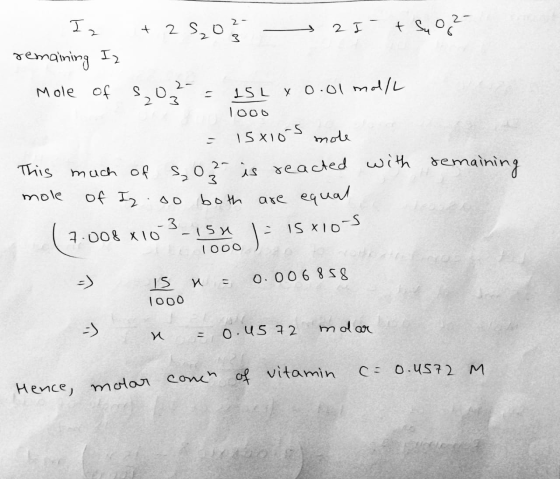
Vitamin C in a titration with potassium iodate
References Mailings Review View AaBbcode Abccdee AaBbcc No...
3) Use the mole ratios contained in both equation 3 and equation 4 to calculate the...
 3) Use the mole ratios contained in both equation 3 and
equation 4 to calculate the
volume (in mL) of 0.0100 M potassium iodate solution needed to
completely oxidize all
of the ascorbic acid contained in 20.00 mL of 0.0200 M
ascorbic acid solution.
concentration of the titrant can be used along with the mole ratios from the reaction equations to determine the amount of ascorbic acid in the solution Chemical Reactions involved with the redox titration: Equation 1 shows...
3) Use the mole ratios contained in both equation 3 and
equation 4 to calculate the
volume (in mL) of 0.0100 M potassium iodate solution needed to
completely oxidize all
of the ascorbic acid contained in 20.00 mL of 0.0200 M
ascorbic acid solution.
concentration of the titrant can be used along with the mole ratios from the reaction equations to determine the amount of ascorbic acid in the solution Chemical Reactions involved with the redox titration: Equation 1 shows...
A student adds 50 mL of his potassium iodate solution to the vitamin C suspension. However,...
A student adds 50 mL of his potassium iodate solution to the vitamin C suspension. However, he does not see the expected color change. Supply at least three reasons for this observation. This is a question in my Ascorbic Acid Content in Vitamin C Tablets via Iodometric Titration Lab and I want to be sure i'm correct.
1) What chemical is the titrant in this experiment? What chemical is the analyte in this experiment? Experi...
 1) What chemical is the titrant in this experiment? What
chemical is the analyte in this
experiment?
Experiment #8: Measuring the Vitamin C Content of Emergen-C™ Objectives: • Students will learn how to use a burette. • Students will learn how to use the iodine starch indicator system to monitor oxidation/reduction reactions. Students will learn how to conduct a titration to determine the amount of analyte in an unknown solution. • Students will learn about ascorbic acid's role as a...
1) What chemical is the titrant in this experiment? What
chemical is the analyte in this
experiment?
Experiment #8: Measuring the Vitamin C Content of Emergen-C™ Objectives: • Students will learn how to use a burette. • Students will learn how to use the iodine starch indicator system to monitor oxidation/reduction reactions. Students will learn how to conduct a titration to determine the amount of analyte in an unknown solution. • Students will learn about ascorbic acid's role as a...
Determination of Vitamin C Concentration by Redox Titration An alternative titration method for determining the concentration...
 Determination of Vitamin C Concentration by Redox Titration An alternative titration method for determining the concentration of vitamin C in a sample is to use an iodine solution. In this reaction iodine oxidizes the ascorbic acid to C&H&O 2. A 20.00 ml sample of a 1.00 mg/mL vitamin C solution is placed in a flask along with 1 mL of a 1% starch solution to serve as an indicator. A dilute solution of iodine is placed in a buret. A...
16 7-2 Titration Calculations Ascorbic acid (vitamin C) reacts with according to the equation Starch is used as an i...
 16 7-2 Titration Calculations Ascorbic acid (vitamin C) reacts with according to the equation Starch is used as an indicator in the reaction. The end point is marked by the appearance of a deep blue starch-iodine complex when the first fraction of a drop of unreacted remains in the solution. TI (a) Stundurdization: If 29.41 mL of iodine solution is required to react with 0.197 0 g of pure ascorbic acid, what is the molarity of the iodine solution?! (b)...
2) What chemical reaction does the titrant contribute to this experiment? CHEM 1A Experiment #8: Measuring the Vit...
 2)
What chemical reaction does the titrant contribute to this
experiment?
CHEM 1A Experiment #8: Measuring the Vitamin C Content of Emergen-C™ Objectives: Students will learn how to use a burette. Students will learn how to use the iodine starch indicator system to monitor oxidation/reduction reactions. • Students will learn how to conduct a titration to determine the amount of analyte in an unknown solution. • Students will learn about ascorbic acid's role as a biological reducing agent. Introduction: Vitamin...
2)
What chemical reaction does the titrant contribute to this
experiment?
CHEM 1A Experiment #8: Measuring the Vitamin C Content of Emergen-C™ Objectives: Students will learn how to use a burette. Students will learn how to use the iodine starch indicator system to monitor oxidation/reduction reactions. • Students will learn how to conduct a titration to determine the amount of analyte in an unknown solution. • Students will learn about ascorbic acid's role as a biological reducing agent. Introduction: Vitamin...
I understand part a, I need help with B and C. Thanks! 6-B. Vitamin C (ascorbic...
 I understand part a, I need help with B and C. Thanks!
6-B. Vitamin C (ascorbic acid) from foods can be measured by titration with 13: CH4O6 + + H2O = C,H,O + 30 + 2H Ascorbic acid Triiodide Dehydroascorbic acid FM 176.126 Starch is used as an indicator in the reaction. The end point is marked by the appearance of a deep blue starch-iodine complex when unreacted 15 is present. (a) If 29.41 mL of Iz solution are required...
I understand part a, I need help with B and C. Thanks!
6-B. Vitamin C (ascorbic acid) from foods can be measured by titration with 13: CH4O6 + + H2O = C,H,O + 30 + 2H Ascorbic acid Triiodide Dehydroascorbic acid FM 176.126 Starch is used as an indicator in the reaction. The end point is marked by the appearance of a deep blue starch-iodine complex when unreacted 15 is present. (a) If 29.41 mL of Iz solution are required...
(a) Potassium iodate solution was prepared by dissolving 1.022 g of KIO3 (FM 214.00) in a...
(a) Potassium iodate solution was prepared by dissolving 1.022 g of KIO3 (FM 214.00) in a 500 mL volumetric flask. Then 50.00 mL of the solution was pipetted into a flask and treated with excess KI (2 g) and acid (10 mL of 0.5 M H2SO4). How many millimoles of I3− are created by the reaction? (b) The triiodide from part (a) reacted with 37.54 mL of Na2S2O3 solution. What is the concentration of the Na2S2O3 solution? (c) A 1.223...
Ascorbic acid (vitamin C, MM 176.124 g/mol)) can be determined using an iodometric back titration. A...
 Ascorbic acid (vitamin C, MM 176.124 g/mol)) can be determined using an iodometric back titration. A vitamin C tablet was dissolved in 60 mL of 0.3 M H2S04. To the dissolved tablet, 2 g of KI and 50.00 mL of 0.0105 M KIO3 were added, resulting in the formation of a dark orange solution indicating the presence of 13-. The resulting solution was titrated with 0.0685 M S2032- until the starch indicator turned purple. If the end point was observed...
1. A sample contains an unknown amount of tartaric acid, H2C4H4O6. If 0.3888 g of the...
1. A sample contains an unknown amount of tartaric acid, H2C4H4O6. If 0.3888 g of the sample requires 37.74 mL of 0.1000 M NaOH to neutralize the H2C4H4O6 completely, what is the percentage of H2C4H4O6 in the sample? The molar mass of H2C4H4O6 is 150.09 g/mol. The balanced equation for the reaction is: H2C4H4O6 + 2 NaOH → 2 H2O + Na2C4H4O6 2. Sodium thiosulfate, Na2S2O3, is an important reagent for titrations. Its solutions can be standardized by titrating the...
 3) Use the mole ratios contained in both equation 3 and
equation 4 to calculate the
volume (in mL) of 0.0100 M potassium iodate solution needed to
completely oxidize all
of the ascorbic acid contained in 20.00 mL of 0.0200 M
ascorbic acid solution.
concentration of the titrant can be used along with the mole ratios from the reaction equations to determine the amount of ascorbic acid in the solution Chemical Reactions involved with the redox titration: Equation 1 shows...
3) Use the mole ratios contained in both equation 3 and
equation 4 to calculate the
volume (in mL) of 0.0100 M potassium iodate solution needed to
completely oxidize all
of the ascorbic acid contained in 20.00 mL of 0.0200 M
ascorbic acid solution.
concentration of the titrant can be used along with the mole ratios from the reaction equations to determine the amount of ascorbic acid in the solution Chemical Reactions involved with the redox titration: Equation 1 shows...
 1) What chemical is the titrant in this experiment? What
chemical is the analyte in this
experiment?
Experiment #8: Measuring the Vitamin C Content of Emergen-C™ Objectives: • Students will learn how to use a burette. • Students will learn how to use the iodine starch indicator system to monitor oxidation/reduction reactions. Students will learn how to conduct a titration to determine the amount of analyte in an unknown solution. • Students will learn about ascorbic acid's role as a...
1) What chemical is the titrant in this experiment? What
chemical is the analyte in this
experiment?
Experiment #8: Measuring the Vitamin C Content of Emergen-C™ Objectives: • Students will learn how to use a burette. • Students will learn how to use the iodine starch indicator system to monitor oxidation/reduction reactions. Students will learn how to conduct a titration to determine the amount of analyte in an unknown solution. • Students will learn about ascorbic acid's role as a...
 Determination of Vitamin C Concentration by Redox Titration An alternative titration method for determining the concentration of vitamin C in a sample is to use an iodine solution. In this reaction iodine oxidizes the ascorbic acid to C&H&O 2. A 20.00 ml sample of a 1.00 mg/mL vitamin C solution is placed in a flask along with 1 mL of a 1% starch solution to serve as an indicator. A dilute solution of iodine is placed in a buret. A...
 16 7-2 Titration Calculations Ascorbic acid (vitamin C) reacts with according to the equation Starch is used as an indicator in the reaction. The end point is marked by the appearance of a deep blue starch-iodine complex when the first fraction of a drop of unreacted remains in the solution. TI (a) Stundurdization: If 29.41 mL of iodine solution is required to react with 0.197 0 g of pure ascorbic acid, what is the molarity of the iodine solution?! (b)...
 2)
What chemical reaction does the titrant contribute to this
experiment?
CHEM 1A Experiment #8: Measuring the Vitamin C Content of Emergen-C™ Objectives: Students will learn how to use a burette. Students will learn how to use the iodine starch indicator system to monitor oxidation/reduction reactions. • Students will learn how to conduct a titration to determine the amount of analyte in an unknown solution. • Students will learn about ascorbic acid's role as a biological reducing agent. Introduction: Vitamin...
2)
What chemical reaction does the titrant contribute to this
experiment?
CHEM 1A Experiment #8: Measuring the Vitamin C Content of Emergen-C™ Objectives: Students will learn how to use a burette. Students will learn how to use the iodine starch indicator system to monitor oxidation/reduction reactions. • Students will learn how to conduct a titration to determine the amount of analyte in an unknown solution. • Students will learn about ascorbic acid's role as a biological reducing agent. Introduction: Vitamin...
 I understand part a, I need help with B and C. Thanks!
6-B. Vitamin C (ascorbic acid) from foods can be measured by titration with 13: CH4O6 + + H2O = C,H,O + 30 + 2H Ascorbic acid Triiodide Dehydroascorbic acid FM 176.126 Starch is used as an indicator in the reaction. The end point is marked by the appearance of a deep blue starch-iodine complex when unreacted 15 is present. (a) If 29.41 mL of Iz solution are required...
I understand part a, I need help with B and C. Thanks!
6-B. Vitamin C (ascorbic acid) from foods can be measured by titration with 13: CH4O6 + + H2O = C,H,O + 30 + 2H Ascorbic acid Triiodide Dehydroascorbic acid FM 176.126 Starch is used as an indicator in the reaction. The end point is marked by the appearance of a deep blue starch-iodine complex when unreacted 15 is present. (a) If 29.41 mL of Iz solution are required...
 Ascorbic acid (vitamin C, MM 176.124 g/mol)) can be determined using an iodometric back titration. A vitamin C tablet was dissolved in 60 mL of 0.3 M H2S04. To the dissolved tablet, 2 g of KI and 50.00 mL of 0.0105 M KIO3 were added, resulting in the formation of a dark orange solution indicating the presence of 13-. The resulting solution was titrated with 0.0685 M S2032- until the starch indicator turned purple. If the end point was observed...
Most questions answered within 3 hours.
-
Where is the error in this code sequence?
String s1 = "Hello";
String s2 = "ello";...
asked 10 months ago -
Financial data for Joel de Paris, Inc., for last year
follow:
Joel de Paris, Inc.
Balance...
asked 10 months ago -
Consider this reaction:
Al2(SO4)3 (aq)+ BaCl3
(aq) Al2Cl6 (aq)- +
3BaSO4(s) . What is the...
asked 10 months ago -
Suppose that Savneet is considering increasing her
recent random sample from 20 car rentals to 40...
asked 10 months ago -
Trucks arrive at an unloading terminal at an average rate of 120
per hour.
Trucks arrive...
asked 10 months ago -
Why are methanol and ethanol completely soluble in water while
octanol is not very little soluble....
asked 10 months ago -
A facilities manager at a university reads in a research report
that the mean amount of...
asked 10 months ago -
When the CuSO4 is rehydrated by adding water to the anhydrous
compound, is this an endothermic...
asked 10 months ago -
A ray of sunlight is passing from diamond into crown glass; the
angle of incidence is...
asked 10 months ago -
A block of mass 0.249 kg is placed on top of a light, vertical
spring of...
asked 10 months ago -
how do the kidneys compensate in the presences of acidosis
a) trigger hyperventilate
b) reserve acid...
asked 10 months ago -
Question 501 pts
The rental rate of capital to the firm increases. Which of the
following...
asked 10 months ago