Question 17 A solution is prepared by dissolving 45 g sodium carbonate, Na2CO3, in enough water...
Question 17
A solution is prepared by dissolving 45 g sodium carbonate, Na2CO3, in enough water to make 200 mL of solution. If the density of the solution is 1.1094 g/mL, what is the % mass of the solution?
Question 18
Calculate the molarity of a 4.628 m solution of Sr(NO3)2 in H2O. The density of this solution is 1 g/mL
Include units.
Question 19
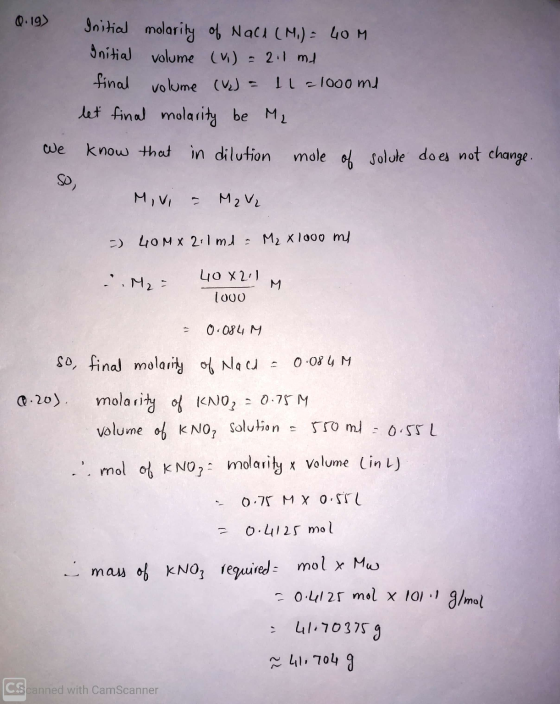
What is the molarity of a sodium chloride solution prepared by diluting 2.1 mL of 40 M NaCl to a total volume of 1 L?
Question 20 pts
How many grams are needed to prepare 550 mL of a 0.75 M KNO3 solution?
Input your numerical answer without units.
Homework Answers

Add Answer to:
Question 17
A solution is prepared by dissolving 45 g sodium carbonate,
Na2CO3, in enough water...
A 115.3 g sodium chloride solution(density =1.05 g/mL) was prepared by dissolving 15.3 g of NaCl...
A 115.3 g sodium chloride solution(density =1.05 g/mL) was prepared by dissolving 15.3 g of NaCl in 100.0 mL of water (density = 1.00 g/mL.) calculate the % of M/M, % M/V, and molarity of this in NaCl solution
A standard nitric acid solution is prepared using 0.425 g of sodium carbonate, Na2CO3. Find the...
A standard nitric acid solution is prepared using 0.425 g of sodium carbonate, Na2CO3. Find the molarity of the acid if 33.25 mL are required to reach a permanent endpoint. 2 HNO3 + Na2CO3 = 2 NaNO3 + H2O + CO2
A solution is prepared by dissolving 11.60 g of a mixture of sodium carbonate and sodium...
A solution is prepared by dissolving 11.60 g of a mixture of sodium carbonate and sodium bicarbonate in 1.00 L of water. A 300.0-cm3 sample of the solution is then treated with excess HNO3 and boiled to remove all the dissolved gas. A total of 0.941 L of dry CO2 is collected at 298 KK and 0.972 atm. Find the molarity of the carbonate in the solution and the bicarbonate in the solution.
A solution is prepared by dissolving 4.90 g sodium chloride in 225.0 g of water. The...
A solution is prepared by dissolving 4.90 g sodium chloride in 225.0 g of water. The density of the resulting solution is 1.33 g/mL. Determine the osmotic pressure (in atm) of this solution at 25.0 oC.
Solution Stoichiometry Hydrochloric acid (HCl) reacts with sodium carbonate (Na2CO3), forming sodium chloride (NaCl), water (H2O),...
Solution Stoichiometry Hydrochloric acid (HCl) reacts with sodium carbonate (Na2CO3), forming sodium chloride (NaCl), water (H2O), and carbon dioxide (CO2). This equation is balanced as written: 2HCl(aq)+Na2CO3(aq)→2NaCl(aq)+H2O(l)+CO2(g) a) What volume of 2.75 M HCl in liters is needed to react completely (with nothing left over) with 0.750 L of 0.300 M Na2CO3? b) A 565-mL sample of unknown HCl solution reacts completely with Na2CO3 to form 10.1 g CO2. What was the concentration of the HCl solution? How do I...
2. Calculate the molarity of a solution prepared by dissolving 2.500 g of Na2CO3 in water to make 500 mL of solutio...
 2. Calculate the molarity of a solution prepared by dissolving 2.500 g of Na2CO3 in water to make 500 mL of solution. (2 pts.)
5. (10 pts) Find pH of solution prepared by dissolving 1.0 g of sodium carbonate and...
 5. (10 pts) Find pH of solution prepared by dissolving 1.0 g of sodium carbonate and 1.0 g of sodium hydrogen carbonate in enough water to make 100.0 mL solution. The base dissociation constant of carbonate ion is 1.8x10⁻⁴. Assume that hydrogen carbonate ion does not react with water.
3. Consider a solution prepared by dissolving 30.000 g of BaCl, in enough water to make...
 3. Consider a solution prepared by dissolving 30.000 g of BaCl, in enough water to make a 200 ml solution. a. Determine the molarity of the BaCl, solution. b. Determine the molarity of Ba2+ ions. c. Determine the molarity of Chions. A chemist adds 800 mL of a 0.140 M NaCl solution to the existing 200 mL solution. d. Determine the new total volume of solution. e. Determine the new molarity of Ba2+ ions. f. Determine the new molarity of...
Sodium carbonate, Na2CO3, reacts with hydrochloric acid, HCl, to produce sodium chloride, carbon dioxide and water....
 Sodium carbonate, Na2CO3, reacts with hydrochloric acid, HCl, to produce sodium chloride, carbon dioxide and water. Refer to slide 7.18 for a summary of formulae relevant to the calculations below. 2HCl(aq) + Na.CO3(aq) + NaCl(aq) + H2O(l) + CO2(g) 1. Use this reaction to explain what is meant by the terms "acid", "conjugate base" and "salt" 2. Balance the equation for this reaction. 3. A solution was prepared by dissolving 5.00 g of Na2CO3 in water and adding water to...
6. A solution is prepared by dissolving 571.6 g of H2SO4 in enough water to make...
 6. A solution is prepared by dissolving 571.6 g of H2SO4 in enough water to make 1000.0 mL of solution. The solution has a density of 1.3294 g/mL. Determine the molarity and molality of the solution.
 2. Calculate the molarity of a solution prepared by dissolving 2.500 g of Na2CO3 in water to make 500 mL of solution. (2 pts.)
 5. (10 pts) Find pH of solution prepared by dissolving 1.0 g of sodium carbonate and 1.0 g of sodium hydrogen carbonate in enough water to make 100.0 mL solution. The base dissociation constant of carbonate ion is 1.8x10⁻⁴. Assume that hydrogen carbonate ion does not react with water.
 3. Consider a solution prepared by dissolving 30.000 g of BaCl, in enough water to make a 200 ml solution. a. Determine the molarity of the BaCl, solution. b. Determine the molarity of Ba2+ ions. c. Determine the molarity of Chions. A chemist adds 800 mL of a 0.140 M NaCl solution to the existing 200 mL solution. d. Determine the new total volume of solution. e. Determine the new molarity of Ba2+ ions. f. Determine the new molarity of...
 Sodium carbonate, Na2CO3, reacts with hydrochloric acid, HCl, to produce sodium chloride, carbon dioxide and water. Refer to slide 7.18 for a summary of formulae relevant to the calculations below. 2HCl(aq) + Na.CO3(aq) + NaCl(aq) + H2O(l) + CO2(g) 1. Use this reaction to explain what is meant by the terms "acid", "conjugate base" and "salt" 2. Balance the equation for this reaction. 3. A solution was prepared by dissolving 5.00 g of Na2CO3 in water and adding water to...
 6. A solution is prepared by dissolving 571.6 g of H2SO4 in enough water to make 1000.0 mL of solution. The solution has a density of 1.3294 g/mL. Determine the molarity and molality of the solution.
Most questions answered within 3 hours.
-
Where is the error in this code sequence?
String s1 = "Hello";
String s2 = "ello";...
asked 10 months ago -
Financial data for Joel de Paris, Inc., for last year
follow:
Joel de Paris, Inc.
Balance...
asked 10 months ago -
Consider this reaction:
Al2(SO4)3 (aq)+ BaCl3
(aq) Al2Cl6 (aq)- +
3BaSO4(s) . What is the...
asked 10 months ago -
Suppose that Savneet is considering increasing her
recent random sample from 20 car rentals to 40...
asked 10 months ago -
Trucks arrive at an unloading terminal at an average rate of 120
per hour.
Trucks arrive...
asked 10 months ago -
Why are methanol and ethanol completely soluble in water while
octanol is not very little soluble....
asked 10 months ago -
A facilities manager at a university reads in a research report
that the mean amount of...
asked 10 months ago -
When the CuSO4 is rehydrated by adding water to the anhydrous
compound, is this an endothermic...
asked 10 months ago -
A ray of sunlight is passing from diamond into crown glass; the
angle of incidence is...
asked 10 months ago -
A block of mass 0.249 kg is placed on top of a light, vertical
spring of...
asked 10 months ago -
how do the kidneys compensate in the presences of acidosis
a) trigger hyperventilate
b) reserve acid...
asked 10 months ago -
Question 501 pts
The rental rate of capital to the firm increases. Which of the
following...
asked 10 months ago