Let v be the wave's speed, λ its wavelength
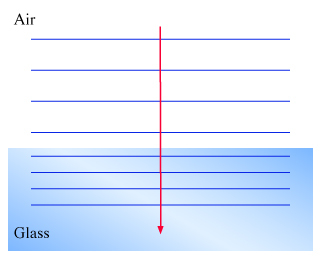
Let v be the wave's
speed, λ its
wavelength, and f its frequency.
These quantities are related via the equation v=λf.
Note that, if the wave speed decreases, the wavelength must also
decrease for the frequency to remain constant.
a) What is the wavelength λ of light in glass if its wavelength in air is λ0, its speed in air is c, and its speed in the glass is v?
Express your answer in terms of λ0, c, and v.
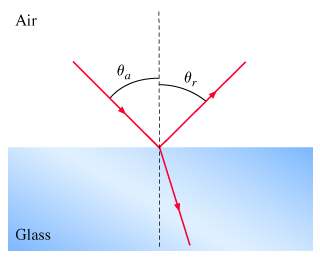
d) If light strikes the air/glass interface at an angle 32.0° to the normal, what is the angle of reflection,θt?
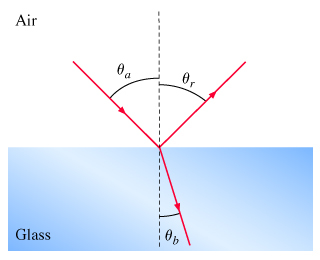
e) If light strikes the air/glass interface at an incidence angle of 32.0° , what is the angle of refraction, θb? Use 1.50 for the index of refraction of glass.
Homework Answers
The concepts used to solve this problem are Planck-Einstein relation, law of reflection, and Snell’s law.
First, find the relationship between the wavelengths of light in glass and its wavelength in air, and speed in glass and air using Planck-Einstein relation.
First, find the angle of reflection of the light that is reflected from the surface of glass using the law of reflection.
Finally, find the angle of refraction of the light using Snell’s law that connects the wavelength of a light in a medium with the refractive index of the medium.
The expression for Planck-Einstein relation is as follows:
Here, the speed of light is , the frequency of light is , and the wavelength of light is .
The expression for the frequency of light in air is as follows:
Here, the frequency of light in air is , the wavelength of light in air is , and the speed of light in air is .
The expression for the frequency of light in glass is as follows:
Here, the frequency of light in glass is , the wavelength of light in glass is , and the speed of light in air is .
The law of reflection states that the angle of incidence and angle of reflection will be equal for a light which gets reflected by a surface.
The expression for this condition is as follows:
Here, the angle of incidence is , and the angle of reflection is .
Snell’s law states that the ratio between the sine of angles of incidence and the refraction of a light that is crossing a boundary between two media is equivalent to the inverse ratio between the refractive indices of those media.
The expression for Snell’s law for the light travelling from air to glass is as follows:
Here, the angle of incidence is , the angle of refraction is , the refractive index of air is , and the refractive index of the glass is .
(a)
The expression for the frequency of light in air is as follows:
…… (1)
The expression for the frequency of light in glass is as follows:
…… (2)
The relationship between the frequency of light in air and frequency of light in glass is as follows:
Use the above condition in Equations (1) and (2).
Rearrange the above expression for the wavelength of light in glass.
(d)
The law of reflection is expressed as follows:
Substitute for .
(e)
Snell’s law is expressed as follows:
The above expression can be rearranged to get the angle of refraction.
Substitute for , for , and for .
Ans: Part a
The expression for the wavelength of light in glass is .
Part dThe angle of reflection of light from the surface of glass is .
Part eThe required angle of refraction of light is .
7. A ray of light has a frequency of f = 6 x 10¹⁴ Hz. It...
 7. A ray of light has a frequency of f = 6 x 10¹⁴ Hz. It enters into a flat surface of glass from air with an angle of incidence of 0 = 30° to the surface normal. The refractive index of the glass at this frequency is 1.4. Note that the refractive index of air is 1.0, and the speed of light in air is c= 3 x 10⁸ m/s. (a) (1 mark) What is the wavelength of the...
Q3 Fresnel Relations A laser beam of 600 nm wavelength propagates in sea water (n =...
 Q3 Fresnel Relations A laser beam of 600 nm wavelength propagates in sea water (n = 1.33), striking the glass window (ng = 1.50) of a submarine at an angle of 50° with respect to normal incidence. The beam undergoes total internal reflection at the glass-air interface. laser 50° n = 1.33 ng = 1.50 Nair = 1.0 (1) [3 marks] Calculate the penetration depth of the light intensity into the air for TE polarization. (2) (4 marks] Determine the...
water interface (the surface of the lake), it is partly reflected back into the air and...
 water interface (the surface of the lake), it is partly
reflected back into the air and partly refracted
or transmitted into the water. This explains why on the surface of
a lake sometimes you see the reflection of the surrounding
landscape and other times the underwater vegetation.
These effects on light propagation occur because light travels at
different speeds depending on the medium. The index of refraction
of a material, denoted by n, gives an indication of the speed of...
water interface (the surface of the lake), it is partly
reflected back into the air and partly refracted
or transmitted into the water. This explains why on the surface of
a lake sometimes you see the reflection of the surrounding
landscape and other times the underwater vegetation.
These effects on light propagation occur because light travels at
different speeds depending on the medium. The index of refraction
of a material, denoted by n, gives an indication of the speed of...
Light strikes a 5.0-cm thick sheet of glass at an angle of incidence in air of...
 Light strikes a 5.0-cm thick sheet of glass at an angle of incidence in air of 50°. The sheet has parallel faces and the glass has an index of refraction 1.50. (a) What is the angle of refraction in the glass? (6) After traveling through the glass the light re-emerges into the air. What is the final angle of refraction in air? () As it leaves the glass, by what distance is the path of the ray is displaced from...
Light with a frequency of 6.8×10¹⁴ Hz is travelling through glass and strikes a glass/air interface...
 Light with a frequency of 6.8×10¹⁴ Hz is travelling
through glass and strikes a glass/air interface as shown above.
Angle X1 is 29.0o to the normal. Some of the
light emerges from the glass and some is reflected back into the
glass.
a.) If the index of refraction for this glass is 1.36, what is
the value of angle X3?
b.) What is the value of angle X2?
c.) What is the speed of light in this glass?
d.) What...
Light with a frequency of 6.8×10¹⁴ Hz is travelling
through glass and strikes a glass/air interface as shown above.
Angle X1 is 29.0o to the normal. Some of the
light emerges from the glass and some is reflected back into the
glass.
a.) If the index of refraction for this glass is 1.36, what is
the value of angle X3?
b.) What is the value of angle X2?
c.) What is the speed of light in this glass?
d.) What...
A ray of light is traveling from air into glass with an index of refraction for...
A ray of light is traveling from air into glass with an index of refraction for air is 1 and for glass is 1.55. If it strikes an air/glass interface with the angle of incidence is 30° to the normal, what is the angle of refraction to the normal? Please draw a diagram.
Monochromatic light of wavelength, λ is traveling in air. The light then strikes a thin film...
Monochromatic light of wavelength, λ is traveling in air. The light then strikes a thin film having an index of refraction n1 that is coating a material having an index of refraction n2. If n2 is larger than n1, what minimum film thickness will result in maximum reflection of this light? A B C D E F G H I J A λ/n1 B λ/4 C λ D λ/(4n2) E λ/n2 F λ/(2n1) G λ/(4n1) H λ/2 I λ/(2n2) J...
Monochromatic light of wavelength, λ is traveling in air. The light then strikes a thin film...
Monochromatic light of wavelength, λ is traveling in air. The light then strikes a thin film having an index of refraction n1 that is coating a material having an index of refraction n2. If n1 is larger than n2, what minimum film thickness will result in minimum reflection of this light? A B C D E F G H I J A λ/(4n2) B λ/n2 C λ/(4n1) D λ/(2n1) E λ/4 F λ G λ/2 H λ/(2n2) I λ/n1 J...
ASAPP A light ray propagates in Material 1 with index of refraction 1.23, strikes an interface,...
 ASAPP
A light ray propagates in Material 1 with index of refraction 1.23, strikes an interface, then passes into Material 2 with index of refraction na = 1.43. The angle of incidence at the interface is , = 29.1. Determine the angle of refraction 0. Material Material 2 02 108 m/s. Given that the index of refraction in ethanol is 1.361, what is the The speed of light c in a vacuum is 2.997 speed of light Vethanol in ethanol?...
ASAPP
A light ray propagates in Material 1 with index of refraction 1.23, strikes an interface, then passes into Material 2 with index of refraction na = 1.43. The angle of incidence at the interface is , = 29.1. Determine the angle of refraction 0. Material Material 2 02 108 m/s. Given that the index of refraction in ethanol is 1.361, what is the The speed of light c in a vacuum is 2.997 speed of light Vethanol in ethanol?...
1. A Nd: YAG laser (1.106 micrometer) beam travels through a glass flint window of refractive...
1. A Nd: YAG laser (1.106 micrometer) beam travels through a glass flint window of refractive index of 1.98. Determine: (a) the speed, the wavelength, the frequency, and the period of the laser beam inside the glass; (b) the energy of its photon outside the glass in Joules. 2. Light travels from a block of glass with an index of refraction of 1.41 into air. (a) if the angle of reflection is 32 degrees, what is the angle of incidence?...
 7. A ray of light has a frequency of f = 6 x 10¹⁴ Hz. It enters into a flat surface of glass from air with an angle of incidence of 0 = 30° to the surface normal. The refractive index of the glass at this frequency is 1.4. Note that the refractive index of air is 1.0, and the speed of light in air is c= 3 x 10⁸ m/s. (a) (1 mark) What is the wavelength of the...
 Q3 Fresnel Relations A laser beam of 600 nm wavelength propagates in sea water (n = 1.33), striking the glass window (ng = 1.50) of a submarine at an angle of 50° with respect to normal incidence. The beam undergoes total internal reflection at the glass-air interface. laser 50° n = 1.33 ng = 1.50 Nair = 1.0 (1) [3 marks] Calculate the penetration depth of the light intensity into the air for TE polarization. (2) (4 marks] Determine the...
 water interface (the surface of the lake), it is partly
reflected back into the air and partly refracted
or transmitted into the water. This explains why on the surface of
a lake sometimes you see the reflection of the surrounding
landscape and other times the underwater vegetation.
These effects on light propagation occur because light travels at
different speeds depending on the medium. The index of refraction
of a material, denoted by n, gives an indication of the speed of...
water interface (the surface of the lake), it is partly
reflected back into the air and partly refracted
or transmitted into the water. This explains why on the surface of
a lake sometimes you see the reflection of the surrounding
landscape and other times the underwater vegetation.
These effects on light propagation occur because light travels at
different speeds depending on the medium. The index of refraction
of a material, denoted by n, gives an indication of the speed of...
 Light strikes a 5.0-cm thick sheet of glass at an angle of incidence in air of 50°. The sheet has parallel faces and the glass has an index of refraction 1.50. (a) What is the angle of refraction in the glass? (6) After traveling through the glass the light re-emerges into the air. What is the final angle of refraction in air? () As it leaves the glass, by what distance is the path of the ray is displaced from...
 Light with a frequency of 6.8×10¹⁴ Hz is travelling
through glass and strikes a glass/air interface as shown above.
Angle X1 is 29.0o to the normal. Some of the
light emerges from the glass and some is reflected back into the
glass.
a.) If the index of refraction for this glass is 1.36, what is
the value of angle X3?
b.) What is the value of angle X2?
c.) What is the speed of light in this glass?
d.) What...
Light with a frequency of 6.8×10¹⁴ Hz is travelling
through glass and strikes a glass/air interface as shown above.
Angle X1 is 29.0o to the normal. Some of the
light emerges from the glass and some is reflected back into the
glass.
a.) If the index of refraction for this glass is 1.36, what is
the value of angle X3?
b.) What is the value of angle X2?
c.) What is the speed of light in this glass?
d.) What...
 ASAPP
A light ray propagates in Material 1 with index of refraction 1.23, strikes an interface, then passes into Material 2 with index of refraction na = 1.43. The angle of incidence at the interface is , = 29.1. Determine the angle of refraction 0. Material Material 2 02 108 m/s. Given that the index of refraction in ethanol is 1.361, what is the The speed of light c in a vacuum is 2.997 speed of light Vethanol in ethanol?...
ASAPP
A light ray propagates in Material 1 with index of refraction 1.23, strikes an interface, then passes into Material 2 with index of refraction na = 1.43. The angle of incidence at the interface is , = 29.1. Determine the angle of refraction 0. Material Material 2 02 108 m/s. Given that the index of refraction in ethanol is 1.361, what is the The speed of light c in a vacuum is 2.997 speed of light Vethanol in ethanol?...
Most questions answered within 3 hours.
-
Where is the error in this code sequence?
String s1 = "Hello";
String s2 = "ello";...
asked 10 months ago -
Financial data for Joel de Paris, Inc., for last year
follow:
Joel de Paris, Inc.
Balance...
asked 10 months ago -
Consider this reaction:
Al2(SO4)3 (aq)+ BaCl3
(aq) Al2Cl6 (aq)- +
3BaSO4(s) . What is the...
asked 10 months ago -
Suppose that Savneet is considering increasing her
recent random sample from 20 car rentals to 40...
asked 10 months ago -
Trucks arrive at an unloading terminal at an average rate of 120
per hour.
Trucks arrive...
asked 10 months ago -
Why are methanol and ethanol completely soluble in water while
octanol is not very little soluble....
asked 10 months ago -
A facilities manager at a university reads in a research report
that the mean amount of...
asked 10 months ago -
When the CuSO4 is rehydrated by adding water to the anhydrous
compound, is this an endothermic...
asked 10 months ago -
A ray of sunlight is passing from diamond into crown glass; the
angle of incidence is...
asked 10 months ago -
A block of mass 0.249 kg is placed on top of a light, vertical
spring of...
asked 10 months ago -
how do the kidneys compensate in the presences of acidosis
a) trigger hyperventilate
b) reserve acid...
asked 10 months ago -
Question 501 pts
The rental rate of capital to the firm increases. Which of the
following...
asked 10 months ago