
Homework Answers
 Calculation
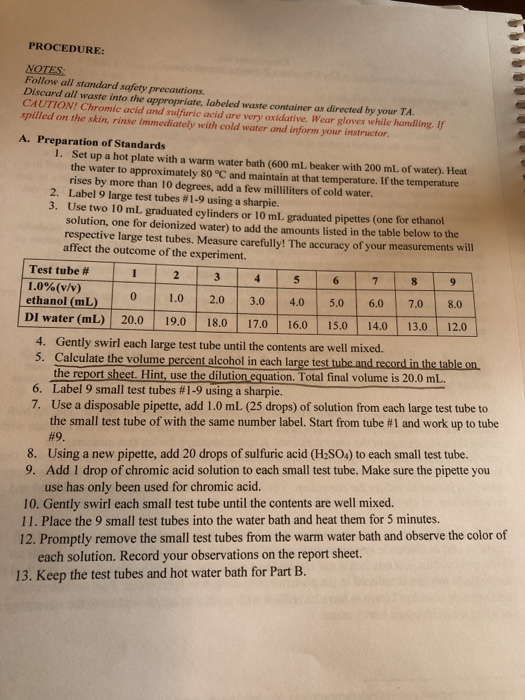
for all test tube are given in file attached.
Calculation
for all test tube are given in file attached.
Add Answer to:
Show Calculation of % ethanol in each tube below.
A. Preparation of Standards (4.5pt) # %(v/v)...
The concentration of a diluted "wine" sample was found to be 0.32 %(v/v) ethanol. Assuming the...
 The concentration of a diluted
"wine" sample was found to be 0.32 %(v/v) ethanol. Assuming the
dilution was done as described in Part B of the procedure for this
lab, what was the original concentration of ethanol in the "wine"?
Enter your answer with 2 significant figures.
B. Preparation of Unknown Samples 1. Label two small test tubes "wine" and "breath”. 2. Use a disposable pipette, add 1.0 mL (25 drops) of “wine” solution to the wine test tube. a....
The concentration of a diluted
"wine" sample was found to be 0.32 %(v/v) ethanol. Assuming the
dilution was done as described in Part B of the procedure for this
lab, what was the original concentration of ethanol in the "wine"?
Enter your answer with 2 significant figures.
B. Preparation of Unknown Samples 1. Label two small test tubes "wine" and "breath”. 2. Use a disposable pipette, add 1.0 mL (25 drops) of “wine” solution to the wine test tube. a....
1.) What would the product be if you oxidized a tertiary alcohol? A.) Ketone B.) Aldehyde...
 1.) What would the product be if you oxidized a tertiary
alcohol?
A.) Ketone
B.) Aldehyde
C.)Carboxylic Acid
D.) No reaction
2.) What would the FULLY oxidized product of a primary alcohol
be?
A.) No reaction
B.) Carboxylic Acid
C.) Aldehyde
D.) Ketone
3.) Which types of alcohol can be oxidized? Choose all that
apply.
A.) Quaternary
B.) Primary
C.) Secondary
D.) Tertiary
4.) the Ethanol standard in test tube 3 will have a final
concentration of _____%(v/v) ethanol.
5.)...
1.) What would the product be if you oxidized a tertiary
alcohol?
A.) Ketone
B.) Aldehyde
C.)Carboxylic Acid
D.) No reaction
2.) What would the FULLY oxidized product of a primary alcohol
be?
A.) No reaction
B.) Carboxylic Acid
C.) Aldehyde
D.) Ketone
3.) Which types of alcohol can be oxidized? Choose all that
apply.
A.) Quaternary
B.) Primary
C.) Secondary
D.) Tertiary
4.) the Ethanol standard in test tube 3 will have a final
concentration of _____%(v/v) ethanol.
5.)...
Proteins are composed of amino acid units bound by peptide bonds. By the addition of the...
Proteins are composed of amino acid units bound by peptide bonds. By the addition of the enzyme Bacterial Protease these bonds are broken and the individual amino acids are freed. A simple test for free amino acids is the use of the reagent Ninhydrin which turns purple in the presence of amino acids but remains yellowish in the presence of protein. I. Label one 250 ml beaker A and one 250 ml beaker B. To each beaker add l 00...
Add 1.5 mL of the 1.0%(v/v) ethanol (mL) to 8.5 mL of deionized water. The ethanol...
Add 1.5 mL of the 1.0%(v/v) ethanol (mL) to 8.5 mL of deionized water. The ethanol standard in the test tube will have a final concentration of ____ %(v/v) ethanol? Add 1.0 mL of wine that has been diluted by a factor of 100, to a test tube and add 20 drops of sulfuric acid to it. The concentration of the diluted wine sample was found to be 0.23%(v/v) ethanol. Using the procedure stated, what was the original concentration of...
Part C. Benedict's Test. Test Tube Samp Prediction Observations Results (+ or -) 2-hydroxybutanal Benzaldehyde Propanone...
 Part C. Benedict's Test. Test Tube Samp Prediction Observations Results (+ or -) 2-hydroxybutanal Benzaldehyde Propanone Cyclohexanone Unknown Part D. Iodoform Test. Test Sample Tube 1 2-hydroxybutanal Prediction Observations Results (+ or -) Benzaldehyde Propanone Cyclohexanone Unknown Experiment 12 Identification of Aldehydes and Ketones O the b e t theader of each holding your breath as a st beward your nose. Record the derson the specified memes from O Ta Test g shes between ones that contain a methyl group...
What causes the lack of on in tube # 5 that is acting as the control...
 What causes the lack of on in tube # 5 that is acting as the control tube? 13. What is the reason for using the control tube What is the reason for 5. used in this exercise 14. What is the relationship between the concentration of pepsin and enzyme activity, as observed on Figure 3-7? 15. How does an increase in the amount of the pepsin, in the test tube, enhance the interaction between pepsin and substrate, thus speeding up...
Measurement and Accuracy Procedure Obtain 5 large test tubes (all the same size), a test tube...
Measurement and Accuracy Procedure Obtain 5 large test tubes (all the same size), a test tube rack, 3 beakers of colored water A-C, and 3 graduated cylinders. With a Sharpie, label the tubes 1-5 Measure 25 mL of solution from beaker A (red) using a clean graduated cylinder. Pour into tube 1. Measure 28 mL of solution from beaker B (yellow) using a clean graduated cylinder. Pour into tube 3. Measure 22 mL of solution from beaker C (blue) using...
1 Reaction C: Copper(II) Hydroxide to Copper(IT) Oxide Observations: The solntich goes from a light blue...
 1 Reaction C: Copper(II) Hydroxide to Copper(IT) Oxide Observations: The solntich goes from a light blue to a dark blue. when heated the solution turns to a green/black color. Balanced Molecular Equation: Balanced Net lonie Equation: Reaction D: Copper(IT) Oxide to Copper(II) Sulfate Observations: "The back sond is dissolved in the acid. This creates a light blue / Clear solurich Balanced Molecular Equation: Balanced Net Ionic Equation: Reaction E: Copper(II) Sulfate to Copper Metal (and Dissolution of excess Mg) Observations:...
please answer questions 1 through 6 with the information provided. Enzyme Specificity Are Sucrase and Lactase...
 please answer questions 1 through 6 with the
information provided.
Enzyme Specificity Are Sucrase and Lactase specific to Sucrose and Lactose? I: Experimental Procedure 1. Add 0.3 g of sucrose to three different test tubes. Make sure to remember to label them 1 to 3. 2. Add 5 mL of Dl water to test tube number 1. Add 5 mL of sucrase to test tube 2. Add 5 ml of lactase to test tube 3. 3. Add 0.3 g of...
please answer questions 1 through 6 with the
information provided.
Enzyme Specificity Are Sucrase and Lactase specific to Sucrose and Lactose? I: Experimental Procedure 1. Add 0.3 g of sucrose to three different test tubes. Make sure to remember to label them 1 to 3. 2. Add 5 mL of Dl water to test tube number 1. Add 5 mL of sucrase to test tube 2. Add 5 ml of lactase to test tube 3. 3. Add 0.3 g of...
PREPARATION OF PHARMACEUTICALS - Fischer Esterification Reactions Q: Calculate the expected mass of both methyl salicylate and aspirin assuming 100% yield. EXPERIMENT7 PREPARATION OF PHARMACEUTICALS...
 PREPARATION OF PHARMACEUTICALS - Fischer Esterification
Reactions
Q: Calculate the expected mass of both methyl salicylate and
aspirin assuming 100% yield.
EXPERIMENT7 PREPARATION OF PHARMACEUTICALS Fischer Esterification Reactions Almost 2500 years ago, physicians such as Hippocrates recommended that patients chew on the bark of the willow to alleviate pain. The active ingredient in willow bark was found to be salicin, a compound made of a molecule of salicyl alcohol bonded to a p-D-glucose molecule. In the stomach, the bond between...
PREPARATION OF PHARMACEUTICALS - Fischer Esterification
Reactions
Q: Calculate the expected mass of both methyl salicylate and
aspirin assuming 100% yield.
EXPERIMENT7 PREPARATION OF PHARMACEUTICALS Fischer Esterification Reactions Almost 2500 years ago, physicians such as Hippocrates recommended that patients chew on the bark of the willow to alleviate pain. The active ingredient in willow bark was found to be salicin, a compound made of a molecule of salicyl alcohol bonded to a p-D-glucose molecule. In the stomach, the bond between...
 The concentration of a diluted
"wine" sample was found to be 0.32 %(v/v) ethanol. Assuming the
dilution was done as described in Part B of the procedure for this
lab, what was the original concentration of ethanol in the "wine"?
Enter your answer with 2 significant figures.
B. Preparation of Unknown Samples 1. Label two small test tubes "wine" and "breath”. 2. Use a disposable pipette, add 1.0 mL (25 drops) of “wine” solution to the wine test tube. a....
The concentration of a diluted
"wine" sample was found to be 0.32 %(v/v) ethanol. Assuming the
dilution was done as described in Part B of the procedure for this
lab, what was the original concentration of ethanol in the "wine"?
Enter your answer with 2 significant figures.
B. Preparation of Unknown Samples 1. Label two small test tubes "wine" and "breath”. 2. Use a disposable pipette, add 1.0 mL (25 drops) of “wine” solution to the wine test tube. a....
 1.) What would the product be if you oxidized a tertiary
alcohol?
A.) Ketone
B.) Aldehyde
C.)Carboxylic Acid
D.) No reaction
2.) What would the FULLY oxidized product of a primary alcohol
be?
A.) No reaction
B.) Carboxylic Acid
C.) Aldehyde
D.) Ketone
3.) Which types of alcohol can be oxidized? Choose all that
apply.
A.) Quaternary
B.) Primary
C.) Secondary
D.) Tertiary
4.) the Ethanol standard in test tube 3 will have a final
concentration of _____%(v/v) ethanol.
5.)...
1.) What would the product be if you oxidized a tertiary
alcohol?
A.) Ketone
B.) Aldehyde
C.)Carboxylic Acid
D.) No reaction
2.) What would the FULLY oxidized product of a primary alcohol
be?
A.) No reaction
B.) Carboxylic Acid
C.) Aldehyde
D.) Ketone
3.) Which types of alcohol can be oxidized? Choose all that
apply.
A.) Quaternary
B.) Primary
C.) Secondary
D.) Tertiary
4.) the Ethanol standard in test tube 3 will have a final
concentration of _____%(v/v) ethanol.
5.)...
 Part C. Benedict's Test. Test Tube Samp Prediction Observations Results (+ or -) 2-hydroxybutanal Benzaldehyde Propanone Cyclohexanone Unknown Part D. Iodoform Test. Test Sample Tube 1 2-hydroxybutanal Prediction Observations Results (+ or -) Benzaldehyde Propanone Cyclohexanone Unknown Experiment 12 Identification of Aldehydes and Ketones O the b e t theader of each holding your breath as a st beward your nose. Record the derson the specified memes from O Ta Test g shes between ones that contain a methyl group...
 What causes the lack of on in tube # 5 that is acting as the control tube? 13. What is the reason for using the control tube What is the reason for 5. used in this exercise 14. What is the relationship between the concentration of pepsin and enzyme activity, as observed on Figure 3-7? 15. How does an increase in the amount of the pepsin, in the test tube, enhance the interaction between pepsin and substrate, thus speeding up...
 1 Reaction C: Copper(II) Hydroxide to Copper(IT) Oxide Observations: The solntich goes from a light blue to a dark blue. when heated the solution turns to a green/black color. Balanced Molecular Equation: Balanced Net lonie Equation: Reaction D: Copper(IT) Oxide to Copper(II) Sulfate Observations: "The back sond is dissolved in the acid. This creates a light blue / Clear solurich Balanced Molecular Equation: Balanced Net Ionic Equation: Reaction E: Copper(II) Sulfate to Copper Metal (and Dissolution of excess Mg) Observations:...
 please answer questions 1 through 6 with the
information provided.
Enzyme Specificity Are Sucrase and Lactase specific to Sucrose and Lactose? I: Experimental Procedure 1. Add 0.3 g of sucrose to three different test tubes. Make sure to remember to label them 1 to 3. 2. Add 5 mL of Dl water to test tube number 1. Add 5 mL of sucrase to test tube 2. Add 5 ml of lactase to test tube 3. 3. Add 0.3 g of...
please answer questions 1 through 6 with the
information provided.
Enzyme Specificity Are Sucrase and Lactase specific to Sucrose and Lactose? I: Experimental Procedure 1. Add 0.3 g of sucrose to three different test tubes. Make sure to remember to label them 1 to 3. 2. Add 5 mL of Dl water to test tube number 1. Add 5 mL of sucrase to test tube 2. Add 5 ml of lactase to test tube 3. 3. Add 0.3 g of...
 PREPARATION OF PHARMACEUTICALS - Fischer Esterification
Reactions
Q: Calculate the expected mass of both methyl salicylate and
aspirin assuming 100% yield.
EXPERIMENT7 PREPARATION OF PHARMACEUTICALS Fischer Esterification Reactions Almost 2500 years ago, physicians such as Hippocrates recommended that patients chew on the bark of the willow to alleviate pain. The active ingredient in willow bark was found to be salicin, a compound made of a molecule of salicyl alcohol bonded to a p-D-glucose molecule. In the stomach, the bond between...
PREPARATION OF PHARMACEUTICALS - Fischer Esterification
Reactions
Q: Calculate the expected mass of both methyl salicylate and
aspirin assuming 100% yield.
EXPERIMENT7 PREPARATION OF PHARMACEUTICALS Fischer Esterification Reactions Almost 2500 years ago, physicians such as Hippocrates recommended that patients chew on the bark of the willow to alleviate pain. The active ingredient in willow bark was found to be salicin, a compound made of a molecule of salicyl alcohol bonded to a p-D-glucose molecule. In the stomach, the bond between...
Most questions answered within 3 hours.
-
Where is the error in this code sequence?
String s1 = "Hello";
String s2 = "ello";...
asked 11 months ago -
Financial data for Joel de Paris, Inc., for last year
follow:
Joel de Paris, Inc.
Balance...
asked 11 months ago -
Consider this reaction:
Al2(SO4)3 (aq)+ BaCl3
(aq) Al2Cl6 (aq)- +
3BaSO4(s) . What is the...
asked 11 months ago -
Suppose that Savneet is considering increasing her
recent random sample from 20 car rentals to 40...
asked 11 months ago -
Trucks arrive at an unloading terminal at an average rate of 120
per hour.
Trucks arrive...
asked 11 months ago -
Why are methanol and ethanol completely soluble in water while
octanol is not very little soluble....
asked 11 months ago -
A facilities manager at a university reads in a research report
that the mean amount of...
asked 11 months ago -
When the CuSO4 is rehydrated by adding water to the anhydrous
compound, is this an endothermic...
asked 11 months ago -
A ray of sunlight is passing from diamond into crown glass; the
angle of incidence is...
asked 11 months ago -
A block of mass 0.249 kg is placed on top of a light, vertical
spring of...
asked 11 months ago -
how do the kidneys compensate in the presences of acidosis
a) trigger hyperventilate
b) reserve acid...
asked 11 months ago -
Question 501 pts
The rental rate of capital to the firm increases. Which of the
following...
asked 11 months ago