Proteins are composed of amino acid units bound by peptide bonds. By the addition of the...
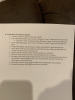
Proteins are composed of amino acid units bound by peptide bonds. By the addition of the enzyme Bacterial Protease these bonds are broken and the individual amino acids are freed. A simple test for free amino acids is the use of the reagent Ninhydrin which turns purple in the presence of amino acids but remains yellowish in the presence of protein.
I. Label one 250 ml beaker A and one 250 ml beaker B. To each beaker add l 00 ml of water and one half of the curd. Stir well to break up the curd.
-
To beaker A add 1.0 g of the enzyme Bacterial Protease. Stir well and allow standing 5 minutes. Add no enzyme to beaker B. Stir both beakers well and allow to stand 5 minutes.
-
After 5 minutes, filter about 5 ml of each solution through separate funnels into separate test tubes marked A and B. To each test tube add 1.0 ml of Ninhydrin reagent and gently swirl the tubes.
-
Make a water bath by adding 150 ml water to a 400 ml beaker and heat to boiling. Place test tubes A and B in this boiling water bath and heat until a color change (4 to 7 minutes) and remove from the heat. The Ninhydrin turns purple in the presence of amino acids but does not change color in the presence of protein.
-
For my results, tube A turned into a dark purple. Yet, tube B also turned into a lighter purple with some curd still at the sides of the tubes. I don't think tube B was supposed to turn purple right if no enzyme was added to it? If so, what may have caused this color change. ?
Homework Answers
Nihydrin reacts with free amino acids only. In baker B (without enzyme), the boiling bath incubation might induce the breaking of some peptide bonds, allowing that some amino acid would be free in solution. That could be the reason of a light purple result instead of yellow.
If you incubate a protein more than 5 minutes in a boiling water batch , there is a small chance of breaking some peptide bonds besides the denaturation of the protein
Add Answer to:
Proteins are composed of amino acid units bound by peptide
bonds. By the addition of the...
I need help with writing the conclusion for this online lab report Abstract By testing the...
I need help with writing the conclusion for this online lab report Abstract By testing the unknown substance with different chemicals such as NaOH, NaHCO3, FeCl3, HCl, Sodium Nirtite, Methanol, Alchol, Borsches’s reaggent, Schiffs reagent by process of elimation we are able to find out the functional group of the substance. The reactions that occur will help us to distinguish which functional group the unknown substance belongs to Materials: Test Tubes- 6 Gloves Droppers Spoon (for unknown substance) Waterbath -...
Show Calculation of % ethanol in each tube below. A. Preparation of Standards (4.5pt) # %(v/v)...
 Show Calculation of % ethanol in each tube below.
A. Preparation of Standards (4.5pt) # %(v/v) Tube Ethanol Observations after heating Oil. turned light orange. LOL turned light orange 2.04. turned burnt orange 3.0% turned dark Yellow green 4.01. turned light green 5.01. turned dark blue igreen 6.07 turned light blue 7.01 turned light blue 8.07. turned light blue Show calculation of %(v/v) ethanol in each tube below (2.25pt): PROCEDURE: NOTES: Follow all standard safety precautions. Discard all waste into...
Show Calculation of % ethanol in each tube below.
A. Preparation of Standards (4.5pt) # %(v/v) Tube Ethanol Observations after heating Oil. turned light orange. LOL turned light orange 2.04. turned burnt orange 3.0% turned dark Yellow green 4.01. turned light green 5.01. turned dark blue igreen 6.07 turned light blue 7.01 turned light blue 8.07. turned light blue Show calculation of %(v/v) ethanol in each tube below (2.25pt): PROCEDURE: NOTES: Follow all standard safety precautions. Discard all waste into...
Can someone help me rewrite procedure #3 in paragraph notation. It should be written so that...
 Can someone help me rewrite procedure #3 in paragraph
notation. It should be written so that anyone reading it could
replicate what you did.
1. Place cell growth media in 37degree incubator for at least 30 minutes. 2. Remove tubes containing frozen cells from liquid nitrogen tanks and quickly place the tubes on dry ice. Cells should thaw in about a minute. 3. Once thawed, transfer the cells into a 50ml conical tube and add 50ml of warm growth media...
Can someone help me rewrite procedure #3 in paragraph
notation. It should be written so that anyone reading it could
replicate what you did.
1. Place cell growth media in 37degree incubator for at least 30 minutes. 2. Remove tubes containing frozen cells from liquid nitrogen tanks and quickly place the tubes on dry ice. Cells should thaw in about a minute. 3. Once thawed, transfer the cells into a 50ml conical tube and add 50ml of warm growth media...
2130 D. HYDROLYSIS OF DISACCHARIDES and POLYSACOLARIDES Make sure you understand what you are doing bore...
 2130 D. HYDROLYSIS OF DISACCHARIDES and POLYSACOLARIDES Make sure you understand what you are doing bore Both the lodine Test and Benedict's best becau described below. Label test tubes so they are t s See the datatable for any that you pre heated in a hot waterbuch e e h 1. You will need 4 test tubes, 1 and 2 forstarch and dowe l of such to test tubes 1 and 2 Add a small pinch of sucrose to test...
Question: Procedure Separation and Identification of Pb2 (aq), Fe (aq), Al(a), and Cu Note: Tests should...
 Question:
Procedure Separation and Identification of Pb2 (aq), Fe (aq), Al(a), and Cu Note: Tests should be performed concurrently on the known and the unknown solutions. Volumes are approximate. All work excepting the centrifugation should be done in the fume hood 1. To about 2. mL of your sample in a test tube, add 5 drops (-0.2 mL) of 6 M HCl(a). Mix well and centrifuge. Decant the clear liquid into a clean test tube and save it for Step...
Question:
Procedure Separation and Identification of Pb2 (aq), Fe (aq), Al(a), and Cu Note: Tests should be performed concurrently on the known and the unknown solutions. Volumes are approximate. All work excepting the centrifugation should be done in the fume hood 1. To about 2. mL of your sample in a test tube, add 5 drops (-0.2 mL) of 6 M HCl(a). Mix well and centrifuge. Decant the clear liquid into a clean test tube and save it for Step...
can someone please answer number one? im so lost DYES AND DYEING CHAPTER 1. Calculate the...
 can someone please answer number one? im so lost
DYES AND DYEING CHAPTER 1. Calculate the amounts of salicylic acid, 1-naphthol, 2-naphthol, 8-anilino-1-naph- thalenesulfonic acid ammonium salt, or N,N-dimethylaniline needed for Part 1B of this experiment (use molecules as assigned by your TA). 190mg 3-aminobenzene 2.5mL Sulfonic acid 2.5% sodium carbonate solution 81mg Sodium nitrate 2. What is the purpose of the sodium carbonate in Part 1A? Why do we add glacial acetic acid in Part 13 when we react...
can someone please answer number one? im so lost
DYES AND DYEING CHAPTER 1. Calculate the amounts of salicylic acid, 1-naphthol, 2-naphthol, 8-anilino-1-naph- thalenesulfonic acid ammonium salt, or N,N-dimethylaniline needed for Part 1B of this experiment (use molecules as assigned by your TA). 190mg 3-aminobenzene 2.5mL Sulfonic acid 2.5% sodium carbonate solution 81mg Sodium nitrate 2. What is the purpose of the sodium carbonate in Part 1A? Why do we add glacial acetic acid in Part 13 when we react...
please answer questions 1 through 6 with the information provided. Enzyme Specificity Are Sucrase and Lactase...
 please answer questions 1 through 6 with the
information provided.
Enzyme Specificity Are Sucrase and Lactase specific to Sucrose and Lactose? I: Experimental Procedure 1. Add 0.3 g of sucrose to three different test tubes. Make sure to remember to label them 1 to 3. 2. Add 5 mL of Dl water to test tube number 1. Add 5 mL of sucrase to test tube 2. Add 5 ml of lactase to test tube 3. 3. Add 0.3 g of...
please answer questions 1 through 6 with the
information provided.
Enzyme Specificity Are Sucrase and Lactase specific to Sucrose and Lactose? I: Experimental Procedure 1. Add 0.3 g of sucrose to three different test tubes. Make sure to remember to label them 1 to 3. 2. Add 5 mL of Dl water to test tube number 1. Add 5 mL of sucrase to test tube 2. Add 5 ml of lactase to test tube 3. 3. Add 0.3 g of...
QUESTION: Write a flow scheme for the work-up. THE WORK UP:
 QUESTION:
Write a flow scheme for the work-up.
THE WORK UP:
C. Work-up (save all layers) and Isolation of Product MgBrCl Benzoic acid Transfer the mixture into a test tube. Rinse the beaker with about 3 mL of regular (not anhydrous) diethyl ether and pour the washings into the test tube. There should be two distinct layers in the test tube Remove the aqueous layer (to be discarded) and shake the ether layer with about 2 mL of 3 M...
QUESTION:
Write a flow scheme for the work-up.
THE WORK UP:
C. Work-up (save all layers) and Isolation of Product MgBrCl Benzoic acid Transfer the mixture into a test tube. Rinse the beaker with about 3 mL of regular (not anhydrous) diethyl ether and pour the washings into the test tube. There should be two distinct layers in the test tube Remove the aqueous layer (to be discarded) and shake the ether layer with about 2 mL of 3 M...
The concentration of a diluted "wine" sample was found to be 0.32 %(v/v) ethanol. Assuming the...
 The concentration of a diluted
"wine" sample was found to be 0.32 %(v/v) ethanol. Assuming the
dilution was done as described in Part B of the procedure for this
lab, what was the original concentration of ethanol in the "wine"?
Enter your answer with 2 significant figures.
B. Preparation of Unknown Samples 1. Label two small test tubes "wine" and "breath”. 2. Use a disposable pipette, add 1.0 mL (25 drops) of “wine” solution to the wine test tube. a....
The concentration of a diluted
"wine" sample was found to be 0.32 %(v/v) ethanol. Assuming the
dilution was done as described in Part B of the procedure for this
lab, what was the original concentration of ethanol in the "wine"?
Enter your answer with 2 significant figures.
B. Preparation of Unknown Samples 1. Label two small test tubes "wine" and "breath”. 2. Use a disposable pipette, add 1.0 mL (25 drops) of “wine” solution to the wine test tube. a....
I need to write a conclusion for this lab. Based off these results what kinds of...
 I need to write a conclusion for this lab. Based off these
results what kinds of conclusions can be drawn?
S OY Orre tes. A, B. Color, pH, Specific Gravity, and Electrolytes "Normal Urine Specimen" Test A. Color I clear "Abnormal Urine Specimen" slightly cloudy PH 2 1.10 gime! Specific gravity 0.70 glume - B. Electrolytes (Indicate absent - present +, strongly present ++) nornal Nat CI SO,2- PO,- 219 C-F. Glucose, Ketone Bodies, Protein, and Urobilinogen "Normal Urine Specimen"...
I need to write a conclusion for this lab. Based off these
results what kinds of conclusions can be drawn?
S OY Orre tes. A, B. Color, pH, Specific Gravity, and Electrolytes "Normal Urine Specimen" Test A. Color I clear "Abnormal Urine Specimen" slightly cloudy PH 2 1.10 gime! Specific gravity 0.70 glume - B. Electrolytes (Indicate absent - present +, strongly present ++) nornal Nat CI SO,2- PO,- 219 C-F. Glucose, Ketone Bodies, Protein, and Urobilinogen "Normal Urine Specimen"...
 Show Calculation of % ethanol in each tube below.
A. Preparation of Standards (4.5pt) # %(v/v) Tube Ethanol Observations after heating Oil. turned light orange. LOL turned light orange 2.04. turned burnt orange 3.0% turned dark Yellow green 4.01. turned light green 5.01. turned dark blue igreen 6.07 turned light blue 7.01 turned light blue 8.07. turned light blue Show calculation of %(v/v) ethanol in each tube below (2.25pt): PROCEDURE: NOTES: Follow all standard safety precautions. Discard all waste into...
Show Calculation of % ethanol in each tube below.
A. Preparation of Standards (4.5pt) # %(v/v) Tube Ethanol Observations after heating Oil. turned light orange. LOL turned light orange 2.04. turned burnt orange 3.0% turned dark Yellow green 4.01. turned light green 5.01. turned dark blue igreen 6.07 turned light blue 7.01 turned light blue 8.07. turned light blue Show calculation of %(v/v) ethanol in each tube below (2.25pt): PROCEDURE: NOTES: Follow all standard safety precautions. Discard all waste into...
 Can someone help me rewrite procedure #3 in paragraph
notation. It should be written so that anyone reading it could
replicate what you did.
1. Place cell growth media in 37degree incubator for at least 30 minutes. 2. Remove tubes containing frozen cells from liquid nitrogen tanks and quickly place the tubes on dry ice. Cells should thaw in about a minute. 3. Once thawed, transfer the cells into a 50ml conical tube and add 50ml of warm growth media...
Can someone help me rewrite procedure #3 in paragraph
notation. It should be written so that anyone reading it could
replicate what you did.
1. Place cell growth media in 37degree incubator for at least 30 minutes. 2. Remove tubes containing frozen cells from liquid nitrogen tanks and quickly place the tubes on dry ice. Cells should thaw in about a minute. 3. Once thawed, transfer the cells into a 50ml conical tube and add 50ml of warm growth media...
 2130 D. HYDROLYSIS OF DISACCHARIDES and POLYSACOLARIDES Make sure you understand what you are doing bore Both the lodine Test and Benedict's best becau described below. Label test tubes so they are t s See the datatable for any that you pre heated in a hot waterbuch e e h 1. You will need 4 test tubes, 1 and 2 forstarch and dowe l of such to test tubes 1 and 2 Add a small pinch of sucrose to test...
 Question:
Procedure Separation and Identification of Pb2 (aq), Fe (aq), Al(a), and Cu Note: Tests should be performed concurrently on the known and the unknown solutions. Volumes are approximate. All work excepting the centrifugation should be done in the fume hood 1. To about 2. mL of your sample in a test tube, add 5 drops (-0.2 mL) of 6 M HCl(a). Mix well and centrifuge. Decant the clear liquid into a clean test tube and save it for Step...
Question:
Procedure Separation and Identification of Pb2 (aq), Fe (aq), Al(a), and Cu Note: Tests should be performed concurrently on the known and the unknown solutions. Volumes are approximate. All work excepting the centrifugation should be done in the fume hood 1. To about 2. mL of your sample in a test tube, add 5 drops (-0.2 mL) of 6 M HCl(a). Mix well and centrifuge. Decant the clear liquid into a clean test tube and save it for Step...
 can someone please answer number one? im so lost
DYES AND DYEING CHAPTER 1. Calculate the amounts of salicylic acid, 1-naphthol, 2-naphthol, 8-anilino-1-naph- thalenesulfonic acid ammonium salt, or N,N-dimethylaniline needed for Part 1B of this experiment (use molecules as assigned by your TA). 190mg 3-aminobenzene 2.5mL Sulfonic acid 2.5% sodium carbonate solution 81mg Sodium nitrate 2. What is the purpose of the sodium carbonate in Part 1A? Why do we add glacial acetic acid in Part 13 when we react...
can someone please answer number one? im so lost
DYES AND DYEING CHAPTER 1. Calculate the amounts of salicylic acid, 1-naphthol, 2-naphthol, 8-anilino-1-naph- thalenesulfonic acid ammonium salt, or N,N-dimethylaniline needed for Part 1B of this experiment (use molecules as assigned by your TA). 190mg 3-aminobenzene 2.5mL Sulfonic acid 2.5% sodium carbonate solution 81mg Sodium nitrate 2. What is the purpose of the sodium carbonate in Part 1A? Why do we add glacial acetic acid in Part 13 when we react...
 please answer questions 1 through 6 with the
information provided.
Enzyme Specificity Are Sucrase and Lactase specific to Sucrose and Lactose? I: Experimental Procedure 1. Add 0.3 g of sucrose to three different test tubes. Make sure to remember to label them 1 to 3. 2. Add 5 mL of Dl water to test tube number 1. Add 5 mL of sucrase to test tube 2. Add 5 ml of lactase to test tube 3. 3. Add 0.3 g of...
please answer questions 1 through 6 with the
information provided.
Enzyme Specificity Are Sucrase and Lactase specific to Sucrose and Lactose? I: Experimental Procedure 1. Add 0.3 g of sucrose to three different test tubes. Make sure to remember to label them 1 to 3. 2. Add 5 mL of Dl water to test tube number 1. Add 5 mL of sucrase to test tube 2. Add 5 ml of lactase to test tube 3. 3. Add 0.3 g of...
 QUESTION:
Write a flow scheme for the work-up.
THE WORK UP:
C. Work-up (save all layers) and Isolation of Product MgBrCl Benzoic acid Transfer the mixture into a test tube. Rinse the beaker with about 3 mL of regular (not anhydrous) diethyl ether and pour the washings into the test tube. There should be two distinct layers in the test tube Remove the aqueous layer (to be discarded) and shake the ether layer with about 2 mL of 3 M...
QUESTION:
Write a flow scheme for the work-up.
THE WORK UP:
C. Work-up (save all layers) and Isolation of Product MgBrCl Benzoic acid Transfer the mixture into a test tube. Rinse the beaker with about 3 mL of regular (not anhydrous) diethyl ether and pour the washings into the test tube. There should be two distinct layers in the test tube Remove the aqueous layer (to be discarded) and shake the ether layer with about 2 mL of 3 M...
 The concentration of a diluted
"wine" sample was found to be 0.32 %(v/v) ethanol. Assuming the
dilution was done as described in Part B of the procedure for this
lab, what was the original concentration of ethanol in the "wine"?
Enter your answer with 2 significant figures.
B. Preparation of Unknown Samples 1. Label two small test tubes "wine" and "breath”. 2. Use a disposable pipette, add 1.0 mL (25 drops) of “wine” solution to the wine test tube. a....
The concentration of a diluted
"wine" sample was found to be 0.32 %(v/v) ethanol. Assuming the
dilution was done as described in Part B of the procedure for this
lab, what was the original concentration of ethanol in the "wine"?
Enter your answer with 2 significant figures.
B. Preparation of Unknown Samples 1. Label two small test tubes "wine" and "breath”. 2. Use a disposable pipette, add 1.0 mL (25 drops) of “wine” solution to the wine test tube. a....
 I need to write a conclusion for this lab. Based off these
results what kinds of conclusions can be drawn?
S OY Orre tes. A, B. Color, pH, Specific Gravity, and Electrolytes "Normal Urine Specimen" Test A. Color I clear "Abnormal Urine Specimen" slightly cloudy PH 2 1.10 gime! Specific gravity 0.70 glume - B. Electrolytes (Indicate absent - present +, strongly present ++) nornal Nat CI SO,2- PO,- 219 C-F. Glucose, Ketone Bodies, Protein, and Urobilinogen "Normal Urine Specimen"...
I need to write a conclusion for this lab. Based off these
results what kinds of conclusions can be drawn?
S OY Orre tes. A, B. Color, pH, Specific Gravity, and Electrolytes "Normal Urine Specimen" Test A. Color I clear "Abnormal Urine Specimen" slightly cloudy PH 2 1.10 gime! Specific gravity 0.70 glume - B. Electrolytes (Indicate absent - present +, strongly present ++) nornal Nat CI SO,2- PO,- 219 C-F. Glucose, Ketone Bodies, Protein, and Urobilinogen "Normal Urine Specimen"...
Most questions answered within 3 hours.
-
Where is the error in this code sequence?
String s1 = "Hello";
String s2 = "ello";...
asked 11 months ago -
Financial data for Joel de Paris, Inc., for last year
follow:
Joel de Paris, Inc.
Balance...
asked 11 months ago -
Consider this reaction:
Al2(SO4)3 (aq)+ BaCl3
(aq) Al2Cl6 (aq)- +
3BaSO4(s) . What is the...
asked 11 months ago -
Suppose that Savneet is considering increasing her
recent random sample from 20 car rentals to 40...
asked 11 months ago -
Trucks arrive at an unloading terminal at an average rate of 120
per hour.
Trucks arrive...
asked 11 months ago -
Why are methanol and ethanol completely soluble in water while
octanol is not very little soluble....
asked 11 months ago -
A facilities manager at a university reads in a research report
that the mean amount of...
asked 11 months ago -
When the CuSO4 is rehydrated by adding water to the anhydrous
compound, is this an endothermic...
asked 11 months ago -
A ray of sunlight is passing from diamond into crown glass; the
angle of incidence is...
asked 11 months ago -
A block of mass 0.249 kg is placed on top of a light, vertical
spring of...
asked 11 months ago -
how do the kidneys compensate in the presences of acidosis
a) trigger hyperventilate
b) reserve acid...
asked 11 months ago -
Question 501 pts
The rental rate of capital to the firm increases. Which of the
following...
asked 11 months ago