1a. A weak monoprotic base has a Kb = 1.67 × 10⁻¹⁰. Calculate the Ka for...
1a.
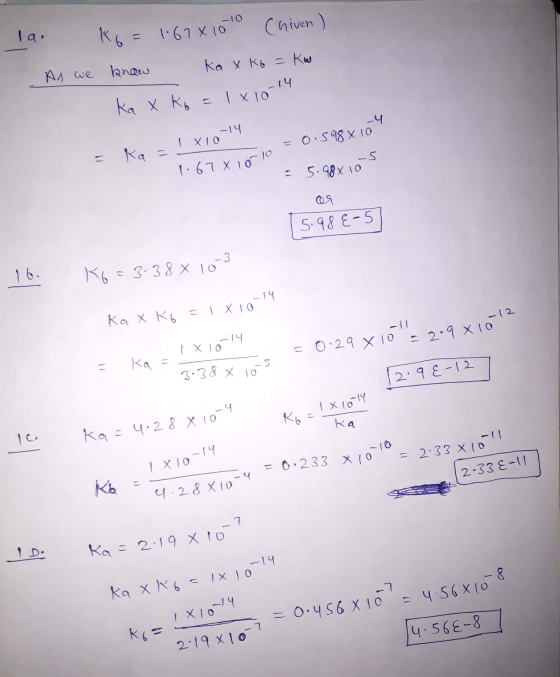
A weak monoprotic base has a Kb = 1.67 × 10⁻¹⁰. Calculate the Ka for the conjugate acid of this base.
Report your answer to THREE significant figures. You may (but are not required to) enter your answer in scientific notation; for example, if your answer is 2.44 × 10⁻², you would enter 2.44E-2. The E must be uppercase.
1b.
A weak monoprotic base has a Kb = 3.38 × 10⁻³. Calculate the Ka for the conjugate acid of this base.
Report your answer to THREE significant figures. You may (but are not required to) enter your answer in scientific notation; for example, if your answer is 2.44 × 10⁻², you would enter 2.44E-2. The E must be uppercase.
1c.
A weak monoprotic acid has a Ka = 4.28 × 10⁻⁴. Calculate the Kb for the conjugate base of this acid.
Report your answer to THREE significant figures. You may (but are not required to) enter your answer in scientific notation; for example, if your answer is 2.44 × 10⁻², you would enter 2.44E-2. The E must be uppercase.
1d.
A weak monoprotic acid has a Ka = 2.19 × 10⁻⁷. Calculate the Kb for the conjugate base of this acid.
Report your answer to THREE significant figures. You may (but are not required to) enter your answer in scientific notation; for example, if your answer is 2.44 × 10⁻², you would enter 2.44E-2. The E must be uppercase.
Homework Answers
Add Answer to:
1a.
A weak monoprotic base has a Kb = 1.67 ×
10−10. Calculate the Ka for...
part 1 A weak monoprotic base has a Kb = 2.43 × 10⁻¹⁰. Calculate the Ka...
part 1 A weak monoprotic base has a Kb = 2.43 × 10⁻¹⁰. Calculate the Ka for the conjugate acid of this base. Report your answer to THREE significant figures. You may (but are not required to) enter your answer in scientific notation; for example, if your answer is 2.44 × 10⁻², you would enter 2.44E-2. The E must be uppercase. part 2 A weak monoprotic base has a Kb = 3.71 × 10⁻⁹. Calculate the Ka for the conjugate...
Calculate the Kb of the conjugate base of a weak acid with a Ka = 5.28...
Calculate the Kb of the conjugate base of a weak acid with a Ka = 5.28 × 10⁻⁵. - report answer in three significant figures - answer should be written in scientific notation (ex. 4.67E-7 or 4.67E7 be sure to use a CAPITAL E not lower case 'e')
The solubility of chlorine gas at 15.5 °C and a chlorine pressure of 620 mmHg is...
The solubility of chlorine gas at 15.5 °C and a chlorine pressure of 620 mmHg is 2.13 × 10⁻³ g/L. What is the Henry's Law constant in mol⋅L−1⋅atm−1? Report your answer to THREE significant figures. You may (but are not required to) enter your answer in scientific notation; for example, if your answer is 2.44 × 10⁻², you would enter 2.44E-2. The E must be uppercase.
A weak base has Kb = . Calculate the hydrolysis constant, Ka, for the weak conjugate...
 A weak base has Kb =
. Calculate the hydrolysis constant, Ka, for the weak conjugate
acid.
7.7.c10-10 A weak base has Kp = 7.7 x 10⁻¹⁰. Calculate the hydrolysis constant, Ka, for the weak conjugate acid. Ka=
A weak base has Kb =
. Calculate the hydrolysis constant, Ka, for the weak conjugate
acid.
7.7.c10-10 A weak base has Kp = 7.7 x 10⁻¹⁰. Calculate the hydrolysis constant, Ka, for the weak conjugate acid. Ka=
2a Calculate the freezing point of a solution that is made from 39.9 g of a...
2a Calculate the freezing point of a solution that is made from 39.9 g of a nonelectrolyte (ℳ = 142.4701 g/mol) dissolved in 186.3 g of solvent. The solvent freezes at 1.24 °C and its Kf value is 2.09 °C/m. Report your answer to TWO places past the decimal. 2b The solubility of carbon dioxide gas at 37.3 °C and a carbon dioxide pressure of 554 mmHg is 4.04 × 10⁻³ g/L. What is the Henry's Law constant in mol⋅L−1⋅atm−1?...
1.)A 75 mL solution of .400 M chlorous acid is titrated with a .125 M solution...
1.)A 75 mL solution of .400 M chlorous acid is titrated with a .125 M solution of sodium hydroxide. What is the pH of the solution after 20 mL of the sodium hydroxide solution has been added? Ka for chlorous acid is 1.1 x 10⁻². (hint: your answer should contain three significant figures) 2.)The compound MX has a Ksp = 4.58 × 10⁻⁶. Calculate the concentration of M+ ions in a solution made by adding 4.18 g of MX to...
A weak base has KB = 1.88 x 10⁻². What is the pKA of its conjugate...
A weak base has KB = 1.88 x 10⁻². What is the pKA of its conjugate acid? Remember: if you want to express an answer in scientific notation, use the letter "E". For example "4.32 x 104" should be entered as "4.32E4".
1a. Benzoic acid, HC7H5CO2, is a weak monoprotic acid with Ka = 6.5 × 10⁻⁵. Calculate...
1a. Benzoic acid, HC7H5CO2, is a weak monoprotic acid with Ka = 6.5 × 10⁻⁵. Calculate the pH of a 0.213 M solution of this acid. Report your answer to TWO places past the decimal. 1b. Acetylsalicylic acid, HC9H7O4, is a weak monoprotic acid with Ka = 3.3 × 10⁻⁴. Calculate the pH of a 0.728 M solution of this acid. Report your answer to TWO places past the decimal. 1c. Benzoic acid, HC7H5CO2, is a weak monoprotic acid with...
3a. Calculate the required mass of an unknown nonelectrolyte (ℳ = 125.7998 g/mol) dissolved in 12...
3a. Calculate the required mass of an unknown nonelectrolyte (ℳ = 125.7998 g/mol) dissolved in 129.7 g of solvent that gives a solution that freezes at 1.85 °C. The freezing point of the pure solvent is 4.44 °C and its Kf value is 1.87 °C/m. Report your answer to TWO places past the decimal. 3b. Calculate the molar mass (in g/mol) of an unknown nonelectrolyte if 0.613 g dissolved in 250.3 mL of water at 19.47 °C has an osmotic...
1. Calculate the hydronium ion concentration and the hydroxide ion concentration in lime juice with a...
1. Calculate the hydronium ion concentration and the hydroxide ion concentration in lime juice with a pH of 2.0. Report answers in scientific notation and 2 significant figures Hydronium ion concentration = Hydroxide ion concentration = 2. What are the hydronium and hydroxide ion concentrations in a solution whose pH is 6.52? Report answers in scientific notation and 2 significant figures Hydronium ion concentration = Hydroxide ion concentration = 3. Which is the stronger acid, NH4+ or HBrO? Hint: Compare...
 A weak base has Kb =
. Calculate the hydrolysis constant, Ka, for the weak conjugate
acid.
7.7.c10-10 A weak base has Kp = 7.7 x 10⁻¹⁰. Calculate the hydrolysis constant, Ka, for the weak conjugate acid. Ka=
A weak base has Kb =
. Calculate the hydrolysis constant, Ka, for the weak conjugate
acid.
7.7.c10-10 A weak base has Kp = 7.7 x 10⁻¹⁰. Calculate the hydrolysis constant, Ka, for the weak conjugate acid. Ka=
Most questions answered within 3 hours.
-
Where is the error in this code sequence?
String s1 = "Hello";
String s2 = "ello";...
asked 11 months ago -
Financial data for Joel de Paris, Inc., for last year
follow:
Joel de Paris, Inc.
Balance...
asked 11 months ago -
Consider this reaction:
Al2(SO4)3 (aq)+ BaCl3
(aq) Al2Cl6 (aq)- +
3BaSO4(s) . What is the...
asked 11 months ago -
Suppose that Savneet is considering increasing her
recent random sample from 20 car rentals to 40...
asked 11 months ago -
Trucks arrive at an unloading terminal at an average rate of 120
per hour.
Trucks arrive...
asked 11 months ago -
Why are methanol and ethanol completely soluble in water while
octanol is not very little soluble....
asked 11 months ago -
A facilities manager at a university reads in a research report
that the mean amount of...
asked 11 months ago -
When the CuSO4 is rehydrated by adding water to the anhydrous
compound, is this an endothermic...
asked 11 months ago -
A ray of sunlight is passing from diamond into crown glass; the
angle of incidence is...
asked 11 months ago -
A block of mass 0.249 kg is placed on top of a light, vertical
spring of...
asked 11 months ago -
how do the kidneys compensate in the presences of acidosis
a) trigger hyperventilate
b) reserve acid...
asked 11 months ago -
Question 501 pts
The rental rate of capital to the firm increases. Which of the
following...
asked 11 months ago