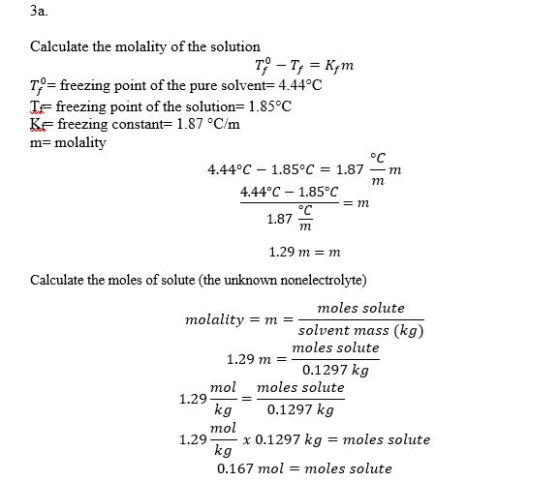
3a. Calculate the required mass of an unknown nonelectrolyte (ℳ = 125.7998 g/mol) dissolved in 12...
3a. Calculate the required mass of an unknown nonelectrolyte (ℳ = 125.7998 g/mol) dissolved in 129.7 g of solvent that gives a solution that freezes at 1.85 °C. The freezing point of the pure solvent is 4.44 °C and its Kf value is 1.87 °C/m.
Report your answer to TWO places past the decimal.
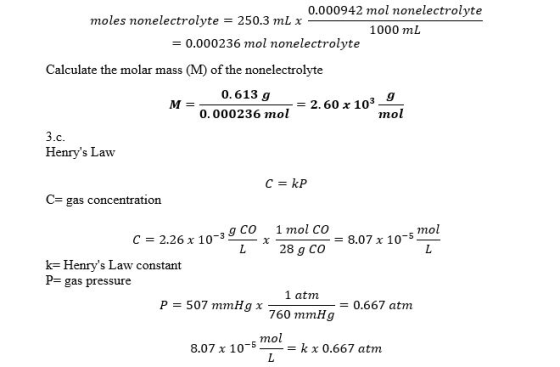
3b. Calculate the molar mass (in g/mol) of an unknown nonelectrolyte if 0.613 g dissolved in 250.3 mL of water at 19.47 °C has an osmotic pressure of 17.2 mmHg.
R = 0.082058 L⋅atm⋅mol−1⋅K−1. 1.00 atm = 760 mmHg. Report your answer to THREE significant figures.
3c. The solubility of carbon monoxide gas at 44.1 °C and a carbon monoxide pressure of 507 mmHg is 2.26 × 10⁻³ g/L. What is the Henry's Law constant in mol⋅L−1⋅atm−1?
Report your answer to THREE significant figures. You may (but are not required to) enter your answer in scientific notation; for example, if your answer is 2.44 × 10⁻², you would enter 2.44E-2. The E must be uppercase.
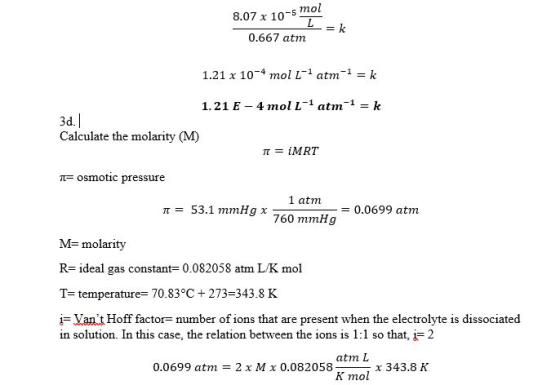
3d. Calculate the molar mass (in g/mol) of an unknown 1:1 electrolyte if 0.429 g dissolved in 218.5 mL of water at 70.83 °C has an osmotic pressure of 53.1 mmHg.
R = 0.082058 L⋅atm⋅mol−1⋅K−1. 1.00 atm = 760 mmHg. Report your answer to THREE significant figures.
3e. What is the solubility (in mol/L) of oxygen gas at a pressure of 0.652 atm? The Henry's Law constant, KH is 1.32 × 10⁻³ mol⋅L−1⋅atm−1.
Report your answer to THREE significant figures. You may (but are not required to) enter your answer in scientific notation; for example, if your answer is 2.44 × 10⁻², you would enter 2.44E-2. The E must be uppercase.
please answer all parts, try not to round and show your work. Thank you so much!
Homework Answers



Add Answer to:
3a. Calculate the required mass of an unknown nonelectrolyte (ℳ = 125.7998 g/mol) dissolved in 12...
3a. Calculate the molar mass (in g/mol) of an unknown 1:1 electrolyte if 0.482 g dissolved...
3a. Calculate the molar mass (in g/mol) of an unknown 1:1 electrolyte if 0.482 g dissolved in 223.1 mL of water at 74.75 °C has an osmotic pressure of 54.4 mmHg. R = 0.082058 L⋅atm⋅mol−1⋅K−1. 1.00 atm = 760 mmHg. Report your answer to THREE significant figures. 3b. Calculate the required mass of an unknown nonelectrolyte (ℳ = 131.5599 g/mol) dissolved in 140.1 g of solvent that gives a solution that boils at 36.04 °C. The boiling point of the...
2a Calculate the freezing point of a solution that is made from 39.9 g of a...
2a Calculate the freezing point of a solution that is made from 39.9 g of a nonelectrolyte (ℳ = 142.4701 g/mol) dissolved in 186.3 g of solvent. The solvent freezes at 1.24 °C and its Kf value is 2.09 °C/m. Report your answer to TWO places past the decimal. 2b The solubility of carbon dioxide gas at 37.3 °C and a carbon dioxide pressure of 554 mmHg is 4.04 × 10⁻³ g/L. What is the Henry's Law constant in mol⋅L−1⋅atm−1?...
Colligative Properties 1a When a solution is made from 25.9 g of an unknown nonelectrolyte dissolved...
Colligative Properties 1a When a solution is made from 25.9 g of an unknown nonelectrolyte dissolved in 167.6 g of solvent, the solution boils at 63.24 °C. The boiling point of the pure solvent and its Kb are 59.02 °C and 2.09 °C/m, respectively. Calculate the molar mass of the unknown electrolyte in g/mol. Report your answer to TWO places past the decimal 1b When a solution is made from 39.5 g of an unknown nonelectrolyte dissolved in 109.1-2.47 °C....
Calculate the molar mass (in g/mol) of an unknown 1:1 electrolyte if 0.45 g dissolved in...
Calculate the molar mass (in g/mol) of an unknown 1:1 electrolyte if 0.45 g dissolved in 199.2 mL of water at 49.72 °C has an osmotic pressure of 34.4 mmHg. R = 0.082058 L⋅atm⋅mol−1⋅K−1. 1.00 atm = 760 mmHg. Report your answer to THREE significant figures.
The solubility of chlorine gas at 15.5 °C and a chlorine pressure of 620 mmHg is...
The solubility of chlorine gas at 15.5 °C and a chlorine pressure of 620 mmHg is 2.13 × 10⁻³ g/L. What is the Henry's Law constant in mol⋅L−1⋅atm−1? Report your answer to THREE significant figures. You may (but are not required to) enter your answer in scientific notation; for example, if your answer is 2.44 × 10⁻², you would enter 2.44E-2. The E must be uppercase.
1.When a solution is made from 32.2 g of an unknown nonelectrolyte dissolved in 151 g...
1.When a solution is made from 32.2 g of an unknown nonelectrolyte dissolved in 151 g of solvent, the solution boils at 83.44 °C. The boiling point of the pure solvent and its Kb are 79.31 °C and 4.47 °C/m, respectively. Calculate the molar mass of the unknown electrolyte in g/mol. 2. Calculate the molar mass (in g/mol) of an unknown nonelectrolyte if 0.898 g dissolved in 268.7 mL of water at 30.13 °C has an osmotic pressure of 68.1...
A solution of an unknown nonelectrolyte is formed by adding 1.13 g in 250 mL of...
A solution of an unknown nonelectrolyte is formed by adding 1.13 g in 250 mL of water. This generates an osmotic pressure of 0.46 atm at 25 °C. Given R = 0.0821 L-atm/K-mol, calculate the molar mass of the nonelectrolyte (to two significant figures). Please explain step-by-step.
Calculate the required mass of an unknown nonelectrolyte (ℳ = 168.0568 g/mol) dissolved in 133.9 g...
Calculate the required mass of an unknown nonelectrolyte (ℳ = 168.0568 g/mol) dissolved in 133.9 g of solvent that gives a solution that boils at 60.35 °C. The boiling point of the pure solvent is 53.89 °C and its Kb value is 4.40 °C/m. Report your answer to TWO places past the decimal.
A flask with a volume of 1.02 L contains 14.58 g of an unknown gas at...
A flask with a volume of 1.02 L contains 14.58 g of an unknown gas at 35.1 °C and 846 torr. What is the molar mass of the unknown in g/mol? Report your answer to TWO places past the decimal. Do not include units. The gas constant R = 0.082058 L⋅atm/mol⋅K and 1 atm = 760 torr.
1a. A weak monoprotic base has a Kb = 1.67 × 10⁻¹⁰. Calculate the Ka for...
1a. A weak monoprotic base has a Kb = 1.67 × 10⁻¹⁰. Calculate the Ka for the conjugate acid of this base. Report your answer to THREE significant figures. You may (but are not required to) enter your answer in scientific notation; for example, if your answer is 2.44 × 10⁻², you would enter 2.44E-2. The E must be uppercase. 1b. A weak monoprotic base has a Kb = 3.38 × 10⁻³. Calculate the Ka for the conjugate acid of...
Most questions answered within 3 hours.
-
Where is the error in this code sequence?
String s1 = "Hello";
String s2 = "ello";...
asked 11 months ago -
Financial data for Joel de Paris, Inc., for last year
follow:
Joel de Paris, Inc.
Balance...
asked 11 months ago -
Consider this reaction:
Al2(SO4)3 (aq)+ BaCl3
(aq) Al2Cl6 (aq)- +
3BaSO4(s) . What is the...
asked 11 months ago -
Suppose that Savneet is considering increasing her
recent random sample from 20 car rentals to 40...
asked 11 months ago -
Trucks arrive at an unloading terminal at an average rate of 120
per hour.
Trucks arrive...
asked 11 months ago -
Why are methanol and ethanol completely soluble in water while
octanol is not very little soluble....
asked 11 months ago -
A facilities manager at a university reads in a research report
that the mean amount of...
asked 11 months ago -
When the CuSO4 is rehydrated by adding water to the anhydrous
compound, is this an endothermic...
asked 11 months ago -
A ray of sunlight is passing from diamond into crown glass; the
angle of incidence is...
asked 11 months ago -
A block of mass 0.249 kg is placed on top of a light, vertical
spring of...
asked 11 months ago -
how do the kidneys compensate in the presences of acidosis
a) trigger hyperventilate
b) reserve acid...
asked 11 months ago -
Question 501 pts
The rental rate of capital to the firm increases. Which of the
following...
asked 11 months ago