A flask with a volume of 1.02 L contains 14.58 g of an unknown gas at...
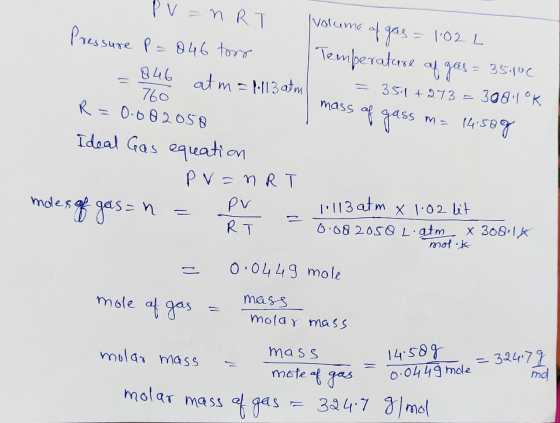
A flask with a volume of 1.02 L contains 14.58 g of an unknown gas at 35.1 °C and 846 torr. What is the molar mass of the unknown in g/mol? Report your answer to TWO places past the decimal. Do not include units. The gas constant R = 0.082058 L⋅atm/mol⋅K and 1 atm = 760 torr.
Homework Answers
Add Answer to:
A flask with a volume of 1.02 L contains 14.58 g of an unknown
gas at...
A flask with a volume of 3.16 L contains 9.33 g of an unknown gas at...
 A flask with a volume of 3.16 L contains 9.33 g of an unknown gas at 32.0°C and 1.00 atm. What is the molar mass of the gas? (R = 0.08206 L • atm/K • mol) Multiple Choice 18 Ο 776 g/mol Ο 144 g/mol Ο 66.1 g/mol Ο 739 g/mol Ο 81.4 g/mol
3a. Calculate the molar mass (in g/mol) of an unknown 1:1 electrolyte if 0.482 g dissolved...
3a. Calculate the molar mass (in g/mol) of an unknown 1:1 electrolyte if 0.482 g dissolved in 223.1 mL of water at 74.75 °C has an osmotic pressure of 54.4 mmHg. R = 0.082058 L⋅atm⋅mol−1⋅K−1. 1.00 atm = 760 mmHg. Report your answer to THREE significant figures. 3b. Calculate the required mass of an unknown nonelectrolyte (ℳ = 131.5599 g/mol) dissolved in 140.1 g of solvent that gives a solution that boils at 36.04 °C. The boiling point of the...
Colligative Properties 1a When a solution is made from 25.9 g of an unknown nonelectrolyte dissolved...
Colligative Properties 1a When a solution is made from 25.9 g of an unknown nonelectrolyte dissolved in 167.6 g of solvent, the solution boils at 63.24 °C. The boiling point of the pure solvent and its Kb are 59.02 °C and 2.09 °C/m, respectively. Calculate the molar mass of the unknown electrolyte in g/mol. Report your answer to TWO places past the decimal 1b When a solution is made from 39.5 g of an unknown nonelectrolyte dissolved in 109.1-2.47 °C....
Calculate the molar mass (in g/mol) of an unknown 1:1 electrolyte if 0.45 g dissolved in...
Calculate the molar mass (in g/mol) of an unknown 1:1 electrolyte if 0.45 g dissolved in 199.2 mL of water at 49.72 °C has an osmotic pressure of 34.4 mmHg. R = 0.082058 L⋅atm⋅mol−1⋅K−1. 1.00 atm = 760 mmHg. Report your answer to THREE significant figures.
3a. Calculate the required mass of an unknown nonelectrolyte (ℳ = 125.7998 g/mol) dissolved in 12...
3a. Calculate the required mass of an unknown nonelectrolyte (ℳ = 125.7998 g/mol) dissolved in 129.7 g of solvent that gives a solution that freezes at 1.85 °C. The freezing point of the pure solvent is 4.44 °C and its Kf value is 1.87 °C/m. Report your answer to TWO places past the decimal. 3b. Calculate the molar mass (in g/mol) of an unknown nonelectrolyte if 0.613 g dissolved in 250.3 mL of water at 19.47 °C has an osmotic...
A flask with a volume of 3.10 L , provided with a stopcock, contains ethane gas...
A flask with a volume of 3.10 L , provided with a stopcock, contains ethane gas (C2H6) at a temperature of 310 K and atmospheric pressure 1.013×10⁵ Pa . The molar mass of ethane is 30.1 g/mol . The system is warmed to a temperature of 381 K , with the stopcock open to the atmosphere. The stopcock is then closed, and the flask cooled to its original temperature. A) What is the final pressure of the ethane in the...
A 1.25 g sample of an unknown gas at 23 "C and 1.00 atm is stored in a 2.85 L flask. What is the density of the gas...
 A 1.25 g sample of an unknown gas at 23 "C and 1.00 atm is stored in a 2.85 L flask. What is the density of the gas? density: What is the molar mass of the gas? molar mass: y/mol
Question 10 of 22 A 4.05 g sample of an unknown gas at 35 °C and...
 Question 10 of 22 A 4.05 g sample of an unknown gas at 35 °C and 1.05 atm is stored in a 2.15 L flask. What is the density of the gas? density: 1.88372 g/L What is the molar mass of the gas? molar mass: g/mol Incorrect Question 14 of 22 A gas mixture is made by combining 6.7 g each of Ar, Ne, and an unknown diatomic gas. At STP, the mixture occupies a volume of 15.14 L. What...
A flask with a volume of 1.70 L , provided with a stopcock, contains ethane gas...
A flask with a volume of 1.70 L , provided with a stopcock, contains ethane gas (C2H6) at a temperature of 297 K and atmospheric pressure 1.013×10⁵ Pa . The molar mass of ethane is 30.1 g/mol . The system is warmed to a temperature of 379 K , with the stopcock open to the atmosphere. The stopcock is then closed, and the flask cooled to its original temperature. What is the final pressure of the ethane in the flask?...
4. A 200.0mL flask of an unknown gas was placed in a hot water bath. The...
 4. A 200.0mL flask of an unknown gas was placed in a hot water bath. The temperature of the bath was found to be 99°C. The pressure of the flask was 733mmHg. The flask with the unknown gas in it had a mass of 126.593g. The same flask weighed 125.623g when it was empty. Determine the mass of the unknown gas in the flask. Determine the Molar Mass of an unknown gas. Assume that the Ideal Gas Law is obeyed...
 A flask with a volume of 3.16 L contains 9.33 g of an unknown gas at 32.0°C and 1.00 atm. What is the molar mass of the gas? (R = 0.08206 L • atm/K • mol) Multiple Choice 18 Ο 776 g/mol Ο 144 g/mol Ο 66.1 g/mol Ο 739 g/mol Ο 81.4 g/mol
 A 1.25 g sample of an unknown gas at 23 "C and 1.00 atm is stored in a 2.85 L flask. What is the density of the gas? density: What is the molar mass of the gas? molar mass: y/mol
 Question 10 of 22 A 4.05 g sample of an unknown gas at 35 °C and 1.05 atm is stored in a 2.15 L flask. What is the density of the gas? density: 1.88372 g/L What is the molar mass of the gas? molar mass: g/mol Incorrect Question 14 of 22 A gas mixture is made by combining 6.7 g each of Ar, Ne, and an unknown diatomic gas. At STP, the mixture occupies a volume of 15.14 L. What...
 4. A 200.0mL flask of an unknown gas was placed in a hot water bath. The temperature of the bath was found to be 99°C. The pressure of the flask was 733mmHg. The flask with the unknown gas in it had a mass of 126.593g. The same flask weighed 125.623g when it was empty. Determine the mass of the unknown gas in the flask. Determine the Molar Mass of an unknown gas. Assume that the Ideal Gas Law is obeyed...
Most questions answered within 3 hours.
-
Where is the error in this code sequence?
String s1 = "Hello";
String s2 = "ello";...
asked 11 months ago -
Financial data for Joel de Paris, Inc., for last year
follow:
Joel de Paris, Inc.
Balance...
asked 11 months ago -
Consider this reaction:
Al2(SO4)3 (aq)+ BaCl3
(aq) Al2Cl6 (aq)- +
3BaSO4(s) . What is the...
asked 11 months ago -
Suppose that Savneet is considering increasing her
recent random sample from 20 car rentals to 40...
asked 11 months ago -
Trucks arrive at an unloading terminal at an average rate of 120
per hour.
Trucks arrive...
asked 11 months ago -
Why are methanol and ethanol completely soluble in water while
octanol is not very little soluble....
asked 11 months ago -
A facilities manager at a university reads in a research report
that the mean amount of...
asked 11 months ago -
When the CuSO4 is rehydrated by adding water to the anhydrous
compound, is this an endothermic...
asked 11 months ago -
A ray of sunlight is passing from diamond into crown glass; the
angle of incidence is...
asked 11 months ago -
A block of mass 0.249 kg is placed on top of a light, vertical
spring of...
asked 11 months ago -
how do the kidneys compensate in the presences of acidosis
a) trigger hyperventilate
b) reserve acid...
asked 11 months ago -
Question 501 pts
The rental rate of capital to the firm increases. Which of the
following...
asked 11 months ago