A flask with a volume of 3.10 L , provided with a stopcock, contains ethane gas...
A flask with a volume of 3.10 L , provided with a stopcock, contains ethane gas (C2H6) at a temperature of 310 K and atmospheric pressure 1.013×10⁵ Pa . The molar mass of ethane is 30.1 g/mol . The system is warmed to a temperature of 381 K , with the stopcock open to the atmosphere. The stopcock is then closed, and the flask cooled to its original temperature.
A) What is the final pressure of the ethane in the flask? (Pa)
B) Find the mass of ethane remaining in the flask. (g)
Homework Answers

Add Answer to:
A flask with a volume of 3.10 L , provided with a stopcock,
contains ethane gas...
A flask with a volume of 1.70 L , provided with a stopcock, contains ethane gas...
A flask with a volume of 1.70 L , provided with a stopcock, contains ethane gas (C2H6) at a temperature of 297 K and atmospheric pressure 1.013×10⁵ Pa . The molar mass of ethane is 30.1 g/mol . The system is warmed to a temperature of 379 K , with the stopcock open to the atmosphere. The stopcock is then closed, and the flask cooled to its original temperature. What is the final pressure of the ethane in the flask?...
4. A flask with a volume of 2.20 L, provided with a stopcock, contains ethane gas (C2H6) at a temperature of 310 K and atmospheric pressure 1.013x10 Pa. The molar mass of ethane is 30.1 g/mol. The sy...
 4. A flask with a volume of 2.20 L, provided with a stopcock, contains ethane gas (C2H6) at a temperature of 310 K and atmospheric pressure 1.013x10 Pa. The molar mass of ethane is 30.1 g/mol. The system is warmed to a temperature of 375 K, with the stopcock open to the atmosphere. The stopcock is then closed, and the flask cooled to its original temperature. A) What is the final pressure of the ethane in the flask? B) Find...
Part A A flask with a volume of 2.50 L , provided with a stopcock, contains...
 Part A A flask with a volume of 2.50 L , provided with a stopcock, contains ethane gas (C2H6) at a temperature of 285 K and atmospheric pressure 1.013x10⁵ Pa . The molar mass of ethane is 30.1 g/mol. The system is warmed to a temperature of 380 K , with the stopcock open to the atmosphere. The stopcock is then closed, and the flask cooled to its original temperature. What is the final pressure of the ethane in the...
need part B A flask with a volume of 1.10 L, provided with a stopcock, contains...
 need part B
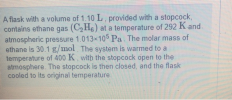
A flask with a volume of 1.10 L, provided with a stopcock, contains ethane gas (C2H6) at a temperature of 292 Kand. atmospheric pressure 1.013 109 Pa. The molar mass of ethane is 30.1 g/mol. The system is warmed to al temperature of 400 K , with the stopcock open to the atmosphere. The stopcock is then closed, and the flask! cooled to its original temperature. We were unable to transcribe this imagePart B Find the mass...
need part B
A flask with a volume of 1.10 L, provided with a stopcock, contains ethane gas (C2H6) at a temperature of 292 Kand. atmospheric pressure 1.013 109 Pa. The molar mass of ethane is 30.1 g/mol. The system is warmed to al temperature of 400 K , with the stopcock open to the atmosphere. The stopcock is then closed, and the flask! cooled to its original temperature. We were unable to transcribe this imagePart B Find the mass...
Part 1. The air in a bicycle tire is bubbled through water and collected at 25∘C. If the total volume of gas collected i...
Part 1. The air in a bicycle tire is bubbled through water and collected at 25∘C. If the total volume of gas collected is 5.60 L at a temperature of 25∘C and a pressure of 760 torr, how many moles of gas were in the bicycle tire? - Part 2. A 295-mL flask contains pure helium at a pressure of 755 torr . A second flask with a volume of 480 mL contains pure argon at a pressure of 714...
Please help with these two 1. A flask is filled with 1.08 moles of a gas...
 Please help with these two
1. A flask is filled with 1.08 moles of a gas at 20.7 K and
646.8 mm Hg. The flask is then opened and an additional 1.33 moles
are added. The temperature of the flask is then changed to 272.4 K.
What is the pressure (in atm) of the flask under these final
conditions?
2. The density of a gas is 4.22 g/L at a pressure of 1.77 atm
and a temperature of 14.66 °C. What...
Please help with these two
1. A flask is filled with 1.08 moles of a gas at 20.7 K and
646.8 mm Hg. The flask is then opened and an additional 1.33 moles
are added. The temperature of the flask is then changed to 272.4 K.
What is the pressure (in atm) of the flask under these final
conditions?
2. The density of a gas is 4.22 g/L at a pressure of 1.77 atm
and a temperature of 14.66 °C. What...
1.Carbon monoxide gas reacts with hydrogen gas to form methanol via the following reaction: CO(g)+2H2(g)→CH3OH(g)CO(g)+2H2(g)→CH3OH(g) A...
1.Carbon monoxide gas reacts with hydrogen gas to form methanol via the following reaction: CO(g)+2H2(g)→CH3OH(g)CO(g)+2H2(g)→CH3OH(g) A 1.65 LL reaction vessel, initially at 305 KK, contains carbon monoxide gas at a partial pressure of 232 mmHg and hydrogen gas at a partial pressure of 395 mmHg. Identify the limiting reactant and determine the theoretical yield of methanol in grams. Express your answer with the appropriate units. 2. What is the pressure in a 12.0-LL cylinder filled with 39.5 g of oxygen...
A flask with a volume of 1.02 L contains 14.58 g of an unknown gas at...
A flask with a volume of 1.02 L contains 14.58 g of an unknown gas at 35.1 °C and 846 torr. What is the molar mass of the unknown in g/mol? Report your answer to TWO places past the decimal. Do not include units. The gas constant R = 0.082058 L⋅atm/mol⋅K and 1 atm = 760 torr.
A flask with a volume of 3.16 L contains 9.33 g of an unknown gas at...
 A flask with a volume of 3.16 L contains 9.33 g of an unknown gas at 32.0°C and 1.00 atm. What is the molar mass of the gas? (R = 0.08206 L • atm/K • mol) Multiple Choice 18 Ο 776 g/mol Ο 144 g/mol Ο 66.1 g/mol Ο 739 g/mol Ο 81.4 g/mol
A rigid tank contains 64.5 g of chlorine gas (Cl2) at a temperature of 75 °C...
A rigid tank contains 64.5 g of chlorine gas (Cl2) at a temperature of 75 °C and an absolute pressure of 5.10 × 10⁵ Pa. Later, the temperature of the tank has dropped to 32 °C and, due to a leak, the pressure has dropped to 3.10 × 10⁵ Pa. How many grams of chlorine gas have leaked out of the tank? (The mass per mole of Cl2 is 70.9 g/mol.)
 4. A flask with a volume of 2.20 L, provided with a stopcock, contains ethane gas (C2H6) at a temperature of 310 K and atmospheric pressure 1.013x10 Pa. The molar mass of ethane is 30.1 g/mol. The system is warmed to a temperature of 375 K, with the stopcock open to the atmosphere. The stopcock is then closed, and the flask cooled to its original temperature. A) What is the final pressure of the ethane in the flask? B) Find...
 Part A A flask with a volume of 2.50 L , provided with a stopcock, contains ethane gas (C2H6) at a temperature of 285 K and atmospheric pressure 1.013x10⁵ Pa . The molar mass of ethane is 30.1 g/mol. The system is warmed to a temperature of 380 K , with the stopcock open to the atmosphere. The stopcock is then closed, and the flask cooled to its original temperature. What is the final pressure of the ethane in the...
 need part B
A flask with a volume of 1.10 L, provided with a stopcock, contains ethane gas (C2H6) at a temperature of 292 Kand. atmospheric pressure 1.013 109 Pa. The molar mass of ethane is 30.1 g/mol. The system is warmed to al temperature of 400 K , with the stopcock open to the atmosphere. The stopcock is then closed, and the flask! cooled to its original temperature. We were unable to transcribe this imagePart B Find the mass...
need part B
A flask with a volume of 1.10 L, provided with a stopcock, contains ethane gas (C2H6) at a temperature of 292 Kand. atmospheric pressure 1.013 109 Pa. The molar mass of ethane is 30.1 g/mol. The system is warmed to al temperature of 400 K , with the stopcock open to the atmosphere. The stopcock is then closed, and the flask! cooled to its original temperature. We were unable to transcribe this imagePart B Find the mass...
 Please help with these two
1. A flask is filled with 1.08 moles of a gas at 20.7 K and
646.8 mm Hg. The flask is then opened and an additional 1.33 moles
are added. The temperature of the flask is then changed to 272.4 K.
What is the pressure (in atm) of the flask under these final
conditions?
2. The density of a gas is 4.22 g/L at a pressure of 1.77 atm
and a temperature of 14.66 °C. What...
Please help with these two
1. A flask is filled with 1.08 moles of a gas at 20.7 K and
646.8 mm Hg. The flask is then opened and an additional 1.33 moles
are added. The temperature of the flask is then changed to 272.4 K.
What is the pressure (in atm) of the flask under these final
conditions?
2. The density of a gas is 4.22 g/L at a pressure of 1.77 atm
and a temperature of 14.66 °C. What...
 A flask with a volume of 3.16 L contains 9.33 g of an unknown gas at 32.0°C and 1.00 atm. What is the molar mass of the gas? (R = 0.08206 L • atm/K • mol) Multiple Choice 18 Ο 776 g/mol Ο 144 g/mol Ο 66.1 g/mol Ο 739 g/mol Ο 81.4 g/mol
Most questions answered within 3 hours.
-
Where is the error in this code sequence?
String s1 = "Hello";
String s2 = "ello";...
asked 11 months ago -
Financial data for Joel de Paris, Inc., for last year
follow:
Joel de Paris, Inc.
Balance...
asked 11 months ago -
Consider this reaction:
Al2(SO4)3 (aq)+ BaCl3
(aq) Al2Cl6 (aq)- +
3BaSO4(s) . What is the...
asked 11 months ago -
Suppose that Savneet is considering increasing her
recent random sample from 20 car rentals to 40...
asked 11 months ago -
Trucks arrive at an unloading terminal at an average rate of 120
per hour.
Trucks arrive...
asked 11 months ago -
Why are methanol and ethanol completely soluble in water while
octanol is not very little soluble....
asked 11 months ago -
A facilities manager at a university reads in a research report
that the mean amount of...
asked 11 months ago -
When the CuSO4 is rehydrated by adding water to the anhydrous
compound, is this an endothermic...
asked 11 months ago -
A ray of sunlight is passing from diamond into crown glass; the
angle of incidence is...
asked 11 months ago -
A block of mass 0.249 kg is placed on top of a light, vertical
spring of...
asked 11 months ago -
how do the kidneys compensate in the presences of acidosis
a) trigger hyperventilate
b) reserve acid...
asked 11 months ago -
Question 501 pts
The rental rate of capital to the firm increases. Which of the
following...
asked 11 months ago