

Homework Answers
1. Weight of NaCl = 20g ; Volume of solution = 1L = 1000mL
Thus, weight by volume % = (weight/volume)*100
= (20/1000)*100 = 2%
2. Weight of KCl = 1g in 10g of solution.
Thus, weight by weight% =
(weight of KCl/weight of solution)*100
= (1/10)*100 = 10%
3. Molarity of NaCl = (moles of NaCl)/V(of solution) in litres
Moles of NaCl =
(weight of NaCl in example)/(Molecular weight of NaCl)
Now, Molecular weight of NaCl = 23g/mil and in example weight = 20g
Thus, moles of NaCl = 20g/23g/mol = 0.8696mol
Thus, molarity = 0.8696 moles/1L = 0.8696 M
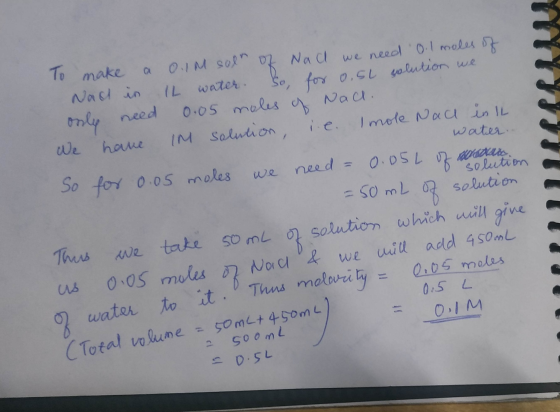
4.
Add Answer to:
1 . Calculate the composition of the following solution in weight/volume %. A. 20 g of...
1. What is the weight/volume % of a solution with 15g of NaCl in 1.1 liters...
1. What is the weight/volume % of a solution with 15g of NaCl in 1.1 liters of water? 2. How many grams of glucose are in 0.95 L of a 10.6% w/v solution of glucose? 3. If a solution has 0.023 g of lead in 1.5L of water, how much lead is that in ppm?
Calculate the molarity of each of the following: a. 2.00 mol of glucose in 4.00 L of a glucose solution b. 4.00 g...
 Calculate the molarity of each of the following: a. 2.00 mol of glucose in 4.00 L of a glucose solution b. 4.00 g of KOH in 2.00 L of a KOH solution c. 5.85 g of NaCl in 400. mL of a NaCl solution Calculate the grams of solute needed to prepare each of the following: a. 2.00 L of a 1.50 M NaOH solution b. 4.00 L of a 0.200 M KCl solution c. 25.0 mL of a 6.00...
Calorimetry 1. Consider the following data: 4.99 g g 50 g 24 C 38.7 °C 111.1...
 Calorimetry 1. Consider the following data: 4.99 g g 50 g 24 C 38.7 °C 111.1 g/mol Mass of CaCl Mass of Water Intial Temperature Final Temeprature Molar Mass of CaCl2 (a) Calculate the heat of solution. (AH) Assume that the specific heat of the solution is the same as water, 4.184 J/g- C and that no heat is gained or lost by the cup. (4 pts) (b) Calculate the number of moles of CaCl2. (3 pts) (c) Calculate the...
Calculate the mass/volume percent composition, or % (m/V), of 4.00 × 10² mL of solution containing...
Calculate the mass/volume percent composition, or % (m/V), of 4.00 × 10² mL of solution containing 14.2 g of glucose.
When 50.0 g of 0.200 M NaCl(aq) at 24.1 °C is added to 100.0 g of...
When 50.0 g of 0.200 M NaCl(aq) at 24.1 °C is added to 100.0 g of 0.100 M AgNO3(aq) at 24.1 °C in a calorimeter, the temperature increases to 25.2 °C as AgCl(s) forms. Assuming the specific heat of the solution and products is 4.20 J/g °C, calculate the approximate amount of heat in joules produced.
need help with #2 Volume of 0.60 M HPO 7.0m Volume of 1.85 M NaOH 8.0mL...
 need help with #2
Volume of 0.60 M HPO 7.0m Volume of 1.85 M NaOH 8.0mL Average Trial 2 Trial 3 (when needed) Mass of Calorimeter (grams) 2.150 Mass of Calorimeter reacted solution (grams Mass of solution (grams) 17.455g Initial Temperature ( C.) Maximum temperature(C) Temperature Change) 32.2°C Questions: 1) The specific heat of the dilute solution(s) in the experiment is very close to that of water. We will use 4.18 J'g. Cas the specific heat. Find what what is...
need help with #2
Volume of 0.60 M HPO 7.0m Volume of 1.85 M NaOH 8.0mL Average Trial 2 Trial 3 (when needed) Mass of Calorimeter (grams) 2.150 Mass of Calorimeter reacted solution (grams Mass of solution (grams) 17.455g Initial Temperature ( C.) Maximum temperature(C) Temperature Change) 32.2°C Questions: 1) The specific heat of the dilute solution(s) in the experiment is very close to that of water. We will use 4.18 J'g. Cas the specific heat. Find what what is...
Prepare 1 M NaCl in 150 mL of DI water. Calculate the weight (g) of NaCl...
Prepare 1 M NaCl in 150 mL of DI water. Calculate the weight (g) of NaCl that I added to DI water to obtain a 1 M NaCl solution. Show your work. (MW NaCl = 58.44 g/mol).
1) Suppose you made an intravenous solution, intended to be isoosmotic to red blood cells (i.e.,...
1) Suppose you made an intravenous solution, intended to be isoosmotic to red blood cells (i.e., 300 mOsm). You add 5 grams of NaCl to 800 ml of distilled water. Will this solution be isoosmotic to cells? if not, what will happen to the cells? (Will they take in water or lose water?) How would you make 500ml of a 5% NaCl solution? You dissolve 20 grams of glucose into water to give a solution whose final volume is exactly...
Part 1: Specific Heat of Copper Metal Your Data Neighbor 1 Neighbor 2 Weight of copper...
 Part 1: Specific Heat of Copper Metal Your Data Neighbor 1 Neighbor 2 Weight of copper taken, grams 24.724 g __ 24.916 g 25.124 g Weight of water taken, grams 49.591 g_ 50.129 g 24.983 g Temperature of heated copper, 100°C 100°C 100°C Temperature of cool water, °C 22°C 23.2°C 21.5°C Final temperature reached, °C 25.5°C 26.5°C 24.9°C Heat GAINED by water, Joules Heat LOST by copper, Joules Specific heat of copper, Joules/g°C Average value of specific heat of copper...
1. When a 4.00 g sample of RbBr is dissolved in water in a calorimeter that...
1. When a 4.00 g sample of RbBr is dissolved in water in a calorimeter that has a total heat capacity of 1.26 kJ⋅K−1, the temperature decreases by 0.420 K. Calculate the molar heat of solution of RbBr. ΔHsoln= 2. In a constant‑pressure calorimeter, 60.0 mL of 0.340 M Ba(OH)2 was added to 60.0 mL of 0.680 M HCl. The reaction caused the temperature of the solution to rise from 22.24 ∘C to 26.87 ∘C. If the solution has the...
 Calculate the molarity of each of the following: a. 2.00 mol of glucose in 4.00 L of a glucose solution b. 4.00 g of KOH in 2.00 L of a KOH solution c. 5.85 g of NaCl in 400. mL of a NaCl solution Calculate the grams of solute needed to prepare each of the following: a. 2.00 L of a 1.50 M NaOH solution b. 4.00 L of a 0.200 M KCl solution c. 25.0 mL of a 6.00...
 Calorimetry 1. Consider the following data: 4.99 g g 50 g 24 C 38.7 °C 111.1 g/mol Mass of CaCl Mass of Water Intial Temperature Final Temeprature Molar Mass of CaCl2 (a) Calculate the heat of solution. (AH) Assume that the specific heat of the solution is the same as water, 4.184 J/g- C and that no heat is gained or lost by the cup. (4 pts) (b) Calculate the number of moles of CaCl2. (3 pts) (c) Calculate the...
 need help with #2
Volume of 0.60 M HPO 7.0m Volume of 1.85 M NaOH 8.0mL Average Trial 2 Trial 3 (when needed) Mass of Calorimeter (grams) 2.150 Mass of Calorimeter reacted solution (grams Mass of solution (grams) 17.455g Initial Temperature ( C.) Maximum temperature(C) Temperature Change) 32.2°C Questions: 1) The specific heat of the dilute solution(s) in the experiment is very close to that of water. We will use 4.18 J'g. Cas the specific heat. Find what what is...
need help with #2
Volume of 0.60 M HPO 7.0m Volume of 1.85 M NaOH 8.0mL Average Trial 2 Trial 3 (when needed) Mass of Calorimeter (grams) 2.150 Mass of Calorimeter reacted solution (grams Mass of solution (grams) 17.455g Initial Temperature ( C.) Maximum temperature(C) Temperature Change) 32.2°C Questions: 1) The specific heat of the dilute solution(s) in the experiment is very close to that of water. We will use 4.18 J'g. Cas the specific heat. Find what what is...
 Part 1: Specific Heat of Copper Metal Your Data Neighbor 1 Neighbor 2 Weight of copper taken, grams 24.724 g __ 24.916 g 25.124 g Weight of water taken, grams 49.591 g_ 50.129 g 24.983 g Temperature of heated copper, 100°C 100°C 100°C Temperature of cool water, °C 22°C 23.2°C 21.5°C Final temperature reached, °C 25.5°C 26.5°C 24.9°C Heat GAINED by water, Joules Heat LOST by copper, Joules Specific heat of copper, Joules/g°C Average value of specific heat of copper...
Most questions answered within 3 hours.
-
Where is the error in this code sequence?
String s1 = "Hello";
String s2 = "ello";...
asked 11 months ago -
Financial data for Joel de Paris, Inc., for last year
follow:
Joel de Paris, Inc.
Balance...
asked 11 months ago -
Consider this reaction:
Al2(SO4)3 (aq)+ BaCl3
(aq) Al2Cl6 (aq)- +
3BaSO4(s) . What is the...
asked 11 months ago -
Suppose that Savneet is considering increasing her
recent random sample from 20 car rentals to 40...
asked 11 months ago -
Trucks arrive at an unloading terminal at an average rate of 120
per hour.
Trucks arrive...
asked 11 months ago -
Why are methanol and ethanol completely soluble in water while
octanol is not very little soluble....
asked 11 months ago -
A facilities manager at a university reads in a research report
that the mean amount of...
asked 11 months ago -
When the CuSO4 is rehydrated by adding water to the anhydrous
compound, is this an endothermic...
asked 11 months ago -
A ray of sunlight is passing from diamond into crown glass; the
angle of incidence is...
asked 11 months ago -
A block of mass 0.249 kg is placed on top of a light, vertical
spring of...
asked 11 months ago -
how do the kidneys compensate in the presences of acidosis
a) trigger hyperventilate
b) reserve acid...
asked 11 months ago -
Question 501 pts
The rental rate of capital to the firm increases. Which of the
following...
asked 11 months ago