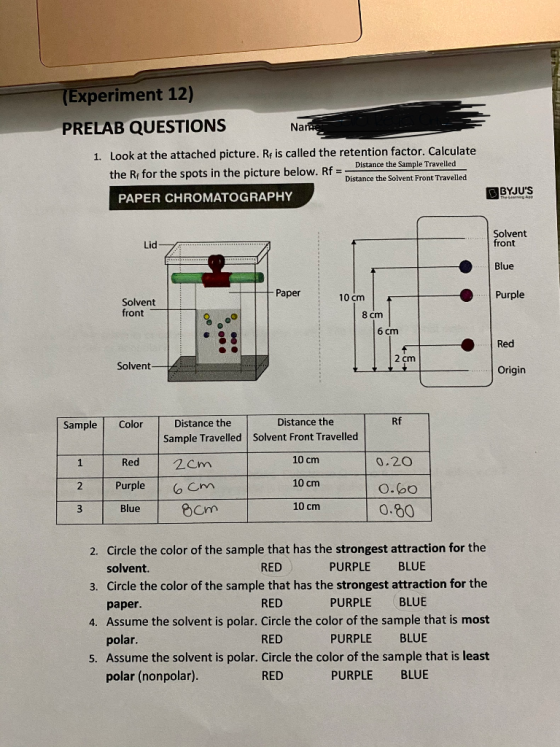
I need the answers or the explanation of the last 4.
Homework Answers
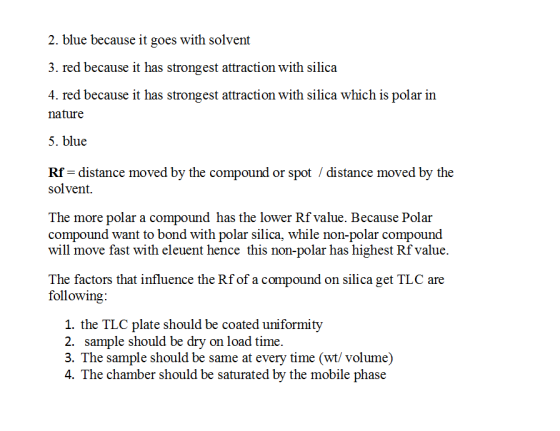
Add Answer to:
I need the answers or the explanation of the last 4.
(Experiment 12) PRELAB QUESTIONS Nane...
urn in only the Data, Post Lab Questions, and Conclusions for this experiment POST-LAB QUESTIONS: t....
 urn in only the Data, Post Lab Questions, and Conclusions for this experiment POST-LAB QUESTIONS: t. Why is it necessary to use a pencil instead of a pen when drawing the origin line and labeling the pltan ml nhe used Calculate the Rf (Retention factor) value for the spot on this chromatograph. Write formula and show set-up. 2. Solvent Compound Baseline Origin) ph below shows the sample separated into two spots (2.5 cm and 7.5 cm). The distance alues for...
LOS SCULUI EXPERIMENT # 6 PAPER CHROMATOGRAPHY LABORATORY REPORT DATA AND CALCULATIONS Measure the retention factors...
 LOS SCULUI EXPERIMENT # 6 PAPER CHROMATOGRAPHY LABORATORY REPORT DATA AND CALCULATIONS Measure the retention factors (R) for each of the components and report the values in the data table. Student Name Course Section Date Instructor PRE-LAB ASSIGNMENT son Rd? Hetardation factor Re Value) is the distance a given component (analute) divided by the distance the Re values o f mobile phase There is no shry unit for i migration distance of substance Imigrahon 1. What are the units on...
"R" group polarity nonpolar, polar, or polar with H- bonds. 1. choose any two know amino acids with similar Rf and based...
 "R" group polarity nonpolar, polar, or polar with H-
bonds.
1. choose any two know amino acids with similar Rf and based on the
size and polarity of their side chains, give an explanation for why
their retention factors are similar.
2. choose any two known amino acids with very different Rf values
and based on the size and polarity of their side chains, give an
explanation for why their retention factors are dissimilar.
3. Explain why lysines Rf is...
"R" group polarity nonpolar, polar, or polar with H-
bonds.
1. choose any two know amino acids with similar Rf and based on the
size and polarity of their side chains, give an explanation for why
their retention factors are similar.
2. choose any two known amino acids with very different Rf values
and based on the size and polarity of their side chains, give an
explanation for why their retention factors are dissimilar.
3. Explain why lysines Rf is...
2. If two different compounds have the same Rr value, how might they be identified using paper chromatography?...
 2. If two different compounds have the same Rr value, how might they be identified using paper chromatography? 3. Why is it important to keep the spots on the paper as small as possible? 4. If the solvent pool at the bottom of the beaker touched the spots on the 1.5cm line, what would happen to the spots? How would you address this error? 5. If you were teaching a student how to do paper chromatography, what three pieces of...
Table 2: Alcohol and Ketone Standards GC Retention Times GC#: Retention time Alcohol Standard Mixture Phent...
 Table 2: Alcohol and Ketone Standards GC Retention Times GC#: Retention time Alcohol Standard Mixture Phent ion= 2.05Smin low Peak 1 Compound Name: athanol Rapesnal utanal aclapeatanal 4.755min oilng 6.895min .230 min Peak 2 Compound Name: Peak 3 Compound Name: Peak 4 Compound Name: GC#:1 Ketone Standard Mixture Retention time 2.575un Peak 1 Compound Name: Acclono Butanon a Pentanone 2tHex anon Peak 2 Compound Name: min Peak 3 Compound Name: 615 min 1D. 307 min Peak 4 Compound Name: Part...
-Give a brief background on the role of pigments in photosythensis. -state your hypothesis. -finish with...
 -Give a brief background on the role of pigments in
photosythensis.
-state your hypothesis.
-finish with stating the rationale for your hypothesis (how
did you arrive at these hypothesis?)
this is an introduction piece, so it doesn't need the results to
write the papee. introduction sections set up the background,
purpose, rationale, and hypothesis for a study.
Biod 20 PHOTOSYNTHESIS Background Plants harness the energy of the sun through a process called photosynthesis. The leaf is the plant organ that...
-Give a brief background on the role of pigments in
photosythensis.
-state your hypothesis.
-finish with stating the rationale for your hypothesis (how
did you arrive at these hypothesis?)
this is an introduction piece, so it doesn't need the results to
write the papee. introduction sections set up the background,
purpose, rationale, and hypothesis for a study.
Biod 20 PHOTOSYNTHESIS Background Plants harness the energy of the sun through a process called photosynthesis. The leaf is the plant organ that...
Attached is the lab experiment. Here are the questions I need help with: 1. What is...
 Attached is the lab experiment. Here are the questions I need
help with:
1. What is the purpose of each of the following steps in this
experiment?
a. Adding solid NaCl to the reaction mixture
b. Repeated washings with water, sat'd NAHCO3, and brine
c. the pipet column chromatography
2. Which compound, cyclohexanol or cyclohexanone will have a
higher Rf on a TLC plate?
3. What is the advantage of using sodium hypochlorite as an
oxidant over CrO3 or Na2Cr2O7...
Attached is the lab experiment. Here are the questions I need
help with:
1. What is the purpose of each of the following steps in this
experiment?
a. Adding solid NaCl to the reaction mixture
b. Repeated washings with water, sat'd NAHCO3, and brine
c. the pipet column chromatography
2. Which compound, cyclohexanol or cyclohexanone will have a
higher Rf on a TLC plate?
3. What is the advantage of using sodium hypochlorite as an
oxidant over CrO3 or Na2Cr2O7...
QUESTIONS TO ANSWER: Prepare a table of all chemicals used with the structure and purpose of...
 QUESTIONS TO ANSWER:
Prepare a table of all chemicals used with the structure and
purpose of each.
Calculate the theoretical yield by finding limiting reactant of
the experiment by converting reactants to product (remember to show
all calculations used)
Calculate the percent yield using the limiting reactant
Calculate the Rf for triphenylmethanol. If there are two dots,
determine which one is triphenylmethanol.. ( I did not provide
data. Please let me know how I Would do this if I did)...
QUESTIONS TO ANSWER:
Prepare a table of all chemicals used with the structure and
purpose of each.
Calculate the theoretical yield by finding limiting reactant of
the experiment by converting reactants to product (remember to show
all calculations used)
Calculate the percent yield using the limiting reactant
Calculate the Rf for triphenylmethanol. If there are two dots,
determine which one is triphenylmethanol.. ( I did not provide
data. Please let me know how I Would do this if I did)...
 urn in only the Data, Post Lab Questions, and Conclusions for this experiment POST-LAB QUESTIONS: t. Why is it necessary to use a pencil instead of a pen when drawing the origin line and labeling the pltan ml nhe used Calculate the Rf (Retention factor) value for the spot on this chromatograph. Write formula and show set-up. 2. Solvent Compound Baseline Origin) ph below shows the sample separated into two spots (2.5 cm and 7.5 cm). The distance alues for...
 LOS SCULUI EXPERIMENT # 6 PAPER CHROMATOGRAPHY LABORATORY REPORT DATA AND CALCULATIONS Measure the retention factors (R) for each of the components and report the values in the data table. Student Name Course Section Date Instructor PRE-LAB ASSIGNMENT son Rd? Hetardation factor Re Value) is the distance a given component (analute) divided by the distance the Re values o f mobile phase There is no shry unit for i migration distance of substance Imigrahon 1. What are the units on...
 "R" group polarity nonpolar, polar, or polar with H-
bonds.
1. choose any two know amino acids with similar Rf and based on the
size and polarity of their side chains, give an explanation for why
their retention factors are similar.
2. choose any two known amino acids with very different Rf values
and based on the size and polarity of their side chains, give an
explanation for why their retention factors are dissimilar.
3. Explain why lysines Rf is...
"R" group polarity nonpolar, polar, or polar with H-
bonds.
1. choose any two know amino acids with similar Rf and based on the
size and polarity of their side chains, give an explanation for why
their retention factors are similar.
2. choose any two known amino acids with very different Rf values
and based on the size and polarity of their side chains, give an
explanation for why their retention factors are dissimilar.
3. Explain why lysines Rf is...
 2. If two different compounds have the same Rr value, how might they be identified using paper chromatography? 3. Why is it important to keep the spots on the paper as small as possible? 4. If the solvent pool at the bottom of the beaker touched the spots on the 1.5cm line, what would happen to the spots? How would you address this error? 5. If you were teaching a student how to do paper chromatography, what three pieces of...
 Table 2: Alcohol and Ketone Standards GC Retention Times GC#: Retention time Alcohol Standard Mixture Phent ion= 2.05Smin low Peak 1 Compound Name: athanol Rapesnal utanal aclapeatanal 4.755min oilng 6.895min .230 min Peak 2 Compound Name: Peak 3 Compound Name: Peak 4 Compound Name: GC#:1 Ketone Standard Mixture Retention time 2.575un Peak 1 Compound Name: Acclono Butanon a Pentanone 2tHex anon Peak 2 Compound Name: min Peak 3 Compound Name: 615 min 1D. 307 min Peak 4 Compound Name: Part...
 -Give a brief background on the role of pigments in
photosythensis.
-state your hypothesis.
-finish with stating the rationale for your hypothesis (how
did you arrive at these hypothesis?)
this is an introduction piece, so it doesn't need the results to
write the papee. introduction sections set up the background,
purpose, rationale, and hypothesis for a study.
Biod 20 PHOTOSYNTHESIS Background Plants harness the energy of the sun through a process called photosynthesis. The leaf is the plant organ that...
-Give a brief background on the role of pigments in
photosythensis.
-state your hypothesis.
-finish with stating the rationale for your hypothesis (how
did you arrive at these hypothesis?)
this is an introduction piece, so it doesn't need the results to
write the papee. introduction sections set up the background,
purpose, rationale, and hypothesis for a study.
Biod 20 PHOTOSYNTHESIS Background Plants harness the energy of the sun through a process called photosynthesis. The leaf is the plant organ that...
 Attached is the lab experiment. Here are the questions I need
help with:
1. What is the purpose of each of the following steps in this
experiment?
a. Adding solid NaCl to the reaction mixture
b. Repeated washings with water, sat'd NAHCO3, and brine
c. the pipet column chromatography
2. Which compound, cyclohexanol or cyclohexanone will have a
higher Rf on a TLC plate?
3. What is the advantage of using sodium hypochlorite as an
oxidant over CrO3 or Na2Cr2O7...
Attached is the lab experiment. Here are the questions I need
help with:
1. What is the purpose of each of the following steps in this
experiment?
a. Adding solid NaCl to the reaction mixture
b. Repeated washings with water, sat'd NAHCO3, and brine
c. the pipet column chromatography
2. Which compound, cyclohexanol or cyclohexanone will have a
higher Rf on a TLC plate?
3. What is the advantage of using sodium hypochlorite as an
oxidant over CrO3 or Na2Cr2O7...
 QUESTIONS TO ANSWER:
Prepare a table of all chemicals used with the structure and
purpose of each.
Calculate the theoretical yield by finding limiting reactant of
the experiment by converting reactants to product (remember to show
all calculations used)
Calculate the percent yield using the limiting reactant
Calculate the Rf for triphenylmethanol. If there are two dots,
determine which one is triphenylmethanol.. ( I did not provide
data. Please let me know how I Would do this if I did)...
QUESTIONS TO ANSWER:
Prepare a table of all chemicals used with the structure and
purpose of each.
Calculate the theoretical yield by finding limiting reactant of
the experiment by converting reactants to product (remember to show
all calculations used)
Calculate the percent yield using the limiting reactant
Calculate the Rf for triphenylmethanol. If there are two dots,
determine which one is triphenylmethanol.. ( I did not provide
data. Please let me know how I Would do this if I did)...
Most questions answered within 3 hours.
-
Where is the error in this code sequence?
String s1 = "Hello";
String s2 = "ello";...
asked 11 months ago -
Financial data for Joel de Paris, Inc., for last year
follow:
Joel de Paris, Inc.
Balance...
asked 11 months ago -
Consider this reaction:
Al2(SO4)3 (aq)+ BaCl3
(aq) Al2Cl6 (aq)- +
3BaSO4(s) . What is the...
asked 11 months ago -
Suppose that Savneet is considering increasing her
recent random sample from 20 car rentals to 40...
asked 11 months ago -
Trucks arrive at an unloading terminal at an average rate of 120
per hour.
Trucks arrive...
asked 11 months ago -
Why are methanol and ethanol completely soluble in water while
octanol is not very little soluble....
asked 11 months ago -
A facilities manager at a university reads in a research report
that the mean amount of...
asked 11 months ago -
When the CuSO4 is rehydrated by adding water to the anhydrous
compound, is this an endothermic...
asked 11 months ago -
A ray of sunlight is passing from diamond into crown glass; the
angle of incidence is...
asked 11 months ago -
A block of mass 0.249 kg is placed on top of a light, vertical
spring of...
asked 11 months ago -
how do the kidneys compensate in the presences of acidosis
a) trigger hyperventilate
b) reserve acid...
asked 11 months ago -
Question 501 pts
The rental rate of capital to the firm increases. Which of the
following...
asked 11 months ago