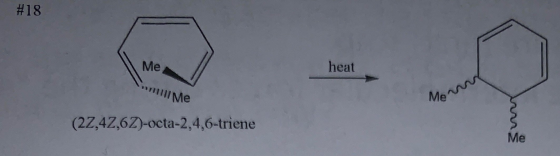
The reaction above is an electrocyclization reaction. Please:
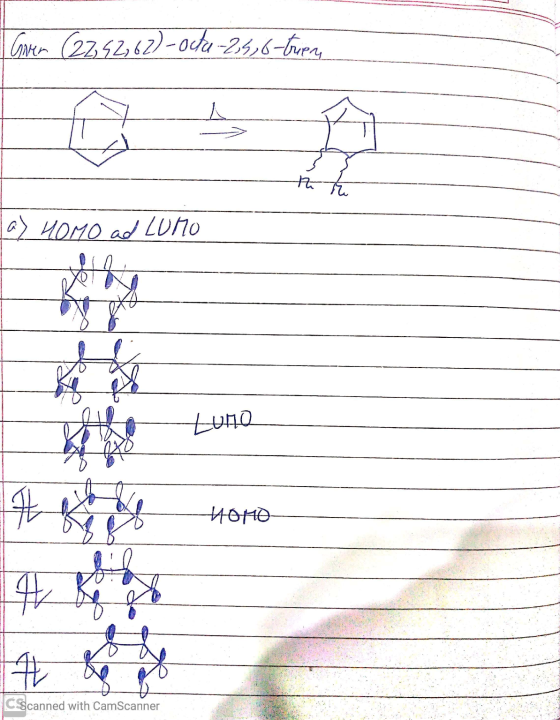
a. Draw the HOMO and LUMO levels for the reaction
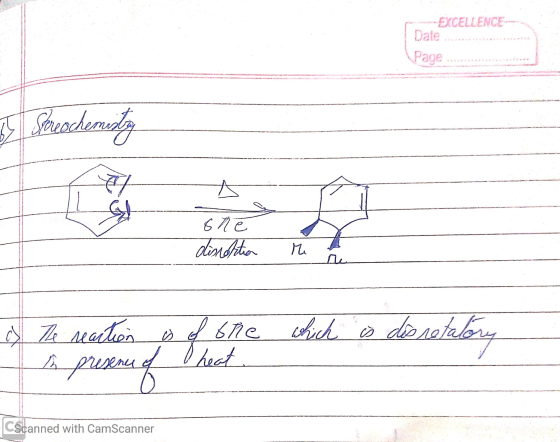
b. What is the stereochemistry of the product ?
c. Is the reaction conrotatory or disrotatory?
Homework Answers
Add Answer to:
The reaction above is an electrocyclization reaction.
Please:
a. Draw the HOMO and LUMO levels for...
Give the product of the following reaction: Draw the HOMO of butadiene and the LUMO of...
 Give the product of the following reaction: Draw the HOMO of butadiene and the LUMO of ethene (ethylene); include orbital phases. An unknown starting material underwent an S_n^2 reaction with NaBr to give the following products. Based on the mass spectrum below, what is the unknown starting material? (1)
Please note: This is 1 practice homework organic chemistry question with 4 parts in A-C to...
 Please note: This is 1 practice homework organic chemistry
question with 4 parts in A-C to answer!
1. Give full curved arrow pushing for the electrocyclic ring
closure reaction.
2. Indicate if product is achiral, meso compound or racemic.
3. Draw the HOMO of the reactant cation on top of the
structure.
4. To form your ALLOWED product, did the reaction proceed
conrotatary or disrotatory?
If you are unable to answer any of the parts PLEASE leave
question alone for...
Please note: This is 1 practice homework organic chemistry
question with 4 parts in A-C to answer!
1. Give full curved arrow pushing for the electrocyclic ring
closure reaction.
2. Indicate if product is achiral, meso compound or racemic.
3. Draw the HOMO of the reactant cation on top of the
structure.
4. To form your ALLOWED product, did the reaction proceed
conrotatary or disrotatory?
If you are unable to answer any of the parts PLEASE leave
question alone for...
Can you also go into detail about drawing the HOMO and LUMO, like how to know...
 Can you also go into detail about drawing the HOMO and LUMO,
like how to know how many molecular orbitals there should be and
how many orbitals I should draw? Thanks!
LUH III. (16 pts). The Diels-Alder reaction of 1,3-cyclopentadiene with maleic anhydride (A) gives B as the major product. В a. (4 pts). Can product B be designated endo or exo? Explain b. (8 pts). Draw the highest occupied and lowest unoccupied molecular orbitals of the diene and of...
Can you also go into detail about drawing the HOMO and LUMO,
like how to know how many molecular orbitals there should be and
how many orbitals I should draw? Thanks!
LUH III. (16 pts). The Diels-Alder reaction of 1,3-cyclopentadiene with maleic anhydride (A) gives B as the major product. В a. (4 pts). Can product B be designated endo or exo? Explain b. (8 pts). Draw the highest occupied and lowest unoccupied molecular orbitals of the diene and of...
Question 7 (16 pts) For the following electrocyclic ring closure reaction heat CF3 a) Given the c...
 asap THANK YOU!
Question 7 (16 pts) For the following electrocyclic ring closure reaction heat CF3 a) Given the curved arrow-pushing, draw the product. Pay particular attention to stereochemistry and indicate any racemic mixtures. b) Give the number of electrons involved in the reaction o) Does the allowed rection proceed via a Huckel or a Mobius transition state? d) Is the allowed reaction a conrotatory or disrotatory ring closure?
Question 7 (16 pts) For the following electrocyclic ring closure reaction...
asap THANK YOU!
Question 7 (16 pts) For the following electrocyclic ring closure reaction heat CF3 a) Given the curved arrow-pushing, draw the product. Pay particular attention to stereochemistry and indicate any racemic mixtures. b) Give the number of electrons involved in the reaction o) Does the allowed rection proceed via a Huckel or a Mobius transition state? d) Is the allowed reaction a conrotatory or disrotatory ring closure?
Question 7 (16 pts) For the following electrocyclic ring closure reaction...
A) at least one retrosynthetic analysis (disconnection) B) a reaction scheme showing each of the synthetic...
A) at least one retrosynthetic analysis (disconnection) B) a reaction scheme showing each of the synthetic steps with starting materials, products, reagents and conditions C) a paragraph or so describing the logic of a synthetic strategy and why it would be the most likely to give the desired product. octa-2,4,6-triene
Question 6 (22 pts). For the following electrocyclic ring-opening reaction a) Give the product, including stereochemistry...
 Question 6 (22 pts). For the following electrocyclic ring-opening reaction a) Give the product, including stereochemistry and draw the curved arrow-pushing that describes bond making/breaking CH heat CH3 b) give the number of electrons involved in the reaction c) For the number of electrons you gave in the answer to b) above, would that many electrons in a Huckel loop be aromatic, nonaromatic or antiaromatic? d) For the number of electrons you gave in the answer to b) above, would...
1) Predict the major product(s) of each Diels-Alder reaction. Be clear with stereochemistry H3C (C0) [4+2]...
 1) Predict the major product(s) of each Diels-Alder reaction. Be clear with stereochemistry H3C (C0) [4+2] H3C CH3 1 CH3 heat heat 2) Draw the HOMO and LUMO of (3E,5E)-2-methylocta-1,3,5,7-tetraene.
Question 6 (22 pts). For the following electrocyclic ring-opening reaction a) Give the product, including stereochemistry...
 Question 6 (22 pts). For the following electrocyclic ring-opening reaction a) Give the product, including stereochemistry and draw the curved arrow-pushing that describes bond making/breaking CH3 heat CHE b) give the number of electrons involved in the reaction C) For the number of electrons you gave in the answer to b) above, would that many electrons in a Huckel loop be aromatic, nonaromatic or antiaromatic? d) For the number of electrons you gave in the answer to b) above, would...
Sn2 reaction - sketching molecular orbitals
 The equation can be seen in the picture. I was assuming it was an Sn2 reaction given the polar aprotic solvent and strong nucleophile.For b), I assumed that the question asked me to draw the orbitals as shown above (as opposed to orbital diagram) because it asked me to identify the HOMO and LUMO.I'm confused as to where SEt (-) attacks/how to draw the attack i.e. the reaction itself as both steps occur at the same time. Also I'm assuming...
Question 1 (18 pts) For the following reaction: a) Give the curved arrow.pushing for electrocyclic ring...
 Question 1 (18 pts) For the following reaction: a) Give the curved arrow.pushing for electrocyclic ring opening heat b) How many electrons are involved in the reaction? c) Will the ALLOWED reaction proceed via a Huckel or a Mobius transition state? d) Will the ALLOWED reaction proceed via conrotatory or disrotatory ring opening?
 Give the product of the following reaction: Draw the HOMO of butadiene and the LUMO of ethene (ethylene); include orbital phases. An unknown starting material underwent an S_n^2 reaction with NaBr to give the following products. Based on the mass spectrum below, what is the unknown starting material? (1)
 Please note: This is 1 practice homework organic chemistry
question with 4 parts in A-C to answer!
1. Give full curved arrow pushing for the electrocyclic ring
closure reaction.
2. Indicate if product is achiral, meso compound or racemic.
3. Draw the HOMO of the reactant cation on top of the
structure.
4. To form your ALLOWED product, did the reaction proceed
conrotatary or disrotatory?
If you are unable to answer any of the parts PLEASE leave
question alone for...
Please note: This is 1 practice homework organic chemistry
question with 4 parts in A-C to answer!
1. Give full curved arrow pushing for the electrocyclic ring
closure reaction.
2. Indicate if product is achiral, meso compound or racemic.
3. Draw the HOMO of the reactant cation on top of the
structure.
4. To form your ALLOWED product, did the reaction proceed
conrotatary or disrotatory?
If you are unable to answer any of the parts PLEASE leave
question alone for...
 Can you also go into detail about drawing the HOMO and LUMO,
like how to know how many molecular orbitals there should be and
how many orbitals I should draw? Thanks!
LUH III. (16 pts). The Diels-Alder reaction of 1,3-cyclopentadiene with maleic anhydride (A) gives B as the major product. В a. (4 pts). Can product B be designated endo or exo? Explain b. (8 pts). Draw the highest occupied and lowest unoccupied molecular orbitals of the diene and of...
Can you also go into detail about drawing the HOMO and LUMO,
like how to know how many molecular orbitals there should be and
how many orbitals I should draw? Thanks!
LUH III. (16 pts). The Diels-Alder reaction of 1,3-cyclopentadiene with maleic anhydride (A) gives B as the major product. В a. (4 pts). Can product B be designated endo or exo? Explain b. (8 pts). Draw the highest occupied and lowest unoccupied molecular orbitals of the diene and of...
 asap THANK YOU!
Question 7 (16 pts) For the following electrocyclic ring closure reaction heat CF3 a) Given the curved arrow-pushing, draw the product. Pay particular attention to stereochemistry and indicate any racemic mixtures. b) Give the number of electrons involved in the reaction o) Does the allowed rection proceed via a Huckel or a Mobius transition state? d) Is the allowed reaction a conrotatory or disrotatory ring closure?
Question 7 (16 pts) For the following electrocyclic ring closure reaction...
asap THANK YOU!
Question 7 (16 pts) For the following electrocyclic ring closure reaction heat CF3 a) Given the curved arrow-pushing, draw the product. Pay particular attention to stereochemistry and indicate any racemic mixtures. b) Give the number of electrons involved in the reaction o) Does the allowed rection proceed via a Huckel or a Mobius transition state? d) Is the allowed reaction a conrotatory or disrotatory ring closure?
Question 7 (16 pts) For the following electrocyclic ring closure reaction...
 Question 6 (22 pts). For the following electrocyclic ring-opening reaction a) Give the product, including stereochemistry and draw the curved arrow-pushing that describes bond making/breaking CH heat CH3 b) give the number of electrons involved in the reaction c) For the number of electrons you gave in the answer to b) above, would that many electrons in a Huckel loop be aromatic, nonaromatic or antiaromatic? d) For the number of electrons you gave in the answer to b) above, would...
 1) Predict the major product(s) of each Diels-Alder reaction. Be clear with stereochemistry H3C (C0) [4+2] H3C CH3 1 CH3 heat heat 2) Draw the HOMO and LUMO of (3E,5E)-2-methylocta-1,3,5,7-tetraene.
 Question 6 (22 pts). For the following electrocyclic ring-opening reaction a) Give the product, including stereochemistry and draw the curved arrow-pushing that describes bond making/breaking CH3 heat CHE b) give the number of electrons involved in the reaction C) For the number of electrons you gave in the answer to b) above, would that many electrons in a Huckel loop be aromatic, nonaromatic or antiaromatic? d) For the number of electrons you gave in the answer to b) above, would...
 Question 1 (18 pts) For the following reaction: a) Give the curved arrow.pushing for electrocyclic ring opening heat b) How many electrons are involved in the reaction? c) Will the ALLOWED reaction proceed via a Huckel or a Mobius transition state? d) Will the ALLOWED reaction proceed via conrotatory or disrotatory ring opening?
Most questions answered within 3 hours.
-
Where is the error in this code sequence?
String s1 = "Hello";
String s2 = "ello";...
asked 10 months ago -
Financial data for Joel de Paris, Inc., for last year
follow:
Joel de Paris, Inc.
Balance...
asked 10 months ago -
Consider this reaction:
Al2(SO4)3 (aq)+ BaCl3
(aq) Al2Cl6 (aq)- +
3BaSO4(s) . What is the...
asked 10 months ago -
Suppose that Savneet is considering increasing her
recent random sample from 20 car rentals to 40...
asked 10 months ago -
Trucks arrive at an unloading terminal at an average rate of 120
per hour.
Trucks arrive...
asked 10 months ago -
Why are methanol and ethanol completely soluble in water while
octanol is not very little soluble....
asked 10 months ago -
A facilities manager at a university reads in a research report
that the mean amount of...
asked 10 months ago -
When the CuSO4 is rehydrated by adding water to the anhydrous
compound, is this an endothermic...
asked 10 months ago -
A ray of sunlight is passing from diamond into crown glass; the
angle of incidence is...
asked 10 months ago -
A block of mass 0.249 kg is placed on top of a light, vertical
spring of...
asked 10 months ago -
how do the kidneys compensate in the presences of acidosis
a) trigger hyperventilate
b) reserve acid...
asked 10 months ago -
Question 501 pts
The rental rate of capital to the firm increases. Which of the
following...
asked 10 months ago