
Homework Answers
Add Answer to:
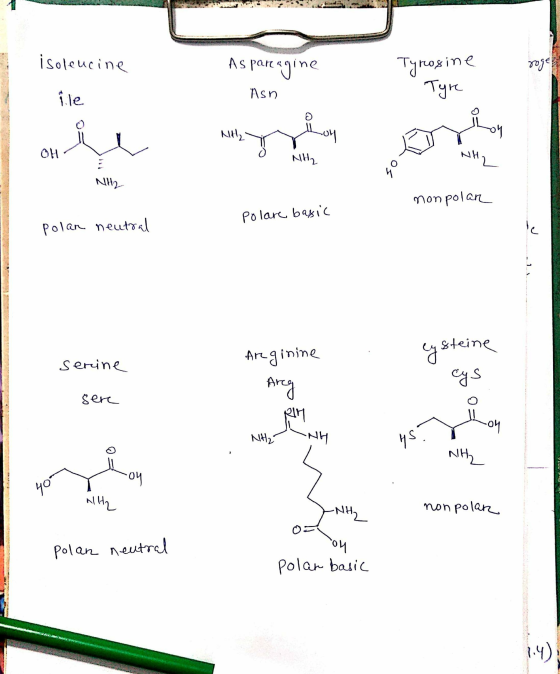
what are the answers to these?
6. For the following amino acids, write its 3-letter abbreviation...
Determine whether the side-chain of each of the following amino acids is polar and neutral, nonpolar,...
 Determine whether the side-chain of each of the following amino acids is polar and neutral, nonpolar, basic, or acidic. Polar and neutral Nonpolar Basic Acidic hydrophobic C-coo amino acid arginine Ser NHy NHs NHİ aspartate Met
1) Which of the following is an amino acid? A) e R-CH-CH2-C00R -CH-CooR -CH-C-CO ile R-CH-C-NH3...
 1) Which of the following is an amino acid? A) e R-CH-CH2-C00R -CH-CooR -CH-C-CO ile R-CH-C-NH3 R-C=CH-Coo NH3 NH3 NH3 ONH 3 D) coo B) E) 2) Which of the following amino acids has a sulfur in the R group? A) serine B) cysteine C) asparagine D) tyrosine E) leucine 3) Which of the following terms describes the side chain of valine? A) acidic B) basic C) charged, polar D) uncharged, polar E) nonpolar 4) Which of the following is...
1)Match the name of each amino acid with one of its characteristics. 2)has a hydroxy group...
1)Match the name of each amino acid with one of its characteristics. 2)has a hydroxy group its aromatic side chain 3)has a sulfur atom in its side chain that can form disulfide bonds its side chain is a nonpolar isopropyl group 4)it has the smallest acidic side chain 5)this amino acid has the smallest side chain of all, a hydrogen atom 6)its side chain is a methyl group its side chain of 3 carbons forms a 5-membered ring with the...
What amino acid is attached to a tRNA with the following anticodon: 5' GCA 3'? SECOND...
 What amino acid is attached to a tRNA with the following anticodon: 5' GCA 3'? SECOND POSITION с A U phenyl- alanine tyrosine cysteine U serine U с A leucine stop stop tryptophan stop G histidine U с A с leucine proline arginine FIRST POSITION glutamine THIRD POSITION G U isoleucine asparagine serine A threonine A lysine arginine methionine G U с A valine G aspartic acid glutamic acid alanine glycine and start Cysteine Alanine Arginine Serine
9) What type of attraction would you expect between the R groups of each of the following amino acids in a tertiary str...
 9) What type of attraction would you expect between the R groups of each of the following amino acids in a tertiary structure of a protein? (see Table 16.2) a) proline and phenylalanine b) Aspartate and arginine c) Tyrosine and water d) Cysteine and cysteine e) Serine and tyrosine f) Leucine and alanine 2
9) What type of attraction would you expect between the R groups of each of the following amino acids in a tertiary structure of a protein?...
9) What type of attraction would you expect between the R groups of each of the following amino acids in a tertiary structure of a protein? (see Table 16.2) a) proline and phenylalanine b) Aspartate and arginine c) Tyrosine and water d) Cysteine and cysteine e) Serine and tyrosine f) Leucine and alanine 2
9) What type of attraction would you expect between the R groups of each of the following amino acids in a tertiary structure of a protein?...
1. Amino acids have both a three letter, and a one letter code, for example the...
1. Amino acids have both a three letter, and a one letter code, for example the amino acid Glycine is “Gly” or “G.” There are 20 single letter codes for amino acids, which is almost an entire alphabet. (skip any letters without a corresponding amino acid) it would make. A. For example: “Ryan Smith”, would be: “Arginine, Tyrosine, Alanine, Asparagine, Serine, Methionine, Isoleucine, Threonine, Histidine” B. Take this sequence of amino acids, and write out a sequence of RNA that could...
The one-letter sequence is: WATER a) Draw the peptide (R-groups trans), indicating charges, in pr...
 The one-letter sequence is: WATER
a) Draw the peptide (R-groups trans), indicating charges, in
predominant form found at pH = 0.
b) What is the isoelectric point?
c) What is the average charge on the population of peptide
macromolecules at pH = 2.2?
d) What is the average charge on the population of peptide
macromolecules at pH = 12.5?
TABLE 4.1 Amino Acid Alanine Arginine Asparagine Aspartic acid Cysteine....« Glutamic acid Glutamine Glycine Histidine Isoleucine Leucine Lysine … Methionine Phenylalanine...
The one-letter sequence is: WATER
a) Draw the peptide (R-groups trans), indicating charges, in
predominant form found at pH = 0.
b) What is the isoelectric point?
c) What is the average charge on the population of peptide
macromolecules at pH = 2.2?
d) What is the average charge on the population of peptide
macromolecules at pH = 12.5?
TABLE 4.1 Amino Acid Alanine Arginine Asparagine Aspartic acid Cysteine....« Glutamic acid Glutamine Glycine Histidine Isoleucine Leucine Lysine … Methionine Phenylalanine...
Choose three amino acids, no more than one of each of the following types: a. polar...
 Choose three amino acids, no more than one of each of the following types: a. polar side group b. non-polar side group c. acidic side group d. basic side group Draw an unambiguous structure for each of the amino acids you chose, in the full propionate form (at pH=0). That is, all oxygen/sulfur sites should be neutral, and appropriate amino sites should have a+1 charge. For full credit, show all stereochemistry properly. a. b. c. CIRCLE the side groups for...
page 2 Chem 102 Work Shot 9.0 Dr.O. Amino Acids NAME_Sheena Thompson For each amino acid:...
 page 2 Chem 102 Work Shot 9.0 Dr.O. Amino Acids NAME_Sheena Thompson For each amino acid: A. Draw a circle around the carboxylic acid group B. Drow a triangle around the c-amino group C. Draw a box (or rectangle or polygon) around the Rgroup in each amino acid D. Use hi-lighters or colored pencils on each name to classify the amino acids as one of the following: 1. Nonpolar 2. Polar neutral 3. Polar acidic 4. Polor basic NH CO_H...
The chemical structures of the 20 standard amino acids at pH 7, along with their 3...
 The chemical structures of the 20 standard amino acids at pH 7, along with their 3 and 1 letter codes, are givern in alphabetical order below. While the oxygen and nitrogen atoms of the peptide bonds may serve as a donor atom to complex a metal ion, very often the ligands for the metal come from the amino acid side chains. Takea few moments to examine the chemical structures of the different side chains. Circle the side chains that you...
 Determine whether the side-chain of each of the following amino acids is polar and neutral, nonpolar, basic, or acidic. Polar and neutral Nonpolar Basic Acidic hydrophobic C-coo amino acid arginine Ser NHy NHs NHİ aspartate Met
 1) Which of the following is an amino acid? A) e R-CH-CH2-C00R -CH-CooR -CH-C-CO ile R-CH-C-NH3 R-C=CH-Coo NH3 NH3 NH3 ONH 3 D) coo B) E) 2) Which of the following amino acids has a sulfur in the R group? A) serine B) cysteine C) asparagine D) tyrosine E) leucine 3) Which of the following terms describes the side chain of valine? A) acidic B) basic C) charged, polar D) uncharged, polar E) nonpolar 4) Which of the following is...
 What amino acid is attached to a tRNA with the following anticodon: 5' GCA 3'? SECOND POSITION с A U phenyl- alanine tyrosine cysteine U serine U с A leucine stop stop tryptophan stop G histidine U с A с leucine proline arginine FIRST POSITION glutamine THIRD POSITION G U isoleucine asparagine serine A threonine A lysine arginine methionine G U с A valine G aspartic acid glutamic acid alanine glycine and start Cysteine Alanine Arginine Serine
 9) What type of attraction would you expect between the R groups of each of the following amino acids in a tertiary structure of a protein? (see Table 16.2) a) proline and phenylalanine b) Aspartate and arginine c) Tyrosine and water d) Cysteine and cysteine e) Serine and tyrosine f) Leucine and alanine 2
9) What type of attraction would you expect between the R groups of each of the following amino acids in a tertiary structure of a protein?...
9) What type of attraction would you expect between the R groups of each of the following amino acids in a tertiary structure of a protein? (see Table 16.2) a) proline and phenylalanine b) Aspartate and arginine c) Tyrosine and water d) Cysteine and cysteine e) Serine and tyrosine f) Leucine and alanine 2
9) What type of attraction would you expect between the R groups of each of the following amino acids in a tertiary structure of a protein?...
 The one-letter sequence is: WATER
a) Draw the peptide (R-groups trans), indicating charges, in
predominant form found at pH = 0.
b) What is the isoelectric point?
c) What is the average charge on the population of peptide
macromolecules at pH = 2.2?
d) What is the average charge on the population of peptide
macromolecules at pH = 12.5?
TABLE 4.1 Amino Acid Alanine Arginine Asparagine Aspartic acid Cysteine....« Glutamic acid Glutamine Glycine Histidine Isoleucine Leucine Lysine … Methionine Phenylalanine...
The one-letter sequence is: WATER
a) Draw the peptide (R-groups trans), indicating charges, in
predominant form found at pH = 0.
b) What is the isoelectric point?
c) What is the average charge on the population of peptide
macromolecules at pH = 2.2?
d) What is the average charge on the population of peptide
macromolecules at pH = 12.5?
TABLE 4.1 Amino Acid Alanine Arginine Asparagine Aspartic acid Cysteine....« Glutamic acid Glutamine Glycine Histidine Isoleucine Leucine Lysine … Methionine Phenylalanine...
 Choose three amino acids, no more than one of each of the following types: a. polar side group b. non-polar side group c. acidic side group d. basic side group Draw an unambiguous structure for each of the amino acids you chose, in the full propionate form (at pH=0). That is, all oxygen/sulfur sites should be neutral, and appropriate amino sites should have a+1 charge. For full credit, show all stereochemistry properly. a. b. c. CIRCLE the side groups for...
 page 2 Chem 102 Work Shot 9.0 Dr.O. Amino Acids NAME_Sheena Thompson For each amino acid: A. Draw a circle around the carboxylic acid group B. Drow a triangle around the c-amino group C. Draw a box (or rectangle or polygon) around the Rgroup in each amino acid D. Use hi-lighters or colored pencils on each name to classify the amino acids as one of the following: 1. Nonpolar 2. Polar neutral 3. Polar acidic 4. Polor basic NH CO_H...
 The chemical structures of the 20 standard amino acids at pH 7, along with their 3 and 1 letter codes, are givern in alphabetical order below. While the oxygen and nitrogen atoms of the peptide bonds may serve as a donor atom to complex a metal ion, very often the ligands for the metal come from the amino acid side chains. Takea few moments to examine the chemical structures of the different side chains. Circle the side chains that you...
Most questions answered within 3 hours.
-
Where is the error in this code sequence?
String s1 = "Hello";
String s2 = "ello";...
asked 11 months ago -
Financial data for Joel de Paris, Inc., for last year
follow:
Joel de Paris, Inc.
Balance...
asked 11 months ago -
Consider this reaction:
Al2(SO4)3 (aq)+ BaCl3
(aq) Al2Cl6 (aq)- +
3BaSO4(s) . What is the...
asked 11 months ago -
Suppose that Savneet is considering increasing her
recent random sample from 20 car rentals to 40...
asked 11 months ago -
Trucks arrive at an unloading terminal at an average rate of 120
per hour.
Trucks arrive...
asked 11 months ago -
Why are methanol and ethanol completely soluble in water while
octanol is not very little soluble....
asked 11 months ago -
A facilities manager at a university reads in a research report
that the mean amount of...
asked 11 months ago -
When the CuSO4 is rehydrated by adding water to the anhydrous
compound, is this an endothermic...
asked 11 months ago -
A ray of sunlight is passing from diamond into crown glass; the
angle of incidence is...
asked 11 months ago -
A block of mass 0.249 kg is placed on top of a light, vertical
spring of...
asked 11 months ago -
how do the kidneys compensate in the presences of acidosis
a) trigger hyperventilate
b) reserve acid...
asked 11 months ago -
Question 501 pts
The rental rate of capital to the firm increases. Which of the
following...
asked 11 months ago