
Homework Answers
45, when adapting to land, plants had to find ways to obtain resources for nutrition, resist desiccation and find ways of reproduction.
The plants adapted to land by obtaining nutrition both from below and above the groud. Water and nutrients from the soil was absorbed by root sytem whereas light and CO2 required for photosynthesis was absorbed by leaves- the shoot system. The evolution of vascular tissues has made it possible to distribute water and food throughout the plant body.
To resist dessication, plants evolved cuticle and stomata. Cuticle the waxy layer to resist water and gas loss, stomata small tiny pores for exchange of gases and transpiration. Stomata regulates according to the climate
Another important evolution is the internal fertilisation in plants. the gametes are fertilised inside the female plant than dispersing it as seen in algae. The gametes are packed inside which has dehyrdration resistant outer coating layers to maintain its viability
what adaptations do non-vascular plants share with vascular plants that allow for a terrestrial existence?
what adaptations do non-vascular plants share with vascular plants that allow for a terrestrial existence?
In two to three paragraphs, describe the characteristics and numbers of plants in a terrestrial ecosystem....
In two to three paragraphs, describe the characteristics and numbers of plants in a terrestrial ecosystem. Describe where they get their energy. Be clear, thorough, and scientifically accurate.
There are a number of adaptations required for life to exist on land. Identify and describe...
There are a number of adaptations required for life to exist on land. Identify and describe five adaptations to life on land for plants AND identify and describe five adaptations to life on land for animals.
3. Name and describe two adaptations that have enabled bacteria to become such a biodiverse domain...
 3. Name and describe two adaptations that have enabled bacteria to become such a biodiverse domain of life. (2 points)
Describe three adaptations of xerophytes (Desert plants). Be sure that your descriptions explain how each adaptation...
Describe three adaptations of xerophytes (Desert plants). Be sure that your descriptions explain how each adaptation is an advantage in an arid environment.
Describe three adaptations of hydrophytes (aquatic plants). Be sure that your descriptions explain how each adaptation...
Describe three adaptations of hydrophytes (aquatic plants). Be sure that your descriptions explain how each adaptation is an advantage in an aquatic environment
Over the years, humans have discovered that the plants have developed special adaptations that allow them...
Over the years, humans have discovered that the plants have developed special adaptations that allow them to grow and survive in specific environments and man has used these adaptations for own use. Choose a plant from any of the different phyla you can study and identify a structure or substance that affords it some distinct benefit. Describe what that benefit is and then briefly discuss how humans have used that trait as an asset for themselves?
Plant Chemical Adaptations Physical adaptations are one way plants have become well-adapted to specific environmental conditions....
Plant Chemical Adaptations Physical adaptations are one way plants have become well-adapted to specific environmental conditions. For example, cacti have spines in place of leaves to prevent water loss in the arid conditions of the desert, and deciduous trees lose their leaves in the fall to survive cold weather conditions over the winter. Chemical adaptations are another means for plant protection. Many plants produce toxic or noxious compounds to protect themselves from insects or animals that would eat them, to...
Bryophytes & Seedless vascular plants: Be able to define a true “plant” Know how plants differ...
Bryophytes & Seedless vascular plants: Be able to define a true “plant” Know how plants differ from other photosynthetic organisms (green algae, cyanobacteria) Understand that land plants share a common ancestor with green algae Be familiar with the four stages in land plant evolution, and know that both bryophytes and seedless vascular plants arose in the first stage seedless vascular plants diversified and dominated the Earth in the second stage, during the Carboniferous Period (~350-300 MYA), when coal deposits were...
14 8. Plants must have special adaptations to dissuade water loss in arid environments. The figure...
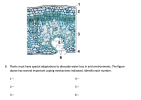 14 8. Plants must have special adaptations to dissuade water loss in arid environments. The figure above has several important coping mechanisms indicated. Identify each number.
 3. Name and describe two adaptations that have enabled bacteria to become such a biodiverse domain of life. (2 points)
 14 8. Plants must have special adaptations to dissuade water loss in arid environments. The figure above has several important coping mechanisms indicated. Identify each number.
Most questions answered within 3 hours.
-
Where is the error in this code sequence?
String s1 = "Hello";
String s2 = "ello";...
asked 10 months ago -
Financial data for Joel de Paris, Inc., for last year
follow:
Joel de Paris, Inc.
Balance...
asked 10 months ago -
Consider this reaction:
Al2(SO4)3 (aq)+ BaCl3
(aq) Al2Cl6 (aq)- +
3BaSO4(s) . What is the...
asked 10 months ago -
Suppose that Savneet is considering increasing her
recent random sample from 20 car rentals to 40...
asked 10 months ago -
Trucks arrive at an unloading terminal at an average rate of 120
per hour.
Trucks arrive...
asked 10 months ago -
Why are methanol and ethanol completely soluble in water while
octanol is not very little soluble....
asked 10 months ago -
A facilities manager at a university reads in a research report
that the mean amount of...
asked 10 months ago -
When the CuSO4 is rehydrated by adding water to the anhydrous
compound, is this an endothermic...
asked 10 months ago -
A ray of sunlight is passing from diamond into crown glass; the
angle of incidence is...
asked 10 months ago -
A block of mass 0.249 kg is placed on top of a light, vertical
spring of...
asked 10 months ago -
how do the kidneys compensate in the presences of acidosis
a) trigger hyperventilate
b) reserve acid...
asked 10 months ago -
Question 501 pts
The rental rate of capital to the firm increases. Which of the
following...
asked 10 months ago