
Homework Answers
Question
16. True leaves are originated from the distinct place other than lycophyll. These true leaves are found in the ferns and seed plants. Hence, option D is correct.
17. Roots have arise from embryonic axis from shoot. Therefore, roots arise after shoot. Hence, option C is correct.
18. Seed protect and nourish the embryo. Hence, option C is correct.
19. Gymnosperm are seed-bearing plant and and include plants like cycads, pines. Hence, option D is correct.
20. Naked seed plant are known as gymnosperms. Hence, option C is correct.
Add Answer to:
16. True leaves are only found in mosses, liverworts, and homworts B. c. D ferns flowering...
All land plants have single cell haploid and single cell diploid states single cell haploid and...
 All land plants have single cell haploid and single cell diploid states single cell haploid and multicellular diploid states multicellular haploid and single cell diploid states multicellular haploid and multicellular diploid states A. B. C. D. E. diplontic life cycles 7. A gametophyte is B. c. 2n 3n 4n 5n A sporophyte is In 2n 3n C. D. E. 9. The dominant (bigger) state in mosses, liverworts, and hornworts is the A gametophyte sporophyte C. sporangium D. archegonium E. antheridium...
Complete Table 17.1 Life Cycle Comparisons. Summarize Your Observations by Adding Yes or No to Indicate...
 Complete
Table 17.1 Life Cycle Comparisons. Summarize Your Observations by Adding Yes or No to Indicate if a Feature Is Found in a Group Characteristics Mosses Ferns Gymnosperms Angiosperms Airborne haploid spores | Haploid gametophyte Egg and sperm produced by mitosis Flagellated sperm Water-dependent fertilization Diploid sporophyte Dependent sporophyte Independent photosynthetic gametophye sporophyte Dependent gametophyte Independent photosynthetic gametophyte Spores produced by meiosis Ovules Pollen Embryo protected by seed coat (seeds) Seed within fruit Vascular tissues
Complete
Table 17.1 Life Cycle Comparisons. Summarize Your Observations by Adding Yes or No to Indicate if a Feature Is Found in a Group Characteristics Mosses Ferns Gymnosperms Angiosperms Airborne haploid spores | Haploid gametophyte Egg and sperm produced by mitosis Flagellated sperm Water-dependent fertilization Diploid sporophyte Dependent sporophyte Independent photosynthetic gametophye sporophyte Dependent gametophyte Independent photosynthetic gametophyte Spores produced by meiosis Ovules Pollen Embryo protected by seed coat (seeds) Seed within fruit Vascular tissues
Question 1 1 pts 1) Which of the following is not functionally important in the cells...
 Question 1 1 pts 1) Which of the following is not functionally important in the cells of the gametophytes of both angiosperms and gymnosperms? A) haploid nuclei B) mitochondria C) cell walls D) plastids ОА OB - OC Question 2 1 pts 2) In addition to seeds, which of the following characteristics is unique to the seed- producing plants? A) sporopollenin B) alternation of generations C) pollen D) megaphylls OD Question 3 1 pts 3) The closest relatives of the...
Which of these belongs in the seedless plants? A. Ferns B. Cactus C. Palm Trees D....
Which of these belongs in the seedless plants? A. Ferns B. Cactus C. Palm Trees D. Slime Mold 2) Angiosperms are: A. invertebrates B. protists C. gametes D. flowering plants 3) Which of these is a trait that was picked up as plants evolve ancestors to Gymnosperms? A. Seeds B. Fruit C. Multicellular D. Flowers 4) Most plants are: A. psychotrophs B. heterotrophs C. homotrophs D. autotrophs 5) The evolution of this trait allowed plants to move to dry environment....
Which of these belongs in the seedless plants? A. Ferns B. Cactus C. Palm Trees D....
Which of these belongs in the seedless plants? A. Ferns B. Cactus C. Palm Trees D. Slime Mold 2. Angiosperms are: A. invertebrates B. protists C. gametes D. flowering plants 3. Which of these is a trait that was picked up as plants evolve ancestors to Gymnosperms? A. Seeds B. Fruit C. Multicellular D. Flowers 4. Most plants are: A. psychotrophs B. heterotrophs C. homotrophs D. autotrophs 5. The evolution of this trait allowed plants to move to dry environment....
The main groups of bryophytes include all except _____. A. Hornworts B. Liverworts C. Mosses D....
The main groups of bryophytes include all except _____. A. Hornworts B. Liverworts C. Mosses D. Whisk Ferns
One day, you go outside and see that the cars on the street are covered in...
 One day, you go outside and see that the cars on the street are covered in a yellow dust. Which of the following statements can be correctly applied to this"dust"? A) The dust is pine pollen and is so abundant because the pines are wind pollinated. B) The dust is the spore production of ferns and is so abundant because the spores are wind dispersed C) The dust is the seed production of ferns and is so abundant because the...
A-D immediately below are possible answers for questions 26-30 A) Gymnosperms B) Flowering plants C) Bryophytes...
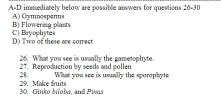 A-D immediately below are possible answers for questions 26-30 A) Gymnosperms B) Flowering plants C) Bryophytes D) Two of these are correct 26. What you see is usually the gametophyte. 27. Reproduction by seeds and pollen 28. What you see is usually the sporophyte 29. Make fruits 30. Ginko biloba, and Pinus
The ancestors of plants were probably algae. True/False 2) What do plants and the green algae...
The ancestors of plants were probably algae. True/False 2) What do plants and the green algae charophytes have in common? 3) What advantages did life in land provide for plants? 4) What were the disadvantages for life on land for plants? 5) What are some differences between plants and algae? 6) How do land plants maintain moisture in their cells? 7) What structures do land plants use to obtain resources such as water, minerals, and CO2? 8) List the two...
Multicellular diploid and haploid states is called A. haplosporophytic life cycle haplogametophytic life cycle haploplontic life...
 Multicellular diploid and haploid states is called A. haplosporophytic life cycle haplogametophytic life cycle haploplontic life cycle haplodiplontic life cycle alternation of generations life cycle 12. Mosses, liverworts, and hornworts are B. c. nonvascular vascular euphyllophytes seed reproducers tracheids D. 13. Ferns, gymnosperms, and angiosperms are A. B. byrophytes tracheophytes prokaryotes protists polyphyletic D. E. 14. Cooksonia is known as the first vascular land plant because it had B. с. D2 E. roots leaves, xylem and phloem roots, xylem and...
 All land plants have single cell haploid and single cell diploid states single cell haploid and multicellular diploid states multicellular haploid and single cell diploid states multicellular haploid and multicellular diploid states A. B. C. D. E. diplontic life cycles 7. A gametophyte is B. c. 2n 3n 4n 5n A sporophyte is In 2n 3n C. D. E. 9. The dominant (bigger) state in mosses, liverworts, and hornworts is the A gametophyte sporophyte C. sporangium D. archegonium E. antheridium...
 Complete
Table 17.1 Life Cycle Comparisons. Summarize Your Observations by Adding Yes or No to Indicate if a Feature Is Found in a Group Characteristics Mosses Ferns Gymnosperms Angiosperms Airborne haploid spores | Haploid gametophyte Egg and sperm produced by mitosis Flagellated sperm Water-dependent fertilization Diploid sporophyte Dependent sporophyte Independent photosynthetic gametophye sporophyte Dependent gametophyte Independent photosynthetic gametophyte Spores produced by meiosis Ovules Pollen Embryo protected by seed coat (seeds) Seed within fruit Vascular tissues
Complete
Table 17.1 Life Cycle Comparisons. Summarize Your Observations by Adding Yes or No to Indicate if a Feature Is Found in a Group Characteristics Mosses Ferns Gymnosperms Angiosperms Airborne haploid spores | Haploid gametophyte Egg and sperm produced by mitosis Flagellated sperm Water-dependent fertilization Diploid sporophyte Dependent sporophyte Independent photosynthetic gametophye sporophyte Dependent gametophyte Independent photosynthetic gametophyte Spores produced by meiosis Ovules Pollen Embryo protected by seed coat (seeds) Seed within fruit Vascular tissues
 Question 1 1 pts 1) Which of the following is not functionally important in the cells of the gametophytes of both angiosperms and gymnosperms? A) haploid nuclei B) mitochondria C) cell walls D) plastids ОА OB - OC Question 2 1 pts 2) In addition to seeds, which of the following characteristics is unique to the seed- producing plants? A) sporopollenin B) alternation of generations C) pollen D) megaphylls OD Question 3 1 pts 3) The closest relatives of the...
 One day, you go outside and see that the cars on the street are covered in a yellow dust. Which of the following statements can be correctly applied to this"dust"? A) The dust is pine pollen and is so abundant because the pines are wind pollinated. B) The dust is the spore production of ferns and is so abundant because the spores are wind dispersed C) The dust is the seed production of ferns and is so abundant because the...
 A-D immediately below are possible answers for questions 26-30 A) Gymnosperms B) Flowering plants C) Bryophytes D) Two of these are correct 26. What you see is usually the gametophyte. 27. Reproduction by seeds and pollen 28. What you see is usually the sporophyte 29. Make fruits 30. Ginko biloba, and Pinus
 Multicellular diploid and haploid states is called A. haplosporophytic life cycle haplogametophytic life cycle haploplontic life cycle haplodiplontic life cycle alternation of generations life cycle 12. Mosses, liverworts, and hornworts are B. c. nonvascular vascular euphyllophytes seed reproducers tracheids D. 13. Ferns, gymnosperms, and angiosperms are A. B. byrophytes tracheophytes prokaryotes protists polyphyletic D. E. 14. Cooksonia is known as the first vascular land plant because it had B. с. D2 E. roots leaves, xylem and phloem roots, xylem and...
Most questions answered within 3 hours.
-
Where is the error in this code sequence?
String s1 = "Hello";
String s2 = "ello";...
asked 10 months ago -
Financial data for Joel de Paris, Inc., for last year
follow:
Joel de Paris, Inc.
Balance...
asked 10 months ago -
Consider this reaction:
Al2(SO4)3 (aq)+ BaCl3
(aq) Al2Cl6 (aq)- +
3BaSO4(s) . What is the...
asked 10 months ago -
Suppose that Savneet is considering increasing her
recent random sample from 20 car rentals to 40...
asked 10 months ago -
Trucks arrive at an unloading terminal at an average rate of 120
per hour.
Trucks arrive...
asked 10 months ago -
Why are methanol and ethanol completely soluble in water while
octanol is not very little soluble....
asked 10 months ago -
A facilities manager at a university reads in a research report
that the mean amount of...
asked 10 months ago -
When the CuSO4 is rehydrated by adding water to the anhydrous
compound, is this an endothermic...
asked 10 months ago -
A ray of sunlight is passing from diamond into crown glass; the
angle of incidence is...
asked 10 months ago -
A block of mass 0.249 kg is placed on top of a light, vertical
spring of...
asked 10 months ago -
how do the kidneys compensate in the presences of acidosis
a) trigger hyperventilate
b) reserve acid...
asked 10 months ago -
Question 501 pts
The rental rate of capital to the firm increases. Which of the
following...
asked 10 months ago