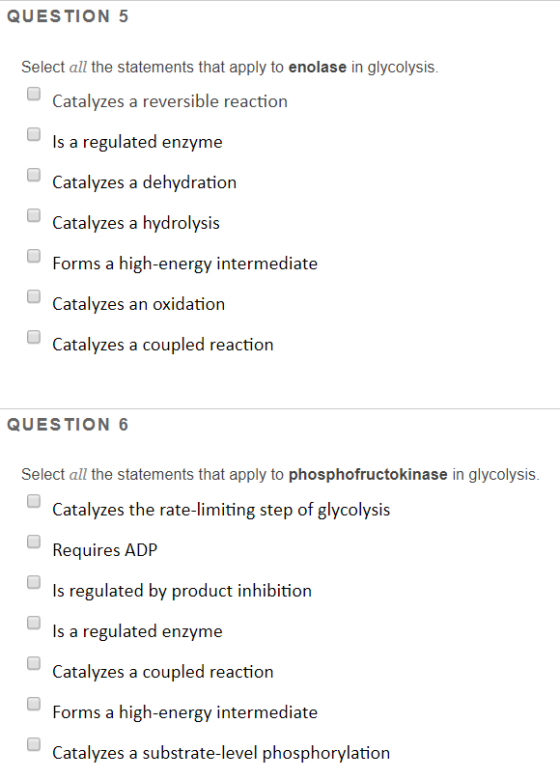
This is a biochemistry question, please take the time to answer both questions and I will like as soon as the answer is posted. Thanks in advance!
Homework Answers
Q.5 : 2-phosphoglycerate is converted to phosphoenolpyravate by enolase in the 9th step of glycolysis. This step is "catalysed as a reversible reaction" by enolase. Enolase "catalyzes a dehydration" that is by removal of water molecule to yield PEP, this is a" high energy intermediate " which cleaves the phosphate in the next step to form the pyravate.
Q6. Phosphofructokinase "catalyzes the rate limiting step of glycolysis" " requires ADP as it is active when ADP concentration is high" when the concentration of ATP is high it is less active because aim of glycolysis is to yield ATP thus it gets slow down so it is " regulated by product inhibition " it is a regulayed enzyme as it is regulated by the energy charge of the cell and it is a "coupled reaction " by hydrolysis of ATP to ADP and Pi. "Catalyses the substrate level phosphorylation to form fructose 1,6 bisphosphate".
Thankyou...
Add Answer to:
This is a biochemistry question, please take the time to answer
both questions and I will...
This is a biochemistry question, please take the time to answer both questions and I will...
 This is a biochemistry question, please take the time to answer
both questions and I will like as soon as the answer is posted.
Thanks in advance!
QUESTION 9 Glycolysis is divided into two stages. Identify which of the following characteristics pertain to stage 1 or stage 2 of glycolysis. A. stage 1 - ATP is utilized B. stage 2 - ATP is synthesized - Six-carbon compounds are involved Only three-carbon compounds are involved - - NADH is produced QUESTION...
This is a biochemistry question, please take the time to answer
both questions and I will like as soon as the answer is posted.
Thanks in advance!
QUESTION 9 Glycolysis is divided into two stages. Identify which of the following characteristics pertain to stage 1 or stage 2 of glycolysis. A. stage 1 - ATP is utilized B. stage 2 - ATP is synthesized - Six-carbon compounds are involved Only three-carbon compounds are involved - - NADH is produced QUESTION...
QUESTION 6 True or false: Anaerobic organisms cannot make ATP. True O False QUESTION 7 Which...
 QUESTION 6 True or false: Anaerobic organisms cannot make ATP. True O False QUESTION 7 Which of the following is a reactant of the first reaction of glycolysis? O Glucose O ADP ОАТР O 02 O Both glucose and ATP QUESTION 8 Each of the following is a high-energy product of glycolysis. From which of these can anaerobic organisms harvest the stored energy? I.e. Which of these is/are useful to an anaerobe? ОАТР O NADH O Pyruvate O All of...
This is a biochemistry question, please take the time to answer both questions and I will...
 This is a biochemistry question, please take the time to answer
both questions and I will like as soon as the answer is posted.
Thanks in advance!
QUESTION 7 Which of these molecules is NOT produced in glycolysis? Glucose-6-phosphate Fructose-6-phosphate water Inorganic phosphate ATP QUESTION 8 Glycolysis is connected to many other metabolic pathways, which can feed intermediates into glycolysis at different steps. Starting glycolysis at dihydroxyacetone phosphate will give a net yield (per DHAP molecule) of: 2 mol of...
This is a biochemistry question, please take the time to answer
both questions and I will like as soon as the answer is posted.
Thanks in advance!
QUESTION 7 Which of these molecules is NOT produced in glycolysis? Glucose-6-phosphate Fructose-6-phosphate water Inorganic phosphate ATP QUESTION 8 Glycolysis is connected to many other metabolic pathways, which can feed intermediates into glycolysis at different steps. Starting glycolysis at dihydroxyacetone phosphate will give a net yield (per DHAP molecule) of: 2 mol of...
Please answer the question. Please write neatly and also make sure you answer is correct! Thank...
 Please answer the question. Please write neatly and also make
sure you answer is correct! Thank you! If you do not know the
answer to a part, please don’t answer it! I will rate good! Also
please fill in the blank followed by the letter choice.
7. (8 pts) Complete the following statements about glycolysis using terms from the list below. Four of these will not be used. 3-phosphoglycerate aldolase dihydroxyacetone phosphate enolase fructose 1,6-bisphosphate glyceraldehyde 3-phosphate lactate oxidative pyruvate...
Please answer the question. Please write neatly and also make
sure you answer is correct! Thank you! If you do not know the
answer to a part, please don’t answer it! I will rate good! Also
please fill in the blank followed by the letter choice.
7. (8 pts) Complete the following statements about glycolysis using terms from the list below. Four of these will not be used. 3-phosphoglycerate aldolase dihydroxyacetone phosphate enolase fructose 1,6-bisphosphate glyceraldehyde 3-phosphate lactate oxidative pyruvate...
QUESTION 1 Which of the following processes/pathways CANNOT occur in the absence of O2? Oxidative phosphorylation...
QUESTION 1 Which of the following processes/pathways CANNOT occur in the absence of O2? Oxidative phosphorylation Substrate level phosphorylation Oxidation of NADH Photosynthesis Fermentation 1 points QUESTION 2 Phosphofructokinase (PFK-1) is one of the most regulated enzymes in metabolism. Which of the following would be expected to be an allosteric inhibitor of PFK-1? Glucose Fructose-6-phosphate Acetyl CoA AMP 1 points QUESTION 3 Which of the following is a reactant of the first reaction of glycolysis? Glucose ADP ATP...
Please help me with ALL of these questions. Thank you so much Question 13 0.4 pts...
 Please help me with ALL of these questions. Thank you so
much
Question 13 0.4 pts For each two carbon molecule (i.e., acetyl) that enters the citric acid cycle, how many molecules of waste CO2 are produced? 0 0 0 0 0 3 Question 14 0.4 pts Which stage of respiration reduces the most electron carriers? citric acid cycle glycolysis acetyl-CoA synthesis Question 16 0.3 pts How is a Carbon atom oxidized during a redox reaction if it has the...
Please help me with ALL of these questions. Thank you so
much
Question 13 0.4 pts For each two carbon molecule (i.e., acetyl) that enters the citric acid cycle, how many molecules of waste CO2 are produced? 0 0 0 0 0 3 Question 14 0.4 pts Which stage of respiration reduces the most electron carriers? citric acid cycle glycolysis acetyl-CoA synthesis Question 16 0.3 pts How is a Carbon atom oxidized during a redox reaction if it has the...
CHEM 351 Biochemistry I - Fall 2018 Study Problems for Metabolism and Glucose Catabolism For the...
 CHEM 351 Biochemistry I - Fall 2018 Study Problems for Metabolism and Glucose Catabolism For the reaction: aA + bB =cC + dD Gibbs free energy: AG = AG" + RT IN THE glucose + glucose 6-phosphate + H20 1. The equilibrium constant for phosphorylation of glucose is: Ke = 3.97 x 10- a. Calculate the standard Gibbs free energy for the uncatalyzed reaction. b. Use the physiological concentrations for glucose (2.0 mm) and inorganic phosphate (20 mM) to determine...
4. What is the commited step of glycolysis and how is this enzyme regulated? 5. Glyceraldehyde-3-phophate...
 4. What is the commited step of glycolysis and how is this enzyme regulated? 5. Glyceraldehyde-3-phophate dehydrogenase (GAPDH) is the most important enzyme in glycolysis. a. What two reactions are coupled by GAPDH? b. Draw the structure of the thiohemiacetal intermediate and show the mechanism for generating the acyl thioester intermediate. A+Bred Ared +B For the reaction: AG = Given: ngAE RT In n[Aj{8,al Nernst Equation: AE=A Use the reduction potentials in Table 14-4 to calculate the electromotive force, AE,...
biochemistry if you could please help me answer the following questions! * 1. (5 pts) Which...
 biochemistry
if you could please help me answer the following questions!
* 1. (5 pts) Which of the following is a catalytic mechanism utilize by enzymes? Multiple answers may be correct. Select all that are correct. 1. Acid-base a) acid-base catalysis d. metal-ion catalysis 12. Covalent b covalent catalysis e. transition state binding c. heterogeneou 3. Metalion . Proximin onentation, E 2. 76 pts) What is the "steady-state" assumption in the derivation of the s.clectrosch? Tynsin Michaelis-Menten equation? Sie binding...
biochemistry
if you could please help me answer the following questions!
* 1. (5 pts) Which of the following is a catalytic mechanism utilize by enzymes? Multiple answers may be correct. Select all that are correct. 1. Acid-base a) acid-base catalysis d. metal-ion catalysis 12. Covalent b covalent catalysis e. transition state binding c. heterogeneou 3. Metalion . Proximin onentation, E 2. 76 pts) What is the "steady-state" assumption in the derivation of the s.clectrosch? Tynsin Michaelis-Menten equation? Sie binding...
Please help me with these questions. I got part of it right not sure about the...
 Please help me with these
questions. I got part of it right not sure about the rest
Incorrect Question 2 0/1 pts The mechanism by which insulin decreases oxidation of fatty acids is: O Inhibition of malonyl CoA synthesis O Activation of acetyl CoA carboxylase O Dephosphorylation of carnitine acyl transferase O Dephosphorylation of ACCOA Partial Question 3 1/3 pts Select all the ways in which beta oxidation of fatty acids is regulated Phosphorylation/dephosphorylation of enyzmes Allosterically by ADP Allosterically...
Please help me with these
questions. I got part of it right not sure about the rest
Incorrect Question 2 0/1 pts The mechanism by which insulin decreases oxidation of fatty acids is: O Inhibition of malonyl CoA synthesis O Activation of acetyl CoA carboxylase O Dephosphorylation of carnitine acyl transferase O Dephosphorylation of ACCOA Partial Question 3 1/3 pts Select all the ways in which beta oxidation of fatty acids is regulated Phosphorylation/dephosphorylation of enyzmes Allosterically by ADP Allosterically...
 This is a biochemistry question, please take the time to answer
both questions and I will like as soon as the answer is posted.
Thanks in advance!
QUESTION 9 Glycolysis is divided into two stages. Identify which of the following characteristics pertain to stage 1 or stage 2 of glycolysis. A. stage 1 - ATP is utilized B. stage 2 - ATP is synthesized - Six-carbon compounds are involved Only three-carbon compounds are involved - - NADH is produced QUESTION...
This is a biochemistry question, please take the time to answer
both questions and I will like as soon as the answer is posted.
Thanks in advance!
QUESTION 9 Glycolysis is divided into two stages. Identify which of the following characteristics pertain to stage 1 or stage 2 of glycolysis. A. stage 1 - ATP is utilized B. stage 2 - ATP is synthesized - Six-carbon compounds are involved Only three-carbon compounds are involved - - NADH is produced QUESTION...
 QUESTION 6 True or false: Anaerobic organisms cannot make ATP. True O False QUESTION 7 Which of the following is a reactant of the first reaction of glycolysis? O Glucose O ADP ОАТР O 02 O Both glucose and ATP QUESTION 8 Each of the following is a high-energy product of glycolysis. From which of these can anaerobic organisms harvest the stored energy? I.e. Which of these is/are useful to an anaerobe? ОАТР O NADH O Pyruvate O All of...
 This is a biochemistry question, please take the time to answer
both questions and I will like as soon as the answer is posted.
Thanks in advance!
QUESTION 7 Which of these molecules is NOT produced in glycolysis? Glucose-6-phosphate Fructose-6-phosphate water Inorganic phosphate ATP QUESTION 8 Glycolysis is connected to many other metabolic pathways, which can feed intermediates into glycolysis at different steps. Starting glycolysis at dihydroxyacetone phosphate will give a net yield (per DHAP molecule) of: 2 mol of...
This is a biochemistry question, please take the time to answer
both questions and I will like as soon as the answer is posted.
Thanks in advance!
QUESTION 7 Which of these molecules is NOT produced in glycolysis? Glucose-6-phosphate Fructose-6-phosphate water Inorganic phosphate ATP QUESTION 8 Glycolysis is connected to many other metabolic pathways, which can feed intermediates into glycolysis at different steps. Starting glycolysis at dihydroxyacetone phosphate will give a net yield (per DHAP molecule) of: 2 mol of...
 Please answer the question. Please write neatly and also make
sure you answer is correct! Thank you! If you do not know the
answer to a part, please don’t answer it! I will rate good! Also
please fill in the blank followed by the letter choice.
7. (8 pts) Complete the following statements about glycolysis using terms from the list below. Four of these will not be used. 3-phosphoglycerate aldolase dihydroxyacetone phosphate enolase fructose 1,6-bisphosphate glyceraldehyde 3-phosphate lactate oxidative pyruvate...
Please answer the question. Please write neatly and also make
sure you answer is correct! Thank you! If you do not know the
answer to a part, please don’t answer it! I will rate good! Also
please fill in the blank followed by the letter choice.
7. (8 pts) Complete the following statements about glycolysis using terms from the list below. Four of these will not be used. 3-phosphoglycerate aldolase dihydroxyacetone phosphate enolase fructose 1,6-bisphosphate glyceraldehyde 3-phosphate lactate oxidative pyruvate...
 Please help me with ALL of these questions. Thank you so
much
Question 13 0.4 pts For each two carbon molecule (i.e., acetyl) that enters the citric acid cycle, how many molecules of waste CO2 are produced? 0 0 0 0 0 3 Question 14 0.4 pts Which stage of respiration reduces the most electron carriers? citric acid cycle glycolysis acetyl-CoA synthesis Question 16 0.3 pts How is a Carbon atom oxidized during a redox reaction if it has the...
Please help me with ALL of these questions. Thank you so
much
Question 13 0.4 pts For each two carbon molecule (i.e., acetyl) that enters the citric acid cycle, how many molecules of waste CO2 are produced? 0 0 0 0 0 3 Question 14 0.4 pts Which stage of respiration reduces the most electron carriers? citric acid cycle glycolysis acetyl-CoA synthesis Question 16 0.3 pts How is a Carbon atom oxidized during a redox reaction if it has the...
 CHEM 351 Biochemistry I - Fall 2018 Study Problems for Metabolism and Glucose Catabolism For the reaction: aA + bB =cC + dD Gibbs free energy: AG = AG" + RT IN THE glucose + glucose 6-phosphate + H20 1. The equilibrium constant for phosphorylation of glucose is: Ke = 3.97 x 10- a. Calculate the standard Gibbs free energy for the uncatalyzed reaction. b. Use the physiological concentrations for glucose (2.0 mm) and inorganic phosphate (20 mM) to determine...
 4. What is the commited step of glycolysis and how is this enzyme regulated? 5. Glyceraldehyde-3-phophate dehydrogenase (GAPDH) is the most important enzyme in glycolysis. a. What two reactions are coupled by GAPDH? b. Draw the structure of the thiohemiacetal intermediate and show the mechanism for generating the acyl thioester intermediate. A+Bred Ared +B For the reaction: AG = Given: ngAE RT In n[Aj{8,al Nernst Equation: AE=A Use the reduction potentials in Table 14-4 to calculate the electromotive force, AE,...
 biochemistry
if you could please help me answer the following questions!
* 1. (5 pts) Which of the following is a catalytic mechanism utilize by enzymes? Multiple answers may be correct. Select all that are correct. 1. Acid-base a) acid-base catalysis d. metal-ion catalysis 12. Covalent b covalent catalysis e. transition state binding c. heterogeneou 3. Metalion . Proximin onentation, E 2. 76 pts) What is the "steady-state" assumption in the derivation of the s.clectrosch? Tynsin Michaelis-Menten equation? Sie binding...
biochemistry
if you could please help me answer the following questions!
* 1. (5 pts) Which of the following is a catalytic mechanism utilize by enzymes? Multiple answers may be correct. Select all that are correct. 1. Acid-base a) acid-base catalysis d. metal-ion catalysis 12. Covalent b covalent catalysis e. transition state binding c. heterogeneou 3. Metalion . Proximin onentation, E 2. 76 pts) What is the "steady-state" assumption in the derivation of the s.clectrosch? Tynsin Michaelis-Menten equation? Sie binding...
 Please help me with these
questions. I got part of it right not sure about the rest
Incorrect Question 2 0/1 pts The mechanism by which insulin decreases oxidation of fatty acids is: O Inhibition of malonyl CoA synthesis O Activation of acetyl CoA carboxylase O Dephosphorylation of carnitine acyl transferase O Dephosphorylation of ACCOA Partial Question 3 1/3 pts Select all the ways in which beta oxidation of fatty acids is regulated Phosphorylation/dephosphorylation of enyzmes Allosterically by ADP Allosterically...
Please help me with these
questions. I got part of it right not sure about the rest
Incorrect Question 2 0/1 pts The mechanism by which insulin decreases oxidation of fatty acids is: O Inhibition of malonyl CoA synthesis O Activation of acetyl CoA carboxylase O Dephosphorylation of carnitine acyl transferase O Dephosphorylation of ACCOA Partial Question 3 1/3 pts Select all the ways in which beta oxidation of fatty acids is regulated Phosphorylation/dephosphorylation of enyzmes Allosterically by ADP Allosterically...
Most questions answered within 3 hours.
-
Where is the error in this code sequence?
String s1 = "Hello";
String s2 = "ello";...
asked 10 months ago -
Financial data for Joel de Paris, Inc., for last year
follow:
Joel de Paris, Inc.
Balance...
asked 10 months ago -
Consider this reaction:
Al2(SO4)3 (aq)+ BaCl3
(aq) Al2Cl6 (aq)- +
3BaSO4(s) . What is the...
asked 10 months ago -
Suppose that Savneet is considering increasing her
recent random sample from 20 car rentals to 40...
asked 10 months ago -
Trucks arrive at an unloading terminal at an average rate of 120
per hour.
Trucks arrive...
asked 10 months ago -
Why are methanol and ethanol completely soluble in water while
octanol is not very little soluble....
asked 10 months ago -
A facilities manager at a university reads in a research report
that the mean amount of...
asked 10 months ago -
When the CuSO4 is rehydrated by adding water to the anhydrous
compound, is this an endothermic...
asked 10 months ago -
A ray of sunlight is passing from diamond into crown glass; the
angle of incidence is...
asked 10 months ago -
A block of mass 0.249 kg is placed on top of a light, vertical
spring of...
asked 10 months ago -
how do the kidneys compensate in the presences of acidosis
a) trigger hyperventilate
b) reserve acid...
asked 10 months ago -
Question 501 pts
The rental rate of capital to the firm increases. Which of the
following...
asked 10 months ago