
Homework Answers
We observe that the light bends away from the normal to the surfaces when going from medium 1 to medium 2.
So, angle of incidence in medium 2 > angle of refraction in medium 1
or,  2 > 1
2 > 1
So, sin2 >
sin1
So, (sin2) / (
sin1) > 1
From Snell's Law,
n1* sin1 = n2*
sin2
So, n1 = n2* (sin2) / (
sin1)
So, n1 > n2
So, medium 1 has more refractive index than medium 2
So, n1 > n2 <---------answer
Add Answer to:
A laser beam passing from n medium 1 to medium 2 is refracted as shown. Which...
2 4. A light beam passing from medium 2 to me- dium 1 is refracted as...
 2 4. A light beam passing from medium 2 to me- dium 1 is refracted as shown in FIGURE Q34.4. Is n, larger than n, is n, smaller than n2, or is there not enough information to tell? Explain. n FIGURE Q34.4
You shine a laser pointer from medium 1 into medium 2 with an incident angle of...
You shine a laser pointer from medium 1 into medium 2 with an incident angle of 39,6 degrees. The beam passes through medium 2 then goes into medium 3 (where n3=1.47n3=1.47). You measure that the refracted angle after the passes beam into medium 3 is 47,5 degrees. Calculate the index of refraction of medium 1. Round your answer to 2 decimal places.
If a laser beam shines from water (n1 = 1.33) into air (n2 = 1.00), what...
If a laser beam shines from water (n1 = 1.33) into air (n2 = 1.00), what is the critical angle θc, beyond which no light is refracted into the air? A) 59 degrees B) 39 degrees C) 49 degrees D) 29 degrees
45° air n=1 glass n=1.5 2 cm 2. A laser beam is incident on a 2...
 45° air n=1 glass n=1.5 2 cm 2. A laser beam is incident on a 2 cm thick sheet of glass at an angle of 45° as shown on the right. A. What is the angle of the laser beam inside of the glass? B. What is the angle of the laser beam that emerges into the air after passing through the glass? C. By what horizontal distance has the laser beam traveled when it emerges from the glass? D....
45° air n=1 glass n=1.5 2 cm 2. A laser beam is incident on a 2...
 45° air n=1 glass n=1.5 2 cm 2. A laser beam is incident on a 2 cm thick sheet of glass at an angle of 45° as shown on the right. A. What is the angle of the laser beam inside of the glass? B. What is the angle of the laser beam that emerges into the air after passing through the glass? C. By what horizontal distance has the laser beam traveled when it emerges from the glass? D....
n1 n2 6. Light rays cross interfaces from medium 1 into medium 2 and then into...
 n1 n2 6. Light rays cross interfaces from medium 1 into medium 2 and then into medium 3. Which of the following is true? n3 A) n1 > n2 and n2 > n3 B) n3 > n2 and n2 > n1 C) n2 > n1 and n2 > n3 D) None of the above
3. The following figure shows light travelling from medium 1 to medium 2. Please draw the...
 3. The following figure shows light travelling from medium 1 to medium 2. Please draw the refracted ray for the following two cases: a. Medium 1 has a higher refractive index than medium 2 b. Medium 1 has a lower refractive index than medium 2 c. In which case is it possible to get total internal reflection? d. If the angle of incidence is 37°, the refractive indices of the two mediums are, n = 1.2 and n2 = 1.35,...
In a laser experiment, a laser beam i of vacuum wavelength has to propagate in air...
 In a laser experiment, a laser beam i of vacuum wavelength has to propagate in air (n1 = 1) through a prism which is anti-reflex (AR) coated to minimize reflections. The prism is made from a glass which has an index of refraction of n3 = 1.3). The thin film is made from a higher index material with an index of n2 = 1.4. The angle of incidence between the laser and the prism is 0 = 30°. Which of...
2. [23pts] A laser is submerged in a tank of liquid benzene. When the laser beam...
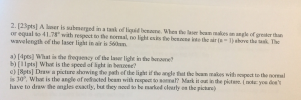 2. [23pts] A laser is submerged in a tank of liquid benzene. When the laser beam makes an angle of greater than wavelength of the laser light in air is 560nm. a) [4pts] What is the frequency of the laser light in the benzene? or equal to 41.78° with respect to the normal, no light exits the benzene into the air (n 1) above the tank. The b) [1 1pts] What is the speed of light in benzene? c) [8pts]...
The drawing shows four different situations in which a light ray is traveling from one medium...
The drawing shows four different situations in which a light ray is traveling from one medium into another. In some of the cases, the refraction is not shown correctly. For cases (a), (b), and (c), the angle of incidence is 42°; for case (d), the angle of incidence is 0°. Determine the angle of refraction in each case. Image won't show up in question so I added the information from it below image a (n1= 1.4, n2= 1.6) image b...
 2 4. A light beam passing from medium 2 to me- dium 1 is refracted as shown in FIGURE Q34.4. Is n, larger than n, is n, smaller than n2, or is there not enough information to tell? Explain. n FIGURE Q34.4
 45° air n=1 glass n=1.5 2 cm 2. A laser beam is incident on a 2 cm thick sheet of glass at an angle of 45° as shown on the right. A. What is the angle of the laser beam inside of the glass? B. What is the angle of the laser beam that emerges into the air after passing through the glass? C. By what horizontal distance has the laser beam traveled when it emerges from the glass? D....
 45° air n=1 glass n=1.5 2 cm 2. A laser beam is incident on a 2 cm thick sheet of glass at an angle of 45° as shown on the right. A. What is the angle of the laser beam inside of the glass? B. What is the angle of the laser beam that emerges into the air after passing through the glass? C. By what horizontal distance has the laser beam traveled when it emerges from the glass? D....
 n1 n2 6. Light rays cross interfaces from medium 1 into medium 2 and then into medium 3. Which of the following is true? n3 A) n1 > n2 and n2 > n3 B) n3 > n2 and n2 > n1 C) n2 > n1 and n2 > n3 D) None of the above
 3. The following figure shows light travelling from medium 1 to medium 2. Please draw the refracted ray for the following two cases: a. Medium 1 has a higher refractive index than medium 2 b. Medium 1 has a lower refractive index than medium 2 c. In which case is it possible to get total internal reflection? d. If the angle of incidence is 37°, the refractive indices of the two mediums are, n = 1.2 and n2 = 1.35,...
 In a laser experiment, a laser beam i of vacuum wavelength has to propagate in air (n1 = 1) through a prism which is anti-reflex (AR) coated to minimize reflections. The prism is made from a glass which has an index of refraction of n3 = 1.3). The thin film is made from a higher index material with an index of n2 = 1.4. The angle of incidence between the laser and the prism is 0 = 30°. Which of...
 2. [23pts] A laser is submerged in a tank of liquid benzene. When the laser beam makes an angle of greater than wavelength of the laser light in air is 560nm. a) [4pts] What is the frequency of the laser light in the benzene? or equal to 41.78° with respect to the normal, no light exits the benzene into the air (n 1) above the tank. The b) [1 1pts] What is the speed of light in benzene? c) [8pts]...
Most questions answered within 3 hours.
-
Where is the error in this code sequence?
String s1 = "Hello";
String s2 = "ello";...
asked 10 months ago -
Financial data for Joel de Paris, Inc., for last year
follow:
Joel de Paris, Inc.
Balance...
asked 10 months ago -
Consider this reaction:
Al2(SO4)3 (aq)+ BaCl3
(aq) Al2Cl6 (aq)- +
3BaSO4(s) . What is the...
asked 10 months ago -
Suppose that Savneet is considering increasing her
recent random sample from 20 car rentals to 40...
asked 10 months ago -
Trucks arrive at an unloading terminal at an average rate of 120
per hour.
Trucks arrive...
asked 10 months ago -
Why are methanol and ethanol completely soluble in water while
octanol is not very little soluble....
asked 10 months ago -
A facilities manager at a university reads in a research report
that the mean amount of...
asked 10 months ago -
When the CuSO4 is rehydrated by adding water to the anhydrous
compound, is this an endothermic...
asked 10 months ago -
A ray of sunlight is passing from diamond into crown glass; the
angle of incidence is...
asked 10 months ago -
A block of mass 0.249 kg is placed on top of a light, vertical
spring of...
asked 10 months ago -
how do the kidneys compensate in the presences of acidosis
a) trigger hyperventilate
b) reserve acid...
asked 10 months ago -
Question 501 pts
The rental rate of capital to the firm increases. Which of the
following...
asked 10 months ago