2. A diploid yeast was ABD on one chromosome and abd on the other. The yeast...
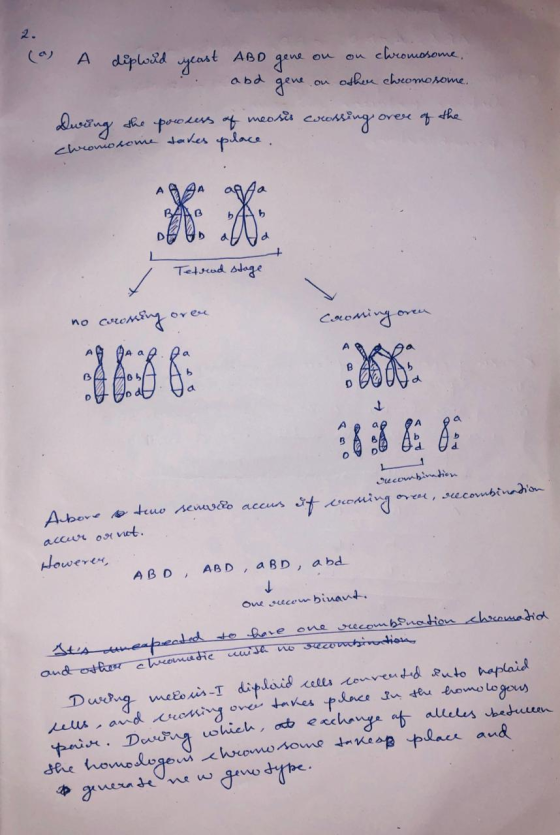
2. A diploid yeast was ABD on one chromosome and abd on the other. The yeast cell underwent meiosis and the four genomes in the resulting tetrad were analyzed and determined to be: ABD, ABD, aBD and abd.
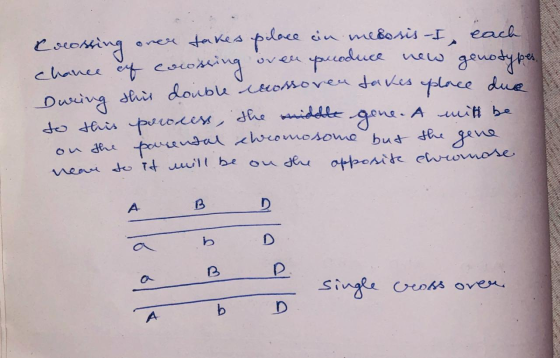
a. For the moment, focus on the outcome regarding the number of B versus b genes? (Ignore D and d.) What is unexpected, regarding the number of gene types in the meiotic cells? Rationalize how this could have happened, assuming that this outcome had something to do with recombination.
b. Is there a second “unexpected” outcome, and, if so, what is it? Assume that this second outcome occurred in a process that was linked to the first outcome, which happened with the B/b gene. Explain how they both might have occurred together
c. What is the name associated with the outcome: ABD/ABD/aBD/abd?
There is a comment regarding needing more knowledge, but I'm not sure what else you would need to answer this question other than a background in genetics.
Homework Answers
Ans
2.(a) recombination between homologous chromosome.
(b) ABd,abD,aBD,aBd,abD

For more knowledge
Add Answer to:
2. A diploid yeast was ABD on one chromosome and abd on the
other. The yeast...
1. The following is a sequence of RNA. Do you expect it to adopt any kind...
 1. The following is a sequence of RNA. Do you expect it to adopt any kind of structure, and, if so, show what the structure would be? 5'-AUACUGCCCCCGGGGGAUGCCCGUAAACCGGGGUUACCCGGUUUAAACGGCCCCCCGGGGGCAGGCG-3'. 2. A dipoid yeast was ABD on one chromosome and abd on the other. The yeast cell underwent meiosis and the four genomes in the resulting tetrad were analyzed and determined to be: ABD, ABD, ABD and abd. a. For the moment, focus on the outcome regarding the number of B versus...
Advanced Genetics Problem: Yeast chromosome 3 has these genes in this order: HIS4 LYS1 URA3 ADE2....
 Advanced Genetics
Problem:
Yeast chromosome 3 has these genes in this order: HIS4 LYS1 URA3
ADE2. You have created a diploid strain of this genotype:
You sporulate the diploid and analyze tetrads. Most tetrads show
2:2 segregation for all markers and recombination frequencies that
are consistent with the established genetic map. However, you
notice the one strange tetrad indicated below:
Your goal is to explain how the genotypes of this tetrad arose
during meiosis:
a. Do these spores indicate that...
Advanced Genetics
Problem:
Yeast chromosome 3 has these genes in this order: HIS4 LYS1 URA3
ADE2. You have created a diploid strain of this genotype:
You sporulate the diploid and analyze tetrads. Most tetrads show
2:2 segregation for all markers and recombination frequencies that
are consistent with the established genetic map. However, you
notice the one strange tetrad indicated below:
Your goal is to explain how the genotypes of this tetrad arose
during meiosis:
a. Do these spores indicate that...
The yeast Saccharomyces cerevisiae can grow as haploid or diploid cells. You have two haploid yeast...
The yeast Saccharomyces cerevisiae can grow as haploid or diploid cells. You have two haploid yeast strains that each carry recessive mutations that affect regulation of the genes required for galactose metabolism. One strain has a deletion of the region of the genome on chromosome II that lies between the GAL1 and GAL10 genes (deltaUAS). The other strain carries a mutant allele of the GAL80 gene on chromosome XIII that produces no functional GAL80 protein. Which of the following correctly...
For the next group of questions consider a diploid cell from a eukaryotic organism with a...
 For the next group of questions consider a diploid cell from a eukaryotic organism with a total of ten chromosomes. After one round of the cell cycle is complete you observe a total of four daughter cells. During this cell division occurred and the resulting daughter cells are. mitosis; haploid with ten total chromosomes each mitosis; diploid with five total chromosomes each meiosis; diploid with ten total chromosomes each meiosis; haploid with five total chromosomes each Before the cell divided,...
1. The following diagram shows the genetic map for a chromosome. A B C D 10cM...
1. The following diagram shows the genetic map for a chromosome. A B C D 10cM 5cM 40cM If a diploid female heterozygous for A and D (A D//a d) is testcrossed to a homozygous recessive male (a d/a d), what percent of the progeny are predicted to have the genotype A d/a d? A. 100 B. 75 C. 50 D. 25 E. Can’t be determined 2. Yellow body (y), vermillion eye color (v) and miniature body (m) are recessive...
Crossing-Over in Meiosis Meiosis is a process of nuclear division that reduces the number of chromosomes...
 Crossing-Over in Meiosis Meiosis is a process of nuclear division that reduces the number of chromosomes in new cells to half the number in the original cell. The parent cell is diploid (2n), and it begins meiosis with a replicated set of chromosomes. During meiosis, this parent cell Homologou will divide twice to create four haploid (1n) cells. pairs During prophase I of meiosis I, homologous pairs of chromosomes pair up and stick together to form tetrads through the process...
Which of the following is TRUE of incomplete penetrance? Select one: a. Epistatic interactions can result...
Which of the following is TRUE of incomplete penetrance? Select one: a. Epistatic interactions can result in incomplete penetrance in some cases. b. Environmental factors do not influence penetrance. c. Incomplete penetrance implies that some individuals will experience less severe forms of disease, such as cancer or Alzheimer's. d. Incomplete penetrance is never observed with Huntington's disease e. Incomplete penetrance refers to cases in which individuals developing a particular disease (e.g., cancer or Alzheimer's) lack the typical genotype for this...
please help and thank you Materials Needed per class: 1 box of 24 microscope slides of...
 please help and thank you
Materials Needed per class: 1 box of 24 microscope slides of meiosis 1 1 box of 24 microscope slides of meiosis 2 red and yellow popbead chromosome kits Objectives To become familiar with the process of meiosis and to be able to identify the principal phases of meiosis To understand how the process of meiosis is similar to mitosis and how it differs from mitosis Introduction The genetic information of a cell is encoded in...
please help and thank you
Materials Needed per class: 1 box of 24 microscope slides of meiosis 1 1 box of 24 microscope slides of meiosis 2 red and yellow popbead chromosome kits Objectives To become familiar with the process of meiosis and to be able to identify the principal phases of meiosis To understand how the process of meiosis is similar to mitosis and how it differs from mitosis Introduction The genetic information of a cell is encoded in...
Can anyone help me with this? Thank you. Lab 13. Mitosis and Meiosis Purpose The purpose...
 Can anyone help me with this? Thank you.
Lab 13. Mitosis and Meiosis Purpose The purpose of this lab is to understand the process of mitosis and melosis in animal and plant cells. Learning Objectives After completing this lab, you will be able to: 1. Describe the stages of mitosis. 2. Identify the stages of mitosis in an onion root or whitefish blastula using a light microscope. 3. Describe how cytokinesis differs in plant vs. animal cells. 4. Name and...
Can anyone help me with this? Thank you.
Lab 13. Mitosis and Meiosis Purpose The purpose of this lab is to understand the process of mitosis and melosis in animal and plant cells. Learning Objectives After completing this lab, you will be able to: 1. Describe the stages of mitosis. 2. Identify the stages of mitosis in an onion root or whitefish blastula using a light microscope. 3. Describe how cytokinesis differs in plant vs. animal cells. 4. Name and...
2. A dominant allele H reduces the number of body bristles that Drosophila flies have, giving...
2. A dominant allele H reduces the number of body bristles that Drosophila flies have, giving rise to a “hairless” phenotype. In the homozygous condition, H is lethal. An independently assorting dominant allele S has no effect on bristle number except in the presence of H, in which case a single dose of S suppresses the hairless phenotype, thus restoring the "hairy" phenotype. However, S also is lethal in the homozygous (S/S) condition. What ratio of hairy to hairless flies...
 1. The following is a sequence of RNA. Do you expect it to adopt any kind of structure, and, if so, show what the structure would be? 5'-AUACUGCCCCCGGGGGAUGCCCGUAAACCGGGGUUACCCGGUUUAAACGGCCCCCCGGGGGCAGGCG-3'. 2. A dipoid yeast was ABD on one chromosome and abd on the other. The yeast cell underwent meiosis and the four genomes in the resulting tetrad were analyzed and determined to be: ABD, ABD, ABD and abd. a. For the moment, focus on the outcome regarding the number of B versus...
 Advanced Genetics
Problem:
Yeast chromosome 3 has these genes in this order: HIS4 LYS1 URA3
ADE2. You have created a diploid strain of this genotype:
You sporulate the diploid and analyze tetrads. Most tetrads show
2:2 segregation for all markers and recombination frequencies that
are consistent with the established genetic map. However, you
notice the one strange tetrad indicated below:
Your goal is to explain how the genotypes of this tetrad arose
during meiosis:
a. Do these spores indicate that...
Advanced Genetics
Problem:
Yeast chromosome 3 has these genes in this order: HIS4 LYS1 URA3
ADE2. You have created a diploid strain of this genotype:
You sporulate the diploid and analyze tetrads. Most tetrads show
2:2 segregation for all markers and recombination frequencies that
are consistent with the established genetic map. However, you
notice the one strange tetrad indicated below:
Your goal is to explain how the genotypes of this tetrad arose
during meiosis:
a. Do these spores indicate that...
 For the next group of questions consider a diploid cell from a eukaryotic organism with a total of ten chromosomes. After one round of the cell cycle is complete you observe a total of four daughter cells. During this cell division occurred and the resulting daughter cells are. mitosis; haploid with ten total chromosomes each mitosis; diploid with five total chromosomes each meiosis; diploid with ten total chromosomes each meiosis; haploid with five total chromosomes each Before the cell divided,...
 Crossing-Over in Meiosis Meiosis is a process of nuclear division that reduces the number of chromosomes in new cells to half the number in the original cell. The parent cell is diploid (2n), and it begins meiosis with a replicated set of chromosomes. During meiosis, this parent cell Homologou will divide twice to create four haploid (1n) cells. pairs During prophase I of meiosis I, homologous pairs of chromosomes pair up and stick together to form tetrads through the process...
 please help and thank you
Materials Needed per class: 1 box of 24 microscope slides of meiosis 1 1 box of 24 microscope slides of meiosis 2 red and yellow popbead chromosome kits Objectives To become familiar with the process of meiosis and to be able to identify the principal phases of meiosis To understand how the process of meiosis is similar to mitosis and how it differs from mitosis Introduction The genetic information of a cell is encoded in...
please help and thank you
Materials Needed per class: 1 box of 24 microscope slides of meiosis 1 1 box of 24 microscope slides of meiosis 2 red and yellow popbead chromosome kits Objectives To become familiar with the process of meiosis and to be able to identify the principal phases of meiosis To understand how the process of meiosis is similar to mitosis and how it differs from mitosis Introduction The genetic information of a cell is encoded in...
 Can anyone help me with this? Thank you.
Lab 13. Mitosis and Meiosis Purpose The purpose of this lab is to understand the process of mitosis and melosis in animal and plant cells. Learning Objectives After completing this lab, you will be able to: 1. Describe the stages of mitosis. 2. Identify the stages of mitosis in an onion root or whitefish blastula using a light microscope. 3. Describe how cytokinesis differs in plant vs. animal cells. 4. Name and...
Can anyone help me with this? Thank you.
Lab 13. Mitosis and Meiosis Purpose The purpose of this lab is to understand the process of mitosis and melosis in animal and plant cells. Learning Objectives After completing this lab, you will be able to: 1. Describe the stages of mitosis. 2. Identify the stages of mitosis in an onion root or whitefish blastula using a light microscope. 3. Describe how cytokinesis differs in plant vs. animal cells. 4. Name and...
Most questions answered within 3 hours.
-
Where is the error in this code sequence?
String s1 = "Hello";
String s2 = "ello";...
asked 11 months ago -
Financial data for Joel de Paris, Inc., for last year
follow:
Joel de Paris, Inc.
Balance...
asked 11 months ago -
Consider this reaction:
Al2(SO4)3 (aq)+ BaCl3
(aq) Al2Cl6 (aq)- +
3BaSO4(s) . What is the...
asked 11 months ago -
Suppose that Savneet is considering increasing her
recent random sample from 20 car rentals to 40...
asked 11 months ago -
Trucks arrive at an unloading terminal at an average rate of 120
per hour.
Trucks arrive...
asked 11 months ago -
Why are methanol and ethanol completely soluble in water while
octanol is not very little soluble....
asked 11 months ago -
A facilities manager at a university reads in a research report
that the mean amount of...
asked 11 months ago -
When the CuSO4 is rehydrated by adding water to the anhydrous
compound, is this an endothermic...
asked 11 months ago -
A ray of sunlight is passing from diamond into crown glass; the
angle of incidence is...
asked 11 months ago -
A block of mass 0.249 kg is placed on top of a light, vertical
spring of...
asked 11 months ago -
how do the kidneys compensate in the presences of acidosis
a) trigger hyperventilate
b) reserve acid...
asked 11 months ago -
Question 501 pts
The rental rate of capital to the firm increases. Which of the
following...
asked 11 months ago