
Homework Answers
Answer 16. :- (d). More than one choice is correct.
Glyceroneogenesis is a metabolic pathway that synthesizes 3-phosphate glycerol, or triglyceride from non-glucose precursors. Usually 3-phosphate glycerol is produced by glycolysis from glucose, but when glucose concentration decreases in the cytosol, it is generated by another pathway called glyceroneogensis. Glycerol may be used as energy source. Unlike glycerol, fatty acids are essential fuel sources, since they contain a large amount of energy. The most important biological function of glycerol, as part of PLs in the cell membrane, is to preserve the physical structure of a cell. The majority of the fats are glycerides, especially triglycerides (glycerol testers). One fatty acid chain is bound to each of the glycerol's three -OH groups by the fatty acid (-COOH) carboxyl end reaction with the alcohol; i.e., three chains per molecule.
Add Answer to:
16. Glycerol can be used to Ca, provide energy to cells 6 b. synthesize glucose c....
Glycerol can be used to 1 provide energy to cells 2. synthesize glucose synthesize fats d....
 Glycerol can be used to 1 provide energy to cells 2. synthesize glucose synthesize fats d. more than one choice is correct Which of the folowing is NOT true about an amino acid that is made from an intermediate of the citric acid cycle? a tis added to the amino acid pool b. it is an essential who acid c. it can leave the cell where it was made d it can be used for protein synthesis To produce 4...
e-coli can synthesize Tryptophan, glucose and lactose for energy is this correct? or are there more
e-coli can synthesize Tryptophan, glucose and lactose for energy is this correct? or are there more
Which of the following is a simple sugar that is a very important source of energy...
 Which of the following is a simple sugar that is a very important source of energy for cells? a. glucose b. cellulose c. starch d. ribose 0. When blood glucose levels decrease (as between meals), what reserves are tapped first? a. glycogen b. fats c. proteins d. steroids e. amino acids 11. Pancreatic cells make insulin, which is a type of protein. the process of_ in order to synthesiz These cells use a. nucleotides, condensation. b. monosaccharides, dehydration synthesis. c....
1Q 5.1 Energy Transformations in Cells The energy released by oxidizing glucose is saved in the...
 1Q 5.1 Energy Transformations in Cells The energy released by oxidizing glucose is saved in the high-energy bonds of: O A ADP and other activated carrier molecules O B ATP and other activated carrier molecules O C GDP and other activated carrier molecules. O D water and carbon dioxide. Unanswered 2 attempts left Assigned as Homework 0 2Q 5.1 Energy Transformations in Cells Sugars (glucose) ingested from food are broken down by O A glycolysis, the citric acid cycle, and...
#83-87 please B p extract CO2 from the atmosphere synthesize macromolecules from monomers The f o...
 #83-87 please
B p extract CO2 from the atmosphere synthesize macromolecules from monomers The f o llar gratis te 4 co Camerot glue E p arhaat describes the synthesis of ATP associated with cler sociated with electron transport B Which of the Allowing synces correctly describe transport chemiosmosis, proton B. NADH, electron transport, proton gradient substrate-level phosphorylation DNADH, electron transport, substrate-level phosphorylation, ATP NADR C NADH, transport prodogradient, dheim N of the above correctly shows the pattern of m y...
#83-87 please
B p extract CO2 from the atmosphere synthesize macromolecules from monomers The f o llar gratis te 4 co Camerot glue E p arhaat describes the synthesis of ATP associated with cler sociated with electron transport B Which of the Allowing synces correctly describe transport chemiosmosis, proton B. NADH, electron transport, proton gradient substrate-level phosphorylation DNADH, electron transport, substrate-level phosphorylation, ATP NADR C NADH, transport prodogradient, dheim N of the above correctly shows the pattern of m y...
1. The energy released by _________ reactions is used to regenerate _______ which can then provide...
1. The energy released by _________ reactions is used to regenerate _______ which can then provide energy for __________ reactions. Multiple Choice anabolic, ATP, catabolic anabolic, NADH, catabolic catabolic, ATP, anabolic catabolic, glucose, anabolic 2. Which of the following would produce the most ATP? Multiple Choice E. coli growing in a sealed glucose broth for 48 hours E. coli growing in a well-aerated glucose broth for 48 hours Both cultures would produce the same amount of ATP. This prediction cannot...
Which precursors can be used to make glucose in gluconeogenesis? amino acids, pyruvate, lactic acid, and...
 Which precursors can be used to make glucose in gluconeogenesis? amino acids, pyruvate, lactic acid, and fatty acids b. amino acids, pyruvate, and fatty acids amino acids, pyruvate, lactic acid, and glycerol d. pyruvate, lactic acid, glycerol, and fatty acids & a. C. is the biosynthetic pathway that assembles glucose into branch chains of 9. glycogen Glycolysis b. Gluconeogenesis Glycogenolysis d. Glycogenesis a. c. 10. Which hormone favors anabolic metabolic pathways? a. insulin b. glucagon c. cortisol d. epinephrine 11....
6. Solution A + 5% Glucose (a penetrating solute) is hyperosmotic to cells. What can you...
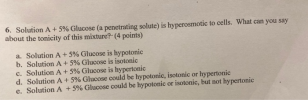 6. Solution A + 5% Glucose (a penetrating solute) is hyperosmotic to cells. What can you say about the tonicity of this mixture?- (4 points) a. Solution A + 5% Glucose is hypotonic b. Solution A + 5% Glucose is isotonic c. Solution A + 5% Glucose is hypertonic d. Solution A + 5% Glucose could be hypotonic, isotonic or hypertonic e. Solution A + 5% Glucose could be hypotonic or isotonic, but not hypertonic
Glucose, C 6 H 12 O 6 , is used as an energy source by the...
Glucose, C 6 H 12 O 6 , is used as an energy source by the human body. The overall reaction in the body is described by the equation C 6 H 12 O 6 ( aq ) + 6 O 2 ( g ) ⟶ 6 CO 2 ( g ) + 6 H 2 O ( l ) Calculate the number of grams of oxygen required to convert 58.0 g of glucose to CO 2 and H 2...
word bank Glucose is a simple sugаr easily used by cells to produce energy. v is...
 word bank
Glucose is a simple sugаr easily used by cells to produce energy. v is the process that breaks the 6 carbon glucose into a three carbon pyruvate. The process takes place in the v. The citric acid cycle uses as a starting point the 2 carbon molecule v that can be obtained from the breakdown of fat, sugars, or proteins. The products of the citric acid cycle include (name one) v which serves as an electron donor for...
word bank
Glucose is a simple sugаr easily used by cells to produce energy. v is the process that breaks the 6 carbon glucose into a three carbon pyruvate. The process takes place in the v. The citric acid cycle uses as a starting point the 2 carbon molecule v that can be obtained from the breakdown of fat, sugars, or proteins. The products of the citric acid cycle include (name one) v which serves as an electron donor for...
 Glycerol can be used to 1 provide energy to cells 2. synthesize glucose synthesize fats d. more than one choice is correct Which of the folowing is NOT true about an amino acid that is made from an intermediate of the citric acid cycle? a tis added to the amino acid pool b. it is an essential who acid c. it can leave the cell where it was made d it can be used for protein synthesis To produce 4...
 Which of the following is a simple sugar that is a very important source of energy for cells? a. glucose b. cellulose c. starch d. ribose 0. When blood glucose levels decrease (as between meals), what reserves are tapped first? a. glycogen b. fats c. proteins d. steroids e. amino acids 11. Pancreatic cells make insulin, which is a type of protein. the process of_ in order to synthesiz These cells use a. nucleotides, condensation. b. monosaccharides, dehydration synthesis. c....
 1Q 5.1 Energy Transformations in Cells The energy released by oxidizing glucose is saved in the high-energy bonds of: O A ADP and other activated carrier molecules O B ATP and other activated carrier molecules O C GDP and other activated carrier molecules. O D water and carbon dioxide. Unanswered 2 attempts left Assigned as Homework 0 2Q 5.1 Energy Transformations in Cells Sugars (glucose) ingested from food are broken down by O A glycolysis, the citric acid cycle, and...
 #83-87 please
B p extract CO2 from the atmosphere synthesize macromolecules from monomers The f o llar gratis te 4 co Camerot glue E p arhaat describes the synthesis of ATP associated with cler sociated with electron transport B Which of the Allowing synces correctly describe transport chemiosmosis, proton B. NADH, electron transport, proton gradient substrate-level phosphorylation DNADH, electron transport, substrate-level phosphorylation, ATP NADR C NADH, transport prodogradient, dheim N of the above correctly shows the pattern of m y...
#83-87 please
B p extract CO2 from the atmosphere synthesize macromolecules from monomers The f o llar gratis te 4 co Camerot glue E p arhaat describes the synthesis of ATP associated with cler sociated with electron transport B Which of the Allowing synces correctly describe transport chemiosmosis, proton B. NADH, electron transport, proton gradient substrate-level phosphorylation DNADH, electron transport, substrate-level phosphorylation, ATP NADR C NADH, transport prodogradient, dheim N of the above correctly shows the pattern of m y...
 Which precursors can be used to make glucose in gluconeogenesis? amino acids, pyruvate, lactic acid, and fatty acids b. amino acids, pyruvate, and fatty acids amino acids, pyruvate, lactic acid, and glycerol d. pyruvate, lactic acid, glycerol, and fatty acids & a. C. is the biosynthetic pathway that assembles glucose into branch chains of 9. glycogen Glycolysis b. Gluconeogenesis Glycogenolysis d. Glycogenesis a. c. 10. Which hormone favors anabolic metabolic pathways? a. insulin b. glucagon c. cortisol d. epinephrine 11....
 6. Solution A + 5% Glucose (a penetrating solute) is hyperosmotic to cells. What can you say about the tonicity of this mixture?- (4 points) a. Solution A + 5% Glucose is hypotonic b. Solution A + 5% Glucose is isotonic c. Solution A + 5% Glucose is hypertonic d. Solution A + 5% Glucose could be hypotonic, isotonic or hypertonic e. Solution A + 5% Glucose could be hypotonic or isotonic, but not hypertonic
 word bank
Glucose is a simple sugаr easily used by cells to produce energy. v is the process that breaks the 6 carbon glucose into a three carbon pyruvate. The process takes place in the v. The citric acid cycle uses as a starting point the 2 carbon molecule v that can be obtained from the breakdown of fat, sugars, or proteins. The products of the citric acid cycle include (name one) v which serves as an electron donor for...
word bank
Glucose is a simple sugаr easily used by cells to produce energy. v is the process that breaks the 6 carbon glucose into a three carbon pyruvate. The process takes place in the v. The citric acid cycle uses as a starting point the 2 carbon molecule v that can be obtained from the breakdown of fat, sugars, or proteins. The products of the citric acid cycle include (name one) v which serves as an electron donor for...
Most questions answered within 3 hours.
-
Where is the error in this code sequence?
String s1 = "Hello";
String s2 = "ello";...
asked 11 months ago -
Financial data for Joel de Paris, Inc., for last year
follow:
Joel de Paris, Inc.
Balance...
asked 11 months ago -
Consider this reaction:
Al2(SO4)3 (aq)+ BaCl3
(aq) Al2Cl6 (aq)- +
3BaSO4(s) . What is the...
asked 11 months ago -
Suppose that Savneet is considering increasing her
recent random sample from 20 car rentals to 40...
asked 11 months ago -
Trucks arrive at an unloading terminal at an average rate of 120
per hour.
Trucks arrive...
asked 11 months ago -
Why are methanol and ethanol completely soluble in water while
octanol is not very little soluble....
asked 11 months ago -
A facilities manager at a university reads in a research report
that the mean amount of...
asked 11 months ago -
When the CuSO4 is rehydrated by adding water to the anhydrous
compound, is this an endothermic...
asked 11 months ago -
A ray of sunlight is passing from diamond into crown glass; the
angle of incidence is...
asked 11 months ago -
A block of mass 0.249 kg is placed on top of a light, vertical
spring of...
asked 11 months ago -
how do the kidneys compensate in the presences of acidosis
a) trigger hyperventilate
b) reserve acid...
asked 11 months ago -
Question 501 pts
The rental rate of capital to the firm increases. Which of the
following...
asked 11 months ago