Homework Answers
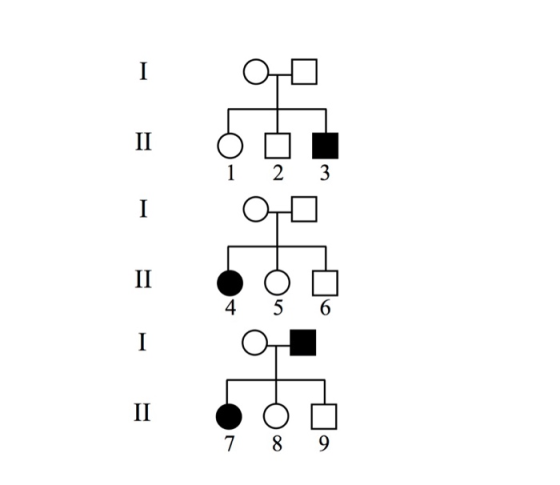
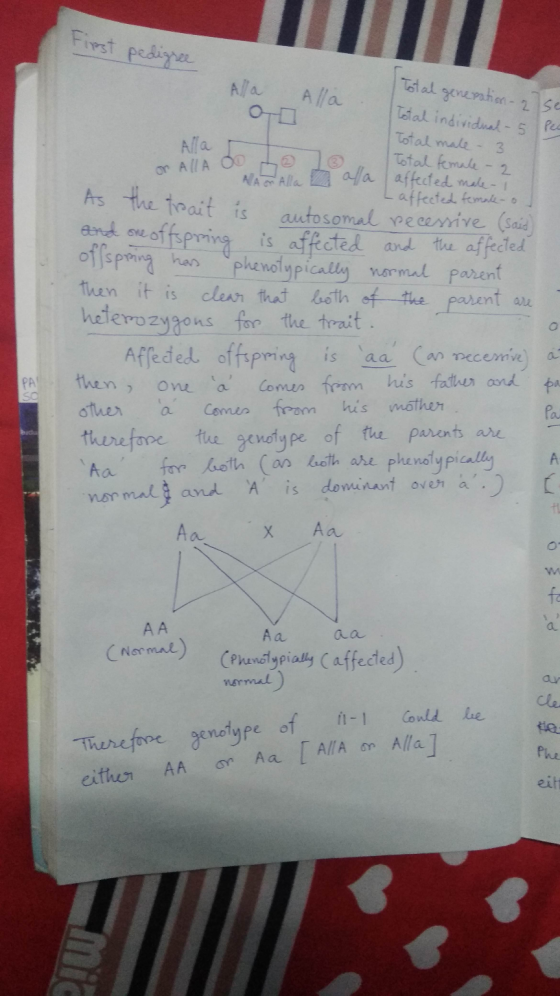
In case of first pedigree
Affected offspring has phenotypically normal parent , hence the parents are heterozygous for that trait ( as the trait is recessive ) . I. e the parents are of A//a genotype and
ii-1 offspring could be either A//A or A//a ( probability of two genotype)
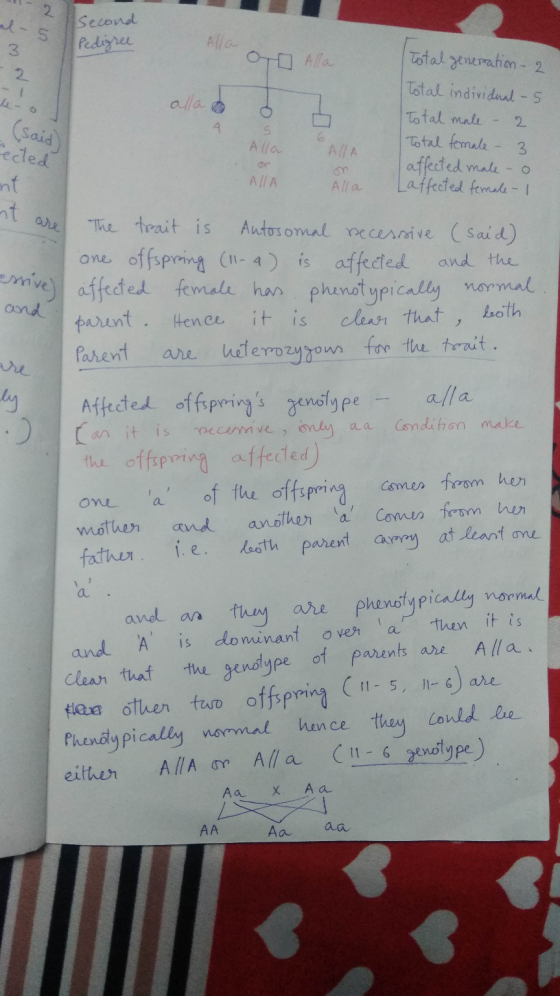
In case of second pedigree
Affected offspring has phenotypically normal parent hence the parents must be heterozygous for the trait i. e A//a therefore
ii-6 has A//a or A//A genotype (probability of two genotype )
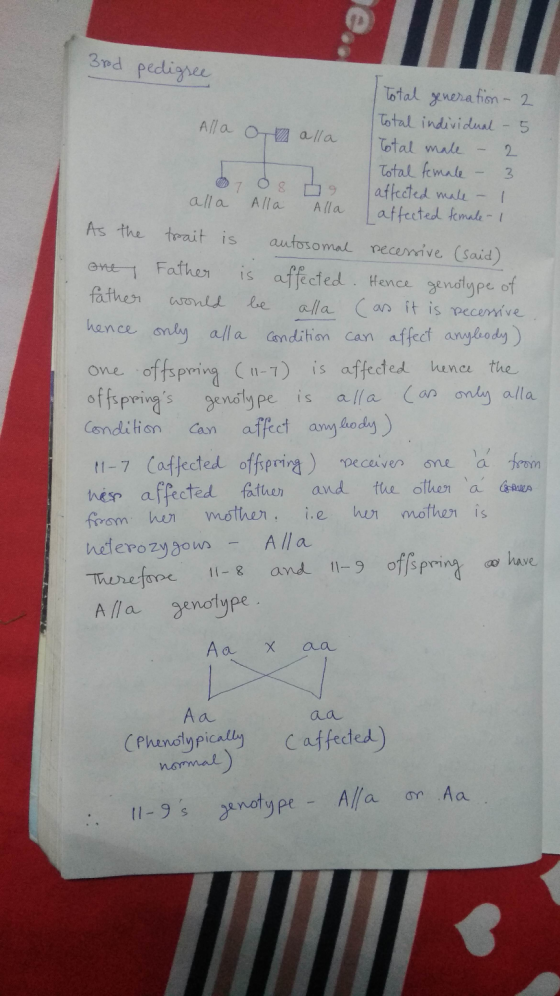
In case of 3rd pedigree father is affected i.e homozygous for recessive allele a//a and one offspring is affected (a//a) therefore mother must be heterozygous i.e A//a hence
ii-9 has A//a heterozygous genotype (probability of only one genotype )
Add Answer to:
If
the pedigree shown is for an autosomal recessive trait, what are
the genotypes of individuals...
For the following pedigree (Pedigree Tree I, used for following questions, too), decide whether a trait...
 For the following pedigree (Pedigree Tree I, used for following questions, too), decide whether a trait is inherited as an autosomal dominant, autosomal recessive, or X-linked recessive. 2 10 11 po og po 0000 TO 1 2 3 4 5 12 13 14 Autosomal dominant Most likely autosomal recessive Most likely X-linked recessive Autosomal recessive X-linked recessive Either autosomal recessive or X-linked recessive QUESTION 4 (Pedigree Tree 1) What is the genotype of Generation individual 12 АА ОАа Оаа Either...
A pedigree affected by a rare human autosomal recessive trait is shown below. ODO What is...
 A pedigree affected by a rare human autosomal recessive trait is shown below. ODO What is the probability that III-2 is a carrier? (enter your answer as a percentage; if the answer is 83% enter 83) Answer:
please show work 4. The pedigree shown at below is for a rare autosomal recessive trait....
 please show work
4. The pedigree shown at below is for a rare autosomal recessive trait. What is the probability that individual 1.2 was heterozygous for this trait? a. 1 b. 1/2 c. 1/4 d. 0 e. cannot determine
please show work
4. The pedigree shown at below is for a rare autosomal recessive trait. What is the probability that individual 1.2 was heterozygous for this trait? a. 1 b. 1/2 c. 1/4 d. 0 e. cannot determine
NAME: 6. Red-green color deficiency is an X-linked recessive trait. A woman with normal color vision...
 NAME: 6. Red-green color deficiency is an X-linked recessive trait. A woman with normal color vision has a father who is color-deficient. The woman has a child with a man with normal color vision. Which phenotype is NOT expected as a possibility for that child? a) a color-deficient male b) a color deficient female c) a male with normal color vision d) a female with normal color vision 7. Which of the individuals in the human pedigree shown below allow...
If the pedigree is for an autosomal recessive characterizing, which individuals are definitely heterozygous?
 If the pedigree is for an autosomal recessive characterizing, which individuals are definitely heterozygous?
What is the mode of inheritance for hypercholesterolemia? a. Autosomal dominant b. Autosomal recessive c. X-linked...
 What is the mode of inheritance for hypercholesterolemia?
a.
Autosomal dominant
b.
Autosomal recessive
c.
X-linked dominant
d.
X-linked recessive
e.
More than one of the above are possible
----------------------------------------------------------------
What is the mode of inheritance for Hunter's syndrome?
a.
Autosomal dominant
b.
Autosomal recessive
c.
X-linked dominant
d.
X-linked recessive
e.
More than one of the above are possible.
------------------------------------------------------------
What is the genotype for individual II-3 at the
hypercholesterolemia locus (dominant allele is denoted by H,
recessive allele...
What is the mode of inheritance for hypercholesterolemia?
a.
Autosomal dominant
b.
Autosomal recessive
c.
X-linked dominant
d.
X-linked recessive
e.
More than one of the above are possible
----------------------------------------------------------------
What is the mode of inheritance for Hunter's syndrome?
a.
Autosomal dominant
b.
Autosomal recessive
c.
X-linked dominant
d.
X-linked recessive
e.
More than one of the above are possible.
------------------------------------------------------------
What is the genotype for individual II-3 at the
hypercholesterolemia locus (dominant allele is denoted by H,
recessive allele...
The conclusions about inheritance (above) can be used to help analyze pedigrees. For each pedigree below,...
 The conclusions about inheritance (above) can be used to help analyze pedigrees. For each pedigree below, tell if the trait can be autosomal dominant, autosomal recessive, and X-linked recessive. If the pedigree cannot fit a mode of inheritance, tell why. Record your answers in the table on the next page. Pedigree A 2 3 o.a. 9 10 12 (13 14 ad ada 15 16 Xx 20 aa ia ha Pedigree B 910 11 12 14 a ta da Enter either...
In the pedigree below, what is the most likely mode of inheritance for this condition?: X-linked...
 In the pedigree below, what is the most likely mode of inheritance for this condition?: X-linked recessive, autosomal dominant, or autosomal recessive? Affected individuals are shown as black symbols. Based on your prediction, give the genotypes of the following individuals: I-1, I-2, II-1, II-3, II-4, III-1, III-2, III-4, IV-2, and IV-3. If you choose autosomal, use A or a; if you choose X-linked, use X^A, X^a, or Y List the proposed genotypes of the designated individuals along the side:
QUESTION 11 For the following pedigree (Pedigree Tree II, used for following questions, too), decide whether...
 QUESTION 11 For the following pedigree (Pedigree Tree II, used for following questions, too), decide whether a trait is inherited as an autosomal dominant, autosomal recessive, or X-linked recessive. - 2 - 모아 고 오오오 아 오 오오 11 12. 13 14 IV 1 2 13 oo Autosomal dominant Most likely autosomal recessive Most likely X-linked recessive Autosomal recessive X-linked recessive Either autosomal or X-linked recessive QUESTION 12 (Pedigree Tree II) Is it possible for the couple (Generation III individual...
In the pedigree below, what is the most likely mode of inheritance for this condition? X-linked...
 In the pedigree below, what is the most likely mode of
inheritance for this condition? X-linked dominant, X-linked
recessive, autosomal dominant, or autosomal recessive? Affected
individuals are shown as black symbols.
Based on your prediction, give the genotypes of the following
individuals: I-1, I-2, II-1, II-3, II-4, III-1, III-2, III-4, IV-2,
and IV-3. If you choose autosomal, use A or a; if you choose
X-linked, use XA, Xa, or Y List the proposed genotypes of the
designated individuals along the...
In the pedigree below, what is the most likely mode of
inheritance for this condition? X-linked dominant, X-linked
recessive, autosomal dominant, or autosomal recessive? Affected
individuals are shown as black symbols.
Based on your prediction, give the genotypes of the following
individuals: I-1, I-2, II-1, II-3, II-4, III-1, III-2, III-4, IV-2,
and IV-3. If you choose autosomal, use A or a; if you choose
X-linked, use XA, Xa, or Y List the proposed genotypes of the
designated individuals along the...
 For the following pedigree (Pedigree Tree I, used for following questions, too), decide whether a trait is inherited as an autosomal dominant, autosomal recessive, or X-linked recessive. 2 10 11 po og po 0000 TO 1 2 3 4 5 12 13 14 Autosomal dominant Most likely autosomal recessive Most likely X-linked recessive Autosomal recessive X-linked recessive Either autosomal recessive or X-linked recessive QUESTION 4 (Pedigree Tree 1) What is the genotype of Generation individual 12 АА ОАа Оаа Either...
 A pedigree affected by a rare human autosomal recessive trait is shown below. ODO What is the probability that III-2 is a carrier? (enter your answer as a percentage; if the answer is 83% enter 83) Answer:
 please show work
4. The pedigree shown at below is for a rare autosomal recessive trait. What is the probability that individual 1.2 was heterozygous for this trait? a. 1 b. 1/2 c. 1/4 d. 0 e. cannot determine
please show work
4. The pedigree shown at below is for a rare autosomal recessive trait. What is the probability that individual 1.2 was heterozygous for this trait? a. 1 b. 1/2 c. 1/4 d. 0 e. cannot determine
 NAME: 6. Red-green color deficiency is an X-linked recessive trait. A woman with normal color vision has a father who is color-deficient. The woman has a child with a man with normal color vision. Which phenotype is NOT expected as a possibility for that child? a) a color-deficient male b) a color deficient female c) a male with normal color vision d) a female with normal color vision 7. Which of the individuals in the human pedigree shown below allow...
 If the pedigree is for an autosomal recessive characterizing, which individuals are definitely heterozygous?
 What is the mode of inheritance for hypercholesterolemia?
a.
Autosomal dominant
b.
Autosomal recessive
c.
X-linked dominant
d.
X-linked recessive
e.
More than one of the above are possible
----------------------------------------------------------------
What is the mode of inheritance for Hunter's syndrome?
a.
Autosomal dominant
b.
Autosomal recessive
c.
X-linked dominant
d.
X-linked recessive
e.
More than one of the above are possible.
------------------------------------------------------------
What is the genotype for individual II-3 at the
hypercholesterolemia locus (dominant allele is denoted by H,
recessive allele...
What is the mode of inheritance for hypercholesterolemia?
a.
Autosomal dominant
b.
Autosomal recessive
c.
X-linked dominant
d.
X-linked recessive
e.
More than one of the above are possible
----------------------------------------------------------------
What is the mode of inheritance for Hunter's syndrome?
a.
Autosomal dominant
b.
Autosomal recessive
c.
X-linked dominant
d.
X-linked recessive
e.
More than one of the above are possible.
------------------------------------------------------------
What is the genotype for individual II-3 at the
hypercholesterolemia locus (dominant allele is denoted by H,
recessive allele...
 The conclusions about inheritance (above) can be used to help analyze pedigrees. For each pedigree below, tell if the trait can be autosomal dominant, autosomal recessive, and X-linked recessive. If the pedigree cannot fit a mode of inheritance, tell why. Record your answers in the table on the next page. Pedigree A 2 3 o.a. 9 10 12 (13 14 ad ada 15 16 Xx 20 aa ia ha Pedigree B 910 11 12 14 a ta da Enter either...
 In the pedigree below, what is the most likely mode of inheritance for this condition?: X-linked recessive, autosomal dominant, or autosomal recessive? Affected individuals are shown as black symbols. Based on your prediction, give the genotypes of the following individuals: I-1, I-2, II-1, II-3, II-4, III-1, III-2, III-4, IV-2, and IV-3. If you choose autosomal, use A or a; if you choose X-linked, use X^A, X^a, or Y List the proposed genotypes of the designated individuals along the side:
 QUESTION 11 For the following pedigree (Pedigree Tree II, used for following questions, too), decide whether a trait is inherited as an autosomal dominant, autosomal recessive, or X-linked recessive. - 2 - 모아 고 오오오 아 오 오오 11 12. 13 14 IV 1 2 13 oo Autosomal dominant Most likely autosomal recessive Most likely X-linked recessive Autosomal recessive X-linked recessive Either autosomal or X-linked recessive QUESTION 12 (Pedigree Tree II) Is it possible for the couple (Generation III individual...
 In the pedigree below, what is the most likely mode of
inheritance for this condition? X-linked dominant, X-linked
recessive, autosomal dominant, or autosomal recessive? Affected
individuals are shown as black symbols.
Based on your prediction, give the genotypes of the following
individuals: I-1, I-2, II-1, II-3, II-4, III-1, III-2, III-4, IV-2,
and IV-3. If you choose autosomal, use A or a; if you choose
X-linked, use XA, Xa, or Y List the proposed genotypes of the
designated individuals along the...
In the pedigree below, what is the most likely mode of
inheritance for this condition? X-linked dominant, X-linked
recessive, autosomal dominant, or autosomal recessive? Affected
individuals are shown as black symbols.
Based on your prediction, give the genotypes of the following
individuals: I-1, I-2, II-1, II-3, II-4, III-1, III-2, III-4, IV-2,
and IV-3. If you choose autosomal, use A or a; if you choose
X-linked, use XA, Xa, or Y List the proposed genotypes of the
designated individuals along the...
Most questions answered within 3 hours.
-
Where is the error in this code sequence?
String s1 = "Hello";
String s2 = "ello";...
asked 10 months ago -
Financial data for Joel de Paris, Inc., for last year
follow:
Joel de Paris, Inc.
Balance...
asked 10 months ago -
Consider this reaction:
Al2(SO4)3 (aq)+ BaCl3
(aq) Al2Cl6 (aq)- +
3BaSO4(s) . What is the...
asked 10 months ago -
Suppose that Savneet is considering increasing her
recent random sample from 20 car rentals to 40...
asked 10 months ago -
Trucks arrive at an unloading terminal at an average rate of 120
per hour.
Trucks arrive...
asked 10 months ago -
Why are methanol and ethanol completely soluble in water while
octanol is not very little soluble....
asked 10 months ago -
A facilities manager at a university reads in a research report
that the mean amount of...
asked 10 months ago -
When the CuSO4 is rehydrated by adding water to the anhydrous
compound, is this an endothermic...
asked 10 months ago -
A ray of sunlight is passing from diamond into crown glass; the
angle of incidence is...
asked 10 months ago -
A block of mass 0.249 kg is placed on top of a light, vertical
spring of...
asked 10 months ago -
how do the kidneys compensate in the presences of acidosis
a) trigger hyperventilate
b) reserve acid...
asked 10 months ago -
Question 501 pts
The rental rate of capital to the firm increases. Which of the
following...
asked 10 months ago