
Homework Answers
Add Answer to:
QUESTION 2 Hershey and Chase carried out an experiment to follow the movement of the bacteriophage...
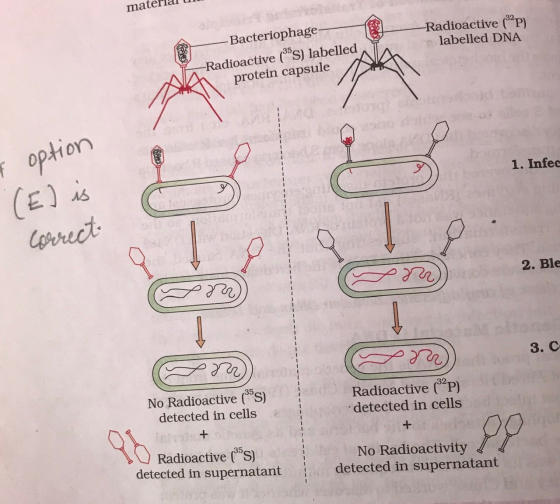
The Hershey Chase experiment using radioactively labeled bacteriophage to infect bacteria proved that DNA was the...
The Hershey Chase experiment using radioactively labeled bacteriophage to infect bacteria proved that DNA was the genetic material. If you were reviewing those experimental results, which of the following would provide evidence that DNA was the genetic material? Select all that would apply. a) The DNA was localized in the cytoplasm of the bacterial cell, which is the same site that the bacterial chromosome is located. b) Radioactively labeled viral proteins were only found outside the cell and the viral...
The Hershey - Chase experiment provided strong evidence for which of the following? DNA is composed...
The Hershey - Chase experiment provided strong evidence for which of the following? DNA is composed of four different nitrogenous bases. Genetic trait can be transferred between different bacterial strains. Nucleic acids are the hereditary material of viruses. Proteins are the hereditary material of viruses.
Hershey and Chase used phages to show that DNA was the genetic information. When they labeled...
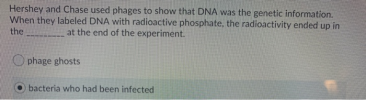 Hershey and Chase used phages to show that DNA was the genetic information. When they labeled DNA with radioactive phosphate, the radioactivity ended up in them at the end of the experiment. phage ghosts O bacteria who had been infected
Imagine that you repeat the Hershey and Chase experiment but use radioactive Carbon instead of Sulfur...
 Imagine that you repeat the Hershey and Chase experiment but use radioactive Carbon instead of Sulfur or Phosphorous. What statements below will be true for this experimental setting? Select one: a. The macromolecule responsible of genetic transmission could NOT be identified by this experiment O b. None of the listed statements are appropriate conclusions for this experimental setting c. Based on this experimental setting, it can be concluded that Protein, and not DNA, is the macromolecule responsible of genetic transmission....
Book: ESSENTIAL BIOLOGY - Chapter 10 question; In a classic 1952 experiment, biologist Alfred Hershey and...
Book: ESSENTIAL BIOLOGY - Chapter 10 question; In a classic 1952 experiment, biologist Alfred Hershey and Martha Chase labeled two batches of bacteriophage one with radioactive sulfur ( which only tags protein) and the other with radioactive phosphorus ( which only tags DNA). In separate test tubes, they allowed each batch of phage to bind to nonradioactive bacteria and inject its DNA. After a few minutes, they separated the bacterial cells from the viral parts that remained outside the bacterial...
Question 23 Not yet answered Imagine that you repeat the Hershey and Chase experiment but use...
 Question 23 Not yet answered Imagine that you repeat the Hershey and Chase experiment but use radioactive Carbon instead of Sulfur or Phosphorous. What statements below will be true for this experimental setting? Points out of 2.50 P Flag question Select one: a. None of the listed statements are appropriate conclusions for this experimental setting O b. The radioactive carbon would NOT be found neither in the supernatant or the bacterial pellet O c. The macromolecule responsible of genetic transmission...
Need help with number 1,5,6,7 and 8 please Restriction enzymes are a.) bacterial enzymes that elongate...
 Need help with number 1,5,6,7 and 8 please
Restriction enzymes are a.) bacterial enzymes that elongate DNA b.) viral enzymes that destroy host DNA c.) bacterial enzymes that destroy incoming foreign DNA d.) animal enzymes that splice RNA Mice that are injected with only the R strain of Streptococcus pneumoniae a.) become sick and then recover b.) stay healthy, this is a non-virulent strain c.) are killed, this is the virulent strain Mice that are injected with only the S...
Need help with number 1,5,6,7 and 8 please
Restriction enzymes are a.) bacterial enzymes that elongate DNA b.) viral enzymes that destroy host DNA c.) bacterial enzymes that destroy incoming foreign DNA d.) animal enzymes that splice RNA Mice that are injected with only the R strain of Streptococcus pneumoniae a.) become sick and then recover b.) stay healthy, this is a non-virulent strain c.) are killed, this is the virulent strain Mice that are injected with only the S...
Name: Date: Section: Biology 190: Introduction to Cdl and Molecular Biolog Reading guide # 16 Ch.-DNA...
 Name: Date: Section: Biology 190: Introduction to Cdl and Molecular Biolog Reading guide # 16 Ch.-DNA Structure & Replication Read p. 257-273 from Cha dar the following question Prior to Watson and Crick's deduction of DNA structure, the parad that protein and not DNA was the molecule that was the likely genetic mate candidate at the time? on of DNA structure, the paradigm among the scientific community was Necule that was the likely genetic material. Why was protein a stronger...
Match each definition in Column A with a term in Column B. Some terms may be...
 Match each definition in Column A with a term in Column B. Some terms may be used more than once or not at all. Column A ______ 1. Process by which a cell breaks apart ______ 2. Process by which a virus carries DNA from one bacterium to another ______ 3. A sexual reproduction process that occurs in some types of bacteria _________ 4. Organisms that get nourishment from dead organic matter __________ 5. Rod-shaped bacteria _________ 6. Organisms that...
Question 1a Frederick Griffith is known for a classic experiment carried out in 1928. He identified...
Question 1a Frederick Griffith is known for a classic experiment carried out in 1928. He identified the action of a hereditary biomolecule when he observed... a. isolation of pure DNA molecules from a bacterial cell using detergents and alcohol to spool out a long mucus-like mass. b. a phenotypic change, a transformation, of a bacteria that formed a rough colony (R strain) into bacteria that formed a smooth colony (S strain) when the R strain was exposed to dead S...
 Hershey and Chase used phages to show that DNA was the genetic information. When they labeled DNA with radioactive phosphate, the radioactivity ended up in them at the end of the experiment. phage ghosts O bacteria who had been infected
 Imagine that you repeat the Hershey and Chase experiment but use radioactive Carbon instead of Sulfur or Phosphorous. What statements below will be true for this experimental setting? Select one: a. The macromolecule responsible of genetic transmission could NOT be identified by this experiment O b. None of the listed statements are appropriate conclusions for this experimental setting c. Based on this experimental setting, it can be concluded that Protein, and not DNA, is the macromolecule responsible of genetic transmission....
 Question 23 Not yet answered Imagine that you repeat the Hershey and Chase experiment but use radioactive Carbon instead of Sulfur or Phosphorous. What statements below will be true for this experimental setting? Points out of 2.50 P Flag question Select one: a. None of the listed statements are appropriate conclusions for this experimental setting O b. The radioactive carbon would NOT be found neither in the supernatant or the bacterial pellet O c. The macromolecule responsible of genetic transmission...
 Need help with number 1,5,6,7 and 8 please
Restriction enzymes are a.) bacterial enzymes that elongate DNA b.) viral enzymes that destroy host DNA c.) bacterial enzymes that destroy incoming foreign DNA d.) animal enzymes that splice RNA Mice that are injected with only the R strain of Streptococcus pneumoniae a.) become sick and then recover b.) stay healthy, this is a non-virulent strain c.) are killed, this is the virulent strain Mice that are injected with only the S...
Need help with number 1,5,6,7 and 8 please
Restriction enzymes are a.) bacterial enzymes that elongate DNA b.) viral enzymes that destroy host DNA c.) bacterial enzymes that destroy incoming foreign DNA d.) animal enzymes that splice RNA Mice that are injected with only the R strain of Streptococcus pneumoniae a.) become sick and then recover b.) stay healthy, this is a non-virulent strain c.) are killed, this is the virulent strain Mice that are injected with only the S...
 Name: Date: Section: Biology 190: Introduction to Cdl and Molecular Biolog Reading guide # 16 Ch.-DNA Structure & Replication Read p. 257-273 from Cha dar the following question Prior to Watson and Crick's deduction of DNA structure, the parad that protein and not DNA was the molecule that was the likely genetic mate candidate at the time? on of DNA structure, the paradigm among the scientific community was Necule that was the likely genetic material. Why was protein a stronger...
 Match each definition in Column A with a term in Column B. Some terms may be used more than once or not at all. Column A ______ 1. Process by which a cell breaks apart ______ 2. Process by which a virus carries DNA from one bacterium to another ______ 3. A sexual reproduction process that occurs in some types of bacteria _________ 4. Organisms that get nourishment from dead organic matter __________ 5. Rod-shaped bacteria _________ 6. Organisms that...
Most questions answered within 3 hours.
-
Where is the error in this code sequence?
String s1 = "Hello";
String s2 = "ello";...
asked 10 months ago -
Financial data for Joel de Paris, Inc., for last year
follow:
Joel de Paris, Inc.
Balance...
asked 10 months ago -
Consider this reaction:
Al2(SO4)3 (aq)+ BaCl3
(aq) Al2Cl6 (aq)- +
3BaSO4(s) . What is the...
asked 10 months ago -
Suppose that Savneet is considering increasing her
recent random sample from 20 car rentals to 40...
asked 10 months ago -
Trucks arrive at an unloading terminal at an average rate of 120
per hour.
Trucks arrive...
asked 10 months ago -
Why are methanol and ethanol completely soluble in water while
octanol is not very little soluble....
asked 10 months ago -
A facilities manager at a university reads in a research report
that the mean amount of...
asked 10 months ago -
When the CuSO4 is rehydrated by adding water to the anhydrous
compound, is this an endothermic...
asked 10 months ago -
A ray of sunlight is passing from diamond into crown glass; the
angle of incidence is...
asked 10 months ago -
A block of mass 0.249 kg is placed on top of a light, vertical
spring of...
asked 10 months ago -
how do the kidneys compensate in the presences of acidosis
a) trigger hyperventilate
b) reserve acid...
asked 10 months ago -
Question 501 pts
The rental rate of capital to the firm increases. Which of the
following...
asked 10 months ago