In a study relating college grade point average to time spent in various activities, you distribute a survey to several students.
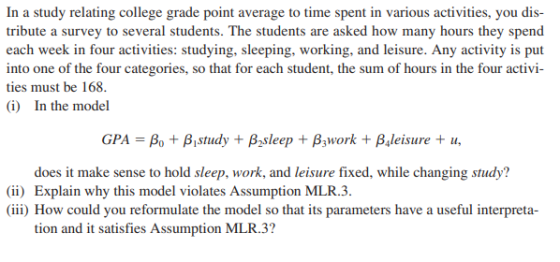
In a study relating college grade point average to time spent in various activities, you distribute a survey to several students. The students are asked how many hours they spend each week in four activities: studying, sleeping, working, and leisure. Any activity is put into one of the four categories, so that for each student, the sum of hours in the four activities must be 168
Homework Answers
i.)
No. By definition, study \(+\) sleep \(+\) work \(+\) leisure \(=168 .\) Therefore, if we change study, we must change at least one of the other categories so that the sum is still 168.
ii.)
From part (i), we can write, say, study as a perfect linear function of the other
independent variables: \(\quad\) study \(=168-\) sleep \(-\) work \(-\) leisure, This holds for every
observation, so MLR. 3 violated
iii.)
Simply drop one of the independent variables, say leisure:
$$ G P A=\beta_{0}+\beta_{1} \text { study }+\beta_{2} \text { sleep }+\beta_{3} \text { work }+\mathrm{ei} $$
Now, for example, \(\beta_{1}\) is interpreted as the change in \(G P A\) when study increases by
one hour, where sleep, work, and \(u\) are all held fixed. If we are holding sleep and work fixed but increasing study by one hour, then we must be reducing leisure by one
hour. The other slope parameters have a similar interpretation.
Add Answer to:
In a study relating college grade point average to time spent in various activities, you distribute a survey to several students.
2. . In a study relating college grade point average (GPA) to time spent in various...
 2. . In a study relating college grade point average (GPA) to time spent in various activities, you distribute a survey to several students. The students are asked how many hours they spend each week in four activities: studying, sleeping, working, and leisure. Any activity is put into one of the four categories, so that for each student, the sum of hours in the four activities must be 168. Based on the study, you set an econometric model: GPA P+study+B,sleep+,work+B,leisure+...
1. To determine the average number of hours spent studying by college students per week, a...
1. To determine the average number of hours spent studying by college students per week, a sample of 39 students was randomly selected, and found to spend an average of 17.1 hours per week, with a standard deviation of 4.3 hours. Find the 90% confidence interval for the mean number of hours spent studying per week by all college students. What is the upper and lower bound? 2. If I asked a random student how many hours they study per...
A recent survey asked college students how much time they spend studying each week. The results...
 A recent survey asked college students how much time they spend studying each week. The results showed a mean of 10 hours with a standard deviation of 2 hours. Complete parts (a) through (c) below. (a) Find the probability that a randomly selected student would spend less than 7 hours studying per week. O A. 0.933 OB. 0.500 OC. 0.067 OD. 0.333 (b) What percent of students spend more than 12 hours studying per wook? O A. 80.0% OB. 15.9%...
A student at a junior college conducted a survey of 20 randomly selected full-time students to...
A student at a junior college conducted a survey of 20 randomly selected full-time students to determine the relation between the number of hours of video game playing each week, x, and grade-point average, y. She found that a linear relation exists between the two variables. The least-squares regression line that describes this relation is y = -0.0516x + 2.9389 (a) Predict the grade-point average of a student who plays video games 8 hours per week. The predicted grade-point average...
A student at a junior college conducted a survey of 20 randomly selected full-time students to...
 A student at a junior college conducted a survey of 20 randomly selected full-time students to determine the relation between the number of hours of video game playing each week, x, and grade-point average, y. She found that a linear relation exists between the two variables. The least squares regression line that describes this relation is ģ= -0.0564x + 2 9482 (a) Predict the grade-point average of a student who plays video games 8 hours per week. The predicted grade...
Dean Halverson recently read that full-time college students study 20 hours each week. She decides to...
Dean Halverson recently read that full-time college students study 20 hours each week. She decides to do a study at her university to see if there is evidence that students study an average of more than 20 hours each week. A random sample of 30 students were asked to keep a diary of their activities over a period of several weeks. It was found that the average number of hours that the 30 students studied each week was 21.6 hours....
Dean Halverson recently read that full-time college students study 20 hours each week. She decides to...
Dean Halverson recently read that full-time college students study 20 hours each week. She decides to do a study at her university to see if there is evidence that students study an average of more than 20 hours each week. A random sample of 34 students were asked to keep a diary of their activities over a period of several weeks. It was found that the average number of hours that the 34 students studied each week was 21.5 hours....
Dean Halverson recently read that full-time college students study 20 hours each week. She decides to...
Dean Halverson recently read that full-time college students study 20 hours each week. She decides to do a study at her university to see if there is evidence that students study an average of more than 20 hours each week. A random sample of 35 students were asked to keep a diary of their activities over a period of several weeks. It was found that the average number of hours that the 35 students studied each week was 21.1 hours....
Dean Halverson recently read that full-time college students study 20 hours each week. She decides to...
Dean Halverson recently read that full-time college students study 20 hours each week. She decides to do a study at her university to see if there is evidence that students study an average of more than 20 hours each week. A random sample of 31 students were asked to keep a diary of their activities over a period of several weeks. It was found that the average number of hours that the 31 students studied each week was 22.4 hours....
Dean Halverson recently read that full-time college students study 20 hours each week. She decides to...
Dean Halverson recently read that full-time college students study 20 hours each week. She decides to do a study at her university to see if there is evidence that students study an average of less than 20 hours each week. A random sample of 33 students were asked to keep a diary of their activities over a period of several weeks. It was found that he average number of hours that the 33 students studied each week was 17.7 hours....
 2. . In a study relating college grade point average (GPA) to time spent in various activities, you distribute a survey to several students. The students are asked how many hours they spend each week in four activities: studying, sleeping, working, and leisure. Any activity is put into one of the four categories, so that for each student, the sum of hours in the four activities must be 168. Based on the study, you set an econometric model: GPA P+study+B,sleep+,work+B,leisure+...
 A recent survey asked college students how much time they spend studying each week. The results showed a mean of 10 hours with a standard deviation of 2 hours. Complete parts (a) through (c) below. (a) Find the probability that a randomly selected student would spend less than 7 hours studying per week. O A. 0.933 OB. 0.500 OC. 0.067 OD. 0.333 (b) What percent of students spend more than 12 hours studying per wook? O A. 80.0% OB. 15.9%...
 A student at a junior college conducted a survey of 20 randomly selected full-time students to determine the relation between the number of hours of video game playing each week, x, and grade-point average, y. She found that a linear relation exists between the two variables. The least squares regression line that describes this relation is ģ= -0.0564x + 2 9482 (a) Predict the grade-point average of a student who plays video games 8 hours per week. The predicted grade...
Most questions answered within 3 hours.
-
Where is the error in this code sequence?
String s1 = "Hello";
String s2 = "ello";...
asked 10 months ago -
Financial data for Joel de Paris, Inc., for last year
follow:
Joel de Paris, Inc.
Balance...
asked 10 months ago -
Consider this reaction:
Al2(SO4)3 (aq)+ BaCl3
(aq) Al2Cl6 (aq)- +
3BaSO4(s) . What is the...
asked 10 months ago -
Suppose that Savneet is considering increasing her
recent random sample from 20 car rentals to 40...
asked 10 months ago -
Trucks arrive at an unloading terminal at an average rate of 120
per hour.
Trucks arrive...
asked 10 months ago -
Why are methanol and ethanol completely soluble in water while
octanol is not very little soluble....
asked 10 months ago -
A facilities manager at a university reads in a research report
that the mean amount of...
asked 10 months ago -
When the CuSO4 is rehydrated by adding water to the anhydrous
compound, is this an endothermic...
asked 10 months ago -
A ray of sunlight is passing from diamond into crown glass; the
angle of incidence is...
asked 10 months ago -
A block of mass 0.249 kg is placed on top of a light, vertical
spring of...
asked 10 months ago -
how do the kidneys compensate in the presences of acidosis
a) trigger hyperventilate
b) reserve acid...
asked 10 months ago -
Question 501 pts
The rental rate of capital to the firm increases. Which of the
following...
asked 10 months ago