PLEASE SHOW CALCULATIONS, Calculate the amount of ATP produced
from glucose fully converted to CO2 by a:]
Homework Answers
 this is entner doudoroff
pathway....
this is entner doudoroff
pathway....
 this is via glycolysis pathway
...
this is via glycolysis pathway
...
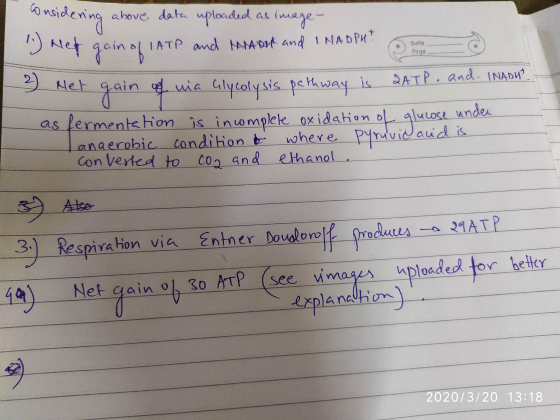
Answer 5.) ED pathway is amongst Campylobacter isolates causing human disease (the majority of which would be of agricultural origin), some glucose-utilizing isolates exhibit specific fitness advantages, including stationary-phase survival and biofilm production, highlighting key physiological benefits of this pathway in addition to energy conservation.
Add Answer to:
PLEASE SHOW CALCULATIONS, Calculate the amount of ATP produced
from glucose fully converted to CO2 by...
Do expect the cell to produce more ATP from one glucose molecule or from one fatty...
 Do expect the cell to produce more ATP from one glucose molecule or from one fatty acid molecule? Explain your answer. Indicate whether the following statements are true or false. If a statement is false, explain why it is false The proteins of the electron-transport chain remove a pair of high-energy electrons from the cofactors, NADH and FADH_2, after which the electrons move across the inner mitochondrial membrane to maintain the voltage gradient. Gluconeogenesis is a linear reaction pathway that...
Part A Explain why glucose consumption must increase in hypoxic tissues to provide the same amount...
 Part A Explain why glucose consumption must increase in hypoxic tissues to provide the same amount of ATP that could be produced from glucose in normoxic (normal O, levels) tissues. et the eprivation mple, in for over reased the tect Jucible factor glycolytic alytic e starved reasing Bases. In hypox tissues, in contrast to normoxic tissues, ATP is additionally consumed to transform lactate to pyruvate Additional glucose is consumed by hipoxic tissues to be metabolized through the glyoxylate pathway In...
Metabolic Pathway Engineering Problem Set 5 Engineering a Fermentation System: Fermentation of plant matter to produce...
Metabolic Pathway Engineering Problem Set 5 Engineering a Fermentation System: Fermentation of plant matter to produce ethanol for fuel is one potential method for reducing the use of fossil fuels and thus the CO2 emissions that lead to global warming. Many microorganisms can break down cellulose then ferment the glucose to ethanol. However, many potential cellulose sources, including agricultural residues and switchgrass, also contain substantial amounts of arabinose, which is not as easily fermented. Escherichia coli is capable of fermenting...
Question 4: (1 point) Name one enzyme you would introduce into Z. mobilis to decrease the...
 Question 4: (1 point) Name one enzyme you would introduce into Z. mobilis to decrease the flux through its ethanol-producing pathway. ΕιΠαΠΠΙΠΟΠΠΕΠιαιιυιυιιιΙο Πυνο Thomas W Jeffries The complete genome sequence of the ethanol-producing bacterium Zymomonas mobilis provides new opportunities for industrial alcohol fermentation. HO D 2016- -glucose 2 Ethanol HC OH YOH 2 NAD 2002 ATP:D-glucose 6-phosphotransferase 2 NADH+H B-o-glucose-6P HC Pyruvato OH Pyruvate TOH NADH+H 2 ATP NADP npg © 2005 Nature Publishing Group http://www.nature.com/naturebiotechnology B-o-glucose-6-phosphate: NADP. 1-oxoreductaso 2...
2) Calculations to determine the amount of CO2(g) produced in the Baking Soda-Vinegar reaction Starting Material:...
2) Calculations to determine the amount of CO2(g) produced in the Baking Soda-Vinegar reaction Starting Material: 40 ml Vinegar - SpecificGrav (CH3COOH) = 1.05 & vol%(CH3COOH) = 5 vol% a) Calculate the stoichiometric amount (moles and grams) of sodium bicarbonate needed. [CH3COOH(aq.) + H2O(l)]+ NaHCO3(s) --> H2O(l) +CO2(g) + NaCH3COO(aq.) c) Given that 1 mol of an ideal gas at standard temperature and pressure occupies 22.4 L, calculate the Ideal Gas Constant (R) in units of liter-atm/mol-K. NOTE: Remember R is...
Short answer questions, answer on blank paper. These questions cannot be answered without work, you must...
 Short answer questions, answer on blank paper. These questions cannot be answered without work, you must show all work for full credit. 1. (8 points) Given the following metabolic pathway of aspartate to pyruvate, all of which occurs in the cytosol thus requiring transport of electrons into the mitochondria, calculate the number of ATP that can produced from the complete cxcidation of aspartate in the muscle aspartate oxaloacetate m NAD NADH NADH NAD alate Pyruvate NAD NADH 2. (7 points)...
1. which of the following are produced during the light reactions of photosynthesis? a) ADP,NADP+,O2 b)glucose,...
1. which of the following are produced during the light reactions of photosynthesis? a) ADP,NADP+,O2 b)glucose, ADP,NAD+ c)ATP,NADPH,CO2 d)glucose,ADP,NADP+,CO2 e)ATP,NADPH,O3 2. Which type of light energy is not used by plants during photosynthesis? a)blue b)yellow c)violet d)red E)none of the above=identofy 3. Photosystem II a)does not have a reaction center b)is reduced by NADPH c)passes electrons to photosystem I d)has P700 at its reaction e)all the choices are correct 4. The photolysis of water a)combines with carbon dioxide b)produces NADPH...
During the aerobic metabolism of glucose, glucose is ____________. Reduced to form water Oxidized to form...
During the aerobic metabolism of glucose, glucose is ____________. Reduced to form water Oxidized to form water Reduced to form CO2 Oxidized to form CO2 Which of the following describes the equation: FAD + XH2 à FADH2 + X. FAD is reduced to FADH2 It is a coupled reduction – oxidation reaction XH2 is oxidized to X All of the above Which of the following is FALSE about glycolysis? The initial steps of glycolysis requires energy derived from the splitting...
shadi cH (4) [ Glucose typically starts with this molecule I Glycolysis CELLULAR RESPIRATION Takes place...
 shadi cH (4) [ Glucose typically starts with this molecule I Glycolysis CELLULAR RESPIRATION Takes place in Takes place transition step Involver is an (a) anaerobic Cyoplovo process produces Takes place in extend the solid line below to the same term found elsewhere process as the final electron acceptor via the process of may be converted to hint: we feel the burn from this acid when we exercise vigorously Cellular Respiration Concept Map Directions: 1. You must cut out and...
Please answer ALL of the questions below! They are all on the same page and related!...
 Please answer ALL of the questions below! They are all on the
same page and related!
I will rate the answer immediately after getting the answer!
Thank you! 7
In the reaction, 6CO2 + 6H20 --C6H12O6 + 602, carbon dioxide is being — oxidized Ophosphorylated hydrolyzed reduced condensed Which portion of the photosynthetic apparatus absorbs light? O NADP reductase O photosystem 1 both photosystem I and NADP reductase O photosystem II both photosystem I and photosystem II The image here...
Please answer ALL of the questions below! They are all on the
same page and related!
I will rate the answer immediately after getting the answer!
Thank you! 7
In the reaction, 6CO2 + 6H20 --C6H12O6 + 602, carbon dioxide is being — oxidized Ophosphorylated hydrolyzed reduced condensed Which portion of the photosynthetic apparatus absorbs light? O NADP reductase O photosystem 1 both photosystem I and NADP reductase O photosystem II both photosystem I and photosystem II The image here...
 Do expect the cell to produce more ATP from one glucose molecule or from one fatty acid molecule? Explain your answer. Indicate whether the following statements are true or false. If a statement is false, explain why it is false The proteins of the electron-transport chain remove a pair of high-energy electrons from the cofactors, NADH and FADH_2, after which the electrons move across the inner mitochondrial membrane to maintain the voltage gradient. Gluconeogenesis is a linear reaction pathway that...
 Part A Explain why glucose consumption must increase in hypoxic tissues to provide the same amount of ATP that could be produced from glucose in normoxic (normal O, levels) tissues. et the eprivation mple, in for over reased the tect Jucible factor glycolytic alytic e starved reasing Bases. In hypox tissues, in contrast to normoxic tissues, ATP is additionally consumed to transform lactate to pyruvate Additional glucose is consumed by hipoxic tissues to be metabolized through the glyoxylate pathway In...
 Question 4: (1 point) Name one enzyme you would introduce into Z. mobilis to decrease the flux through its ethanol-producing pathway. ΕιΠαΠΠΙΠΟΠΠΕΠιαιιυιυιιιΙο Πυνο Thomas W Jeffries The complete genome sequence of the ethanol-producing bacterium Zymomonas mobilis provides new opportunities for industrial alcohol fermentation. HO D 2016- -glucose 2 Ethanol HC OH YOH 2 NAD 2002 ATP:D-glucose 6-phosphotransferase 2 NADH+H B-o-glucose-6P HC Pyruvato OH Pyruvate TOH NADH+H 2 ATP NADP npg © 2005 Nature Publishing Group http://www.nature.com/naturebiotechnology B-o-glucose-6-phosphate: NADP. 1-oxoreductaso 2...
 Short answer questions, answer on blank paper. These questions cannot be answered without work, you must show all work for full credit. 1. (8 points) Given the following metabolic pathway of aspartate to pyruvate, all of which occurs in the cytosol thus requiring transport of electrons into the mitochondria, calculate the number of ATP that can produced from the complete cxcidation of aspartate in the muscle aspartate oxaloacetate m NAD NADH NADH NAD alate Pyruvate NAD NADH 2. (7 points)...
 shadi cH (4) [ Glucose typically starts with this molecule I Glycolysis CELLULAR RESPIRATION Takes place in Takes place transition step Involver is an (a) anaerobic Cyoplovo process produces Takes place in extend the solid line below to the same term found elsewhere process as the final electron acceptor via the process of may be converted to hint: we feel the burn from this acid when we exercise vigorously Cellular Respiration Concept Map Directions: 1. You must cut out and...
 Please answer ALL of the questions below! They are all on the
same page and related!
I will rate the answer immediately after getting the answer!
Thank you! 7
In the reaction, 6CO2 + 6H20 --C6H12O6 + 602, carbon dioxide is being — oxidized Ophosphorylated hydrolyzed reduced condensed Which portion of the photosynthetic apparatus absorbs light? O NADP reductase O photosystem 1 both photosystem I and NADP reductase O photosystem II both photosystem I and photosystem II The image here...
Please answer ALL of the questions below! They are all on the
same page and related!
I will rate the answer immediately after getting the answer!
Thank you! 7
In the reaction, 6CO2 + 6H20 --C6H12O6 + 602, carbon dioxide is being — oxidized Ophosphorylated hydrolyzed reduced condensed Which portion of the photosynthetic apparatus absorbs light? O NADP reductase O photosystem 1 both photosystem I and NADP reductase O photosystem II both photosystem I and photosystem II The image here...
Most questions answered within 3 hours.
-
Where is the error in this code sequence?
String s1 = "Hello";
String s2 = "ello";...
asked 10 months ago -
Financial data for Joel de Paris, Inc., for last year
follow:
Joel de Paris, Inc.
Balance...
asked 10 months ago -
Consider this reaction:
Al2(SO4)3 (aq)+ BaCl3
(aq) Al2Cl6 (aq)- +
3BaSO4(s) . What is the...
asked 10 months ago -
Suppose that Savneet is considering increasing her
recent random sample from 20 car rentals to 40...
asked 10 months ago -
Trucks arrive at an unloading terminal at an average rate of 120
per hour.
Trucks arrive...
asked 10 months ago -
Why are methanol and ethanol completely soluble in water while
octanol is not very little soluble....
asked 10 months ago -
A facilities manager at a university reads in a research report
that the mean amount of...
asked 10 months ago -
When the CuSO4 is rehydrated by adding water to the anhydrous
compound, is this an endothermic...
asked 10 months ago -
A ray of sunlight is passing from diamond into crown glass; the
angle of incidence is...
asked 10 months ago -
A block of mass 0.249 kg is placed on top of a light, vertical
spring of...
asked 10 months ago -
how do the kidneys compensate in the presences of acidosis
a) trigger hyperventilate
b) reserve acid...
asked 10 months ago -
Question 501 pts
The rental rate of capital to the firm increases. Which of the
following...
asked 10 months ago