introduction about Basic techniques and DNA synthesis ( maximum 2 pages )
Homework Answers
DNA synthesis definition
DNA synthesis is defined as the process by which copies of nucleic acids are strung together to form a longer DNA sequence within a laboratory setting.
-
DNA replication is semiconservative. Each strand in the double helix acts as a template for synthesis of a new, complementary strand.
-
New DNA is made by enzymes called DNA polymerases, which require a template and a primer (starter) and synthesize DNA in the 5' to 3' direction.
-
During DNA replication, one new strand (the leading strand) is made as a continuous piece. The other (the lagging strand) is made in small pieces.
-
DNA replication requires other enzymes in addition to DNA polymerase, including DNA primase, DNA helicase, DNA ligase, and topoisomerase.
DNA polymerase
One of the key molecules in DNA replication is the enzyme DNA polymerase. DNA polymerases are responsible for synthesizing DNA: they add nucleotides one by one to the growing DNA chain, incorporating only those that are complementary to the template.
Starting DNA replication
Replication always starts at specific locations on the DNA, which are called origins of replication and are recognized by their sequence.
E. coli, like most bacteria, has a single origin of replication on its chromosome. The origin is about 245245245245 base pairs long and has mostly A/T base pairs (which are held together by fewer hydrogen bonds than G/C base pairs), making the DNA strands easier to separate.
Specialized proteins recognize the origin, bind to this site, and open up the DNA. As the DNA opens, two Y-shaped structures called replication forks are formed, together making up what's called a replication bubble. The replication forks will move in opposite directions as replication proceeds.
Primers and primase
DNA polymerases can only add nucleotides to the 3' end of an existing DNA strand. (They use the free -OH group found at the 3' end as a "hook," adding a nucleotide to this group in the polymerization reaction.)
Primase makes an RNA primer, or short stretch of nucleic acid complementary to the template, that provides a 3' end for DNA polymerase to work on. A typical primer is about five to ten nucleotides long. The primer primes DNA synthesis, i.e., gets it started. Once the RNA primer is in place, DNA polymerase "extends" it, adding nucleotides one by one to make a new DNA strand that's complementary to the template strand.
Leading and lagging strands
In E. coli, the DNA polymerase that handles most of the synthesis is DNA polymerase III. There are two molecules of DNA polymerase III at a replication fork, each of them hard at work on one of the two new DNA strands.
DNA polymerases can only make DNA in the 5' to 3' direction, and this poses a problem during replication. A DNA double helix is always anti-parallel; in other words, one strand runs in the 5' to 3' direction, while the other runs in the 3' to 5' direction. This makes it necessary for the two new strands, which are also antiparallel to their templates, to be made in slightly different ways.
Add Answer to:
introduction about Basic techniques and DNA synthesis ( maximum 2
pages )
A report about : Basic Methods of Collecting Data for engineering applications more than 10 pages...
A report about : Basic Methods of Collecting Data for engineering applications more than 10 pages including introduction, conclusion, and references
Write a 2 pages paper about this topic DNA Squencing What do you think about DNA...
Write a 2 pages paper about this topic DNA Squencing What do you think about DNA sequencing? Would you like your DNA to be sequenced and made public? Would you want other people’s DNA ID out in the open for everybody to see? If you were getting married, would you want to see your fiancé’s DNA map? If you were an employer, would you ask for DNA maps before you hired people? If everybody could easily obtain their DNA ID,...
Many molecular biology techniques exploit components of the DNA replication machinery. However, the enzymes, like DNA...
Many molecular biology techniques exploit components of the DNA replication machinery. However, the enzymes, like DNA polymerase, used in vitro are still constrained by their intrinsic activities. What molecule can be incorporated by DNA polymerase during DNA synthesis in vitro?
Which of the following statements in NOT true about DNA replication? DNA replication involves synthesis of...
 Which of the following statements in NOT true about DNA replication? DNA replication involves synthesis of multiple RNA primers DNA ligase is needed for successful DNA replication DNA replication requires deoxyribonucleotide triphosphates High fidelity of DNA replication is ensured by 5-3' exonuclease activity of DNA polymerase High fidelity of DNA replication is ensured by 3-5' exonuclease activity of DNA polymerases Next
Which of the following statements in NOT true about DNA replication? DNA replication involves synthesis of...
 Which of the following statements in NOT true about DNA replication? DNA replication involves synthesis of multiple RNA primers DNA ligase is needed for successful DNA replication DNA replication requires deoxyribonucleotide triphosphates High fidelity of DNA replication is ensured by 5-3 exonuclease activity of DNA polymerase High fidelity of DNA replication is ensured by 3-5' exonuclease activity of DNA polymerases Next
1) What happens to DNA synthesis when a dideoxyribonucleoside triphosphate ( ddNTP) is added to a...
1) What happens to DNA synthesis when a dideoxyribonucleoside triphosphate ( ddNTP) is added to a growing DNA chain ( rather than the normal deoxyribonucleoside triphosphate) ? 2) About how many copies of DNA are made after 10 cycle of PCR ? 3) What are we doing when we amplify a particular DNA segment ? 4) How are DNA fragments stored in a cDNA library ? 5) What is the basic purpose of a DNA microarray ? Please answer all...
Hello I have a paper to write on the following topic. At least for pages Minimum Wage: Introduction, What exactly is min...
Hello I have a paper to write on the following topic. At least for pages Minimum Wage: Introduction, What exactly is minimum wage?The history behind it? Basic facts about united states minimum wage? help me please I will appreciate that.
Kerry Mullis invented PCR based on what observation about DNA synthesis in cells?
Kerry Mullis invented PCR based on what observation about DNA synthesis in cells?
could you give me a basic introduction about the cooling tower( the approach to wet bulb...
could you give me a basic introduction about the cooling tower( the approach to wet bulb concept), plz.
background information about Hereditary Spherocytosis about 3 pages if possible shera O introduction, topic, and role....
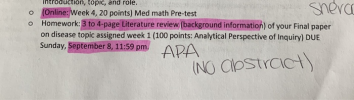 background information about Hereditary Spherocytosis about 3 pages
if possible
shera O introduction, topic, and role. (Online: Week 4, 20 points) Med math Pre-test Homework: 3 to 4-page Literature review (background information of your Final paper on disease topic assigned week 1 (100 points: Analytical Perspective of Inquiry) DUE Sunday, September 8, 11:59 pm. (NO Cbstract)
background information about Hereditary Spherocytosis about 3 pages
if possible
shera O introduction, topic, and role. (Online: Week 4, 20 points) Med math Pre-test Homework: 3 to 4-page Literature review (background information of your Final paper on disease topic assigned week 1 (100 points: Analytical Perspective of Inquiry) DUE Sunday, September 8, 11:59 pm. (NO Cbstract)
 Which of the following statements in NOT true about DNA replication? DNA replication involves synthesis of multiple RNA primers DNA ligase is needed for successful DNA replication DNA replication requires deoxyribonucleotide triphosphates High fidelity of DNA replication is ensured by 5-3' exonuclease activity of DNA polymerase High fidelity of DNA replication is ensured by 3-5' exonuclease activity of DNA polymerases Next
 Which of the following statements in NOT true about DNA replication? DNA replication involves synthesis of multiple RNA primers DNA ligase is needed for successful DNA replication DNA replication requires deoxyribonucleotide triphosphates High fidelity of DNA replication is ensured by 5-3 exonuclease activity of DNA polymerase High fidelity of DNA replication is ensured by 3-5' exonuclease activity of DNA polymerases Next
 background information about Hereditary Spherocytosis about 3 pages
if possible
shera O introduction, topic, and role. (Online: Week 4, 20 points) Med math Pre-test Homework: 3 to 4-page Literature review (background information of your Final paper on disease topic assigned week 1 (100 points: Analytical Perspective of Inquiry) DUE Sunday, September 8, 11:59 pm. (NO Cbstract)
background information about Hereditary Spherocytosis about 3 pages
if possible
shera O introduction, topic, and role. (Online: Week 4, 20 points) Med math Pre-test Homework: 3 to 4-page Literature review (background information of your Final paper on disease topic assigned week 1 (100 points: Analytical Perspective of Inquiry) DUE Sunday, September 8, 11:59 pm. (NO Cbstract)
Most questions answered within 3 hours.
-
Where is the error in this code sequence?
String s1 = "Hello";
String s2 = "ello";...
asked 10 months ago -
Financial data for Joel de Paris, Inc., for last year
follow:
Joel de Paris, Inc.
Balance...
asked 10 months ago -
Consider this reaction:
Al2(SO4)3 (aq)+ BaCl3
(aq) Al2Cl6 (aq)- +
3BaSO4(s) . What is the...
asked 10 months ago -
Suppose that Savneet is considering increasing her
recent random sample from 20 car rentals to 40...
asked 10 months ago -
Trucks arrive at an unloading terminal at an average rate of 120
per hour.
Trucks arrive...
asked 10 months ago -
Why are methanol and ethanol completely soluble in water while
octanol is not very little soluble....
asked 10 months ago -
A facilities manager at a university reads in a research report
that the mean amount of...
asked 10 months ago -
When the CuSO4 is rehydrated by adding water to the anhydrous
compound, is this an endothermic...
asked 10 months ago -
A ray of sunlight is passing from diamond into crown glass; the
angle of incidence is...
asked 10 months ago -
A block of mass 0.249 kg is placed on top of a light, vertical
spring of...
asked 10 months ago -
how do the kidneys compensate in the presences of acidosis
a) trigger hyperventilate
b) reserve acid...
asked 10 months ago -
Question 501 pts
The rental rate of capital to the firm increases. Which of the
following...
asked 10 months ago